Boolean Algebra Laws & Optimization MCQs: 12 Solved Questions
Solve 12 published Boolean algebra questions step by step, with a compact law card and clear methods for consensus, factorisation, nested functions and K-map grouping.
KnowledgeGate Team
Exam prep & CS education
27 Aug 20267 min read
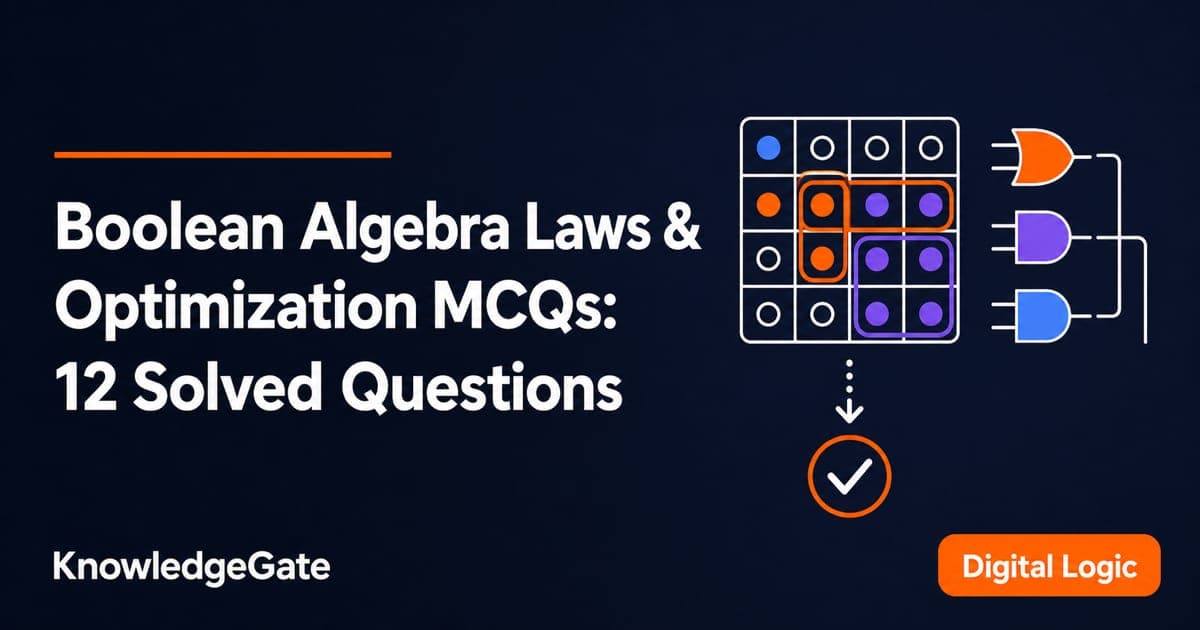
Students often remember individual Boolean laws but lose the correct move when a term is complemented, repeated or hidden inside a nested function. Absorption and consensus remove redundant terms, factorisation exposes complements, nested functions must be evaluated inside out, and a K-map verifies the reduced form. Attempt each item before reading its answer, and write the law used at every line.
Boolean algebra laws: build the six-line scratch card first
Keep these identities on a small scratch card:
Involution:
(X')' = XDe Morgan:
(X + Y)' = X'Y'Absorption:
X(X + Y) = XandX + XY = XDistributive:
X + YZ = (X + Y)(X + Z)Consensus:
XY + X'Z + YZ = XY + X'ZCovering identity:
X + X'Y = X + Y
Verify absorption with values. At (X,Y)=(0,1), X + XY = 0 + 0 = 0 = X. At (1,0), it becomes 1 + 0 = 1 = X.
Now derive the useful covering identity:
X + X'Y = (X + X')(X + Y) = 1(X + Y) = X + Y.
At (0,1), both sides are 1; at (1,0), both sides are again 1. Reuse these laws throughout the set instead of changing notation midway. If any line still feels mechanical, repair the idea with the Boolean Algebra and K-map Minimization Guide.
Boolean laws and absorption MCQs: identify the rule before simplifying
Question 1: Match four Boolean identities to their laws
Match the following. List-1 (I) (X’)’ (II) (X + Y)’ = X’.Y’ (III) X(X + Y) = X (IV) X + YZ = (X + Y)(X + Z) List-2 (A) De Morgan law (B) Involution (C) Distributive (D) Absorption
A. I – D, II – A, III – B, IV – C
B. I – B, II – D, III – A, IV – C
C. I – B, II – A, III – D, IV – C
D. I – C, II – A, III – D, IV – B
Answer: C. I – B, II – A, III – D, IV – C. Double complementation is involution, complementing a sum is De Morgan, X(X+Y)=X is absorption, and converting X+YZ to (X+Y)(X+Z) is distributive. All four matches must hold, so C is the only complete mapping.
Exam reference: Coal India 2017, Computer Science.
Question 2: Recognise the absorption law
Which of the following represents Absorption Law correctly?
A. X + Y·Z = (X + Y)·(X + Z)
B. X + X·Y = X
C. (X + Y)' = X'·Y'
D. (X · X)' = X'
Answer: B. X + X·Y = X. Factor the left side as X(1+Y), then use 1+Y=1 to obtain X. Option A is distributive, while C is De Morgan. For more questions in this topic, continue with the UP LT Grade PYQ Questions.
Exam reference: Kendriya Vidyalaya Sangathan 2023, Computer Science.
Question 3: Apply the covering identity
The Boolean expression x+x′y equals ______.
A. x + y
B. x + xy
C. y + yx
D. More than one of the above
E. None of the above
Answer: A. x + y. Apply distributivity: x+x'y=(x+x')(x+y)=1(x+y)=x+y. The checks (x,y)=(0,1) and (1,0) give 1 on both sides, confirming the algebra.
Exam reference: BPSC 2023, Computer Science, PGT Tier-2.
Consensus theorem MCQs: remove the redundant product term
The consensus theorem says XY + X'Z + YZ = XY + X'Z. To see why, test the only possible extra case, YZ=1, which means Y=Z=1. If X=1, then XY=1; if X=0, then X'Z=1. The term YZ therefore never produces a 1 that the first two terms do not already cover.
Do not remove a term merely because it looks longer. First locate the complementary pair X and X', then confirm that the remaining literals form the consensus product.
Question 4: Remove the consensus term YZ
Simplified form of Boolean Expression XY+(~X)Z+YZ
A. XY+(~X)Z
B. (~X)Y +(~X)Z
C. (~X)Y+XZ
D. XY+XZ
Answer: A. XY+(~X)Z. Map the expression directly to XY + X'Z + YZ. Here YZ is the redundant consensus term, leaving XY + X'Z.
Exam reference: UGC NET 2007, Computer Science, Paper 2 (December).
Question 5: Remove BC from AB + A'C + BC
The Boolean expression AB + A'C + BC = ____.
A. AB
B. AC + A'B
C. AB + A'C
D. A'B+A'C
Answer: C. AB + A'C. Substitute X=A, Y=B, Z=C into the consensus pattern. When BC=1, either A=1 makes AB=1, or A=0 makes A'C=1, so BC adds no uncovered minterm.
Exam reference: DSSSB 2021, Computer Science, PGT.
Boolean factorisation MCQs: collapse four minterms to one literal
Factor the literal shared by every product before pairing terms. When the bracket contains both forms of each remaining variable, complementarity turns those pairs into 1 and exposes the result without a truth table.
Question 6: Factor all four combinations of x and z
The logic expression x′yz′ + x′yz + xyz′ + xyz reduces to
A. x′z
B. xyz
C. y
D. yz
Answer: C. y. Factor y to obtain y(x'z' + x'z + xz' + xz). Regrouping gives y[x'(z'+z)+x(z'+z)] = y(x'+x) = y, since z'+z=1 and x'+x=1.
Exam reference: UGC NET 2005, Computer Science, Paper 2 (June).
Question 7: Prove a three-term expression equals Z
The Boolean Expression X̄ȲZ + YZ + XZ is equivalent to
A. X
B. Y
C. Z
D. X+Y+Z
Answer: C. Z. Factor Z to get Z(X'Y' + Y + X). The identity Y + X'Y' = Y + X' reduces the bracket to (Y+X')+X=1, so the expression is Z.
Exam reference: UGC NET 2009, Computer Science, Paper 2 (December).
For another mixed set where algebra and grouping support each other, solve Boolean Algebra and K-Map MCQs: 12 Solved (GATE).
Nested functions and product-of-sums MCQs: simplify from the inside out
Nested notation fixes the order of work. Write the inner call as a complete Boolean expression, simplify it, then use that result as the first argument of the outer call. For a product of sums, remove any factor already equal to 1 before multiplying the rest.
Question 8: Evaluate the inner Boolean function first
Let f(A, B) = A' + B. The simplified expression for f(f(x + y, y), z) is:
A. x' + z
B. xyz
C. xy' + z
D. None of these
Answer: C. xy' + z. First, f(x+y,y)=(x+y)'+y=x'y'+y=x'+y. Then f(x'+y,z)=(x'+y)'+z=xy'+z; treating a nested call as ordinary multiplication leads away from the function definition.
Exam reference: GATE 2002, Computer Science.
Question 9: Collapse a product of sums
Which of the following is the simplified form of the Boolean expression (AB)'(A'+B)(B'+B)?
A. A
B. A'
C. B
D. B'
Answer: B. A'. First use B'+B=1 and De Morgan, (AB)'=A'+B'. Then (A'+B')(A'+B)=A'+B'B=A', using (P+Q)(P+R)=P+QR.
Exam reference: DSSSB 2018, Computer Science.
Longer Boolean expressions: factor common literals before expanding
Long expressions tempt you to expand everything at once. Scan first for a literal shared by every product. Factoring it out usually turns the bracket into a smaller complement or absorption problem and keeps repeated terms visible.
Question 10: Factor A' and use complementarity
Which of the following options is equivalent to the Boolean expression A'C+A'BC'+A'B'C'?
A. A
B. A'
C. AC
D. BC'
Answer: B. A'. Factor A' to get A'[C + BC' + B'C']. Combine the last two terms as C'(B+B')=C'; the bracket is then C+C'=1, leaving A'.
Exam reference: DSSSB 2018, Computer Science.
Question 11: Absorb repeated E terms
Simplify the following Boolean expression. E(E + F) + DE + D(E + F)
A. E + DF
B. F + DE
C. D + EF
D. D + E + F
Answer: A. E + DF. Absorption gives E(E+F)=E, and expansion gives D(E+F)=DE+DF. Thus E+DE+DE+DF reduces by idempotence and E+DE=E to E+DF.
Exam reference: DSSSB 2021, Computer Science, TGT - Shift 2.
K-map optimization MCQ: verify the algebra geometrically
A K-map check is strongest when every group is named by its fixed literals. Plot the five 1 cells first, use the largest power-of-two group available, and remember that the first and last Gray-code columns are adjacent.
Question 12: Group five minterms on a three-variable K-map
Using K-map, simplify the Boolean function: F(x, y, z) = Σm(0, 2, 4, 5, 6).
Which of the following is the simplified function?
A. F = z + x'y'
B. F = z' + xy'
C. F = z + x'y
D. F = z' + xy
Answer: B. F = z' + xy'. Use rows x=0,1 and columns yz=00,01,11,10 in Gray order. The wraparound group {0,2,4,6} keeps z=0, giving z'; the pair {4,5} keeps x=1,y=0, giving xy'. Their union covers exactly the minterms {0,2,4,5,6} and no others.
Exam reference: DSSSB 2024, Computer Science, TGT.
Boolean algebra MCQ scorecard and the next practice step
Use the score bands only to guide revision of the questions. A score of 10-12/12 means redo Questions 5, 8 and 12 without notes. At 7-9/12, rebuild the law card and retry every consensus or factorisation miss. At 0-6/12, return to the concept guide before another timed set. This score does not predict any exam result.
The short version is to absorb repeated terms, remove consensus terms, factor common literals, and evaluate nested functions from the inside out. Continue with Digital Electronics MCQs for wider practice. If you need the full Digital Logic sequence, GATE Guidance by Sanchit Sir is the structured subject route.
Keep learning
Special Logic Circuits MCQs: 12 Solved Questions on Adders, Encoders, PLA and DAC
Solve 12 special logic circuits MCQs covering recognition, hardware counts, Boolean identities and numerical calculations. Each answer includes the reasoning you should reproduce in an exam.
19 Sep 20268 min read64 viewsDigital Electronics MCQs
Function Equivalence MCQs: 12 Solved Boolean Algebra Problems
Solve 12 function-equivalence questions step by step, from De Morgan's law and absorption to minterm sets, counterexamples and a four-option MSQ.
Updated 17 Sep 20268 min readDigital Electronics MCQs
CLA & Arithmetic Logic MCQs: 10 Solved Questions with Explanations
Solve ten CLA and arithmetic logic MCQs with compact workings for carry equations, timing paths, hardware sizing and operand-pair counting.
Updated 16 Sep 20267 min readDigital Electronics MCQs
Sync Counter Design MCQs: 11 Solved Questions on Modulus, State Sequences and Excitation Logic
Solve 11 synchronous-counter questions covering modulus boundaries, repeated outputs, common-clock tracing, excitation equations, enables and composite states.
Updated 14 Sep 20267 min readDigital Electronics MCQs