Asymptotic Notations Interview Questions and Answers: Big-O, Omega and Theta with Worked Examples
Prepare for Big-O, Omega and Theta questions with proof-ready answers, exact loop and recurrence traces, and a method for avoiding common interview traps.
KnowledgeGate Team
Exam prep & CS education
Updated 24 Oct 20266 min read

Memorising that Big-O means "worst case" is not enough for an interview, and the statement itself is misleading. You may have to give a formal bound, identify a tight bound, trace a loop, or defend your choice of input size. Asymptotic-notation interviews test definitions, computed traces, and reasoning traps that can make otherwise correct candidates contradict themselves. If the concepts are new, begin with Time Complexity and Asymptotic Notation.
Asymptotic notation interview basics: what Big-O, Omega and Theta actually say
What does asymptotic analysis measure? It measures how an algorithm's time or space grows with input size n as n becomes large, independently of machine speed and constant implementation costs.
Why ignore constants and lower-order terms? They do not change the long-run growth class. They can still matter when comparing real implementations.
Is Big-O always the worst case? No. Big-O is an upper bound. It can bound a best-case, average-case, or worst-case cost function after you have defined that case.
Formally, f(n) in O(g(n)) if positive constants c and n0 exist such that 0 <= f(n) <= c g(n) for every n >= n0. For Omega, 0 <= c g(n) <= f(n) eventually. Theta requires both bounds, using positive c1, c2, and a common threshold n0.
Interview-safe wording is simple: Big-O says the function grows no faster than an upper bound, Omega says it grows no slower than a lower bound, and Theta gives the tight growth class. A linear function is in O(n^2), but Theta(n) is more informative.
Big-O, Omega and Theta proof: bound 3n^2 + 5n + 7
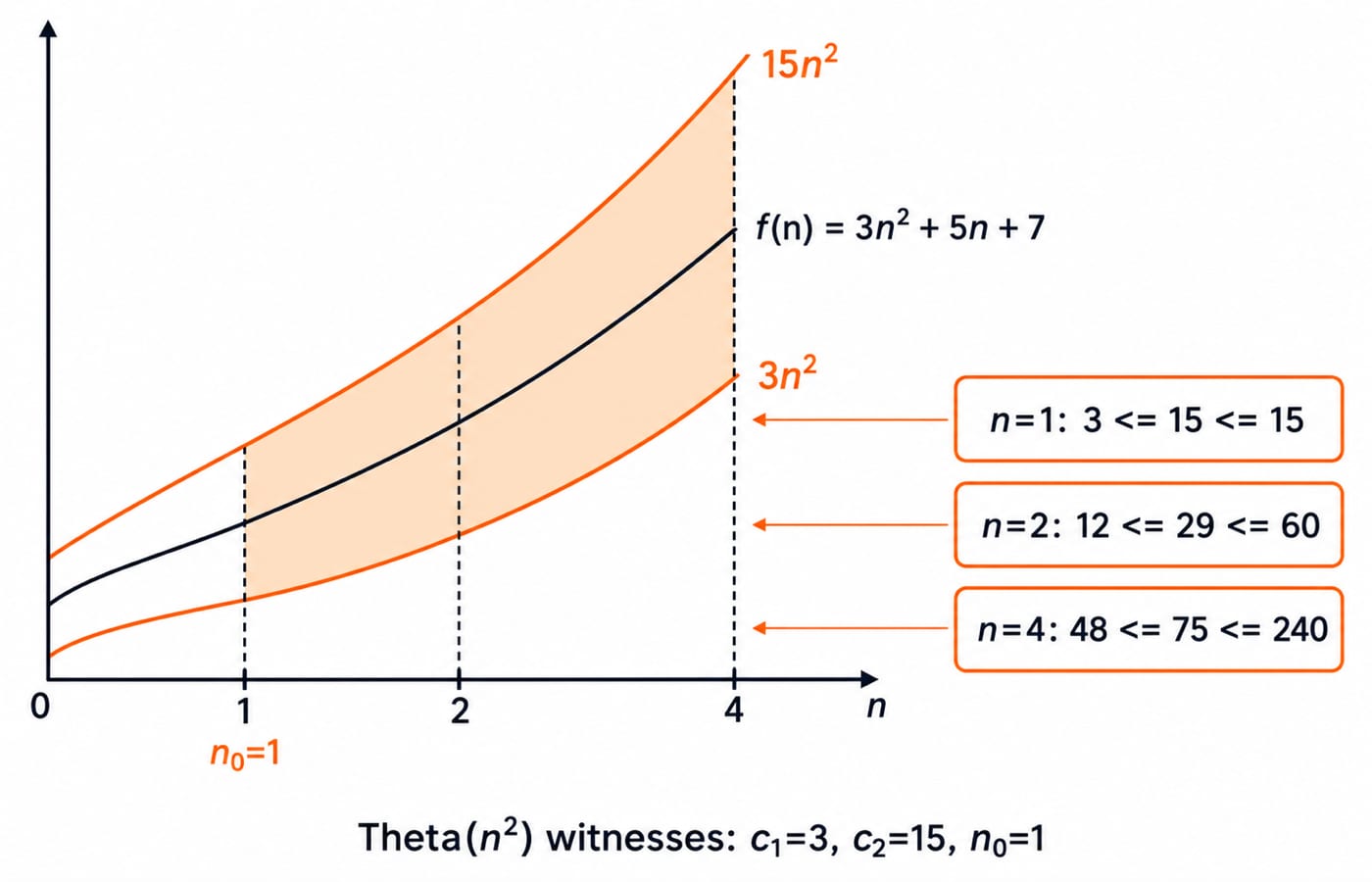
Question: Prove that f(n) = 3n^2 + 5n + 7 is Theta(n^2). Do not merely drop terms.
For every n >= 1, 5n <= 5n^2 and 7 <= 7n^2. Therefore:
f(n) <= 3n^2 + 5n^2 + 7n^2 = 15n^2.
This gives c2 = 15 and n0 = 1. Also, f(n) >= 3n^2, so c1 = 3 works with the same threshold. Thus 3n^2 <= f(n) <= 15n^2, proving f(n) in Theta(n^2).
| Lower |
| Upper |
|---|---|---|---|
1 | 3 | 15 | 15 |
2 | 12 | 29 | 60 |
4 | 48 | 75 | 240 |
The function is also in O(n^3), but that bound is loose. The witnesses are not unique either. A proof needs one valid set, not the smallest possible constants.
Time-complexity interview question: trace a nested loop
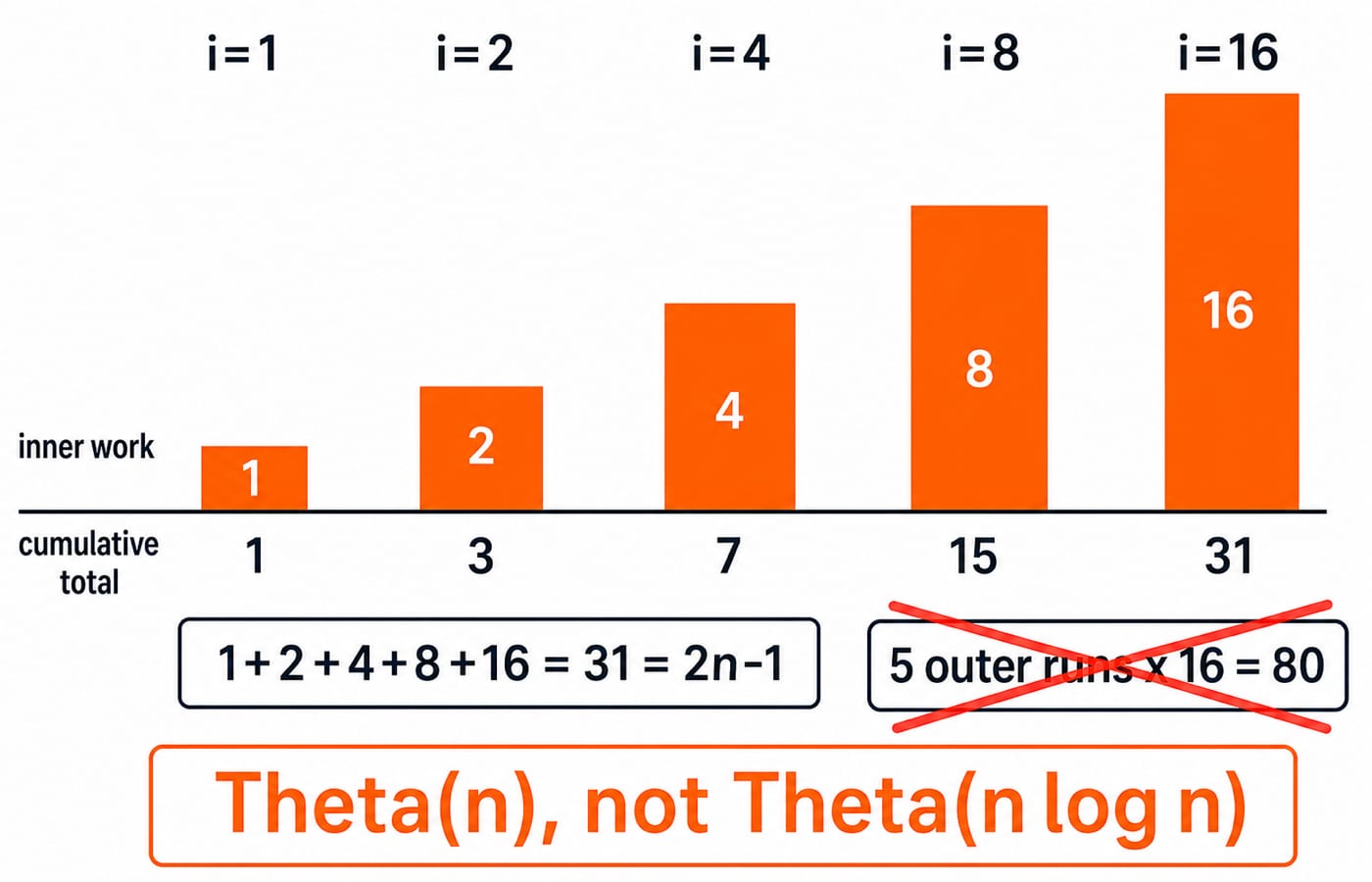
Count only count++ in this code:
for (i = 1; i <= n; i *= 2) {
  for (j = 0; j < i; j++) {
    count++;
  }
}
For n=16, the outer values are 1, 2, 4, 8, 16. The corresponding inner counts are 1, 2, 4, 8, 16, with cumulative totals 1, 3, 7, 15, 31. So 1 + 2 + 4 + 8 + 16 = 31 = 2(16) - 1.
For n = 2^k, the sum is 2n - 1, so the tight bound is Theta(n). Multiplying log n outer iterations by n assumes every inner run costs n; it does not. If the condition were j < n, every outer iteration would cost n, producing Theta(n log n). The dependency j < i changes the answer.
Growth-rate interview questions: rank functions and explain logarithms
Order | Function | Value at |
|---|---|---|
1 |
| 1 |
2 |
| 4 |
3 |
| 4 |
4 |
| 16 |
5 |
| 64 |
6 |
| 256 |
7 |
| 65,536 |
8 |
| 20,922,789,888,000 |
The asymptotic ordering is 1 < log n < sqrt(n) < n < n log n < n^2 < 2^n < n!. At n=16, the logarithm and square root happen to equal 4; equality at one input does not make them the same growth class.
The log base disappears because log_a n = log_b n / log_b a. For fixed bases greater than 1, the divisor is constant, so all are Theta(log n). Keep the base for exact iteration counts. Also, n^2 + n log n is Theta(n^2), while log(n^3) = 3 log n is Theta(log n). Smaller terms still cost time; they simply do not change the class.
Recurrence interview question: solve T(n) = 2T(n/2) + n
Let T(1)=1 and take n=8. Non-recursive work at the root is 8. The next level contributes 2 x 4 = 8, the next contributes 4 x 2 = 8, and the eight leaves contribute 8 x 1 = 8. Hence T(8) = 8 + 8 + 8 + 8 = 32.
For power-of-two n, there are log2 n splitting levels, each costing n, plus n unit-cost leaves. Thus T(n) = n log2 n + n, which is Theta(n log n). The Master Theorem agrees: a=2, b=2, and f(n)=n matches n^(log_b a)=n.
For T(n)=T(n/2)+1, there is one chain with constant work per level, so the result is Theta(log n). At n=64, 64 -> 32 -> 16 -> 8 -> 4 -> 2 -> 1 contains six halvings.
Best, average, worst and amortized complexity
For linear search on eight elements, a first-position match takes 1 comparison. A last-position match or an absent target takes 8. Assuming each successful position is equally likely, the average is (1+2+3+4+5+6+7+8)/8 = 36/8 = 4.5. Best case is Theta(1); average successful and worst cases are Theta(n). An average-case claim must name its distribution assumption.
Now append 16 elements to a dynamic array starting at capacity 1 and doubling on overflow. The appends perform 16 ordinary writes. Resizes copy 1 + 2 + 4 + 8 = 15 existing elements, giving 31 writes. Since 31/16 = 1.9375, the sequence averages fewer than two writes per append. Append is amortized Theta(1), although one resizing append can be Theta(n).
Worst case concerns the most expensive single input or operation of size n. Amortized analysis spreads a deterministic sequence's total cost across its operations. Average case uses a probability distribution. The labels are not interchangeable.
Asymptotic notation interview traps: repair the reasoning
Claim: Two nested loops are always Theta(n^2). Failure: Their bounds may depend on each other. Correction: Count and sum each outer iteration's actual work.
Claim: Big-O means worst case. Failure: This confuses a bound with a case. Correction: Name the case first, then bound its cost function.
A linear algorithm described as O(n^2) has a valid but unhelpful loose bound. Input size can also change the expression. Traversing an r x c matrix is Theta(rc). It is Theta(n^2) only when the matrix is square and n is one side; if N=rc is the cell count, traversal is Theta(N).
Interview styles vary widely between companies. A verbal screen may use definitions, while a technical round may demand a proof, trace, recurrence, or edge case. Use this discipline: define input size, choose the basic operation, count it, simplify after counting, state the tight bound, then name the case. For the full define-count-compare workflow across dependent loops, binary search, and changing constraints, use Algorithm Analysis Interview Questions and Answers: Big-O, Loops and Recurrences. Asymptotic-notation answers demand the narrower discipline of proof witnesses, tight versus loose bounds, and explicit case labels. The Resume & Interview Preparation route adds broader interview preparation.
Asymptotic notation interview answers: the short version
Use this template: "Let n mean ___. The counted operation executes ___. Its exact or bounded count is ___. Dominant growth is ___. Therefore this case is Theta(___); it also belongs to looser upper bounds ___, but Theta is tight."
For the loop above: n is the limit, the operation is count++, and for powers of two its count is 1+2+...+n = 2n-1, so it is Theta(n).
Three final checks:
Sequential loops costing
nandn^2totaln+n^2, henceTheta(n^2).Repeatedly halving
64reaches1after six halvings, giving the general patternTheta(log n).7n+100isTheta(n). Forn>=1,7n <= 7n+100 <= 107nsupplies valid constants.
Use Asymptotic Notations MCQs for direct practice, then Coding for Placements for a structured algorithms and coding follow-up. The habit to carry forward is simple: define, count, bound, and only then simplify.
Keep learning

Advanced DP Interview Questions and Answers: Four Worked Patterns
Work through four advanced dynamic programming patterns with exact states, transitions, reconstructions, proof hooks, and interview-ready explanations.
Updated 21 Oct 20266 min readInterview Corner
Algorithm Interview Questions and Answers: Cross-Concept DSA Problems
Practise cross-concept DSA questions with defensible answers, complete dry runs and the follow-ups that change which algorithm you should choose.
Updated 17 Oct 20266 min readInterview Corner

Backtracking Technique Interview Questions and Answers: Trace, Prune and Explain
Learn to explain backtracking through exact traces, safe pruning, clean state restoration, N-Queens constraints, complexity derivation and interview follow-ups.
Updated 12 Oct 20266 min readInterview Corner

Algorithm Analysis Interview Questions and Answers: Big-O, Loops and Recurrences
Learn how to answer algorithm analysis interviews by defining the input, counting real work, tracing recurrences, and defending time-space tradeoffs.
Updated 8 Oct 20266 min readInterview Corner