Behavioural Interview Failure Questions: Show Ownership, Feedback and Learning
Learn how to select a genuine failure story, explain its consequence without blame, and show that feedback produced a repeatable change in behaviour.
KnowledgeGate Team
Exam prep & CS education
Updated 21 Jul 20265 min read
An honest failure can sound like evidence against hiring you. A polished story that is not really a failure can sound evasive. The answer is to choose a bounded but meaningful incident, state the consequence without excuses, explain how feedback changed your response, and prove the new behaviour lasted. You do not need a flawless ending. You need a credible account of ownership, repair, learning and later change.
Behavioural interview failure questions: what the interviewer is testing
Different phrasings test four signals: whether you own a decision, recognise its effect, repair it, and change your behaviour. A failure is an event with a consequence, not an adjective.
The same four signals sit behind "Tell me about a time you failed", "Describe difficult feedback you received" and "What did you learn from a mistake?", so one well-built story answers all three phrasings. Panels weight the signals differently, which is why a story with a quantified consequence travels further than a story with a neat ending. HR Interview Questions for Freshers & Answers covers the rest of the HR round, and the Resume & Interview Preparation category maps the wider placement track.
Choose a failure story that is real, bounded and useful
Score each story from 0 to 2 for ownership, observable consequence, completed correction and later evidence.
Candidate story | Ownership | Consequence | Correction | Later evidence | Total |
|---|---|---|---|---|---|
A: API mismatch delayed an internal demo | 2 | 2 | 2 | 2 | 8 |
B: Low semester mark, then a revised study method | 2 | 1 | 2 | 1 | 6 |
C: "I care too much about quality" | 0 | 0 | 0 | 0 | 0 |
Choose A because it is specific, recoverable and rich in follow-up detail, not simply safe sounding. Reject stories with confidential key facts, unresolved harm, or an unaddressed integrity or safety concern. Do not blame a teammate or disguise a strength as failure. If no incident comes to mind, reread the projects and responsibilities you already documented in your resume for freshers.
Structure a 90-second failure answer around consequence and change
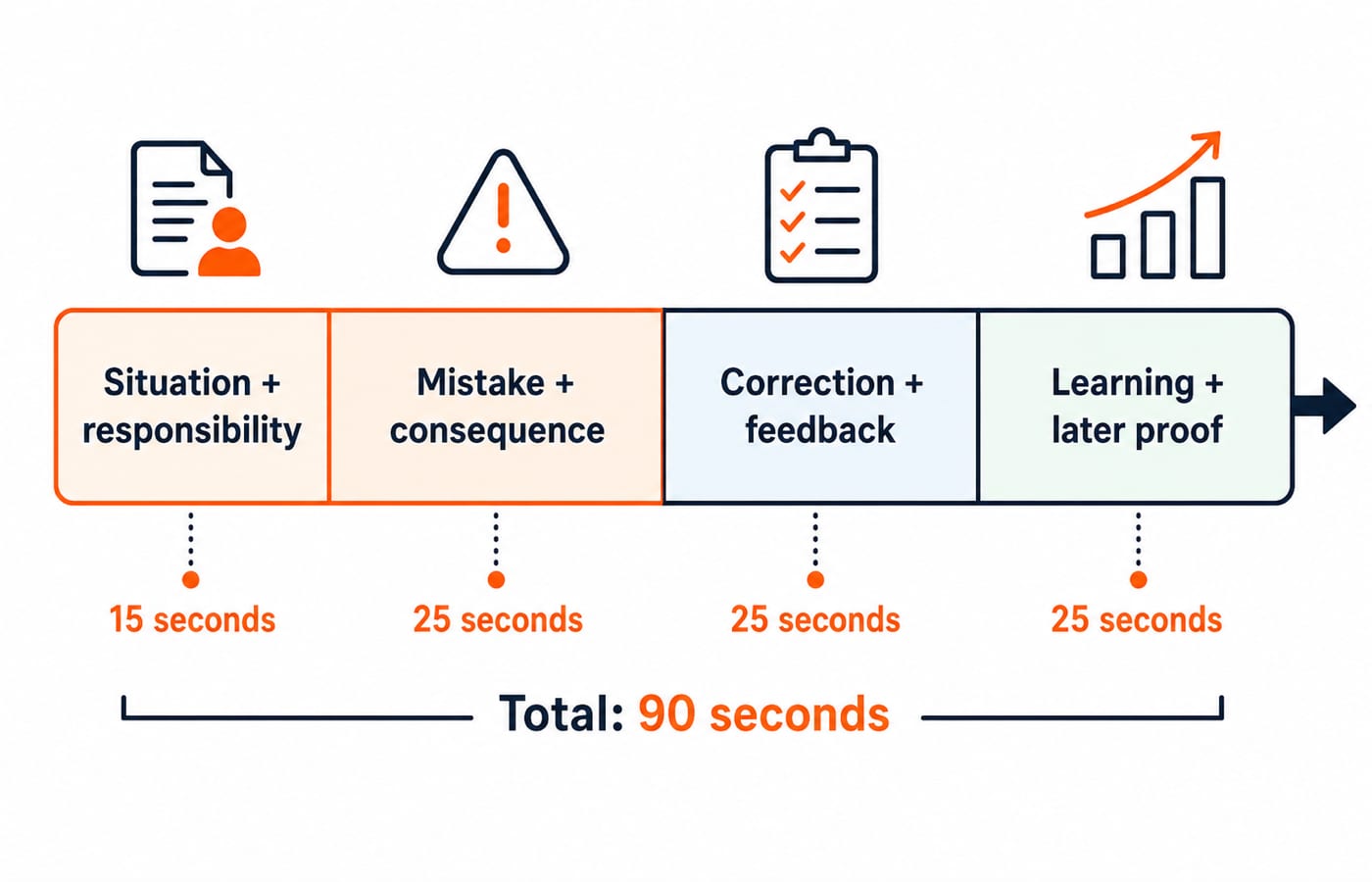
Use STAR-L, with the failure still visible:
15 seconds: situation and responsibility.
25 seconds: mistake and consequence.
25 seconds: correction and feedback.
25 seconds: learning and later proof.
The blocks total 15 + 25 + 25 + 25 = 90 seconds. Most of the answer covers your response, but the consequence must remain clear.
Prepare five anchors: one "I owned" sentence, one quantified consequence, one repair decision, one precise feedback sentence, and one later behaviour with evidence. Learn the anchors, not a script.
Behavioural interview worked example: a missed capstone demo
Take a composite scenario. In a four-member capstone team's 14-day sprint, the candidate owns backend integration for a Friday internal demo. They assume the shared JSON field names instead of agreeing an interface. Integration starts on day 10, 11 of 18 endpoint checks fail, and the demo moves to Sunday, a two-day delay.
I owned the integration and I failed to freeze the interface before parallel work began. When we integrated on day 10, 11 of 18 endpoint checks failed and our Friday internal demo moved to Sunday. I alerted the team that day and ran a 90-minute pairing session to map the fields. We wrote the schema and added 18 contract tests, which passed 18/18 by Saturday evening. We still delivered on Sunday, so the delay remained. My lead told me to agree interfaces before parallel implementation and raise a mismatch on the day it appears. In the next three sprints, I added a pre-coding schema review and ran contract tests on every merge. We had zero schema-mismatch failures.
The answer owns the mistake without blame and preserves the successful repair and two-day consequence.
Show that feedback became a repeatable behaviour
An apology acknowledges impact. Feedback identifies the needed change. Learning proves it happened. "I apologised" is incomplete. "My lead told me to freeze the interface first" names feedback. "I added schema review and merge-time contract tests for the next three sprints" shows learning.
Use a three-step loop:
Clarify the trigger: "Which signal should I have raised, and by when?"
Create an if-then rule: "If two components are built in parallel, agree the schema and three sample payloads before coding."
Verify the rule across three later sprints.
Evidence may be a checklist, review gate or changed communication habit, not a perfect metric.
Handle failure follow-ups without becoming defensive
Keep follow-ups tied to the same facts:
What would you do differently? Freeze the schema on day 1, test three sample payloads, and run the first integration check by day 3 instead of day 10.
Was your teammate responsible? Both people worked from assumptions, but integration was my responsibility.
Did you disagree with the feedback? Explain which part you adopted and how you tested it. Do not perform false agreement.
Compare "The teammate changed the API, so our demo was late" with "I owned integration and did not confirm the shared schema; 11 of 18 checks failed and our internal demo moved by two days." The second shows ownership, scale and consequence. The same discipline repairs the other common placement preparation mistakes: vague outcomes, blame-shifting and over-rehearsal. When the interviewer keeps pulling toward the teammate relationship itself, you are now answering a conflict question; the no-blame decision-rule treatment in behavioural interview conflict and teamwork questions covers that variant.
Practise three failure stories in four honest hours
Use this seven-day, 240-minute plan:
Day | Task | Minutes |
|---|---|---|
1 | List five incidents | 25 |
2 | Score them and select three | 35 |
3 | Build story 1 | 40 |
4 | Build stories 2 and 3, 20 minutes each | 40 |
5 | Record all three twice and review six recordings | 30 |
6 | Run a mock round with six follow-ups | 45 |
7 | Retake each story once and make a five-anchor cue sheet | 25 |
The total is 25 + 35 + 40 + 40 + 30 + 45 + 25 = 240 minutes, or four hours. Keep each recording within 90 seconds.
If you lose one day, combine selection and the first outline into 60 minutes: 20 to score and 40 to draft. If you lose two or more, prepare two stories, but retain the recording and mock-feedback sessions.
For every take, check that the failure is named by second 40, the consequence is quantified, the feedback is quoted or closely paraphrased, later behaviour is proved, and blame language is absent. A story passes only when all five checks appear twice without reading a full script.
The short version: own, repair, learn, prove
Own the mistake, quantify the consequence, explain the repair, name the feedback, and prove the changed behaviour with a later example. Rehearse one 90-second answer today instead of collecting ten shallow stories.
A timer, a phone recording and one honest listener will carry you most of the way. If you want mock rounds with the follow-ups and feedback built in, the Interview & Resume Preparation Course is the guided route.
Keep learning
Advanced DP Interview Questions and Answers: Four Worked Patterns
Work through four advanced dynamic programming patterns with exact states, transitions, reconstructions, proof hooks, and interview-ready explanations.
Updated 21 Oct 20266 min readInterview Corner
Algorithm Interview Questions and Answers: Cross-Concept DSA Problems
Practise cross-concept DSA questions with defensible answers, complete dry runs and the follow-ups that change which algorithm you should choose.
Updated 17 Oct 20266 min readInterview Corner
Backtracking Technique Interview Questions and Answers: Trace, Prune and Explain
Learn to explain backtracking through exact traces, safe pruning, clean state restoration, N-Queens constraints, complexity derivation and interview follow-ups.
Updated 12 Oct 20266 min readInterview Corner

Algorithm Analysis Interview Questions and Answers: Big-O, Loops and Recurrences
Learn how to answer algorithm analysis interviews by defining the input, counting real work, tracing recurrences, and defending time-space tradeoffs.
Updated 8 Oct 20266 min readInterview Corner