C++ Arrays vs std::array vs std::span: Choose the Right Interface
Run the same five integers through raw-array, std::array and std::span interfaces, then choose from their ownership, size and lifetime contracts.
KnowledgeGate Team
Exam prep & CS education
Updated 2 Sep 20266 min read
int a[5], std::array<int, 5> and std::span<const int> can all expose five integers, but they express different ownership, size and lifetime contracts. Each interface exposes the sequence {4, 1, 7, 1, 3} differently in real code and exam-style snippets. If the wider sequence is unfamiliar, start with the C++ Tutorial: Complete Learning Path in 12 Weeks.
1. Start with three questions: who owns, who knows the size, who may outlive whom?
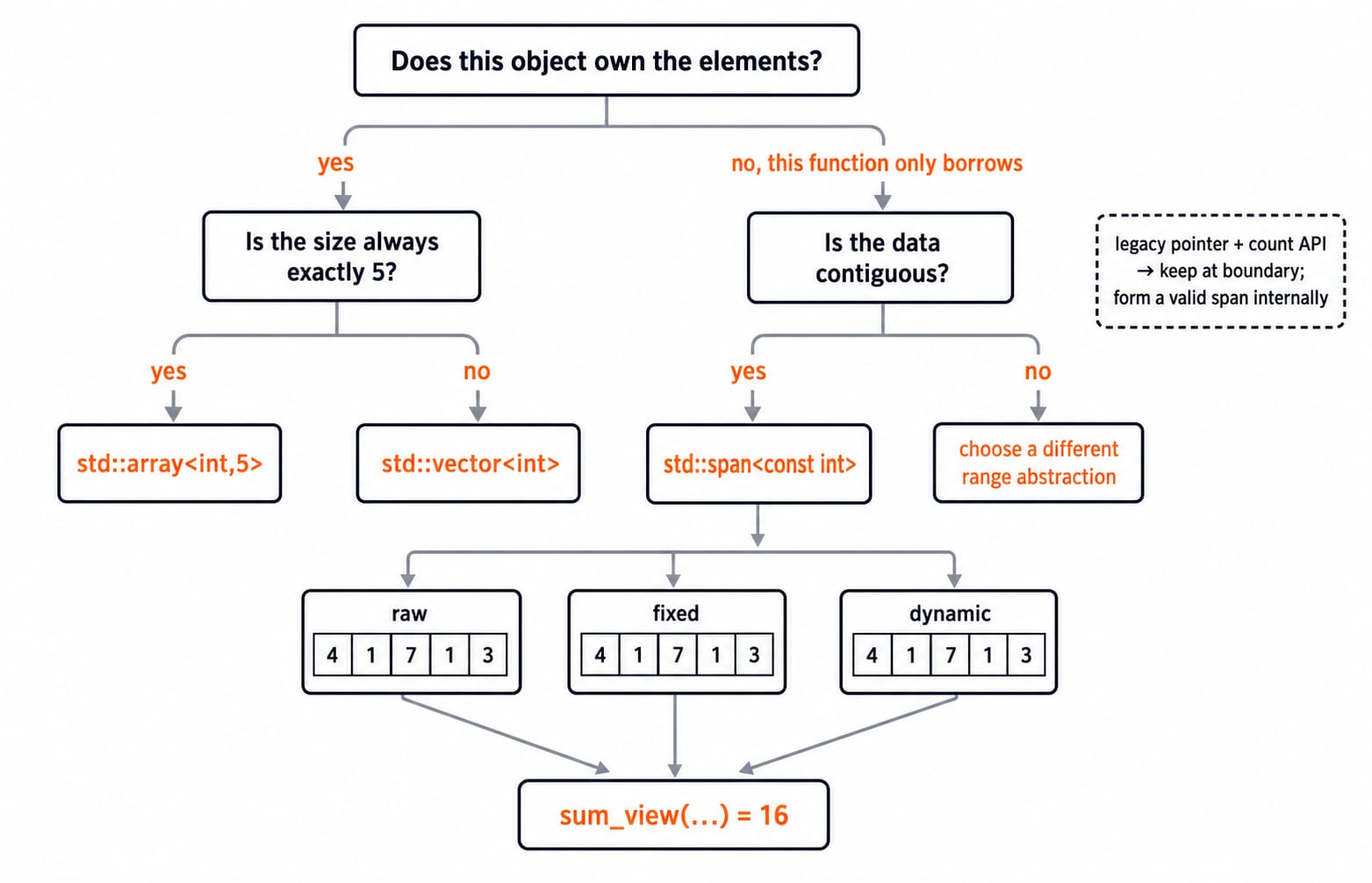
Ownership asks which object controls the element lifetimes. Extent asks where the size lives: in the type, in a runtime value, or nowhere after a function-boundary conversion. Lifetime asks whether a callee merely borrows storage that must remain alive.
The raw array and fixed array contain the same values:
int raw[5]{4, 1, 7, 1, 3};
std::array<int, 5> fixed{4, 1, 7, 1, 3};
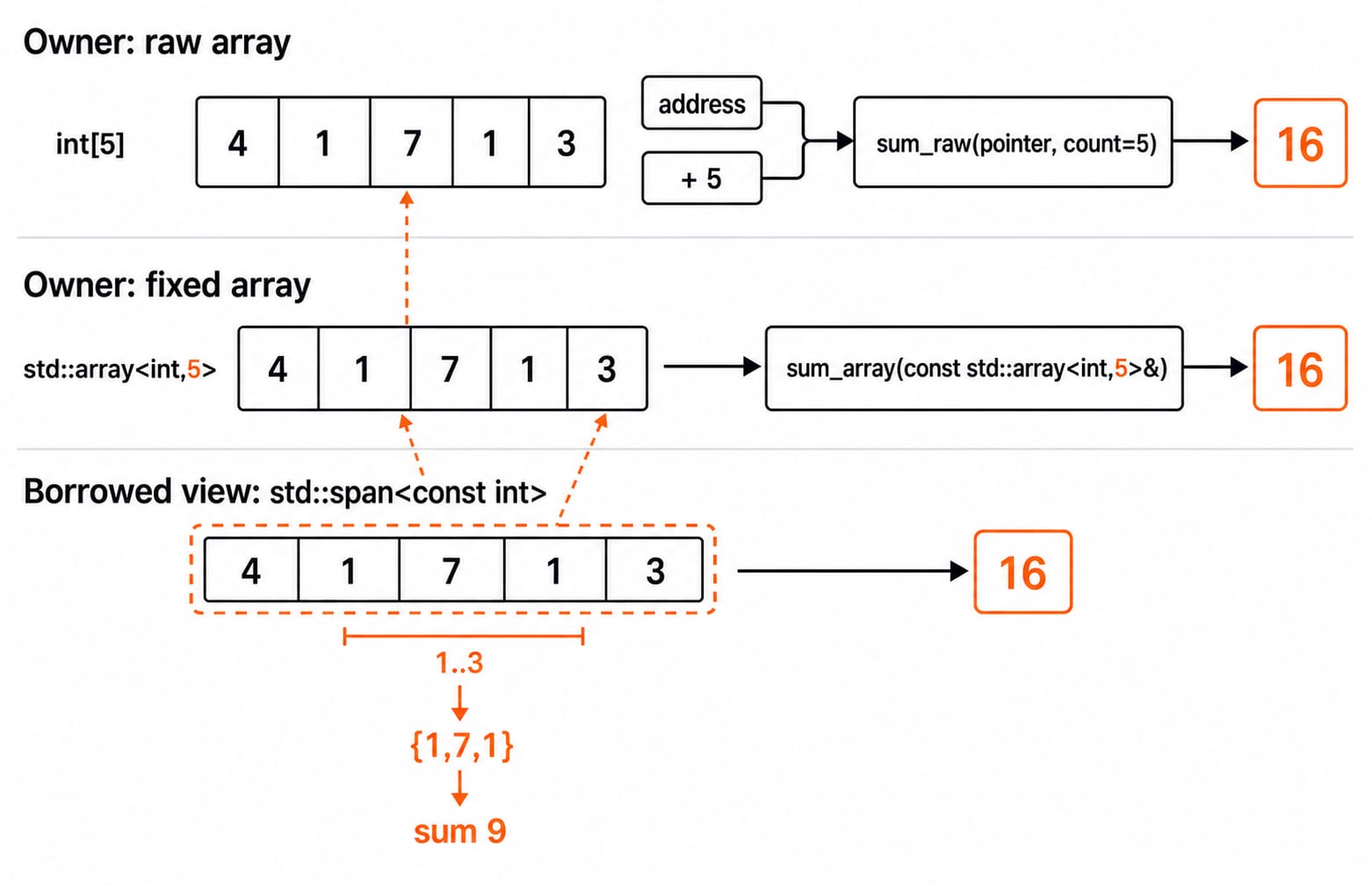
The full sum is 4 + 1 + 7 + 1 + 3 = 16. The middle slice at indices 1, 2, 3 is {1, 7, 1}, so its sum is 1 + 7 + 1 = 9.
Form | Owns elements | Extent visible in declared type | Copy behaviour | Natural use |
|---|---|---|---|---|
| yes | yes before decay | copies all 5 elements if the containing object is copied | legacy or low-level storage |
| yes | yes | value copy of all 5 | fixed-size owning value |
| no | dynamic in this spelling | copies only the view | borrowing contiguous data |
2. Raw arrays: five elements in the caller, pointer plus count in the usual callee
A common interface is int sum_raw(const int* data, std::size_t count). Call it as sum_raw(raw, std::size(raw)).
For indices 0 through 4, the accumulator is 0 -> 4 -> 5 -> 12 -> 13 -> 16. The caller's array owns the five elements. The function receives only an address and the separately supplied value 5, which the caller must keep consistent.
Writing int sum_bad(const int data[5]) does not enforce five elements. In a parameter list, data[5] is adjusted to const int*, so the callee cannot recover the original extent. sizeof(raw) / sizeof(raw[0]) = 5 works only where raw is still an array. No byte count is assumed because sizeof(int) is implementation-dependent.
An advanced alternative is template<std::size_t N> int sum_preserved(const int (&data)[N]). Passing raw deduces N = 5, but this is less uniform than a range-style boundary. The Pointers in C for GATE guide gives more background on decay and pointer-based access.
3. std::array: make fixed-size storage a value
std::array<int, 5> is an owning fixed-size aggregate, and 5 is part of its type. Use int sum_array(const std::array<int, 5>& data). Calling sum_array(fixed) returns 16, while const& avoids a copy. By contrast, auto copy = fixed; copy[0] = 40; makes copy equal to {40, 1, 7, 1, 3}, while fixed remains {4, 1, 7, 1, 3}. The type supports .size() == 5, range-for loops and standard algorithms. Its operator[] does not itself promise bounds checking.
std::array<int, 4> and std::array<int, 5> are different types. That distinction is valuable when the extent is invariant, but awkward when one algorithm should accept several contiguous sizes.
4. std::span: one borrowed interface for contiguous ranges
std::span is a C++20 non-owning view of a contiguous sequence. One function can accept several owners:
int sum_view(std::span<const int> data) {
    int total = 0;
    for (int value : data) total += value;
    return total;
}
Both sum_view(raw) and sum_view(fixed) return 16. Given std::vector<int> dynamic{4, 1, 7, 1, 3};, sum_view(dynamic) also returns 16.
Now form auto middle = std::span{fixed}.subspan(1, 3);. It refers to indices 1 through 3, views {1, 7, 1}, and produces 9. Creating or copying the span copies no integers. If fixed[2] changes from 7 to 70, the same view becomes {1, 70, 1} and the sum becomes 1 + 70 + 1 = 72.
std::span<const int> prevents mutation through this view, not through every alias. A span neither owns nor extends the source lifetime. It is also not automatic bounds safety: indexing must remain within the view, and a bad pointer-range contract can create an invalid view.
5. Worked example: process the same data three ways
The C++20 program passes identical inputs to each function:
#include <array>
#include <cstddef>
#include <iostream>
#include <iterator>
#include <span>
#include <vector>

int sum_raw(const int* data,std::size_t count) {
    int total=0;
    for(std::size_t i=0;i<count;++i) total+=data[i];
    return total;
}

int sum_array(const std::array<int, 5>& data) {
    int total=0;
    for(int value:data) total+=value;
    return total;
}

int sum_view(std::span<const int> data) {
    int total=0;
    for(int value:data) total+=value;
    return total;
}

int main() {
    int raw[5]{4, 1, 7, 1, 3};
    std::array<int, 5> fixed{4, 1, 7, 1, 3};
    std::vector<int> dynamic{4, 1, 7, 1, 3};

    std::cout<<sum_raw(raw,std::size(raw))<<'\n';
    std::cout<<sum_array(fixed)<<'\n';
    std::cout<<sum_view(raw)<<'\n';
    std::cout<<sum_view(fixed)<<'\n';
    std::cout<<sum_view(dynamic)<<'\n';
    std::cout<<sum_view(std::span{fixed}.subspan(1,3))<<'\n';
}
The expected lines, in order, are 16, 16, 16, 16, 16, 9. The raw call carries an address and count that must agree. The std::array call carries ownership and exact extent in its type. The dynamic-extent span carries a borrow and current length, so one algorithm accepts all three contiguous sources. The calculation is identical, but the advertised preconditions differ.
Situation | Prefer | Reason |
|---|---|---|
Local fixed table of exactly 5 owned values |
| Value semantics and size in the type |
Borrow any contiguous integer sequence without copying |
| One pointer-and-extent style interface for several owners |
Interoperate with an API already expressed as pointer plus count | raw pointer/count at that boundary | Matches the external contract; wrap it in a span internally when valid |
Size changes and the object owns its elements |
| Neither |
6. Traps: decay, dangling views and false safety claims
False extent:
void inspect(int values[5])does not enforce five elements. Pass a count, preserve extent with an array reference or template, or accept a span.Dangling view:
std::span<const int> bad() { std::array<int, 3> local{2, 4, 6}; return local; }returns a view tolocal. The array is destroyed on return, so the span dangles. Span improves interface shape, not lifetime ownership.Unnecessary mutation: if the function only reads, prefer
std::span<const int>overstd::span<int>so the signature states its intent.False container replacement: span requires contiguous storage and provides no capacity or growth operations.
Wrong fixed abstraction: using
std::arrayto accept any length forces separatestd::array<int, 4>andstd::array<int, 5>instantiations, or a template. Prefer span when runtime extent is part of the input.
7. How exam-style and interview snippets test the choice
Common tasks ask you to identify array-to-pointer adjustment, predict whether a copy changes the original, compute a subspan result, or choose an interface from ownership and extent requirements.
For an output question, consider:
std::array<int, 5> a{4, 1, 7, 1, 3};
auto s = std::span{a}.subspan(1, 3);
a[2] = 70;
A loop printing s produces 1 70 1, not 1 7 1, because s is a view. Its sum is 72. If the code then uses auto b = a; b[2] = 700;, the original a[2] stays 70 because b owns a copied value.
For a compile-time choice, non-template void f(const std::array<int, 5>&) accepts std::array<int, 5> but not std::array<int, 4>. void g(std::span<const int>) can accept either contiguous array. Confirm the syllabus and permitted language standard with the official source for your own exam or assessment.
8. The short version and the next step
Choose std::array<T, N> for fixed-size ownership and value semantics. Choose std::span<T> or std::span<const T> for a temporary contiguous borrow. Keep raw pointer-plus-count interfaces mainly where an existing boundary requires them. If ownership must grow, use an owning dynamic container.
Next, rewrite sum_view as count_above(data, threshold). With threshold 3, only 4 and 7 qualify, so every full five-element source returns 2. Continue with C++ Programming, broaden your practice through Coding for Placements, or browse Coding & Skills.
Keep learning

C++ Object Lifetime and Storage Duration: Trace Construction, Destruction, and Dangling State
Learn to separate scope, storage duration, lifetime, and ownership. Trace seven objects precisely, then repair dangling pointers, references, and views.
Updated 19 Oct 20265 min readC++
C++ Diamond Problem: Ambiguity, Duplicate State and Virtual Inheritance
See why a C++ diamond duplicates base state, how virtual inheritance shares it, and when qualification, interfaces, or composition is the clearer design.
Updated 15 Oct 20265 min readC++
C++ Abstract Classes and Interfaces: Build a Usable Storage Contract
Build a C++17 ScoreStore interface, swap vector and hash-backed implementations behind it, and verify both with the same runnable contract test.
Updated 11 Oct 20265 min readC++
C++ Virtual Functions and Polymorphism: Trace Dynamic Dispatch Step by Step
Trace a Shape hierarchy line by line to see how static type, dynamic type, final overriders, object slicing, and virtual destructors determine C++ output.
Updated 7 Oct 20265 min readC++