C Operators and Expressions Explained: Precedence, Types and Worked Traces
Learn a repeatable way to parse and evaluate C expressions. Follow typed calculations, bitwise and short-circuit traces, and common exam traps.
KnowledgeGate Team
Exam prep & CS education
Updated 22 Oct 20266 min read
A reliable C expression trace separates four questions: how the tokens group, what type each subtree produces, which subtree is evaluated, and whether every operation is defined. For an operator-family survey and stand-alone examples, use C Operators Explained: Precedence, Types and Worked Examples. Then apply the tree-first method here to one fixed mixed expression and its controlled variations.
C expression tracing starts with four separate questions
An operator specifies an action, an operand supplies a value or object, and an expression produces a typed value. In sum = a + b;, the assignment is itself an expression. Unary, binary, and ternary describe operand count, not precedence.
Write four lines on the scratchpad before calculating:
Grouping: add parentheses from precedence and associativity.
Types: label every operand and intermediate result.
Evaluation: apply sequencing and short-circuit rules.
Validity: stop at the first undefined operation.
This order prevents a common mistake: calculating a plausible number before deciding whether C defines one. Relational, equality, and logical operators produce an int value of 0 or 1. A condition treats zero as false and any nonzero scalar value as true.
C precedence builds a tree; associativity only breaks ties
Precedence determines grouping. 2 + 3 * 4 means 2 + (3 * 4), so the result is 14. Parentheses change the tree: (2 + 3) * 4 is 20. At one precedence level, associativity resolves ties. Thus 20 / 5 * 2 groups as (20 / 5) * 2 and gives 8.
Associativity is not evaluation order. It describes structure; it does not generally promise that the left operand runs first. Assignment associates right to left, so after int x, y; x = y = 7;, both objects contain 7. That fact still does not create a blanket left-to-right execution rule.
Use fixed declarations for the main trace:
int a = 17, b = 5, c = 3, mask = 6;
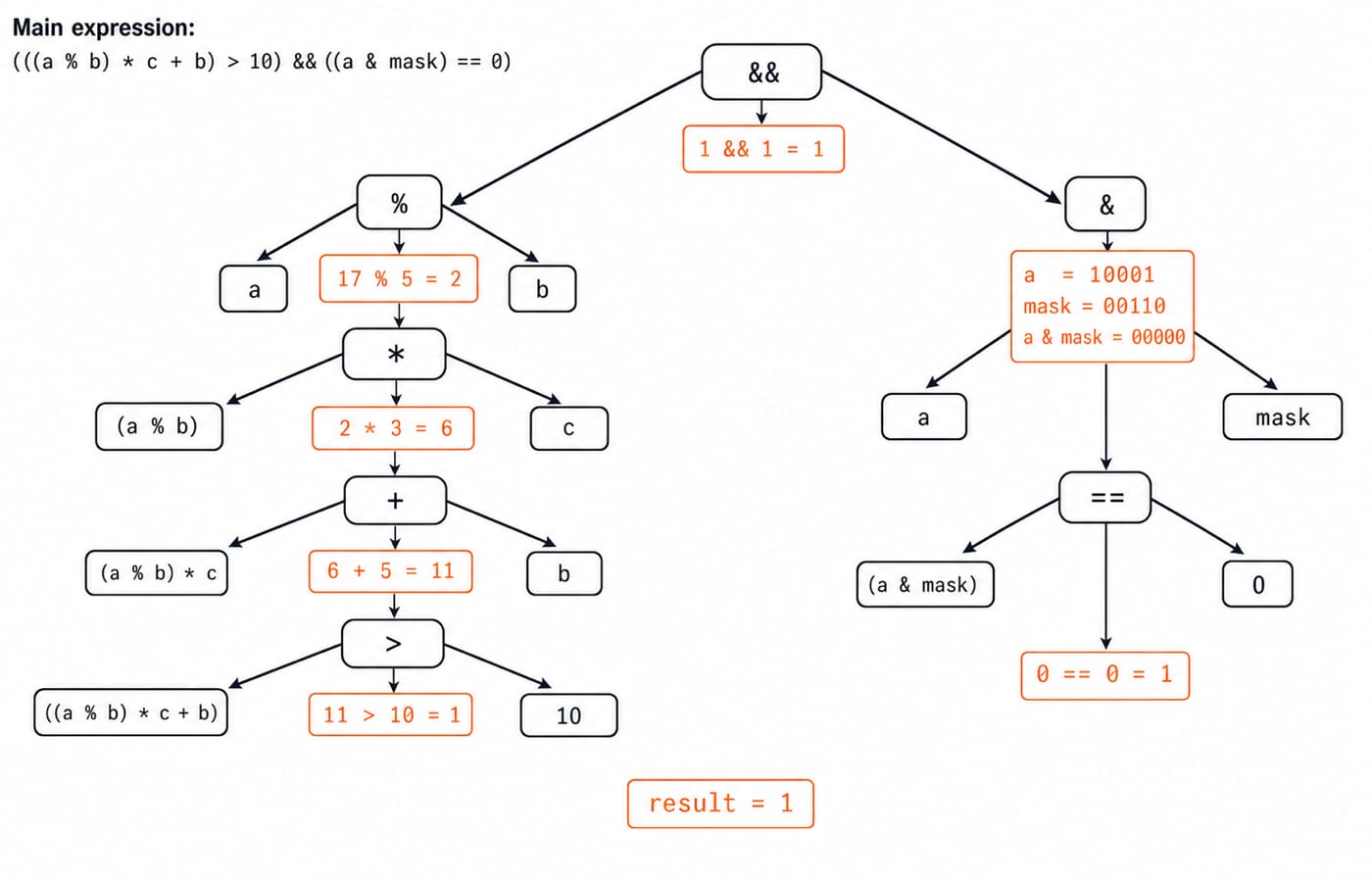
int result = (((a % b) * c + b) > 10) && ((a & mask) == 0);
The root is &&. Its left child is ((a % b) * c + b) > 10; its right child is (a & mask) == 0. Parentheses make the major branches explicit, while precedence still groups % before *, then +, then >.
Worked C expression trace: one typed step at a time
The left branch gives 17 % 5 = 2, then 2 * 3 = 6, then 6 + 5 = 11, and finally 11 > 10 = 1. Every intermediate value has type int. Because the left operand of && is true, the right branch must be evaluated.
For the bitwise branch, 17 is 10001 and 6 is 00110 in a five-bit display. Their bitwise AND is 00000, or 0. Therefore (a & mask) == 0 becomes 0 == 0, which produces the int value 1. The root is 1 && 1, so result is 1.
fragment | operand values | result | result type |
|---|---|---|---|
a % b | 17, 5 | 2 | int |
(a % b) * c | 2, 3 | 6 | int |
(a % b) * c + b | 6, 5 | 11 | int |
((a % b) * c + b) > 10 | 11, 10 | 1 | int |
a & mask | 10001, 00110 | 00000 | int |
(a & mask) == 0 | 0, 0 | 1 | int |
left && right | 1, 1 | 1 | int |
Operand types change a subtree before assignment
The destination type cannot repair an earlier integer calculation. In double x = 7 / 2;, both operands are int, so division produces the int value 3 before conversion to double; x becomes 3.0. In double y = 7 / 2.0;, one operand is double, so the division produces 3.5.
Grouping can move the conversion point. 5 / 2 * 2.0 first produces the int value 2, then the double value 4.0. In 5 / (2 * 2.0), the denominator is 4.0, so the result is 1.25.
Signed and unsigned operands need the same discipline. Given int s = -1; unsigned int u = 1;, the comparison s < u is false. The usual arithmetic conversions turn s into UINT_MAX, which is greater than 1. Do not assume that int is 32 bits. Use C Programming Data Types Explained: Concepts, Conversions and Worked Examples for type families, sizes, and ranges; in an expression trace, carry the type entering and leaving each operator node.
Short-circuit evaluation prunes a complete branch
The main trace evaluates its right branch because the left branch is 1. Change only the values to a = 10, b = 5, c = 1, mask = 6. The left branch becomes 10 % 5 = 0, 0 * 1 + 5 = 5, then 5 > 10 = 0. The && operator stops there. The mask comparison is not evaluated, and the result is 0.
The same rule safely guards division:
int n = 0;
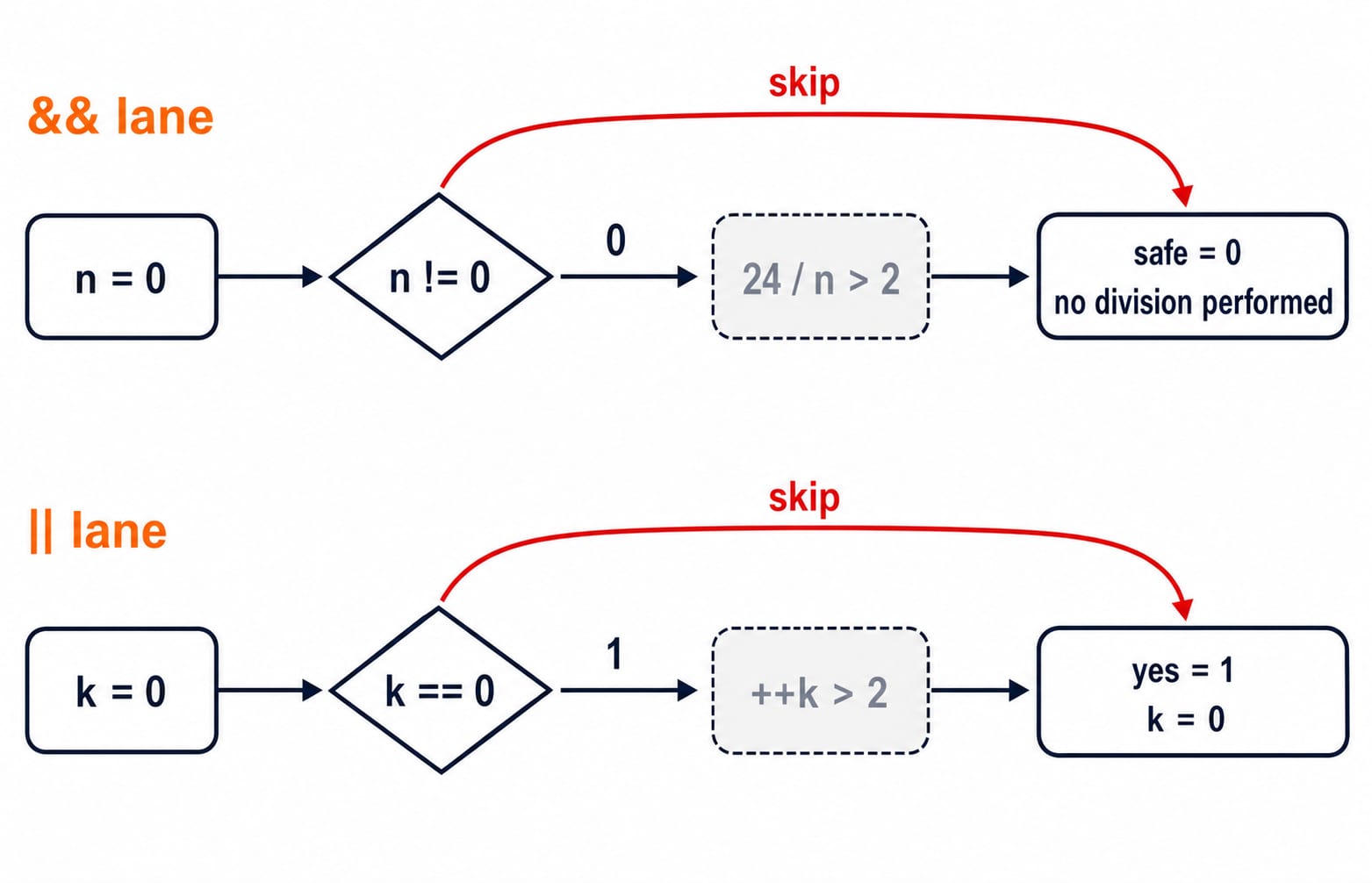
int safe = (n != 0) && (24 / n > 2);

int k = 0;
int yes = (k == 0) || (++k > 2);
For safe, n != 0 is 0, so 24 / n is skipped and no division by zero occurs. For yes, k == 0 is 1, so ++k is skipped. The final values are safe = 0, yes = 1, and k = 0. These are guaranteed results, not optimisation guesses.
C expression traps: calculate, rewrite, or stop
expression | tempting reading | correct analysis |
|---|---|---|
int x = 5; if (x = 0) | Equality test | Assignment stores 0; the branch is not taken. Use x == 0 for equality. |
2 & 1 | Logical AND | Bitwise 10 & 01 is 00, or 0. |
2 && 1 | Bitwise AND | Both operands are nonzero, so the result is 1. |
C has no mathematical chained comparison. With int a = 10, b = 5, c = 2;, a < b < c groups as (10 < 5) < 2, then 0 < 2, so it produces 1. Write a < b && b < c when that is the intended condition.
Some expressions have no numerical answer. In int i = 3; int z = i++ + ++i;, the two modifications of i are unsequenced, so the behaviour is undefined. Stop the trace at that node. Undefined Behavior in C: Common Causes, Examples, and Fixes owns the broader catalogue of invalid bounds, lifetimes, arithmetic, shifts, and library contracts; the expression-tracing rule is simply to reject a requested output after the first undefined operation.
How exams test C operator traces
Typical tasks ask for a defined output, a precedence grouping, a short-circuit side effect, a converted value, a bit mask, or the first undefined operation. Two quick checks show the scratchpad method. In int x = 2; int y = x++ * 3;, postfix increment supplies 2 to the multiplication, so y = 6 and then x = 3. With unsigned int n = 6; unsigned int bit = (n >> 1) & 1u;, 110 shifts to 011, then 011 & 001 gives 001, so bit = 1.
Use the same five-line routine under time pressure: parenthesise, label types, evaluate only sequenced nodes, apply short-circuiting, and stop at undefined behaviour. A final value without those intermediate checks is a guess, even when it happens to match an option.
C expressions: the next practice step
Rework the main expression with a = 10, b = 5, c = 1, mask = 6 and explain why the bitwise branch disappears. Then restore the original values and change mask to 4: 17 & 4 is 10001 & 00100 = 00000, so the right branch remains true and the final result remains 1.
For a structured path through concepts, MCQs, and coding exercises, use the C Language course. For neighbouring programming topics, browse Coding & Skills. Keep the tree and type ledger visible until every intermediate result can be justified aloud.
Keep learning
Introduction to Flowcharts: Symbols, a Worked Example and Exam Traps
Learn how flowchart symbols express sequence, decisions and loops. Then trace a complete even-sum example, translate it into C and repair common logic defects.
Updated 18 Oct 20266 min readC Programming & Data Structures
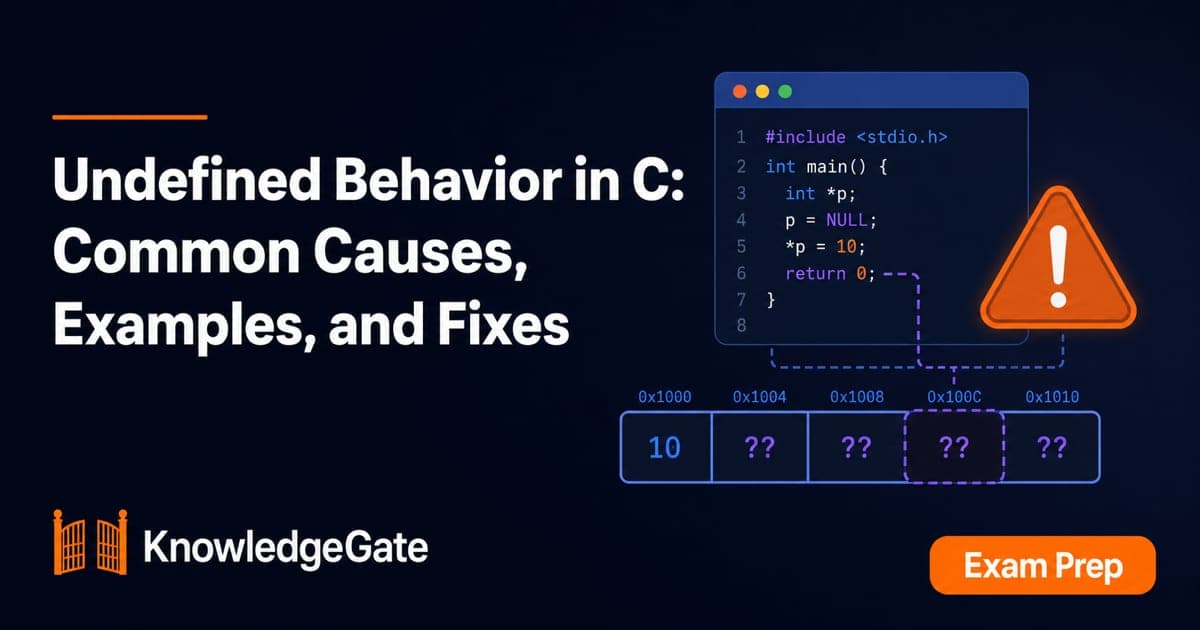
Undefined Behavior in C: Common Causes, Examples, and Fixes
Learn to find the first undefined operation in common C programs, repair the missing invariant, and verify the corrected result with worked examples.
Updated 14 Oct 20266 min readC Programming & Data Structures
Structures in C: Syntax, Member Access and Worked Examples
Learn how C structures group related values, then trace object and pointer access through complete, implementation-safe examples.
Updated 10 Oct 20266 min readC Programming & Data Structures
Functions in C: Syntax, Parameters and Worked Examples
Learn how C declarations, calls, and definitions fit together. Compile two complete programs, follow their values, and trace composition and recursion.
Updated 6 Oct 20266 min readC Programming & Data Structures