CoCubes Assessment Pattern: Map Aptitude, Coding and Domain Modules to Your Drive
Turn the module labels in your current CoCubes invitation into a focused preparation plan, then test that plan with worked aptitude, coding and domain diagnostics.
KnowledgeGate Team
Exam prep & CS education
Updated 23 Aug 20267 min read
CoCubes for engineering candidates draws on six module families: Aptitude, Computer Fundamentals, Programming, a Technical Domain, Personality Behavior and a Written English Test. Your campus or role invitation names only some of them, often under labels of its own, and that invitation is what fixes the question counts, timings and permitted languages. So the work is not memorising a paper. It is routing each label the invitation actually lists to the skill it screens, diagnosing where you lose marks, and rehearsing that exact combination.
1. Read the official CoCubes module families, then your own invitation
Aon's CoCubes student page lists the modules by track. The engineering track (B.E., B.Tech, M.Tech) and the MBA track (MBA, BBA, BMS, BBM) carry four families in common: Aptitude, Technical Domains, Personality Behavior and the Written English Test. They differ on the other two. Engineering gets Computer Fundamentals and Programming where MBA gets Management Fundamentals plus Excel and PowerPoint.
Family | CoCubes - Engineering | CoCubes - MBA |
|---|---|---|
Reasoning | Aptitude | Aptitude |
Fundamentals | Computer Fundamentals | Management Fundamentals |
Applied skill | Programming | Excel and PowerPoint |
Technical domain | Computer Science/IT, Electrical, Mechanical, Electronics, Civil, Chemical | HR, Operations, Finance, Marketing and Sales, IT Management |
Behaviour | Personality Behavior | Personality Behavior |
Language | Written English Test | Written English Test |
That is the menu the platform draws from, not the paper you will sit. Question counts, durations, sectional rules and how the CoCubes score and percentile are read belong to the invitation you were sent and to the official CoCubes student page at cocubes.com.
Record what your own invitation says on a six-field card. The card below is filled in for a sample drive, so replace every value with your own:
Field | Copied or recorded value |
|---|---|
Assessment or drive name | Campus Drive Alpha |
Role title | Graduate Engineer Trainee |
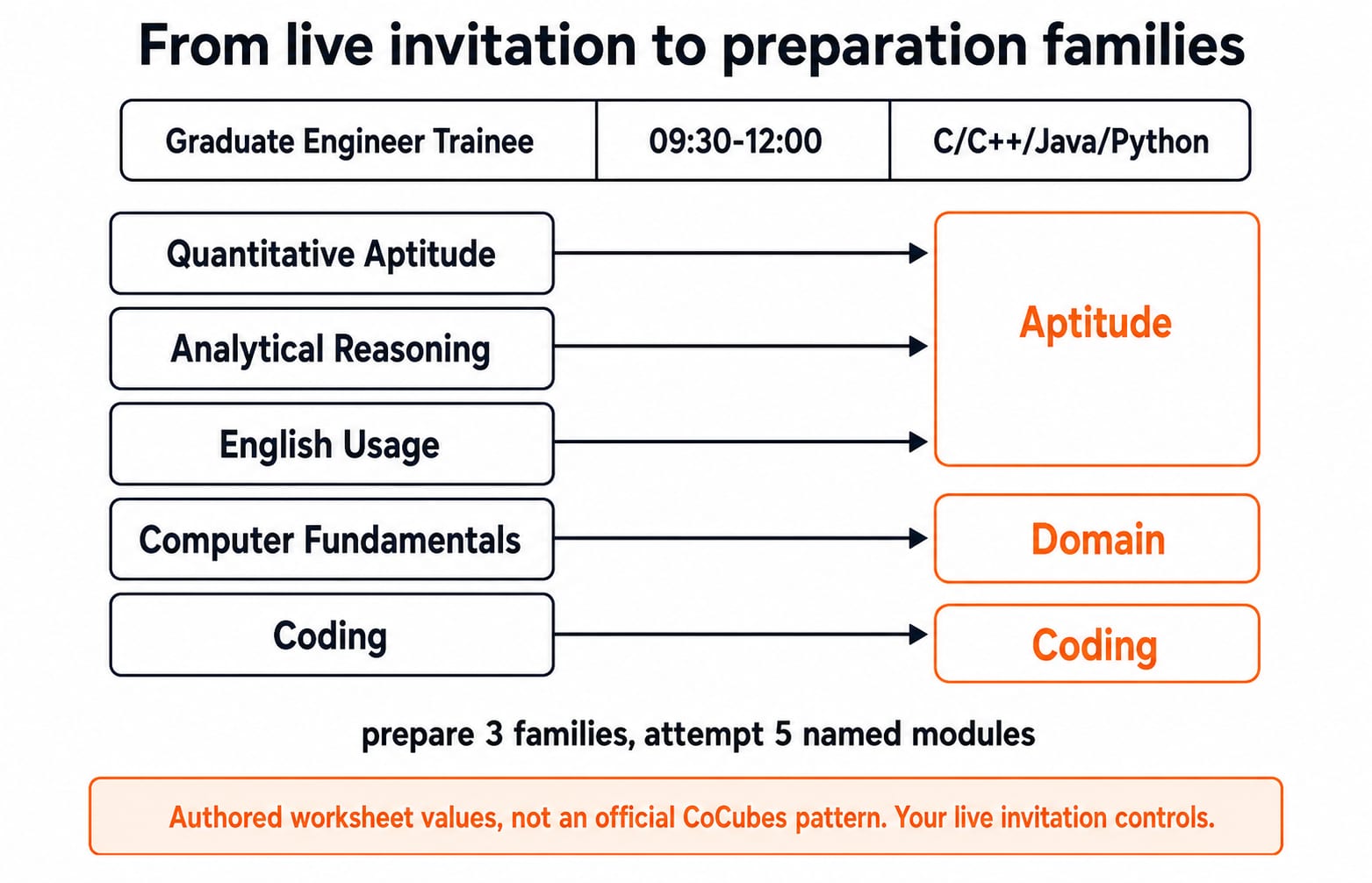
Modules named verbatim | Quantitative Aptitude, Analytical Reasoning, English Usage, Computer Fundamentals, Coding |
Test window | 09:30-12:00 |
Permitted coding languages | C, C++, Java, Python |
Source and last-checked date | Candidate invitation received 18 July; last checked 20 July |
Copy your own labels and restrictions word for word, and ask the placement cell or the named recruiter about anything ambiguous. Never fill a missing section, duration, cutoff or permitted language from a third-party page. AMCAT, CoCubes, eLitmus: Aptitude Tests Compared sets out how the three platforms differ in what they screen.
2. Translate each listed label into the skill it screens
Only a label your live instructions actually name applies.
Listed label | Preparation family and evidence sought |
|---|---|
Quantitative, logical or verbal aptitude | Aptitude: accurate decisions from short information |
Coding or programming | Coding: convert constraints into executable logic and test edge cases |
Computer science or technical domain | Domain: retrieve and apply discipline concepts |
Personality Behavior, Written English Test or another named module | Behaviour and language: answer consistently, or write to the brief in clear English |
On the sample card, Quantitative Aptitude, Analytical Reasoning and English Usage route to aptitude, Coding to coding, and Computer Fundamentals to domain. The fourth row applies only when your invitation names Personality Behavior, a Written English Test or another extra module. English Usage on the sample card is a verbal aptitude label rather than that separate writing module, which is why it routes to aptitude. Five labels form three preparation families but remain five modules. Grouping families does not merge assessment sections.
3. See how two drives can combine modules differently
Two drives at the same campus can name very different modules. Drive A is the Graduate Engineer Trainee card above. Its five labels route to aptitude, coding and domain. Drive B, a second illustrative card for a Business Operations Trainee, names Numerical Ability, Logical Reasoning and a Written English Test, has a 14:00-15:30 window, and names no coding language or technical subject. Numerical Ability and Logical Reasoning route to aptitude, the Written English Test is the fourth routing row from step 2 rather than a verbal aptitude label, and nothing routes to coding or domain.
That absence is a reason to confirm before preparing coding or domain as test modules, not proof that CoCubes never screens them for the role. Use one rule: listed means prepare and verify rules; unclear means ask the named contact; absent means do not invent one, while keeping any interview preparation separate. A later round or revised invitation can change the card, so recheck it 24 hours before the assessment.
4. Diagnose the aptitude family with one small mixed set
Start with a 20-question, 25-minute baseline: 8 quantitative, 6 logical reasoning and 6 verbal questions. Suppose the result is:
Quantitative: 6/8 in 11 minutes = 75.0%.
Logical: 4/6 in 9 minutes = 66.7%.
Verbal: 5/6 in 5 minutes = 83.3%.
Total: (6 + 4 + 5)/20 = 15/20 = 75.0%.
Average time is 25/20 = 1.25 minutes, or 75 seconds, per question. These are your own accuracy figures, not the CoCubes score or percentile that the official student report describes. Logical comes first for repair: it has the lowest accuracy and takes 9/6 = 1.5 minutes, or 90 seconds, per question. Quantitative follows because its 11-minute block loses two questions. Label each miss as concept, reading, calculation or time pressure, then redo all five untimed. Aptitude for Placements: Section Topics and Weekly Plan sets out the section topics and a weekly practice load for exactly these three areas.
5. Treat coding as constraints, trace, implementation and tests
Use this practice problem: given [7, 2, 7, 3, 2, 7], return each distinct value with its frequency in ascending key order. The required output is [(2, 2), (3, 1), (7, 3)]. Write the constraints down before any code: one row per distinct value, keys ascending numerically, negative values legal.
Trace before coding. The map becomes {7:1}, {7:1,2:1}, {7:2,2:1}, {7:2,2:1,3:1}, {7:2,2:2,3:1}, then {7:3,2:2,3:1}. Insertion order is 7, 2, 3, so sorting the three keys is what produces 2, 3, 7. For n values and k distinct keys, this takes O(n + k log k) time and O(k) extra space.
def frequencies(values):
    counts = {}
    for value in values:
        counts[value] = counts.get(value, 0) + 1
    return [(key, counts[key]) for key in sorted(counts)]

print(frequencies([7, 2, 7, 3, 2, 7]))
# [(2, 2), (3, 1), (7, 3)]
The dictionary counts in a single pass and sorted(counts) does the ordering, so the two requirements stay separate and each can be tested on its own.
Test [] -> [], [5] -> [(5,1)], [2,2,2] -> [(2,3)] and [-1,2,-1] -> [(-1,2),(2,1)]. The empty and single-element cases guard the loop, and the negative case confirms the counting makes no assumption about sign. Score the attempt out of 10: 2 for constraints, 3 for correct logic, 2 for complexity, 2 for edge cases and 1 for readable naming. Anything below 8 out of 10 is your own trigger to attempt it again. This problem is a practice exercise, not a CoCubes question; Coding for Placements covers the same C, C++, Java and Python ground in structured form.
6. Scope the domain module to your named label instead of revising all of CS
Begin with the sample card's exact label, Computer Fundamentals. On the official list, Computer Fundamentals and a Technical Domain are separate families, so a Computer Fundamentals label is not a licence to revise your entire branch syllabus. Confirm the broader scope from the invitation or the drive's own syllabus before expanding it. Once the invitation or syllabus confirms four practice buckets, use this 12-question diagnostic: DBMS 4, Operating Systems 4, Computer Networks 2 and OOP 2.
Suppose DBMS is 3/4 = 75%, OS 2/4 = 50%, CN 1/2 = 50% and OOP 2/2 = 100%. Overall, (3 + 2 + 1 + 2)/12 = 8/12 = 66.7%. Allocate 120 repair minutes: 45 for OS, 30 for CN, 25 for DBMS and 20 for OOP recall. Check: 45 + 30 + 25 + 20 = 120. The two 50% buckets get more time, while OOP retains a short retrieval pass despite full accuracy. The split reflects your own diagnostic, not any published weightage.
7. Rehearse the exact combination on one personal mock sheet
For Drive A, build a 90-minute rehearsal: 30 minutes aptitude, 35 coding, 20 domain and 5 review. Check: 30 + 35 + 20 + 5 = 90. Use 24 aptitude questions, the exact frequency problem plus one fresh coding problem, and 12 domain questions.
Record outcomes separately: aptitude 18/24 = 75%; frequency problem 9/10 on its self-check; fresh coding problem passes 4/6 tests; domain 9/12 = 75%. The 4/6 pass is the clearest weakness despite the strong frequency trace. Target boundary cases next, not random aptitude questions. If the invitation gives section locks, navigation rules or timing, copy them into the rehearsal. Otherwise, do not invent them.
8. CoCubes assessment pattern in the short version
Use four steps: copy, route, diagnose, rehearse. Copy the live labels, route only those labels into aptitude, coding and domain, diagnose a weakness, then rehearse the confirmed module combination. Your invitation, the candidate portal and authorised drive communication are what control the modules, timings, languages and scoring rules.
The IT Recruitment Exam Preparation category collects the other standardised recruitment assessments a campus drive may put in front of you. For a CoCubes-focused next step, the CoCubes Preparation Course sets out concepts and previous-year questions, topic-wise videos and a test series.
Keep learning
TCS NQT Eligibility: Check Backlogs, Gaps and Degree Rules
Use a closed TCS hiring notice as a worked checklist for degree, backlog, course-duration and academic-gap rules, then verify the current drive.
Updated 2 Sep 20264 min readIT Recruitment Exams
CoCubes Preparation Plan: Six Weeks for Campus Hiring Tests
Build a practical six-week CoCubes study plan around the modules in your own test invitation, your diagnostic results, and 72 hours of focused work.
Updated 1 Sep 20266 min readIT Recruitment Exams
eLitmus Retake Decision: Read Section Percentiles Before Testing Again
Do not retake eLitmus on disappointment alone. Use your section pattern, target-job evidence, and fresh timed practice to decide whether to go, wait, or rebuild.
Updated 30 Aug 20264 min readIT Recruitment Exams
eLitmus Mock Analysis: Diagnose Knowledge Gaps and Attempt Errors
A worked mock-review method to separate concept gaps from calculation, reading and decision errors, recover marks, and plan the next four weeks.
Updated 29 Aug 20265 min readIT Recruitment Exams