Computer Networks for GATE: Syllabus Areas, Weightage Pattern and How to Prepare
Learn what CN covers in GATE, where its questions tend to come from, and how to sequence the subject. Includes verified subnetting and stop-and-wait examples.
KnowledgeGate Team
Exam prep & CS education
Updated 29 Aug 20264 min read59 views
Computer Networks can feel endless: several layer models, many protocols and formulas at every turn. For GATE, the official syllabus narrows that sprawl to a defined set of protocol families. The useful preparation question is which clusters to learn first and which numerical patterns to practise repeatedly.
Where Computer Networks sits in the GATE CS paper
Recent GATE information brochures have specified a 100-mark, 65-question, three-hour paper, with General Aptitude carrying 15 marks and the subject portion carrying 85. They have also specified MCQ, MSQ and NAT formats. The archived brochure and syllabus for that cycle remain available through the official GATE 2026 portal, while CN appears as a named core section of the CS syllabus.
CN is one of ten sections in the official CS syllabus. The syllabus fixes no section-wise mark split, so treat any weightage estimate as a past-paper trend rather than a promise for the next paper. For the wider comparison, use GATE CS Subject Weightage: Where Hours Pay Off.
Computer Networks syllabus areas in five clusters
Recent official syllabus documents have organised the named CN topics into a scope that is easiest to learn as five clusters:
Cluster | What to cover |
|---|---|
Layering and switching | OSI and TCP/IP stacks; packet, circuit and virtual-circuit switching |
Data link layer | Framing, error detection, medium access control and Ethernet bridging |
Network layer | Shortest path, flooding, distance vector and link-state routing; IPv4 addressing, fragmentation, CIDR, ARP, DHCP, ICMP and NAT |
Transport layer | UDP, TCP, sockets, flow control and congestion control |
Application layer | DNS, SMTP, HTTP, FTP and email |
Do not expand the subject from memory. Detailed cryptography and network security, token ring and ATM may appear in old notes, but they are outside this syllabus wording. Check the current cycle's official syllabus before adding material beyond these clusters.
CN weightage pattern across question families
Official GATE documents do not assign CN or its subtopics a fixed mark share. For preparation, treat weightage as recurrence by question family, not as a guaranteed allocation. Start with IP addressing and subnetting, TCP sequence and congestion-window behaviour, stop-and-wait and sliding-window performance, and routing iterations. These families demand multi-step working and benefit most from repeated practice. Then cover the lighter recall families: port numbers, application-protocol choices, OSI-layer identification and header fields.
Use the official question papers and answer keys to count these families cycle by cycle. A single historical average can hide a paper that leans heavily toward one family, so revise every cluster even when numericals receive more practice time.
Subnetting worked example for a /20 network
Suppose a host has IP address 172.16.45.130/20. Find the network address, broadcast address and number of usable host addresses.
A
/20prefix gives the mask255.255.240.0.The third octet, 45, is
00101101in binary. Keeping its top four network bits gives00100000, which is 32.Therefore, the network address is
172.16.32.0.A mask octet of 240 creates blocks of
256 - 240 = 16. The block beginning at 32 ends at 47, so the broadcast address is172.16.47.255.There are
32 - 20 = 12host bits. Usable hosts are2^12 - 2 = 4096 - 2 = 4094.
The common error is 172.16.45.0, which treats /20 like /24. Block-size thinking prevents it. The IP Addressing and Subnetting Explained guide develops the full method and adds practice.
Stop-and-wait efficiency and the window that fixes it
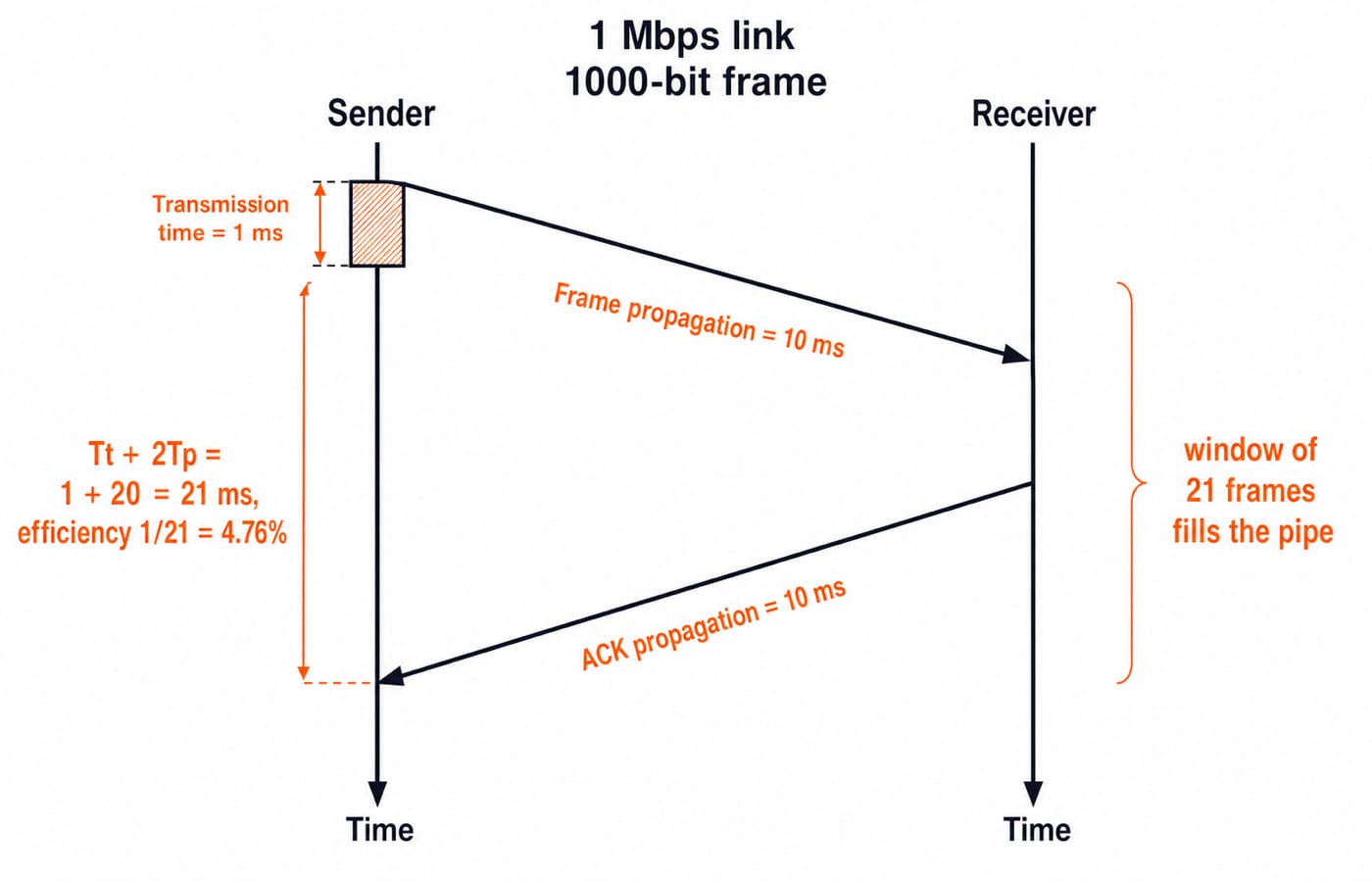
Take a 1 Mbps link, a 1,000-bit frame and a one-way propagation delay of 10 ms. Ignoring ACK transmission time, transmission time is Tt = 1000 bits / 1,000,000 bits per second = 1 ms. Therefore, a = Tp/Tt = 10/1 = 10.
Stop-and-wait efficiency is 1/(1 + 2a) = 1/(1 + 20) = 1/21, or about 4.76%. Under the same assumptions, a sliding-window protocol reaches full utilisation with a minimum window of 1 + 2a = 21 frames.
The sequence-number follow-up is just as mechanical. Go-Back-N requires W <= 2^n - 1; n = 5 works because 31 >= 21, while four bits allow only 15. Selective Repeat requires W <= 2^(n-1); n = 6 works because 32 >= 21, while five bits allow only 16.
Computer Networks preparation order that works
Start with IP addressing, subnetting and CIDR. They are self-contained, mechanical and a reliable numerical source.
Move to data-link performance: stop-and-wait, sliding windows, CRC and checksum ideas, then MAC basics. This builds the
TtandTpvocabulary.Study TCP connection management, flow control and congestion-control phases. This is the conceptual heart of CN and fertile ground for MSQs.
Take up distance vector, link state and shortest-path routing, including iteration-based questions.
Finish with application protocols and one-mark facts, then compress them into a revision sheet.
At five 60-minute sessions a week, use week one for addressing and data-link performance, week two for TCP and routing, and week three for application protocols plus mixed revision. If college work leaves only three sessions a week, stretch the same order across four weeks instead of dropping problem practice. After the first two clusters, use timed topic tests so subnetting and window arithmetic become automatic. GATE Test Series: Mocks & Topic-wise Tests provides both topic-level and full-length practice.
The short version and the next step
For preparation, group CN into five clusters: layering and switching, data link, network, transport and application.
Give the most numerical practice to subnetting, sliding windows and TCP congestion behaviour.
Treat it as a mid-size subject with a strong return for focused practice.
Prepare addressing first and application-layer facts last.
Verify every paper or syllabus specific against the current cycle's official GATE documents.
If you want CN and the other core subjects paced in sequence, GATE Guidance by Sanchit Sir provides the organised route. If you prefer to assemble your own plan, use the GATE CS Exam Preparation category to choose the preparation material you need.
Keep learning
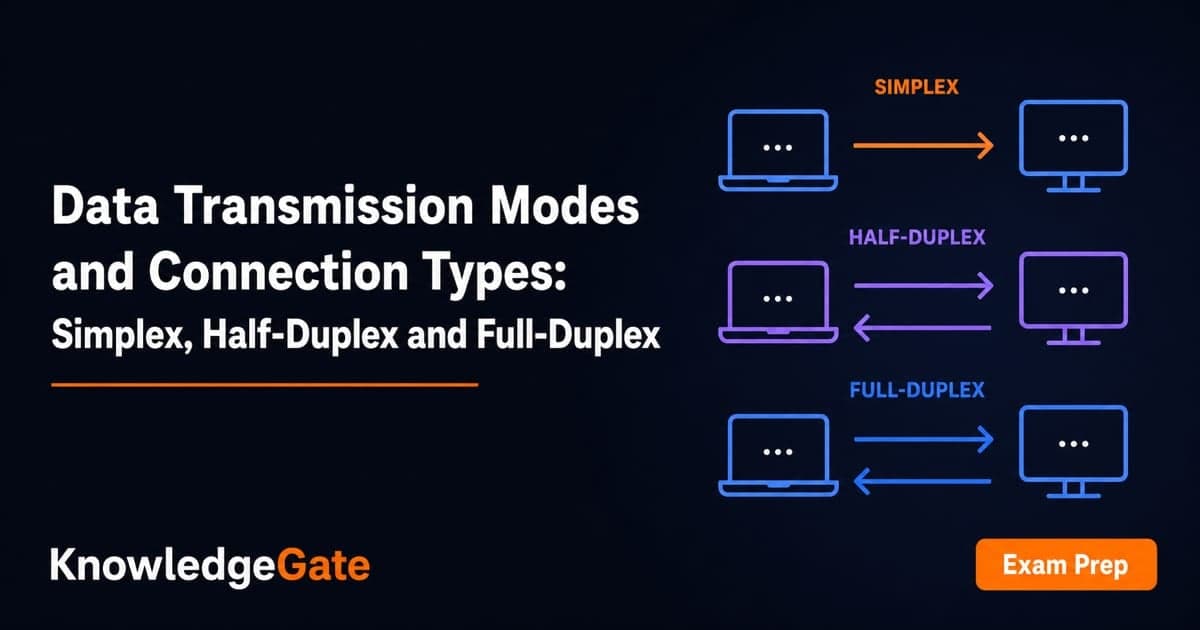
Data Transmission Modes and Connection Types: Simplex, Half-Duplex and Full-Duplex
Learn to classify simplex, half-duplex, full-duplex, point-to-point and multipoint links, then calculate completion time without relying on memorised examples.
Updated 22 Oct 20265 min readComputer Networks
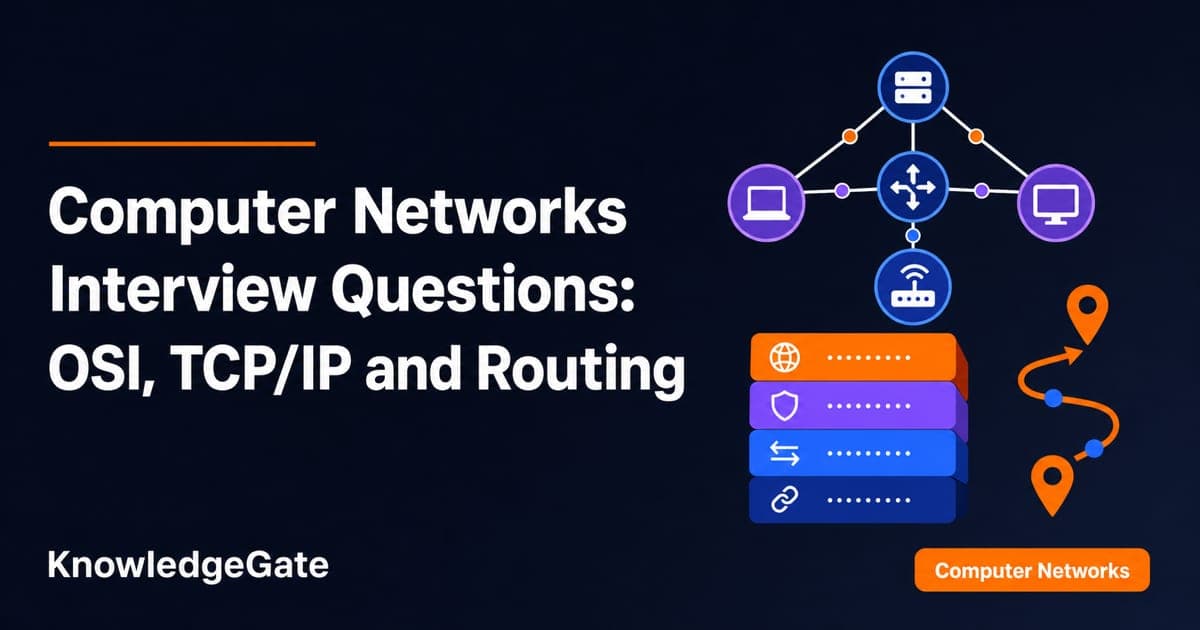
Computer Networks Interview Questions: Trace OSI, TCP/IP and Routing Step by Step
Follow one synthetic web request across DNS, ARP, TCP, NAT and longest-prefix routing, then turn each step into a strong interview answer.
Updated 18 Oct 20266 min readComputer Networks
Basics of Cyber Security: CIA Triad, Risks and a Worked Defence
Learn a consistent security vocabulary, connect common attack paths to suitable controls, and calculate how two defensive layers reduce account takeovers.
Updated 14 Oct 20266 min readComputer Networks
Cyber Threats and Attacks Explained: Types, Worked DDoS Example and Exam Traps
Learn to separate threats, vulnerabilities, vectors and attacks, then apply the distinctions to a calculated DDoS scenario and exam-style questions.
Updated 10 Oct 20266 min readComputer Networks