Java Concurrent Collections Tutorial: Runnable Map, List, and Queue Examples
Choose a Java concurrent collection from its access pattern, then run three deterministic examples that show atomic updates, snapshot traversal, and bounded hand-off.
KnowledgeGate Team
Exam prep & CS education
Updated 29 Aug 20265 min read
Two threads can perform valid operations on a shared HashMap or ArrayList, yet their combined result can still be wrong and iteration unsafe. Collection choice depends on the access pattern, and operation-level guarantees do not make a sequence of operations indivisible.
What a concurrent collection actually protects
A concurrent collection coordinates its documented individual operations while several threads access it. It does not automatically make a sequence such as "check, then update" one indivisible action.
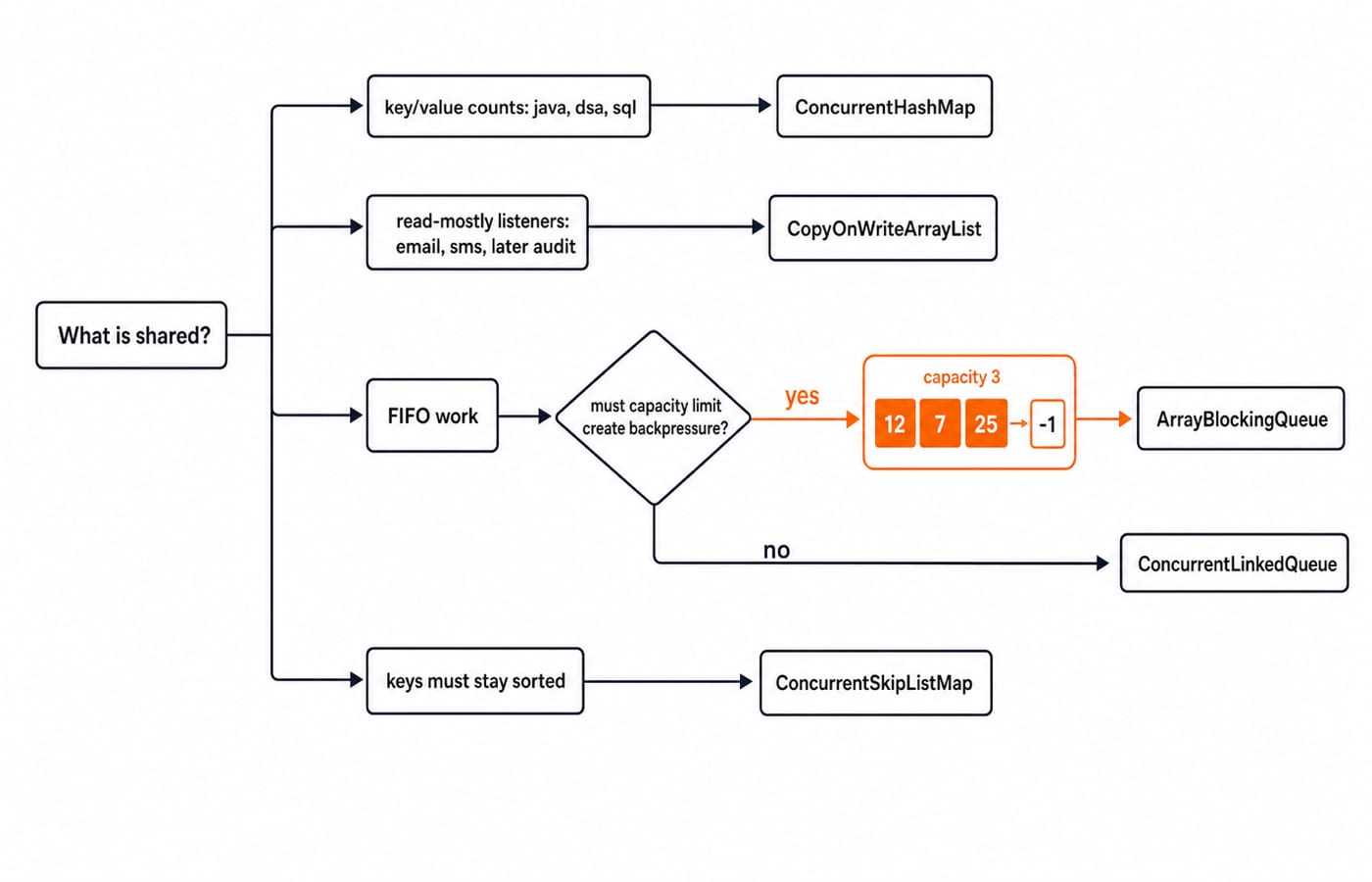
Suppose four workers record 20 tags across java, dsa, and sql. An ordinary HashMap needs externally controlled access. Collections.synchronizedMap adds synchronisation, but its API contract still requires care during iteration. ConcurrentHashMap provides atomic operations such as putIfAbsent, compute, and merge.
Choose by operation pattern, not a familiar class name. Thread-safe storage is only one part of thread-safe design.
Choose the collection from the access pattern
Access pattern | Suitable collection | Main trade-off |
|---|---|---|
Shared key/value updates |
| Strong atomic per-key operations, but a multi-key workflow is not one transaction. |
Small list with very frequent traversal and rare changes |
| Snapshot traversal is convenient, while every structural change copies the backing array. |
Unbounded non-blocking FIFO hand-off |
| Producers do not wait for capacity, so the queue supplies no backpressure. |
Bounded producer/consumer hand-off |
| Capacity limits memory growth and can make producers wait. |
Sorted concurrent keys |
| Keys stay ordered, with more machinery than an unordered map. |
The Coding & DSA category connects these choices to their underlying data structures.
Count 20 tags with ConcurrentHashMap
Each worker receives five tags, and merge atomically updates one key.
import java.util.*;
import java.util.concurrent.*;

public class ConcurrentTagCounter {
    public static void main(String[] args) throws Exception {
        List<List<String>> inputs = List.of(
            List.of("java", "dsa", "java", "sql", "java"),
            List.of("dsa", "java", "dsa", "sql", "java"),
            List.of("java", "dsa", "sql", "sql", "dsa"),
            List.of("dsa", "java", "dsa", "java", "sql")
        );
        ConcurrentHashMap<String, Integer> counts = new ConcurrentHashMap<>();
        ExecutorService executor = Executors.newFixedThreadPool(4);
        List<Future<?>> tasks = new ArrayList<>();

        for (List<String> input : inputs) {
            tasks.add(executor.submit(() ->
                input.forEach(tag -> counts.merge(tag, 1, Integer::sum))));
        }
        for (Future<?> task : tasks) task.get();
        executor.shutdown();
        executor.awaitTermination(1, TimeUnit.MINUTES);
        System.out.println(new TreeMap<>(counts));
    }
}
Count before trusting the output. java = 3 + 2 + 1 + 2 = 8; dsa = 1 + 2 + 2 + 2 = 7; sql = 1 + 1 + 2 + 1 = 5. Check: 8 + 7 + 5 = 20. Output:
{dsa=7, java=8, sql=5}The TreeMap only makes display order deterministic. merge is atomic per key, not a transaction across unrelated keys. Separate get and put calls can let two workers read the same old count and overwrite one increment. If needed, learn the language and collections foundation first.
Traverse a snapshot with CopyOnWriteArrayList
Under the Java API contract, a CopyOnWriteArrayList iterator sees the array snapshot present when it was created.
import java.util.*;
import java.util.concurrent.CopyOnWriteArrayList;

public class ListenerSnapshots {
    public static void main(String[] args) {
        CopyOnWriteArrayList<String> listeners =
            new CopyOnWriteArrayList<>(List.of("email", "sms"));
        Iterator<String> eventOne = listeners.iterator();
        listeners.add("audit");

        List<String> first = new ArrayList<>();
        eventOne.forEachRemaining(first::add);
        System.out.println("event 1 -> " + first);
        System.out.println("event 2 -> " + new ArrayList<>(listeners));
    }
}
Output:
event 1 -> [email, sms]
event 2 -> [email, sms, audit]
Its iterator does not support mutation. This fits a short listener or configuration list read thousands of times between rare changes. It is poor for a write-heavy cart, log, or task list because every structural update copies the backing array. It is not a generally faster ArrayList.
Build a bounded producer-consumer hand-off
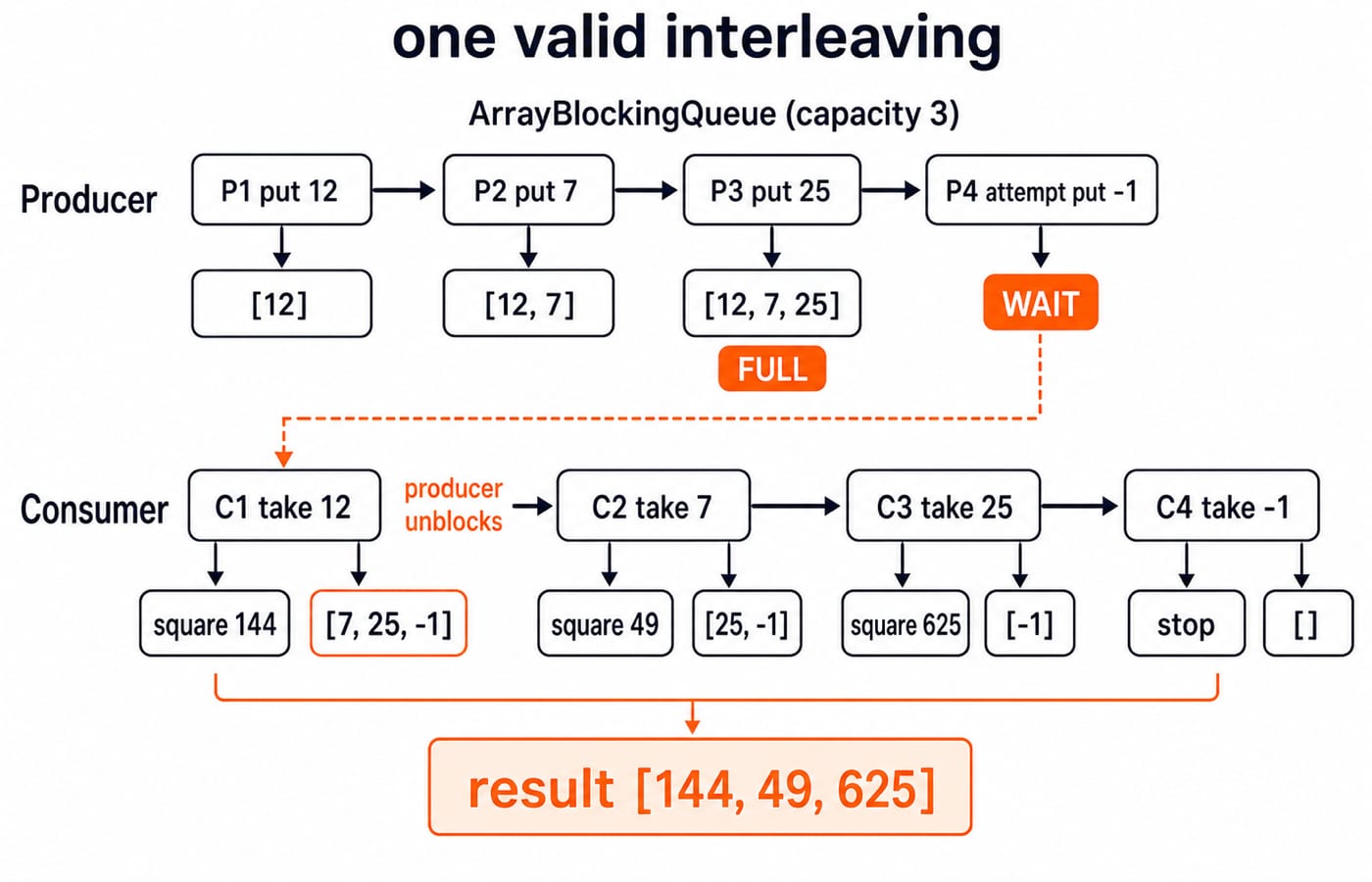
An ArrayBlockingQueue combines FIFO hand-off with capacity. One producer supplies values and a sentinel, while one consumer squares positive values.
import java.util.*;
import java.util.concurrent.*;

public class BoundedSquares {
    public static void main(String[] args) throws Exception {
        ArrayBlockingQueue<Integer> queue = new ArrayBlockingQueue<>(3);
        List<Integer> result = new ArrayList<>();
        ExecutorService executor = Executors.newFixedThreadPool(2);

        Future<?> producer = executor.submit(() -> {
            try {
                for (int value : List.of(12, 7, 25, -1)) queue.put(value);
            } catch (InterruptedException e) {
                Thread.currentThread().interrupt();
            }
        });
        Future<?> consumer = executor.submit(() -> {
            try {
                for (int value; (value = queue.take()) != -1; )
                    result.add(value * value);
            } catch (InterruptedException e) {
                Thread.currentThread().interrupt();
            }
        });

        producer.get();
        consumer.get();
        executor.shutdown();
        executor.awaitTermination(1, TimeUnit.MINUTES);
        System.out.println(result);
    }
}
FIFO order gives [144, 49, 625] because 12 x 12 = 144, 7 x 7 = 49, and 25 x 25 = 625. If the consumer has not removed an item, the fourth put waits while three slots are occupied. Interleaving remains scheduler-dependent.
put and take wait when needed; offer and poll provide non-waiting or timed alternatives. A sentinel works only when its marker cannot be valid data and every consumer receives a termination signal.
Five traps that survive a thread-safe collection
containsKeythenput: another thread can act between the calls. UseputIfAbsent,computeIfAbsent, ormerge.isEmptythenremove: the state can change after the check. Use one queue operation such aspollortake.Treating map traversal as frozen:
ConcurrentHashMaptraversal is weakly consistent by its API contract. Accept that view or create an explicit snapshot when the workflow needs one.Frequent writes to
CopyOnWriteArrayList: repeated copying is the wrong access model. Choose a structure designed for the real mutation pattern.Updating several collections as one action: a safe container does not make the group atomic. Use explicit coordination or redesign state ownership. Process Synchronization and Semaphores explains that wider critical-section problem.
Check null rules class by class. ConcurrentHashMap rejects null keys and values; ArrayBlockingQueue and ConcurrentLinkedQueue reject null elements.
How interviews and objective questions test the topic
Interview and objective questions test guarantees rather than names:
10,000 traversals between rare listener changes: choose
CopyOnWriteArrayListbecause snapshot reads dominate and copying is rare.containsKey(k)followed byput(k, 1): replace the compound sequence withputIfAbsentormerge, depending on the intended update.An iterator is created before adding
audit: predict[email, sms]because that iterator retains its creation-time snapshot.
For related concurrency revision, work through Threads and Process Creation MCQs. KnowledgeGate also has 300+ Java questions available for broader practice.
Try a 20-minute loop: classify four scenarios for 5 minutes, type and run an example for 10, then rewrite one compound update with an atomic API for 5.
Short version and next step
ConcurrentHashMaphandles shared mappings and atomic per-key updates.CopyOnWriteArrayListhandles read-heavy snapshot traversal.ConcurrentLinkedQueuehandles unbounded non-blocking FIFO access.A
BlockingQueueimplementation handles bounded hand-off and backpressure.
None of them makes a multi-step business operation atomic by itself.
Add one more java entry to W1. The result becomes {dsa=7, java=9, sql=5}, with 7 + 9 + 5 = 21. Then change the queue capacity from 3 to 2. Waiting may change, but FIFO output stays [144, 49, 625]. Continue with the DSA using Java course for Java implementations and interview-oriented practice.
Keep learning
Java Multithreading Basics: Threads, Runnable and Safe Counters with Examples
Build two Java thread examples, trace a lost counter update exactly, and learn when to use synchronized, AtomicInteger, volatile or private state.
Updated 26 Oct 20266 min readJava
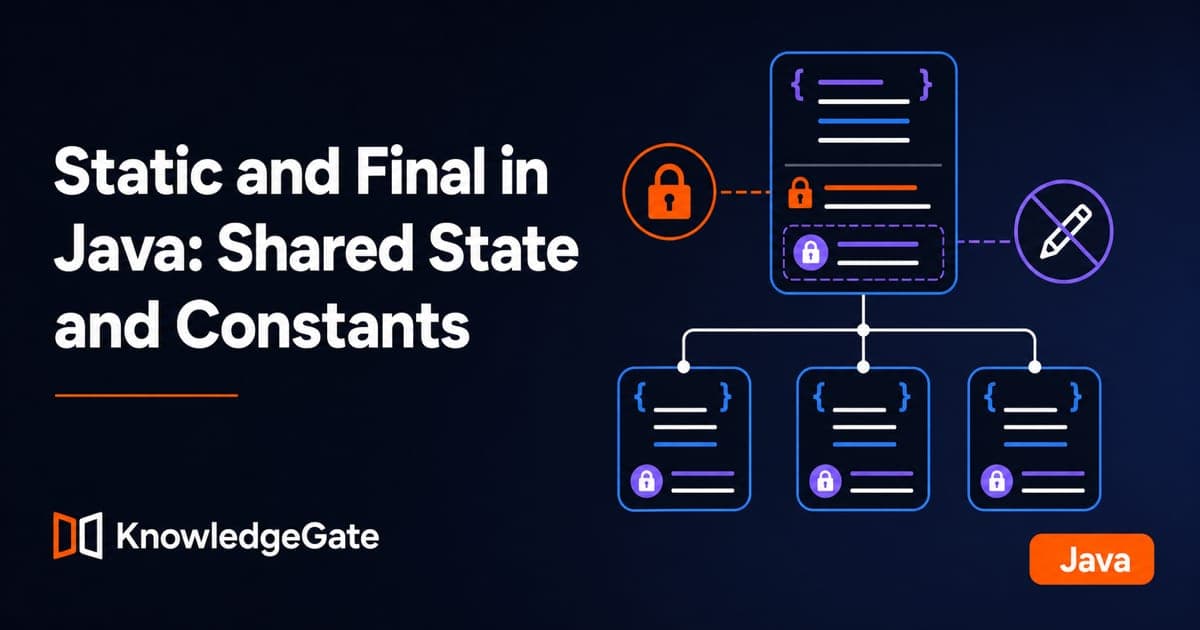
Static and Final in Java: Shared State, Constants and Override Rules with Runnable Examples
Learn what static and final control in Java by tracing a shared counter, class initialisation, final references, constants and inheritance errors.
Updated 24 Oct 20266 min readJava
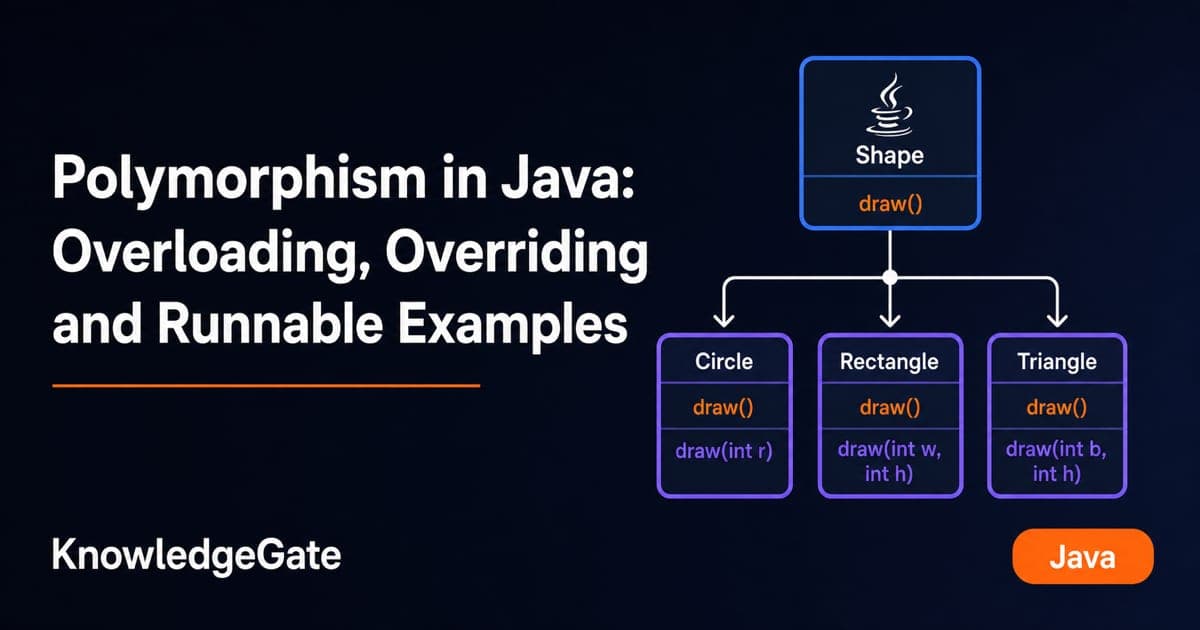
Polymorphism in Java: Overloading, Overriding and Runnable Examples
Learn how Java chooses overloaded methods at compile time and overridden methods at runtime. Trace two complete programs, common traps and practice targets.
Updated 22 Oct 20266 min readJava
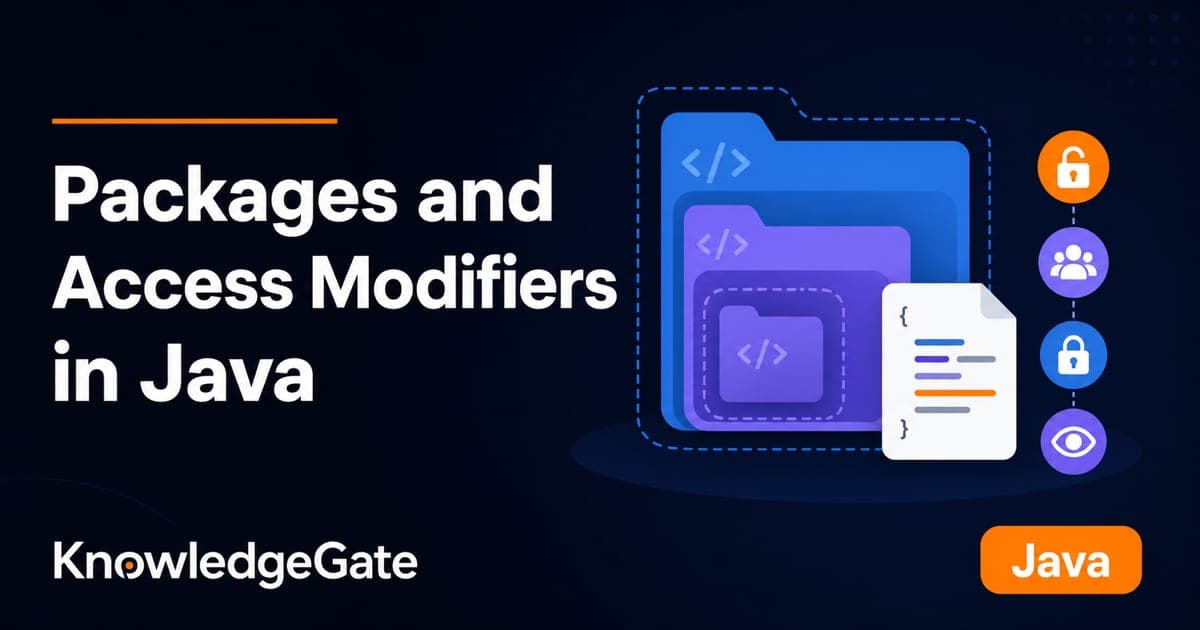
Packages and Access Modifiers in Java: Visibility Rules with Runnable Examples
Learn how Java package boundaries change member visibility. Compile a complete example covering public, protected, package-private and private access.
Updated 18 Oct 20265 min readJava