Derivation and Recursion in CFG: Leftmost, Rightmost and Worked Examples
Follow three exact derivations to separate sentential forms from sentences, see how recursion behaves, and remove immediate left recursion without changing the language.
KnowledgeGate Team
Exam prep & CS education
Updated 26 Aug 20265 min read80 views
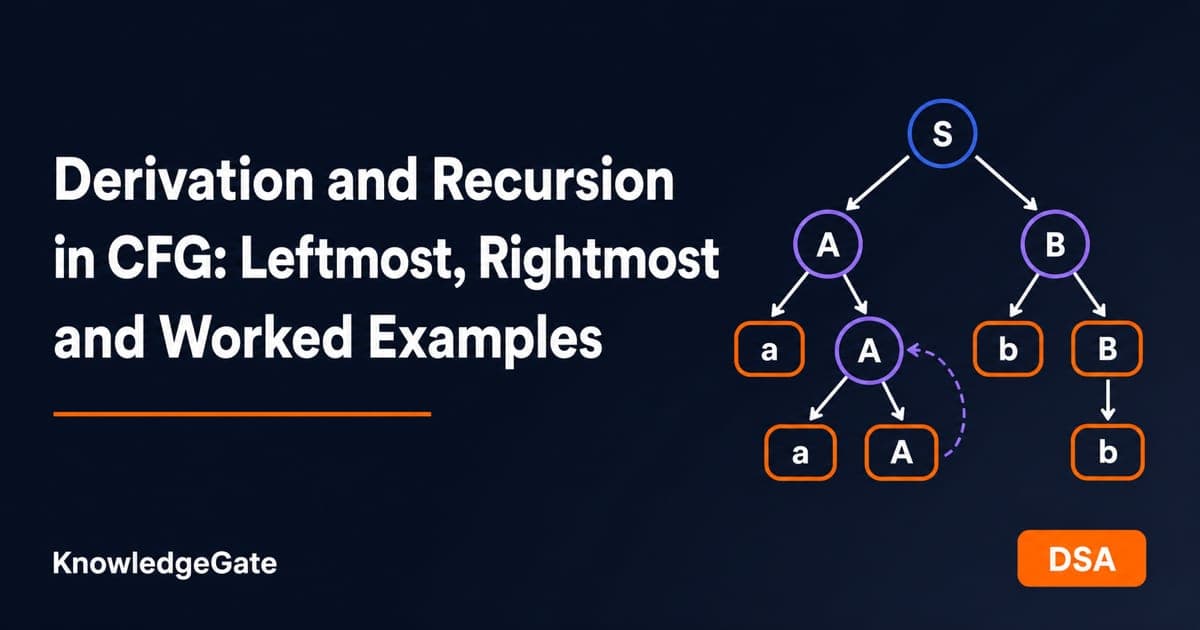
A grammar rule fits on one line, but a derivation question can still make you pause: which nonterminal may be rewritten, in what order, and when has the process actually finished? Recursion adds another trap, because a valid CFG can support finite strings while a careless derivation or parser keeps expanding forever. Exact strings distinguish the ideas; use GATE CS Exam Preparation as the wider subject route when placing them in your full plan.
Related reading: CFG derivation MCQs and Context-free grammars.
CFG derivation: grammar, sentential form and sentence
A context-free grammar is G = (V, Σ, P, S), where V contains nonterminals, Σ contains terminals, P contains productions, and S is the start symbol. Use this grammar:
V = {S, A, B}Σ = {a, b}Start symbol:
SProductions:
S -> AB,A -> aA | a,B -> bB | b
The symbol => means one application; =>* means zero or more. A sentential form may contain terminals and nonterminals, so aAB and aaB qualify. A sentence contains terminals only, so aabbb is a sentence.
This grammar generates exactly {a^m b^n | m >= 1, n >= 1}. Every sentence has at least one a, followed by at least one b. For the wider connection between grammars, languages and stack machines, read Context-Free Grammars and Pushdown Automata.
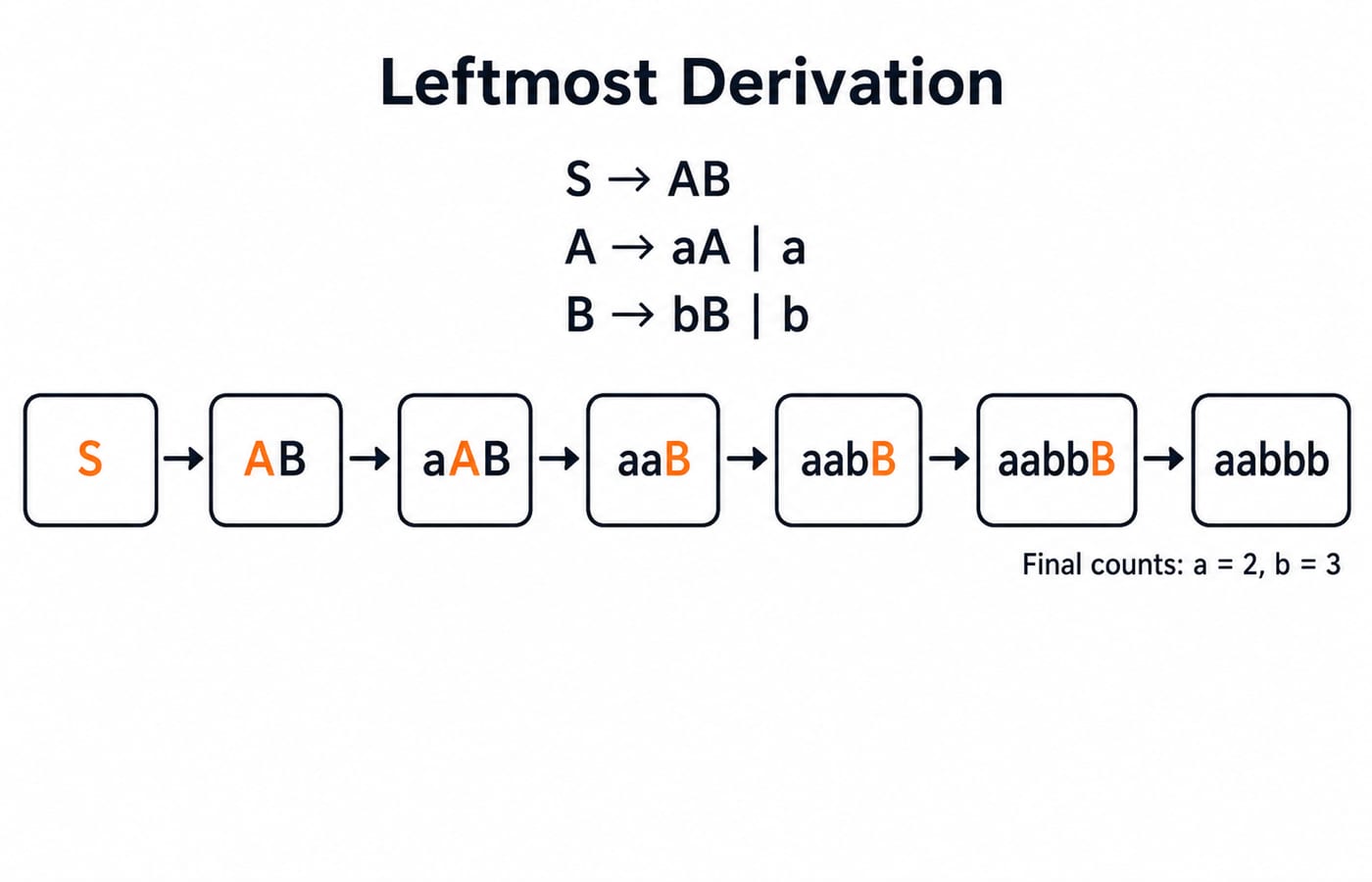
Leftmost derivation: derive aabbb step by step
In a leftmost derivation, always rewrite the leftmost nonterminal in the current sentential form.
S => AB(S -> AB)AB => aAB(A -> aA)aAB => aaB(A -> a)aaB => aabB(B -> bB)aabB => aabbB(B -> bB)aabbB => aabbb(B -> b)
The result has two a symbols, three b symbols and no nonterminal. It is a sentence reached in six applications. While both A and B remain, the leftmost rule forces us to finish A before touching B.
Rightmost derivation: same string, different rewrite order
Now always rewrite the rightmost nonterminal:
S => AB(S -> AB)AB => AbB(B -> bB)AbB => AbbB(B -> bB)AbbB => Abbb(B -> b)Abbb => aAbbb(A -> aA)aAbbb => aabbb(A -> a)
The two orders can be compared directly:
Step | Leftmost sentential form | Rightmost sentential form |
|---|---|---|
0 |
|
|
1 |
|
|
2 |
|
|
3 |
|
|
4 |
|
|
5 |
|
|
6 |
|
|
Both start at S, end at aabbb, and take six applications. The same production choices give the same parse tree. Having a leftmost and a rightmost sequence does not prove ambiguity. That requires two distinct parse trees, equivalently two distinct leftmost or two distinct rightmost derivations for one string.
Recursive grammar rules: direct, indirect, left and right recursion
The rule A -> aA | a has direct right recursion and a base. Choosing recursion twice and then the base gives A => aA => aaA => aaa. Choosing A -> aA forever produces no finite sentence because A never disappears.
The rule E -> E + T | T has direct left recursion because E immediately returns as the leftmost symbol. Recursion can also be indirect. With A -> Bc and B -> Ad | b, the sequence A => Bc => Adc returns to A in the leftmost position after two steps.
Recursion is a grammar property. Non-termination is derivation or parser behaviour. A base alternative permits finite strings. Left recursion is valid in a CFG, but naive recursive descent can call itself without consuming input.
Left-recursion removal: derive id+id+id
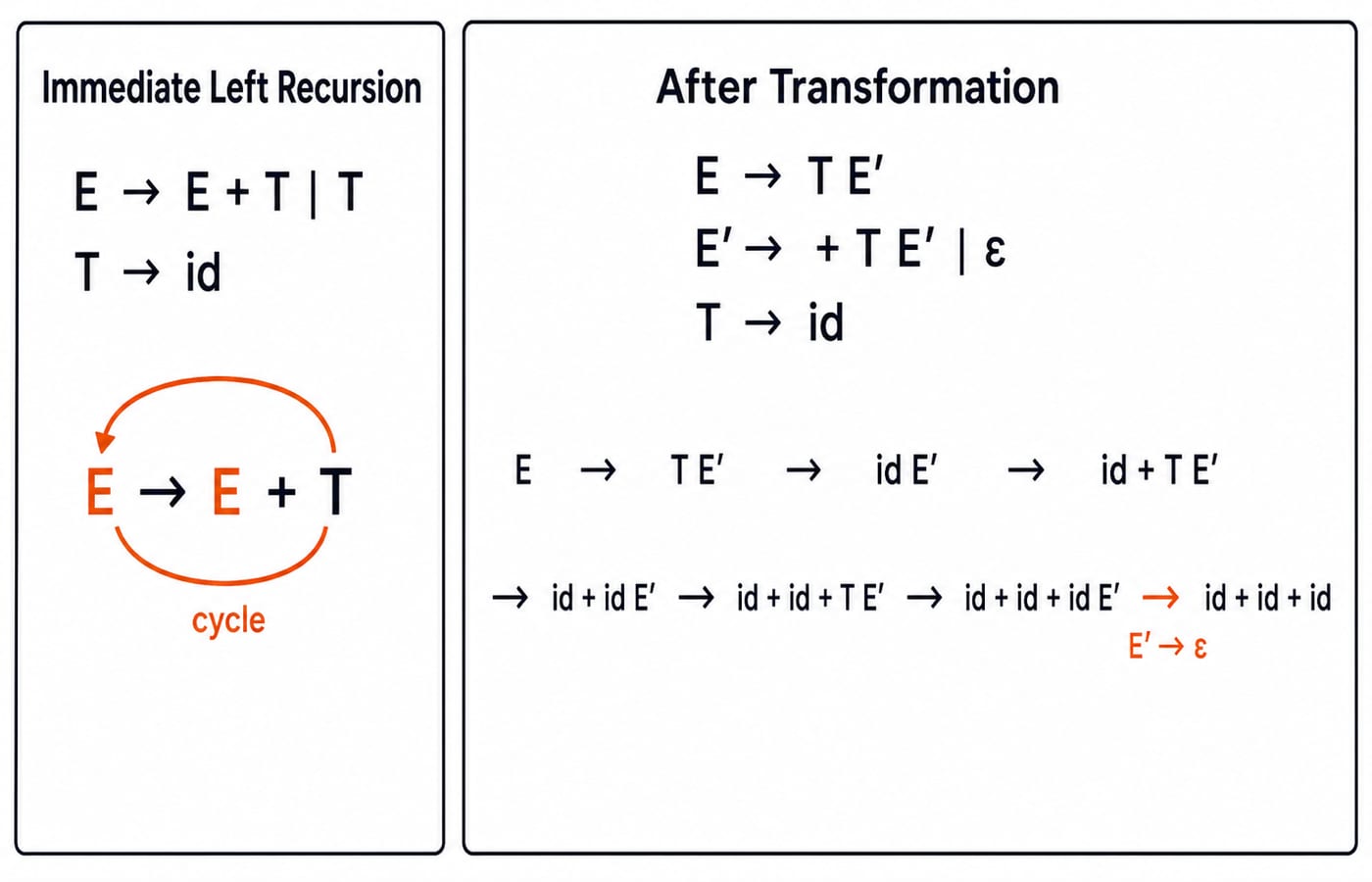
Start with E -> E + T | T and T -> id. Removing immediate left recursion gives:
E -> T E'E' -> + T E' | εT -> id
Both grammars generate one or more id tokens separated by +, although their parse-tree shapes differ. Under the transformed grammar:
E => T E'(E -> T E')T E' => id E'(T -> id)id E' => id + T E'(E' -> + T E')id + T E' => id + id E'(T -> id)id + id E' => id + id + T E'(E' -> + T E')id + id + T E' => id + id + id E'(T -> id)id + id + id E' => id + id + id(E' -> ε)
The terminal string takes seven applications, including the final epsilon production. The transformation supports top-down parsing; Parsing in Compiler Design: Top-Down and Bottom-Up Explained continues from that purpose.
Derivation and recursion traps that lose marks
Trap | What goes wrong | Correction |
|---|---|---|
Rewriting a non-leftmost symbol in a claimed leftmost derivation | The string may be reachable, but the named order is violated | At each arrow, mark the leftmost nonterminal before choosing a rule |
Calling a sentential form a sentence | A nonterminal remains, so generation is unfinished | Stop only when every symbol is terminal |
Calling every recursive grammar ambiguous | Recursion alone says nothing about the number of parse trees | Check whether one string has two distinct parse trees |
Removing | The new helper nonterminal can never disappear | Add |
Two boundary cases clarify termination. X -> xX generates no finite terminal sentence because every step leaves X. In contrast, X -> xX | ε generates {x^n | n >= 0}, including the empty string when epsilon is chosen immediately.
Left-recursion removal preserves the generated language, not the original parse-tree shape. If semantic actions or associativity depend on that old tree, they must be adjusted deliberately during the transformation.
Derivation and recursion exam patterns: what to practise
Common checks ask you to identify derivation order, fill a missing sentential form, count applications, test membership, distinguish direct from indirect recursion, or remove immediate left recursion.
Try two rapid checks with the first grammar:
aaabis generated. AfterS -> AB, useA -> aAtwice,A -> aonce andB -> bonce. Including the start production, that is five applications.bais impossible. Every generated sentence places allasymbols before allbsymbols.
KnowledgeGate has about 10 live practice questions on Derivation & Recursion. Once you can reproduce both six-step derivations without notes, use the GATE Test Series for mixed practice.
Derivation and recursion: the short version and next step
Begin at
S.Rewrite exactly one nonterminal per arrow.
Obey the named leftmost or rightmost order.
Stop only when terminals remain.
For a finite sentence, confirm that every recursive path has a terminating alternative.
Keep two anchors in memory: aabbb takes six applications in either derivation order, while transformed id+id+id takes seven, including E' -> ε. For a structured route through the wider Compiler Design sequence, continue with GATE Guidance by Sanchit Sir. If you need practice rather than teaching, the test series is the focused alternative.
Keep learning

Code Optimization Mistakes in Compiler Design: How to Avoid Losing GATE Marks
A rewrite that looks familiar is not necessarily safe. Trace six common optimization errors, learn why each one changes program meaning, and use a five-step check before accepting an answer.
Updated 22 Oct 20265 min readCompiler Design
Compiler Design Semester Guide: Trace One Program from Tokens to Target Code
Follow one assignment through lexical analysis, parsing, semantic checks, TAC, optimization and abstract target instructions, with every hand-off made visible.
Updated 18 Oct 20267 min readCompiler Design
Bottom-Up Parsing in Compiler Design: Shift-Reduce Trace, LR Items and Conflicts
Follow a nested-parentheses LR(0) parse from input to acceptance, derive every item set, and see why lookahead changes parser-family conflicts.
Updated 14 Oct 20265 min readCompiler Design
Intermediate Code Generation in Compiler Design: One Cross-Concept Worked Example
Carry one C-like fragment from its source facts to typed temporaries, three-address code, quadruples and a control-flow graph, with every value traced.
Updated 10 Oct 20266 min readCompiler Design