DSSSB Computer Science PYQs: Find and Fix Three Practice Gaps
Stop treating a PYQ score as the end of practice. Use an attempt sheet, three clear gap labels and unseen retests to turn every error or slow answer into a small repair task.
KnowledgeGate Team
Exam prep & CS education
Updated 21 Jul 20265 min read357 views
You solve DSSSB Computer Science PYQs, check the score and move on without knowing why marks were lost. Use a repeatable three-pass loop instead: attempt, diagnose and repair. By the third pass you are holding a written list of small repairs with a retest date against each one, instead of a vague sense of which topics feel weak.
Turn a PYQ set into evidence, not just a score
Make a six-column attempt sheet: question number, chosen answer, confidence (H/M/L), elapsed seconds, result against a trusted key and primary gap label. Give each flagged row one label so the ledger counts cleanly.
Set your own block size and clock. The worked example runs a 25-question Computer Science block in a 35-minute window with a 90-second move-on checkpoint, which keeps one diagnosis sitting to about an hour; the official paper pattern is in the DSSSB notification at dsssb.delhi.gov.in. Keep the Computer Science ledger separate from the general paper because Section A subjects need their own plan, and slot both into the wider path the DSSSB preparation courses lay out.
Pass 1: attempt under a clock without interrupting the evidence
Start one 35-minute timer. Record time in 10-second bands and mark confidence before checking. Near 90 seconds, move on. Use no notes, solution videos, answer keys or topic revision.
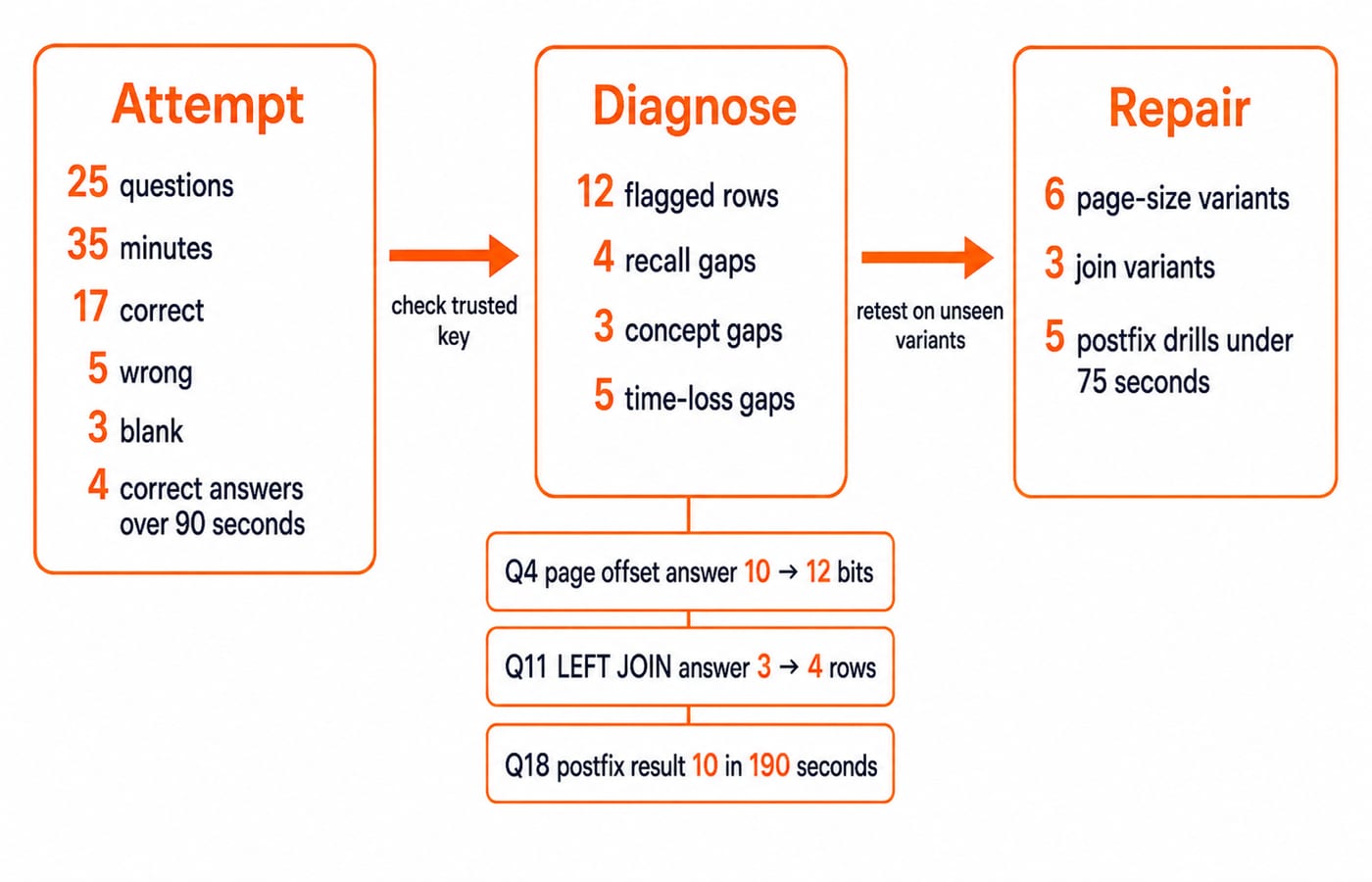
The 25 items produce 17 correct, 5 wrong and 3 blank, with 17 + 5 + 3 = 25. Four correct answers took longer than 90 seconds. That makes 12 flagged rows: 8 wrong or blank, plus 4 correct-but-slow. This is why PYQs should come before another generic question bank: they expose what a score hides.
Pass 2: separate recall, concept and time-loss gaps
Use one decision rule:
Recall gap: you cannot retrieve a fact, formula or conversion.
Concept gap: you misunderstand the rule, especially with a high-confidence wrong answer.
Time-loss gap: you know the method but cross your practice checkpoint.
Apply the rule to one flagged row at a time. The three worked rows are built examples rather than quoted DSSSB questions, so what transfers is the reasoning, not the answer.
Recall row, Q4
Question: “A system uses 4 KiB pages. How many offset bits are required?” The learner answers 10 in 35 seconds with medium confidence. But 4 KiB = 4 × 1024 bytes = 4096 bytes = 2^12 bytes, so the offset needs 12 bits. This is a recall gap.
Concept row, Q11
Let R(A,B) = {(1,x), (2,y), (3,z)} and S(A,C) = {(1,p), (1,q), (3,r)}. The learner predicts 3 rows for R LEFT JOIN S ON R.A = S.A in 75 seconds with high confidence.
The four rows are (1,x,p), (1,x,q), (2,y,NULL) and (3,z,r). A=1 has two matches; unmatched A=2 remains with NULL. Missing one-to-many duplication and unmatched-row preservation makes this a concept gap.
Time-loss row, Q18
Evaluate postfix 8 2 3 * + 4 -: 2 × 3 = 6, 8 + 6 = 14, and 14 - 4 = 10. The learner gets 10 in 190 seconds against a personal 90-second checkpoint. This is execution loss, not concept failure.
Pass 3: convert every label into a small revision task
For Q4, make a recall card: 1 KiB = 2^10, 2 KiB = 2^11, 4 KiB = 2^12, 8 KiB = 2^13, 16 KiB = 2^14 and 32 KiB = 2^15. Solve six fresh variants, then retest closed-book after 48 hours.
For Q11, redraw the four-row LEFT JOIN, explain why A=1 expands and A=2 produces NULL, then solve three new join tables the next day. For Q18, trace five postfix expressions in token and stack columns, aiming for each to finish within a learner-set 75 seconds. Retest after 72 hours.
A gap closes only after two unseen variants are correct in separate sessions. For a time-loss gap, both must meet the learner's threshold. When a concept gap keeps reopening across retests, rebuild the topic from the ground up with structured Section B revision instead of attacking the same question again.
Use a 6.5-hour weekly loop in three phases
Follow this flexible practice week:
Day | Practice task | Minutes |
|---|---|---|
Monday | Concept repair | 60 |
Tuesday | Recall drills | 45 |
Wednesday | 35-minute PYQ block, then first check | 60 |
Thursday | Timed execution drills | 45 |
Friday | Second PYQ block and initial check | 60 |
Saturday | Full diagnosis and task creation | 90 |
Sunday | Closed-book retest and ledger update | 30 |
The total is 60 + 45 + 60 + 45 + 60 + 90 + 30 = 390 minutes, or 6.5 hours.
Weeks 1 and 2 use two 25-question blocks per week, so four blocks give 4 × 25 = 100 attempts. In Weeks 3 and 4, keep one unseen block each week and repair the two most frequent labels. In Weeks 5 and 6, restore two unseen blocks per week and compare gap counts, not only scores.
Recover from missed days without creating a catch-up pile
If you miss one 45- or 60-minute session, carry at most 30 minutes into Sunday and drop the rest. Do not double the next day, because fatigue can distort time-loss data.
If you miss two or more days, protect Wednesday's 60-minute PYQ block and Saturday's 90-minute diagnosis. Add a 15-minute recall drill before each: 60 + 90 + 15 + 15 = 180 minutes. Restart the normal 390-minute cycle on Monday. When time is scarce, retain one timed attempt, its diagnosis and one retest. Remove extra drills first.
Read the ledger without fooling yourself
One learner's ledger reads like this. Week 1 has 12 primary gaps: 4 recall + 3 concept + 5 time-loss = 12. On an unseen 25-question block in Week 4, the learner has 6 gaps: 2 recall + 2 concept + 2 time-loss = 6. Accuracy moves from 17/25 to 21/25, while median time on answered items moves from 82 to 68 seconds.
Do not let one better score hide a persistent weakness. If accuracy rises but high-confidence concept errors remain at 3, the concept is not repaired. If memorised questions improve but unseen variants do not, the ledger shows familiarity, not mastery.
Sort the flagged rows by Section B subject as well: operating systems, DBMS, networks, data structures and programming. When four of six Week 4 gaps sit in DBMS, the next repair week belongs to DBMS whatever the overall accuracy says. Move from diagnostic blocks to broader mocks only after the gap ledger is shrinking, and never use mocks as a substitute for diagnosis.
Short version: attempt, label, repair, retest
Attempt one bounded PYQ block.
Label each flagged row once.
Assign a recall, concept or speed task.
Retest on unseen variants after 48 to 72 hours.
Prepare the six-column sheet and run one 25-question, 35-minute diagnostic block today. Build the concept repairs against the Section B subject blocks, and run the general paper separately through the DSSSB Section A course.
Keep learning
DSSSB TGT Computer Science Exam Pattern and Marking Scheme: Sections, Scores and Timing
Understand how Section A and Section B contribute to the historical 39/22 scheme. Work through the negative-marking calculation, distinguish qualification from merit, and plan a timed mock.
30 Sep 20264 min read455 viewsDSSSB Computer Science
DSSSB Computer Science 16-Week Preparation Plan: 12 Hours a Week
Follow a practical 16-week timetable that balances Computer Science, Section A, questions, error repair and mock analysis, with a clear route back after missed sessions.
Updated 6 Aug 20265 min read345 viewsDSSSB Computer Science
DSSSB vs State PSC Teaching: A Route Guide for CS Graduates
Choose a primary government teaching route by checking your documents, transferable CS preparation, posting preference, and notification readiness.
Updated 3 Aug 20266 min readDSSSB Computer Science

DSSSB Computer Science DBMS, OS and Networks Question Playbook
Learn a repeatable way to solve DBMS dependencies, OS scheduling timelines and network address ranges, with three worked examples and an error-led practice routine.
Updated 31 Jul 20266 min read816 viewsDSSSB Computer Science