Foundations and Evolution of AI: Approaches, Timeline and a Worked Rational-Agent Example
Build a connected map of AI foundations, historical shifts and major paradigms, then calculate how a rational agent chooses under uncertainty.
KnowledgeGate Team
Exam prep & CS education
Updated 19 Oct 20266 min read
AI is often reduced to machine learning or chatbots, while short notes turn its history into disconnected names and years. Four approaches define what counts as intelligence, eight contributing disciplines supply its tools, and the historical timeline explains why symbolic, statistical and generative methods coexist. A rational-agent calculation then shows how probabilities and utilities determine an action.
What artificial intelligence means: systems, agents and four approaches
Artificial intelligence studies and builds systems that perceive information, represent relevant knowledge, reason or learn, and choose actions towards a goal. An agent receives percepts through sensors, acts through actuators, and is judged against a performance measure in an environment.
For a campus delivery robot, a camera and distance sensors supply percepts, wheels are actuators, and safe, on-time delivery is the performance measure. Intelligence can be defined in four ways:
Approach | Central test | Concrete example |
|---|---|---|
Thinking humanly | Does it model human thought? | A cognitive model predicts human reasoning errors. |
Acting humanly | Does it resemble human behaviour? | A conversational system is judged by human-like responses. |
Thinking rationally | Does it apply valid rules? | A theorem prover derives a conclusion from premises. |
Acting rationally | Does it choose the best expected outcome? | A route agent compares probabilities and utilities. |
Acting humanly differs from acting rationally. Rational means choosing well from available evidence, not knowing the future. Machine learning is one AI method family, not the field, and the Coding & Skills category covers broader AI and programming learning. Approaches to AI: The Four Approaches, a Worked Rational-Agent Example, and How Exams Test Them owns the two-axis comparison and Turing-test detail; this post uses the four labels to connect AI's disciplines, historical shifts and utility-based decisions.
AI foundations: the disciplines and their contributions
AI draws on several disciplines, each answering a different part of the intelligence problem.
Discipline | Contribution to AI | Recognisable mechanism |
|---|---|---|
Philosophy | Logic, knowledge and mind | Asking what can be known and how conclusions follow |
Mathematics | Logic, probability, statistics, optimisation and computability | Representing uncertainty and selecting actions |
Economics | Utility and decision theory | Comparing choices by expected consequences |
Neuroscience | Biological inspiration for learning | Inspiring adaptable networks, not literal brain copies |
Psychology and cognitive science | Perception, memory and problem solving | Modelling how information is retained and used |
Computer engineering | Computational hardware and systems | Running calculations and controlling devices |
Control theory | Feedback and goal-directed behaviour | Correcting a robot's path after deviation |
Linguistics | Syntax, meaning and language understanding | Interpreting sentence structure and meaning |
Logic supports explicit representation and inference, probability handles uncertain observations, and learning helps when complete rules cannot be written. The formal branch becomes clearer once truth tables, predicates and quantifiers are secure.
How AI evolved: a timeline of changing methods
AI history records changes in methods and capabilities, not merely names and years.
Period | Milestone | Why it mattered |
|---|---|---|
1943 | McCulloch-Pitts mathematical neuron | Simplified neuron-like units expressed logical computation. |
1950 | Turing's machine-intelligence question and imitation game | An abstract question became an observable behavioural test. |
1956 | Dartmouth workshop | Artificial intelligence became a named research field. |
1950s to 1970s | Symbolic search and reasoning | Programs explored states and manipulated rules. |
1970s and 1980s | Expert systems | Rule bases encoded specialist knowledge. |
1990s and 2000s | Statistical machine learning | Systems learned patterns and represented uncertainty. |
2010s | Deep-learning surge | Multi-layer neural models learned from large datasets. |
Late 2010s onward | Transformer-based and generative systems | Models created flexible outputs from learned distributions. |
This path was uneven. Controlled-domain successes could not overcome brittle rules, limited data and scarce compute in the real world. AI winters were periods of reduced confidence and funding after expectations outran results.
More digital data, stronger hardware and improved algorithms later drove progress. Statistical and generative methods did not erase symbolic reasoning, search or planning. Systems can combine them.
Symbolic, statistical and generative AI on one task
For a campus help desk, a symbolic system applies if request = password_reset, show reset procedure. A statistical classifier learns from labelled requests and returns a class probability. A generative model uses its learned representation and prompt to produce a response token by token.
Paradigm | Knowledge representation | Main strength | Typical failure |
|---|---|---|---|
Symbolic AI | Rules and symbols | Inspectable reasoning | Brittle behaviour outside encoded cases |
Statistical learning | Fitted parameters | Pattern recognition under uncertainty | Dependence on representative data |
Generative AI | Distributions over sequences or other data | Flexible new outputs | Plausible but unsupported content |
A natural-sounding answer is not automatically verified. Search bridges eras: symbolic planners search explicit states, while modern systems can search during planning or decoding. Graph Algorithms: BFS, DFS, and Shortest Paths Worked Out explains state and path exploration, though BFS or DFS alone is not intelligence.
Worked rational-agent example: choose by expected utility
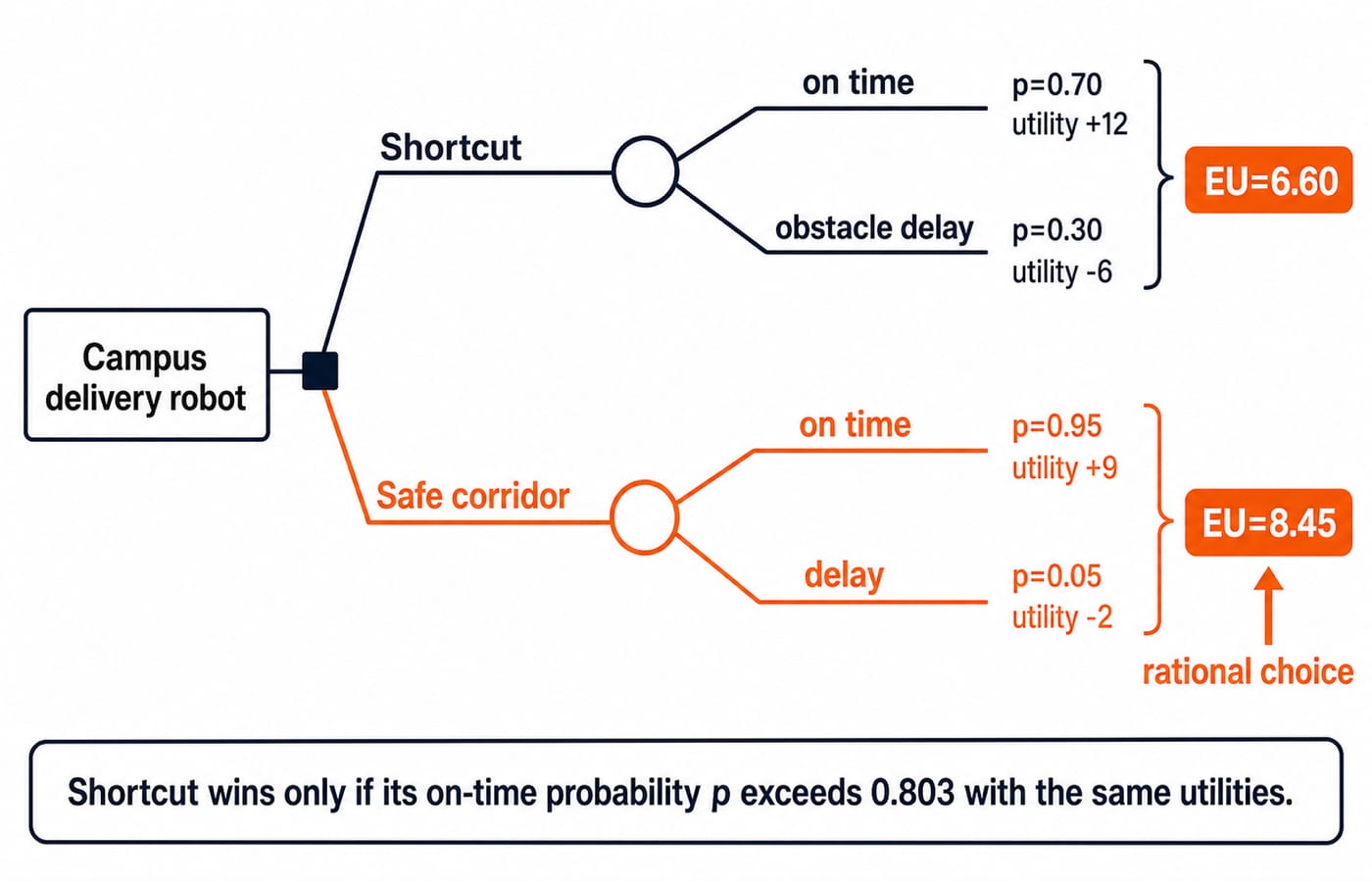
The campus delivery robot reaches a junction and must choose Shortcut or Safe corridor. Its utility scale already combines delivery speed and safety.
Action | Outcome | Probability | Utility |
|---|---|---|---|
Shortcut | On-time arrival | 0.70 | +12 |
Shortcut | Obstacle delay | 0.30 | -6 |
Safe corridor | On-time arrival | 0.95 | +9 |
Safe corridor | Delay | 0.05 | -2 |
First verify the probability totals:
Shortcut: 0.70 + 0.30 = 1.00
Safe corridor: 0.95 + 0.05 = 1.00
Now calculate each expected utility, retaining the negative signs:
EU(Shortcut) = 0.70(12) + 0.30(-6) = 8.40 - 1.80 = 6.60
EU(Safe corridor) = 0.95(9) + 0.05(-2) = 8.55 - 0.10 = 8.45
Because 8.45 > 6.60, the rational choice is Safe corridor. The shortcut's best outcome has the largest single payoff, +12, but rational action compares full probability-weighted outcomes.
For a sensitivity threshold, let p be the shortcut's on-time probability while its utilities stay unchanged:
EU(Shortcut) = p(12) + (1 - p)(-6) = 12p - 6 + 6p = 18p - 6
Set it equal to the safe corridor's expected utility:
18p - 6 = 8.45
18p = 14.45
p = 14.45 / 18 = 0.8028, approximately 0.803
The shortcut becomes preferable only above about 80.3%. The agent is not predicting with certainty or copying a human. It selects the action with the highest expected utility from its model, evidence and performance measure. For deeper agent design, Intelligent and Rational Agents in AI: PEAS, Worked Decisions and Exam Traps owns PEAS, Bayesian belief updates, task-environment classification and multi-agent coordination; this example isolates expected utility and its sensitivity threshold.
AI-foundation traps that look plausible but are wrong
These shortcuts produce convincing but incorrect answers:
AI equals machine learning. Too narrow, because AI also includes representation, reasoning, search and planning.
Human-like equals rational. These are separate evaluation standards.
Rational means always correct. Uncertain outcomes can defeat a well-chosen action.
Neural means identical to the brain. Inspiration is not literal reproduction.
Generative means factually reliable. Fluency is not proof of accuracy.
Two numerical traps are choosing Shortcut because +12 is largest, which ignores probability, and writing 0.70(12) + 0.30(6) = 10.20, which drops the negative sign. The correct shortcut value is 6.60.
AI history is not a replacement chain. Dates without changes in representation, learning, search, compute or data also miss the point. Hybrid systems correct both mistakes.
How questions test foundations and evolution of AI
Questions can match definitions to approaches, connect disciplines to contributions, order milestones, distinguish paradigms, identify a PEAS component, or compare expected utilities. PEAS means performance measure, environment, actuators and sensors.
Use this 60-second routine:
Classify the stem as definition, foundation, history, paradigm, agent or numerical decision.
For an approach question, underline thinking or acting, then humanly or rationally.
For a numerical question, verify probability totals and preserve every utility sign.
Calculate every action's expected utility, then compare only at the end.
Practise all six question shapes on the same campus-robot setup, because one scenario can be re-asked as a definition, a PEAS component or a numerical comparison.
Foundations and evolution of AI: the short version and next step
Remember the chain. Four approaches define intelligence; disciplines supply logic, uncertainty, learning, language and control; AI moved through symbolic, expert-system, statistical, deep-learning and generative phases without discarding older methods. Rational agents choose under uncertainty.
For the robot, EU(Shortcut) = 6.60 and EU(Safe corridor) = 8.45, so Safe corridor wins under the stated model. Redraw the four-approach grid from memory, then change only the shortcut success probability to 0.85:
EU(Shortcut) = 0.85(12) + 0.15(-6) = 10.20 - 0.90 = 9.30
The choice flips to Shortcut because 9.30 > 8.45. For a structured next step through broader AI and machine-learning concepts, continue with the Artificial Intelligence (AI) course.
Keep learning
Natural Language Processing Explained: Pipeline, TF-IDF Worked Example and Exam Patterns
Start from raw text, build BoW and TF-IDF vectors, compute cosine similarity, examine ambiguity, and finish with evaluation and exam-style checks.
Updated 15 Oct 20266 min readML & Data Science
Fundamentals of Planning in AI: STRIPS, State-Space Search and a Worked Blocks World Plan
Build a planning problem from facts, actions and goals, then follow every add and delete effect through a complete six-step Blocks World solution.
Updated 11 Oct 20266 min readML & Data Science
Intelligent and Rational Agents in AI: PEAS, Worked Decisions and Exam Traps
Learn what makes an AI agent rational, specify its task with PEAS, update a belief using Bayes' rule, and see why coordination matters in multi-agent systems.
Updated 7 Oct 20266 min readML & Data Science
A* Search Algorithm: Step-by-Step Worked Example, Heuristics and Exam Traps
Learn A* from first principles, follow every relaxation on a weighted graph, and test optimality, tie-breaking, parent updates and heuristic quality.
Updated 2 Oct 20266 min readML & Data Science