IBPS SO IT Officer Networking: professional knowledge topics to master
IBPS SO IT Officer Networking: master the OSI and TCP/IP models, IP addressing, key protocols and network security for the Professional Knowledge paper.
KnowledgeGate Team
Exam prep & CS education
Updated 25 Jul 20265 min read874 views
The IBPS SO IT Officer Mains paper rewards depth in Computer Networks more than almost any other subject, because networking questions are concept-heavy and hard to bluff. If you can reason about the layered models, IP addressing, and the common protocols, this section turns into reliable marks. The ground to hold is narrow: those models, the addressing arithmetic, the transport and application protocols, and the security vocabulary a banking IT role expects.
Computer Networks for IBPS SO IT: start with the layered model
A network is easier to reason about when you split its job into layers, where each layer does one thing and hands its result to the layer below. Data from an application is wrapped, or encapsulated, with a header at each layer on the way down, and unwrapped on the way up at the receiver. Hold that idea firmly and most protocol questions stop being memory tests.
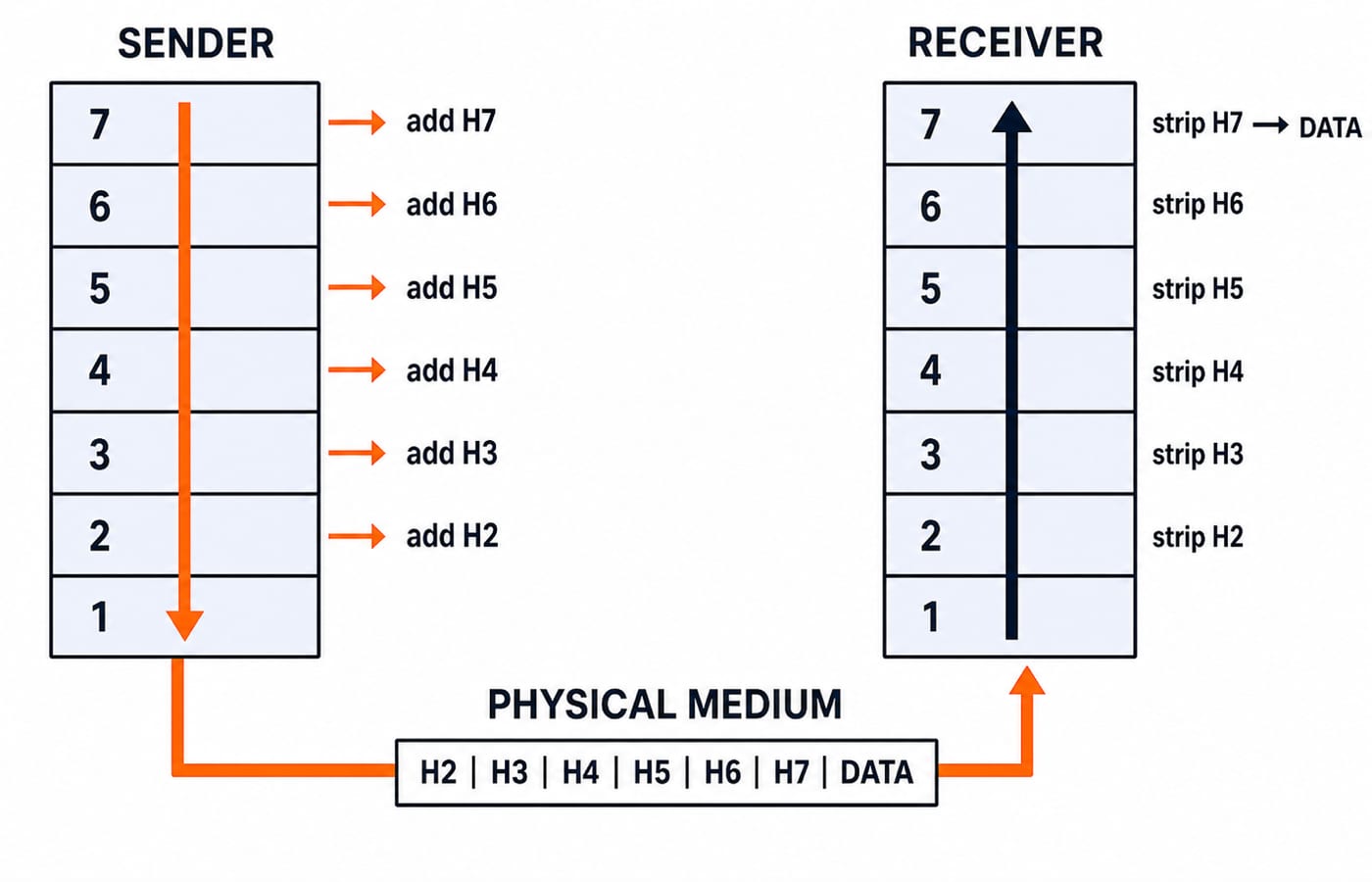
The two models you must know are the seven-layer OSI reference model and the practical TCP/IP model. OSI is the teaching standard; TCP/IP is what the internet actually runs on.
The OSI and TCP/IP models: seven layers you must know cold
Learn the OSI layers top to bottom with one function each:
Application: user-facing services (HTTP, SMTP, DNS, FTP).
Presentation: translation, encryption, and compression of data.
Session: establishing, managing, and terminating sessions.
Transport: end-to-end delivery, segmentation, TCP and UDP.
Network: logical addressing and routing, IP lives here.
Data link: framing, MAC addressing, error detection on a link.
Physical: bits on the wire, voltages, connectors, and timing.
The TCP/IP model collapses these into four working layers: Application, Transport, Internet, and Network Access. A common exam trap is asking which OSI layer a device or protocol belongs to. A router works at the network layer, a switch and bridge at the data link layer, and a hub or repeater at the physical layer. Keep that mapping ready.
IP addressing: the arithmetic that carries marks
An IPv4 address is 32 bits, written as four dotted-decimal octets like 192.168.1.10. The address splits into a network part and a host part, and the split is defined by the subnet mask. Classful addressing (A, B, C) is the old fixed split; classless addressing with CIDR notation like /26 is how it is done now.
Work one host-based subnetting problem by hand and the pattern sticks. Suppose you are given the block 10.15.6.0/24, and each department subnet must support at least 25 usable hosts.
Solve for the host bits: 2 to the power h minus 2 must be at least 25, and h equals 5 gives 30 usable hosts, so the prefix is 32 minus 5, which is /27.
The /27 mask is 255.255.255.224, and the block size is 256 minus 224, which equals 32.
The eight subnet addresses are 10.15.6.0, 10.15.6.32, 10.15.6.64, 10.15.6.96, 10.15.6.128, 10.15.6.160, 10.15.6.192 and 10.15.6.224.
Each subnet holds 32 addresses of which 30 are usable hosts, because the first is the network address and the last is the broadcast address.
Find the host bits, fix the prefix and mask, take the block size, list the subnets, and drop the network and broadcast addresses: that one procedure answers most addressing questions you will see. If the binary behind it is still shaky, work through IP addressing and subnetting: a worked guide with the exam angle, which builds the same arithmetic from the bits up.
Core protocols: transport and application layer
At the transport layer, TCP is connection-oriented and reliable: it sets up a connection with a three-way handshake (SYN, SYN-ACK, ACK), numbers bytes, acknowledges them, and retransmits losses. UDP is connectionless and lightweight, with no handshake and no delivery guarantee, which is why it suits DNS lookups, streaming, and voice. Knowing which application uses which, and why, is a frequent question.
At the application layer, keep a short table in your head: HTTP and HTTPS for the web, DNS to resolve names to addresses, SMTP, POP3 and IMAP for email, FTP for file transfer, and DHCP to hand out addresses automatically. ARP maps an IP address to a MAC address on the local link, and it sits right at the boundary of the network and data link layers.
Three more ideas come up constantly. IPv6 uses 128-bit addresses written in hexadecimal, introduced because the 32-bit IPv4 space is exhausted. NAT (Network Address Translation) lets many private hosts share one public address, and a port number identifies the specific application a segment is meant for, which is how one machine runs many network services at once.
Network security basics for the IT Officer role
Because this is a banking IT role, security shows up in the Professional Knowledge paper. Four blocks cover most of what gets asked:
Symmetric encryption uses one shared key (AES, DES); asymmetric encryption uses a public and private key pair (RSA).
Hashing (SHA family) gives a fixed-length fingerprint used for integrity, not for reversible secrecy.
A firewall filters traffic by rules; TLS secures HTTP into HTTPS using a mix of asymmetric key exchange and symmetric bulk encryption.
Recognise the common attack names: denial of service, man-in-the-middle, phishing, and spoofing.
How Computer Networks is tested in the IBPS SO IT Mains
Professional Knowledge in the Mains draws on the whole computer science syllabus, and networking is one of its densest subjects. Our Computer Networks question bank carries over 2,100 questions, so there is no shortage of practice on layered models, subnetting, and protocol identification.
The exam favours precise conceptual questions: which layer does a protocol belong to, what does a given TCP flag do, how many usable hosts in a /27, which protocol is connectionless. The question count, sectional timing, marks and any negative marking are set by the current notification at ibps.in, and they can shift between cycles. The concepts do not shift, and that is what you should bank on.
Your next step
Computer Networks is learned by working problems, not by reading summaries. Build the subject properly and then drill it.
The core paper for this stage is prepared in the IBPS SO IT Officer Mains course, which frames networking for the banking IT role.
If you want all three stages sequenced together, the IBPS SO IT Officer Scale-1 bundle covers Prelims, Mains, and Interview in one place.
For layer-by-layer depth, work the OSI model learn module.
More banking-IT preparation sits under the Banking and Insurance category.
Learn the seven layers cold, hand-solve two subnetting problems, and keep TCP and UDP cleanly apart. Do that and Computer Networks becomes a section you count on rather than fear.
Keep learning
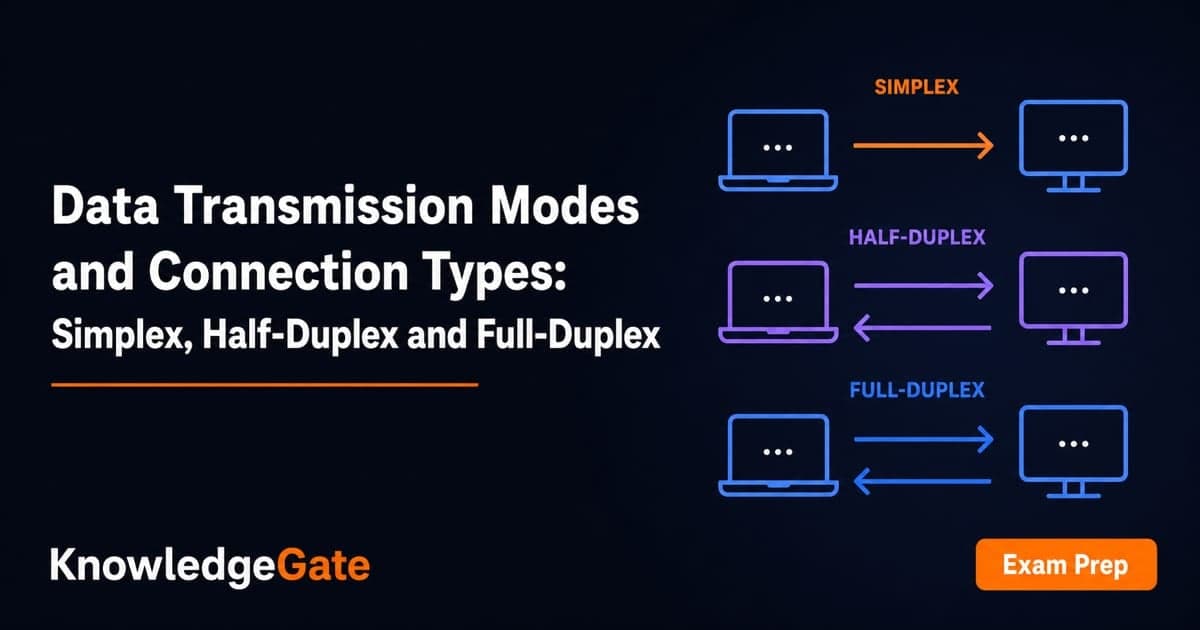
Data Transmission Modes and Connection Types: Simplex, Half-Duplex and Full-Duplex
Learn to classify simplex, half-duplex, full-duplex, point-to-point and multipoint links, then calculate completion time without relying on memorised examples.
Updated 22 Oct 20265 min readComputer Networks
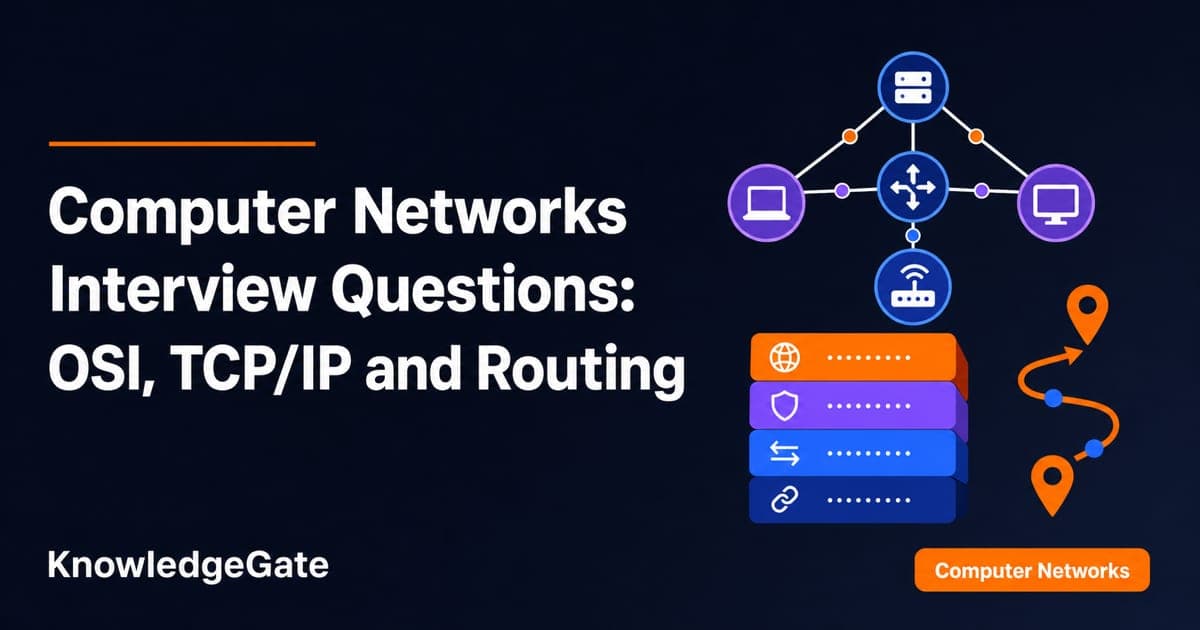
Computer Networks Interview Questions: Trace OSI, TCP/IP and Routing Step by Step
Follow one synthetic web request across DNS, ARP, TCP, NAT and longest-prefix routing, then turn each step into a strong interview answer.
Updated 18 Oct 20266 min readComputer Networks
Basics of Cyber Security: CIA Triad, Risks and a Worked Defence
Learn a consistent security vocabulary, connect common attack paths to suitable controls, and calculate how two defensive layers reduce account takeovers.
Updated 14 Oct 20266 min readComputer Networks
Cyber Threats and Attacks Explained: Types, Worked DDoS Example and Exam Traps
Learn to separate threats, vulnerabilities, vectors and attacks, then apply the distinctions to a calculated DDoS scenario and exam-style questions.
Updated 10 Oct 20266 min readComputer Networks