LR(0) Parser Explained: Bottom-Up Parsing, Item Sets and a Worked Example
Build an LR(0) parser from one augmented grammar, then follow every state, table entry and stack operation until cdd$ is accepted.
KnowledgeGate Team
Exam prep & CS education
Updated 15 Sep 20266 min read58 views
Bottom-up parsing sounds intuitive until dots, item sets, ACTION/GOTO entries and stack reductions appear together. Then one changed state number can invalidate the entire solution. The construction runs from the augmented grammar through closure, GOTO, a seven-state LR(0) automaton, the complete parsing table and acceptance of cdd$. Each shift, reduction and GOTO in that trace follows from one table cell, and each table cell follows from one item set, so a wrong state number is always traceable to the exact item set that produced it.
Related reading: top-down and bottom-up parsing and parsing MCQs.
Bottom-up parsing means finding handles in reverse
Bottom-up parsing starts with the input and reduces handles until only the start symbol remains. A handle matches the production used in one step of a rightmost derivation. It is not an arbitrary match: the viable prefix and parser state decide whether it is legal.
The parsing table can prescribe four outcomes:
shift j: consume the next terminal and push it with statej.reduce A -> beta: pop2 x |beta|interleaved entries, then pushAandGOTO[top,A].accept: succeed only for the completed augmented item with$.error: no legal action exists.
For our input, the rightmost derivation is S => C C => C d => c C d => c d d. The parser reverses it using d -> C, cC -> C, d -> C, then CC -> S.
LR(0) items, closure and GOTO without lookahead
An LR(0) item is a production with a dot showing progress. C -> c C gives C -> . c C, C -> c . C and C -> c C .. The dot is parser position, not input; at the far right, the item is complete.
For closure(I), if an item has A -> alpha . B beta, add B -> . gamma for every production of B; repeat to a fixed point. GOTO(I,X) moves every eligible dot across X, then takes closure. Terminals lead to shifts; non-terminals fill GOTO.
The zero means no lookahead. Thus A -> beta . reduces in every terminal column, including $; S' -> S . instead puts accept only under $. SLR restricts reductions using FOLLOW sets, which this LR(0) construction does not use.
Build the seven LR(0) item sets for one grammar
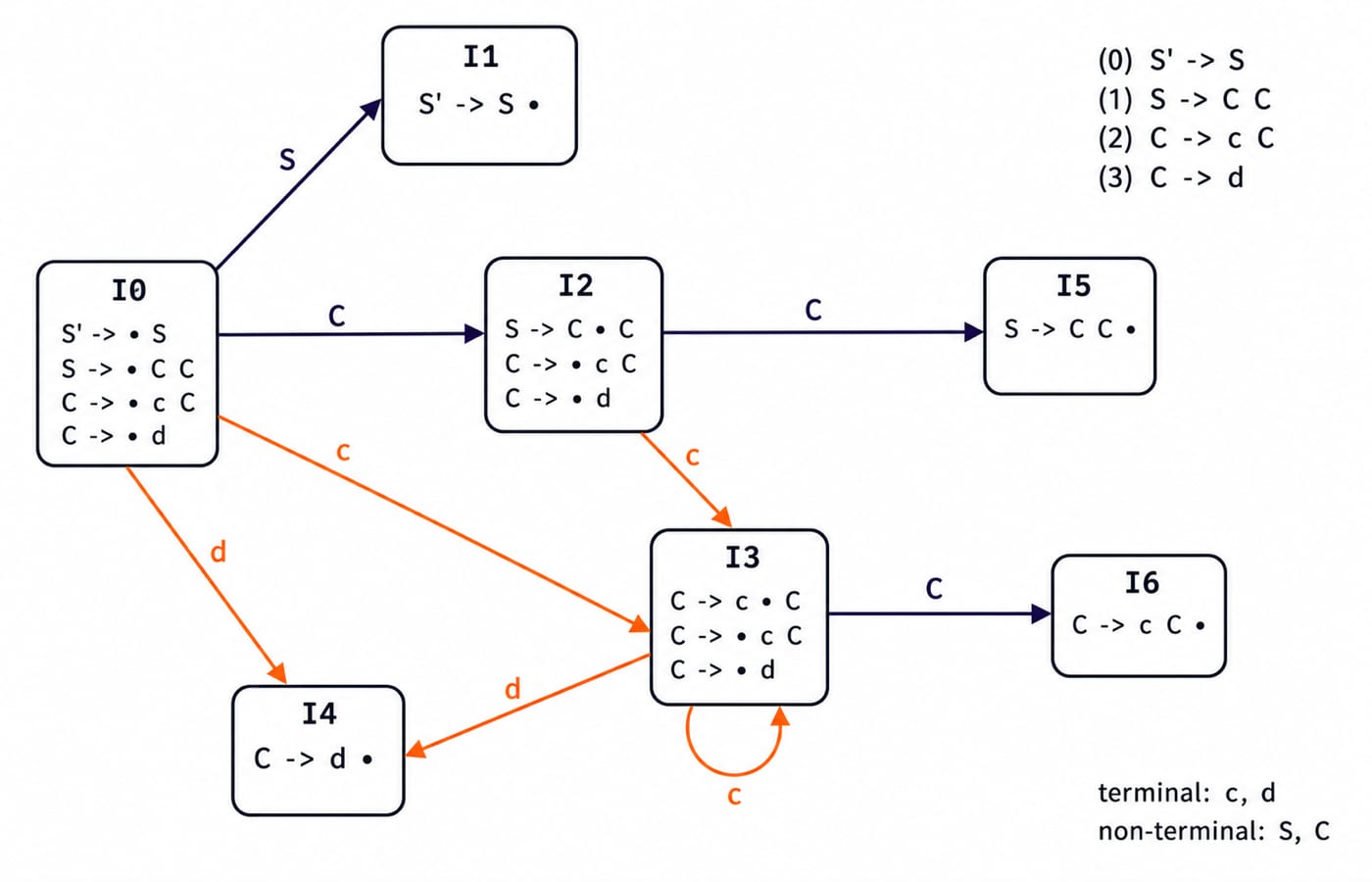
Use (0) S' -> S, (1) S -> C C, (2) C -> c C, (3) C -> d. The terminals are {c,d,$} and the non-terminals are {S,C}. Starting with closure({S' -> . S}), not a memorised state, gives:
I0: S' -> . S
    S  -> . C C
    C  -> . c C
    C  -> . d

I1: S' -> S .

I2: S  -> C . C
    C  -> . c C
    C  -> . d

I3: C  -> c . C
    C  -> . c C
    C  -> . d

I4: C  -> d .

I5: S  -> C C .

I6: C  -> c C .
Every non-empty transition is:
I0 --S--> I1    I0 --C--> I2    I0 --c--> I3    I0 --d--> I4
I2 --C--> I5    I2 --c--> I3    I2 --d--> I4
I3 --C--> I6    I3 --c--> I3    I3 --d--> I4
GOTO(I3,c)=I3 because moving across c produces C -> c . C; closure then restores C -> . c C and C -> . d.
Convert the item sets into the LR(0) ACTION/GOTO table
Let r1 mean S -> C C, r2 mean C -> c C, and r3 mean C -> d. A terminal edge creates a shift, a non-terminal edge fills GOTO, and a completed ordinary item fills its reduction across c, d and $. Only S' -> S . creates accept, under $.
State | ACTION | ACTION | ACTION | GOTO | GOTO |
|---|---|---|---|---|---|
0 | s3 | s4 | error | 1 | 2 |
1 | error | error | accept | error | error |
2 | s3 | s4 | error | error | 5 |
3 | s3 | s4 | error | error | 6 |
4 | r3 | r3 | r3 | error | error |
5 | r1 | r1 | r1 | error | error |
6 | r2 | r2 | r2 | error | error |
No ACTION cell contains a shift-reduce or reduce-reduce pair. This absence of conflicts, not merely having a table, makes the grammar LR(0).
Parse cdd$ from the first shift to accept
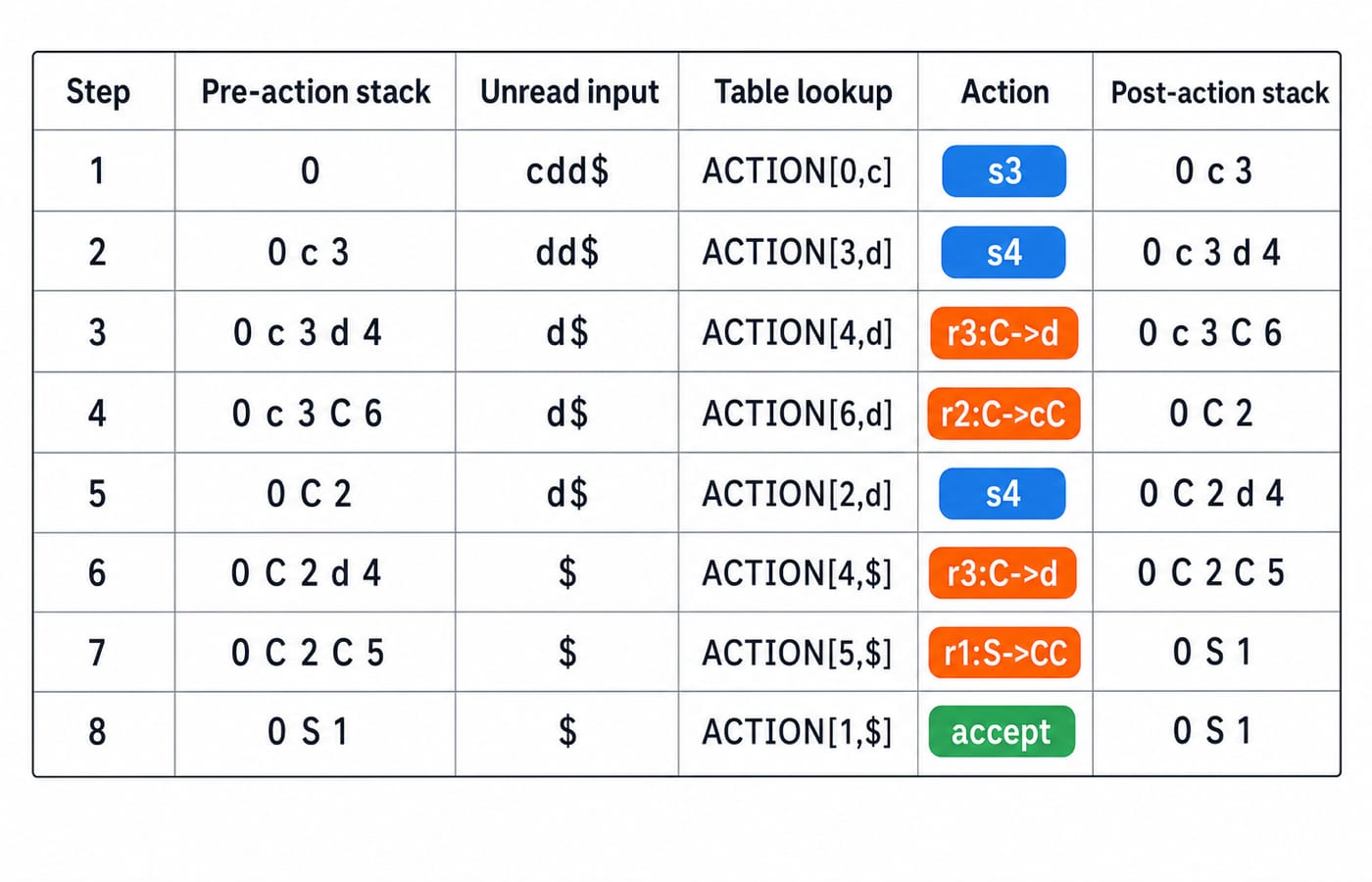
Read each row before performing its action:
Step | Pre-action stack | Unread input | Table lookup | Action | Post-action stack |
|---|---|---|---|---|---|
1 |
|
|
|
|
|
2 |
|
|
|
|
|
3 |
|
|
|
|
|
4 |
|
|
|
|
|
5 |
|
|
|
|
|
6 |
|
|
|
|
|
7 |
|
|
|
|
|
8 |
|
|
|
|
|
At step 3, r3 pops d 4, exposes 3, uses GOTO(3,C)=6, then pushes C 6. At step 4, r2 pops c 3 C 6, exposes 0, uses GOTO(0,C)=2, then pushes C 2. Reductions do not advance input.
The reduction order C -> d, C -> cC, C -> d, S -> CC exactly reverses S => CC => Cd => cCd => cdd.
Detect LR(0) conflicts and avoid common construction traps
For (0) S' -> S, (1) S -> a A, (2) A -> b, (3) A -> b c, the state after ab contains A -> b . and A -> b . c. The first reduces everywhere; the second shifts on c. Their shift-reduce conflict means the grammar is not LR(0).
Mistake | Why it fails | Correction |
|---|---|---|
Omit | No unique accept item | Augment first |
Stop closure early | Items are missing | Repeat to a fixed point |
Compare one item | States may differ elsewhere | Compare full sets |
Reduce only under | LR(0) uses every terminal | Fill |
Consume input on reduce | Reduce reads nothing | Move only on shift |
Pop only symbols | States remain on stack | Pop |
Trust a partial table | Hidden cells may conflict | Inspect every ACTION cell |
Useful checks are that I3 has a self-loop on c; I4, I5 and I6 reduce under all three terminals; and only I1 accepts, only on $.
How exams test LR(0) construction and tracing
Common tasks ask you to complete closure or GOTO, count states, fill a cell, find a conflict, classify a grammar, or trace input. Here the answers are 7 states, GOTO(I3,C)=I6, ACTION[4,$]=r3, and final stack 0 S 1.
A 45-second order is: augment, close I0, generate and deduplicate GOTO states, number productions, fill shifts and GOTOs, add all-terminal reductions and accept, then scan ACTION cells for multiple entries. State count alone proves nothing.
Next, compare SLR, CLR and LALR parsers, which keep this item-set machinery but restrict where each reduction may fire, using FOLLOW sets or explicit lookaheads. The stack discipline from the cdd$ trace carries over to all three unchanged.
LR(0) in the short version, then the next study step
Remember: dotted items recognise viable prefixes; closure expands after a non-terminal; GOTO moves the dot; completed ordinary items reduce on every terminal; multiple ACTION entries mean conflict. Recall 7 states -> cdd$ accepted.
For a complete core-CS sequence, use ZERO TO HERO, Complete CS Course. For broader GATE preparation, see GATE Guidance by Sanchit Sir. Browse adjacent subjects in CS Fundamentals. Now build the states, trace cdd$, and spot a conflict without the finished table.
Keep learning
Intermediate Code Generation Formula Sheet: TAC, Quadruples and Backpatching Revision Notes
Revise intermediate code generation through compact formulas, representation tables and verified traces. Follow one expression from TAC to DAG reuse, then patch a Boolean branch exactly.
Updated 27 Oct 20266 min readCompiler Design
Grammar and CFG Formula Sheet: Rules, Worked Example and GATE Revision Notes
Revise CFGs in problem-solving order through precise rules, use cues, one consistent worked grammar, an LL(1) table, normal forms and a final audit routine.
Updated 26 Oct 20266 min readCompiler Design
Grammar and CFG Mistakes for GATE: 7 Traps and How to Fix Them
Seven small grammars expose the errors that make CFG answers go wrong, with reproducible checks for classification, ambiguity, FIRST sets and CNF.
Updated 24 Oct 20265 min readCompiler Design

Code Optimization Mistakes in Compiler Design: How to Avoid Losing GATE Marks
A rewrite that looks familiar is not necessarily safe. Trace six common optimization errors, learn why each one changes program meaning, and use a five-step check before accepting an answer.
Updated 22 Oct 20265 min readCompiler Design