Introduction to Natural Language Processing MCQs: 12 Solved Questions with Explanations
Attempt 12 NLP MCQs drawn from teaching and state PSC computer science papers, then use the explanations to separate NLU, NLG, speech, entities, and embeddings.
KnowledgeGate Team
Exam prep & CS education
Updated 21 Jul 20268 min read125 views
AI sections in teaching-recruitment and state PSC computer science papers repeatedly test NLP full forms, NLU versus NLG, and applications. These 12 solved MCQs include ten previous-year questions from DSSSB, Beltron Programmer, BPSC, and MPPSC papers. Attempt each before reading the explanation.
The traps repeat across boards: a full form with one word mutated, an application that is really computer vision or robotics, and the speech-versus-speaker pair asked from both directions. To revise the underlying theory, start with the Paper 2 Artificial Intelligence and High Performance Computing module. The Teaching CS Exams Compared: DSSSB, KVS, RSSB guide helps you choose which papers to practise.
NLP full forms and the parent discipline
Natural Language Processing lets computers understand, interpret, and generate human language. Natural Language Understanding is its comprehension side. Computational linguistics is the wider field where linguistics meets computer science.
Q1. NLU is a component of NLP. What is the full-form of NLU?
(a) Natural Language Understanding
(b) Neutral Language Understanding
(c) Natural Language Unfolding
(d) Neutral Language Unfolding
Answer: (a) Natural Language Understanding. NLU interprets meaning through tasks such as intent recognition, sentiment analysis, and semantic parsing. Every distractor replaces one correct word with "Neutral" or "Unfolding", neither of which belongs in the term. Papers often create a full-form trap by mutating just one word. Open the DSSSB Computer Science 2022 solved question.
Q2. _____ is the science of computers dealing with languages?
(a) Distributed computing
(b) Machine language
(c) Assembly Language
(d) Computational linguistics
Answer: (d) Computational linguistics. It studies human language through computational methods and is the academic parent of NLP. Machine language and assembly language are programming notations for processors, not sciences that study human language. Distributed computing concerns systems spread across multiple machines. Open the DSSSB Computer Science 2021 solved question.
NLU vs NLG: which direction the language flows
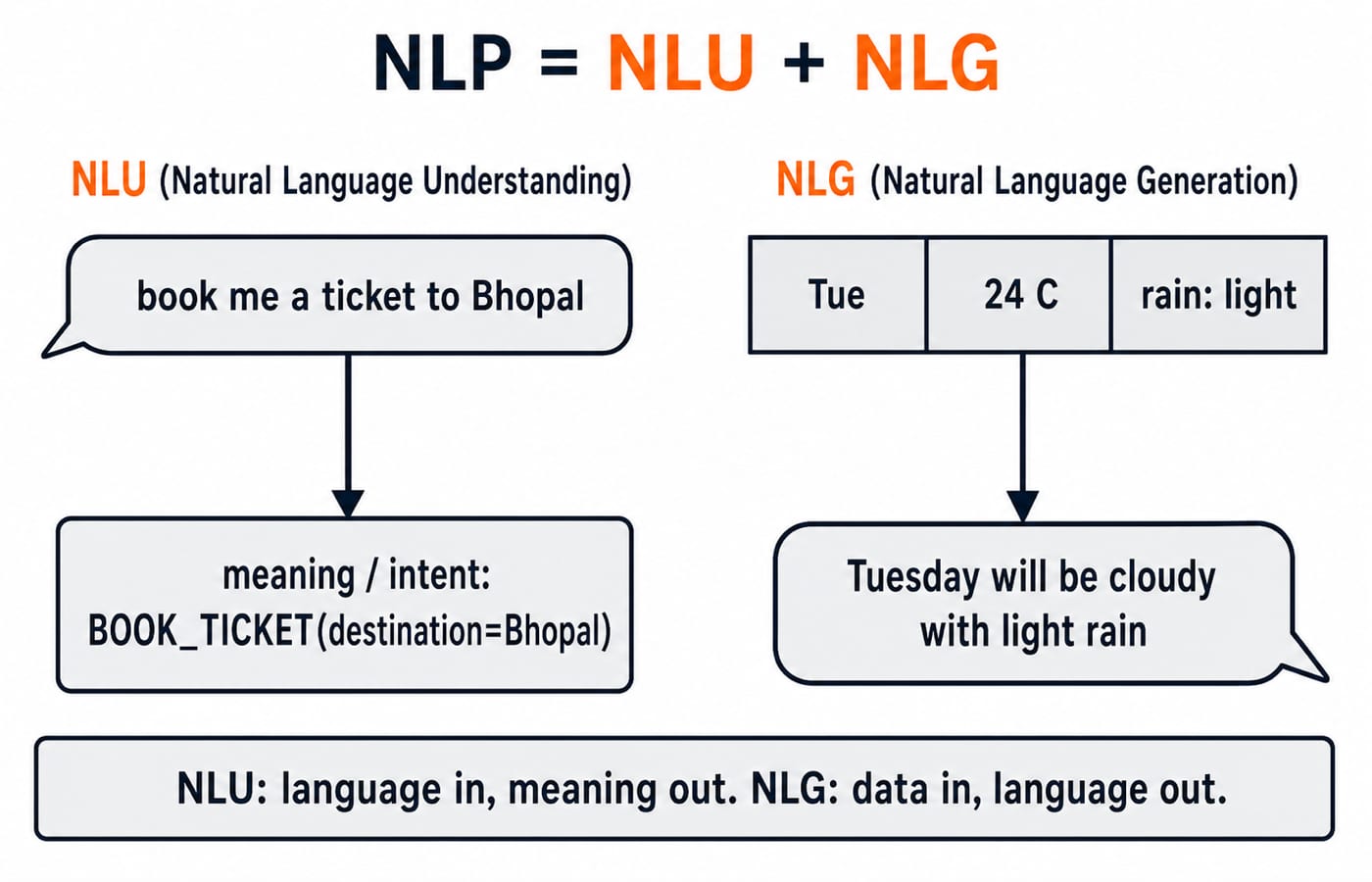
NLU consumes language and extracts meaning. A chatbot reading "book me a ticket to Bhopal" uses NLU to find the intent and destination. NLG moves in the other direction, turning structured data into language, such as a weather system writing a forecast from a data table.
Q3. Which of the following aims to construct natural language outputs from non-linguistic inputs?
(i) NLU
(ii) NLG
(a) Only (i)
(b) Only (ii)
(c) Both (i) and (ii)
(d) Neither (i) nor (ii)
Answer: (b) Only (ii). Constructing language from a database, measurement table, or other non-linguistic input is Natural Language Generation. NLU follows the opposite arrow, from language to meaning, so statement (i) is false and option (c) also fails. Open the DSSSB Computer Science 2022 solved question.
NLP application questions
When a paper asks you to identify an NLP application, inspect the input and output. Human text or speech points to NLP. Images point to computer vision, robot arms to robotics and control, and protein folding to scientific machine learning.
Q4. In which application area is Natural Language Processing (NLP), a subfield of AI, most commonly used?
(a) Object detection in images
(b) Translating text from one language to another
(c) Controlling robotic arms in factories
(d) Predicting protein structures
Answer: (b) Translating text from one language to another. Machine translation takes language as input and returns language as output, making it the clearest NLP task here. Object detection is computer vision, robotic-arm control belongs to robotics, and protein-structure prediction is computational biology. (Beltron Programmer 2025 Shift-3)
Q5. Autocorrect and Autocomplete Search are applications of
(a) Multiagent System
(b) Constraints Satisfaction Problem
(c) Natural Language Processing
(d) Genetic Algorithm
Answer: (c) Natural Language Processing. Both features analyse partial language to predict or correct characters and words. Multiagent systems coordinate interacting agents, constraint solvers search for assignments that satisfy rules, and genetic algorithms use evolutionary search. None of those three operates on language, which is exactly what autocorrect and autocomplete do at every keystroke.
Q6. Which of the following is an application of Artificial Intelligence?
(a) It helps to exploit vulnerabilities to secure the firm
(b) Language understanding and problem-solving (Text analytics and NLP)
(c) It helps to deploy applications on the cloud
(d) More than one of the above
(e) None of the above
Answer: (b) Language understanding and problem-solving (Text analytics and NLP). Text analytics and NLP are explicitly AI capabilities. Security tooling in (a) and cloud deployment in (c) are not inherently AI, so (d) fails, and (e) cannot stand once (b) is true. The five-option BPSC format rewards checking every statement rather than guessing from the answer pattern. Open the BPSC Computer Science 2024 solved question.
Speech recognition vs speaker recognition
Speech recognition determines what was said and converts it into text or a command. Speaker recognition determines who said it. Voice biometrics belongs on the speaker side when identity is the goal, while dictation and voice commands depend on speech recognition.
Q7. Which of the following is used in applications, such as home automation, dictating to Microsoft Word, and voice biometrics?
(a) Chatbot
(b) Speech recognition
(c) Virtual reality
(d) Information extraction
Answer: (b) Speech recognition. Home automation, dictation, and voice biometrics all take spoken audio as their input channel, and speech recognition is what turns that audio into machine-usable input. Voice biometrics then adds an identity decision on top, which is the distinction Q8 tests. A chatbot is a conversation layer, virtual reality is an immersive display technology, and information extraction finds facts in documents. Open the DSSSB Computer Science 2022 solved question.
Q8. The ability to input data directly into a computer system by speaking to it is known as __________.
(a) speech recognition
(b) speaker recognition
(c) speaker identification
(d) speech enhancement
Answer: (a) speech recognition. The phrase "input data by speaking" asks about the content of speech, so it is on the what side. Speaker recognition and identification concern the speaker's identity, while speech enhancement improves audio quality. Remember the rule: speech recognition finds what was said, speaker recognition finds who said it. Open the DSSSB TGT Shift 1 2021 solved question.
NLP ambiguity, entities, and word embeddings
Language brings three different problems into this set. A word may carry several senses, text may mention real-world entities, and meaning must be represented in a form a model can process. Word sense disambiguation, named entity recognition, and dense word embeddings address those problems respectively.
Q9. In Natural Language Processing, which of the following best describes the challenge addressed by word sense disambiguation?
(a) Recognising entities such as organisations and places
(b) Identifying the appropriate meaning of a word based on its surrounding context
(c) Correcting syntactic mistakes in textual datasets
(d) Converting text between different languages accurately
Answer: (b) Identifying the appropriate meaning of a word based on its surrounding context. A polysemous word has several senses, so the surrounding words must decide whether "bank" means a river bank or a bank account. Option (a) describes named entity recognition, (c) describes grammar correction, and (d) describes machine translation. (Beltron Programmer 2025 Shift-2)
Q10. Which NLP task identifies names of persons, organizations, or locations within text?
(a) Tokenization
(b) Stemming
(c) Named Entity Recognition
(d) Text Classification
Answer: (c) Named Entity Recognition. NER finds spans that name real-world things and labels their types. In "Sundar Pichai announced Google's new office in Hyderabad", it tags Sundar Pichai as PERSON, Google as ORGANIZATION, and Hyderabad as LOCATION. Tokenization only splits text, stemming reduces forms such as "playing" to "play", and text classification labels a whole document rather than spans within it.
Q11. How do word embeddings (e.g., Word2Vec) represent semantic relationships?
(a) By storing dictionary definitions
(b) Using sparse one-hot vectors
(c) Through syntactic parse trees
(d) Via dense vectors in continuous space
Answer: (d) Via dense vectors in continuous space. Embeddings place words in a continuous vector space where geometric closeness can reflect similarity and learned directions can capture relationships. In the classic analogy, the vector operation King - Man + Woman lands near Queen. One-hot vectors in (b) are real representations, but they are sparse and do not encode similarity; options (a) and (c) are symbolic structures. (Beltron Programmer 2025 Shift-3)
NLP history and Chomsky's critique of behaviourism
B. F. Skinner's Verbal Behaviour explained language through learned stimulus-response conditioning. Noam Chomsky's 1959 review stressed that people produce and understand new sentences, challenging Skinner's account and steering attention towards formal, generative, and programmable language models.
Q12. Which of the following statement best summarizes the impact of Noam Chomsky's review of B. F. Skinner's book "Verbal Behaviour" on the development of natural language processing?
(a) It supported Skinner's behaviorist theory, laying the groundwork for modern NLP
(b) It introduced computational linguistics as a purely philosophical discipline
(c) It challenged the behaviorist approach by highlighting the creative nature of language, influencing formal and programmable models of language understanding
(d) It emphasized that sentence structure alone is sufficient for full language comprehension
Answer: (c) It challenged the behaviorist approach by highlighting the creative nature of language, influencing formal and programmable models of language understanding. Option (a) reverses the history because Chomsky opposed Skinner's account. Computational linguistics is empirical and computational, not purely philosophical as (b) claims, while (d) overstates the role of syntax. Open the MPPSC Computer Science 2025 solved question.
The short version and your next step
NLP applies AI to human language. NLU understands language, while NLG generates it.
For application questions, ask whether the input or output is human text or speech.
Speech recognition identifies what was said. Speaker recognition identifies who said it.
Word sense disambiguation handles ambiguity, NER finds entities, and dense embeddings represent semantic relationships.
Chomsky's critique of behaviourism helped steer language research towards formal models.
You can work through the same questions with full solutions inside the UPPSC Polytechnic Lecturer 2025 (CS) course and the MPPSC Assistant Professor (CS) 2026 course. For the wider exam cluster, browse the Teaching Recruitment (Computer Science) blog category and build your next set around the concepts you missed here.
Keep learning
Schedulers and Context Switching MCQs: 12 Solved Questions with Explanations
Solve 12 exam questions on long-term, medium-term and short-term schedulers, the dispatcher, context state, mode switches and process-switch counting.
Updated 25 Oct 20268 min readOperating System MCQs
Process Synchronization MCQs: 10 Solved Cross-Concept Questions with Explanations
Solve 10 mixed Process Synchronization questions, then learn how shared state, atomic operations, waiting behaviour and lock ownership decide each answer.
Updated 24 Oct 20267 min readOperating System MCQs
Process Basics and PCB MCQs: 12 Solved Questions with Explanations
Solve 12 Process Basics and PCB questions, then use each explanation to repair the exact concept boundary behind the correct option.
Updated 20 Oct 20268 min readOperating System MCQs
Critical Section MCQs: 12 Solved Questions on Race Conditions and Mutual Exclusion
Practise critical-section MCQs on race conditions, mutual exclusion, Bakery ordering, stale writes and priority inversion, with explanations and two complete traces.
Updated 16 Oct 20268 min readOperating System MCQs