Logical Operators MCQs: 12 Solved Questions on Negation, Conjunction and Disjunction
Solve 12 logical-operator questions covering symbols, negation, De Morgan's laws, custom truth tables, CNF and exactly-two proposition logic.
KnowledgeGate Team
Exam prep & CS education
24 Aug 20267 min read
NOT, AND and OR look elementary until a question nests them, asks for a precise negation, or replaces a familiar connective with a truth-table-defined operator. Attempt each question before reading its explanation. Questions 8 to 12 are previous-year papers and each one carries a link to its own solved page. Questions 1 to 7 are practice items from the same subtopic, which holds over fifty questions in all, so work the rest on the Logical Operators practice questions page in the GATE CS Exam Preparation Courses and Test Series.
Related reading: propositional logic and propositional logic MCQs.
Logical operators truth table: the four rows to use before the MCQs
The operator ¬p reverses the truth value of p. The conjunction p ∧ q is true only when both inputs are true. The disjunction p ∨ q is inclusive OR, so it is false only when both inputs are false. In particular, ordinary propositional ∨ includes the (T,T) row: T ∨ T = T.
p | q | ¬p | p ∧ q | p ∨ q |
|---|---|---|---|---|
T | T | F | T | T |
T | F | F | F | T |
F | T | T | F | T |
F | F | T | F | F |
Use the (T,F) row to calibrate both De Morgan laws. Here, ¬(p∧q)=¬F=T, while ¬p∨¬q=F∨T=T. Also, ¬(p∨q)=¬T=F, while ¬p∧¬q=F∧T=F.
Keep one solving routine fixed. Locate the main connective first, evaluate brackets, apply negation, then evaluate conjunction before disjunction unless parentheses specify another order. A newly defined symbol has no familiar meaning until its four rows reveal one.
Logical operator MCQs 1-3: recognise OR, AND and NOT
Question 1
Which logical operator is represented by the symbol '∨'?
A. And
B. Or
C. Not
D. If-then
Answer: B. Or. The symbol ∨ is the inclusive OR connective. The calibration row (T,T) distinguishes it from exclusive OR because T ∨ T = T.
Question 2
Which logical operator is represented by the symbol '∧'?
A. And
B. Or
C. Not
D. If-then
Answer: A. And. The symbol ∧ denotes conjunction. Only (T,T) makes p ∧ q true, while the other three input pairs make it false.
Question 3
Which logical operator is represented by the symbol '¬'?
A. And
B. Or
C. Not
D. If-then
Answer: C. Not. The symbol ¬ is unary, so it acts on one proposition instead of joining two propositions. Its two checks are ¬T=F and ¬F=T.
Negation MCQs 4-6: statements and De Morgan's laws
Question 4
What is the negation of the statement “It is raining”?
A. It is not raining.
B. It is sunny.
C. It is cloudy.
D. It is raining heavily.
Answer: A. It is not raining. Negation denies exactly the original proposition, rather than replacing it with a different weather statement. If p means “It is raining”, option A is ¬p; sunny and cloudy are not logical complements of raining.
Question 5
The negation of "p ∧ q" is:
A. ¬p ∧ ¬q
B. ¬p ∨ ¬q
C. ¬p → ¬q
D. ¬p ∨ q
Answer: B. ¬p ∨ ¬q. De Morgan's law negates both operands and changes ∧ to ∨. At p=T, q=F, ¬(T∧F)=¬F=T, and ¬T∨¬F=F∨T=T, so the two sides agree.
Question 6
The negation of "p ∨ q" is:
A. ¬p ∧ ¬q
B. ¬p ∨ ¬q
C. ¬p → ¬q
D. ¬p ∨ q
Answer: A. ¬p ∧ ¬q. A disjunction is false only when both propositions are false, so negating p∨q requires ¬p∧¬q. At (F,F), both sides are true; at (T,F), ¬(T∨F)=F and ¬T∧¬F=F∧T=F.
Logical equivalence MCQs 7-9: matching truth sets and decoding operators
Question 7
Expression (~p⋀~q)⋁(p⋀q) is logically equivalent to
A. p→q
B. p↔q
C. ~p⋀q
D. p⋀q
Answer: B. p↔q. The expression is true at (F,F) through ~p⋀~q, and at (T,T) through p⋀q. Those are exactly the two rows in which p and q have the same truth value, which is the truth set of the biconditional.
Question 8
GATE 2006
A logical binary relation □ ,is defined as follows:
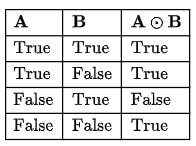
Let ~ be the unary negation (NOT) operator, with higher precedence than □. Which one of the following is equivalent to A∧B ?
A. (~A □ B)
B. ~(A □ ~B)
C. ~(~A □ ~B)
D. ~(~A □ B)
Answer: D. ~(~A □ B). The table, which prints the operator as a circled dot, gives X □ Y = X ∨ ¬Y, since only (F,T) produces false. Therefore ~A □ B = ¬A ∨ ¬B, and ~(~A □ B)=¬(¬A∨¬B)=A∧B; the other options simplify to ¬(A∧B), ¬A∧¬B, and A∧¬B. See the GATE 2006 solved page.
Question 9
GATE 2008
P and Q are two propositions. Which of the following logical expressions are equivalent?
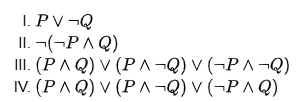
A. Only I, II and III
B. Only I, II and IV
C. All of I, II, III and IV
D. Only I and II
Answer: A. Only I, II and III. From the source image, I is P∨¬Q; De Morgan's law reduces II to P∨¬Q, and combining (P∧Q)∨(P∧¬Q)=P reduces III to the same form. Expression IV reduces to P∨Q; the row P=F, Q=F makes I, II and III true but IV false. See the GATE 2008 solved page.
Conjunction and disjunction MCQs 10-12: custom tables, CNF and exactly-two logic
Question 10
GATE 2009
The binary operation ? is defined as follows
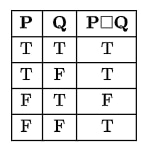
Which one of the following is equivalent to P∨Q?
A.

B.

C.

D.

Answer: B, the option image representing P ? ¬Q. The table, which prints the operator as a box, defines X ? Y = X∨¬Y. Substituting option B gives P ? ¬Q=P∨¬(¬Q)=P∨Q, whose outputs for (T,T),(T,F),(F,T),(F,F) are T,T,T,F. See the GATE 2009 solved page.
Question 11
GATE 2007
Which of the following is TRUE about formulae in Conjunctive Normal Form?
A. For any formula, there is a truth assignment for which at least half the clauses evaluate to true.
B. For any formula, there is a truth assignment for which all the clauses evaluate to true
C. There is a formula such that for each truth assignment, at most one-fourth of the clauses evaluate to true.
D. None of the above
Answer: A. For any formula, there is a truth assignment for which at least half the clauses evaluate to true. Under an independently random truth assignment, every non-empty clause is true with probability at least 1/2, so the expected number of true clauses among m clauses is at least m/2; therefore some assignment reaches at least that value. Option B fails for (x)∧(¬x): no assignment satisfies both clauses, but either value of x satisfies exactly one of the two. See the GATE 2007 solved page.
Question 12
UGC NET 2014
Give a compound proposition involving propositions p, q and r that is true when exactly two of p, q and r are true and is false otherwise.
A. (p∨q∧¬r) ∧ (p∧¬q∧r) ∧ (¬p∧q∧r)
B. (p∧q∧¬r) ∧ (p∨q∧¬r) ∧ (¬p∧q∧r)
C. (p∧q∧¬r) ∨ (p∧¬q∧r) ∧ (¬p∧q∧r)
D. (p∧q∧¬r) ∨ (p∧¬q∧r) ∨ (¬p∧q∧r)
Answer: D. (p∧q∧¬r) ∨ (p∧¬q∧r) ∨ (¬p∧q∧r). The only satisfying rows are (T,T,F), (T,F,T) and (F,T,T), and each conjunction in D captures one of them. OR joins those three alternatives, while (T,T,T) makes every term false because each term requires exactly one negated variable. See the UGC NET 2014 solved page.
Logical operators answer traps: five traps and the audit to run after every question
Trap | What goes wrong | Check from this set |
|---|---|---|
Treating | You incorrectly reject the | Question 1: |
Changing the sentence instead of negating it | A related claim is mistaken for the logical complement | Question 4: negate “raining” directly |
Keeping the connective under negation | De Morgan's law is applied only halfway | Questions 5-6: swap |
Guessing a custom operator from its symbol | The symbol has no standard truth function | Questions 8 and 10: decode all four rows |
Trusting a long DNF by appearance | A missing or extra satisfying row stays hidden | Question 12: check |
After every answer, mark the main connective, list only the decisive rows, simplify one law at a time, and test a row that separates close options. Reproduce these four anchors without looking: ¬(T∧F)=T, ¬(F∨F)=T, ~(~A □ B)=A∧B, and the exactly-two rows TTF, TFT, FTT. For a broader set after this audit, use Propositional and Predicate Logic MCQs: 12 Solved.
Logical operators MCQs: the short version and next step
Your revision card is compact: ¬ flips one truth value, ∧ needs both inputs true, and inclusive ∨ needs at least one input true. Also remember ¬(p∧q)=¬p∨¬q, ¬(p∨q)=¬p∧¬q, and translate every newly defined operator from its truth table before substitution.
Use GATE Guidance by Sanchit Sir when you want the complete Discrete Mathematics lesson and practice sequence. If only the remaining binary connectives are weak, continue with Implication and Biconditional Operators in Logic: 11 Solved MCQs. Do not memorise an option letter. Rebuild it from the connective and the decisive rows.
Keep learning
Bijective Function MCQs: 10 Solved Questions on Definition, Counting and Properties
Solve 10 bijective-function MCQs with collision checks, range analysis, composition logic and permutation counting, each followed by a worked explanation.
Updated 24 Oct 20267 min readDiscrete Mathematics MCQs
Conditional Probability Questions with Solutions: 12-Question Practice Set
Practise 12 conditional probability questions on independence, restricted samples, Bayes' rule, draws and complements, with checked calculations.
20 Oct 20267 min readDiscrete Mathematics MCQs
Order of Elements in Groups MCQs: 10 Solved Objective Questions
Build a reliable method for finding element orders, then apply it to 10 bank questions, including NAT, MSQ and two composition-table problems.
Updated 16 Oct 20267 min readDiscrete Mathematics MCQs
Partial Order Relation MCQs: 12 Solved Poset and Total Order Questions
Solve 12 published partial order questions with fresh explanations covering posets, total orders, lattices, recursive comparisons, linear extensions and counterexamples.
12 Oct 20267 min readDiscrete Mathematics MCQs