Minimum Spanning Tree for GATE: Kruskal and Prim Numericals with Unique-MST Questions
Run Kruskal and Prim on the same weighted graph, verify their common cost, and use cut, cycle, and equal-weight reasoning to answer uniqueness questions.
KnowledgeGate Team
Exam prep & CS education
Updated 21 Jul 20266 min read

An MST numerical should end with two checks: the tree has V-1 edges, and an independent algorithm gives the same minimum cost. GATE questions then add a conceptual twist about a safe edge, an impossible edge, or whether equal weights create several minimum trees. The five-vertex graph below is small enough to trace by hand and still raises every one of those twists.
What a minimum spanning tree must satisfy
For a connected, undirected, weighted graph, a spanning tree includes every vertex, stays connected, and contains no cycle. A graph with V vertices therefore contributes exactly V-1 edges to any spanning tree. An MST is a spanning tree with minimum total edge weight.
Kruskal and Prim are greedy, but their choices are justified by two properties:
Cut property: for a cut that splits the vertices into two non-empty groups, a uniquely lightest crossing edge is in every MST.
Cycle property: in a cycle, a uniquely heaviest edge is in no MST.
The graph algorithms guide helps separate MST problems from shortest-path problems. An MST minimises the sum of tree edges, not the distance from one source.
The worked graph: five vertices, seven weighted edges
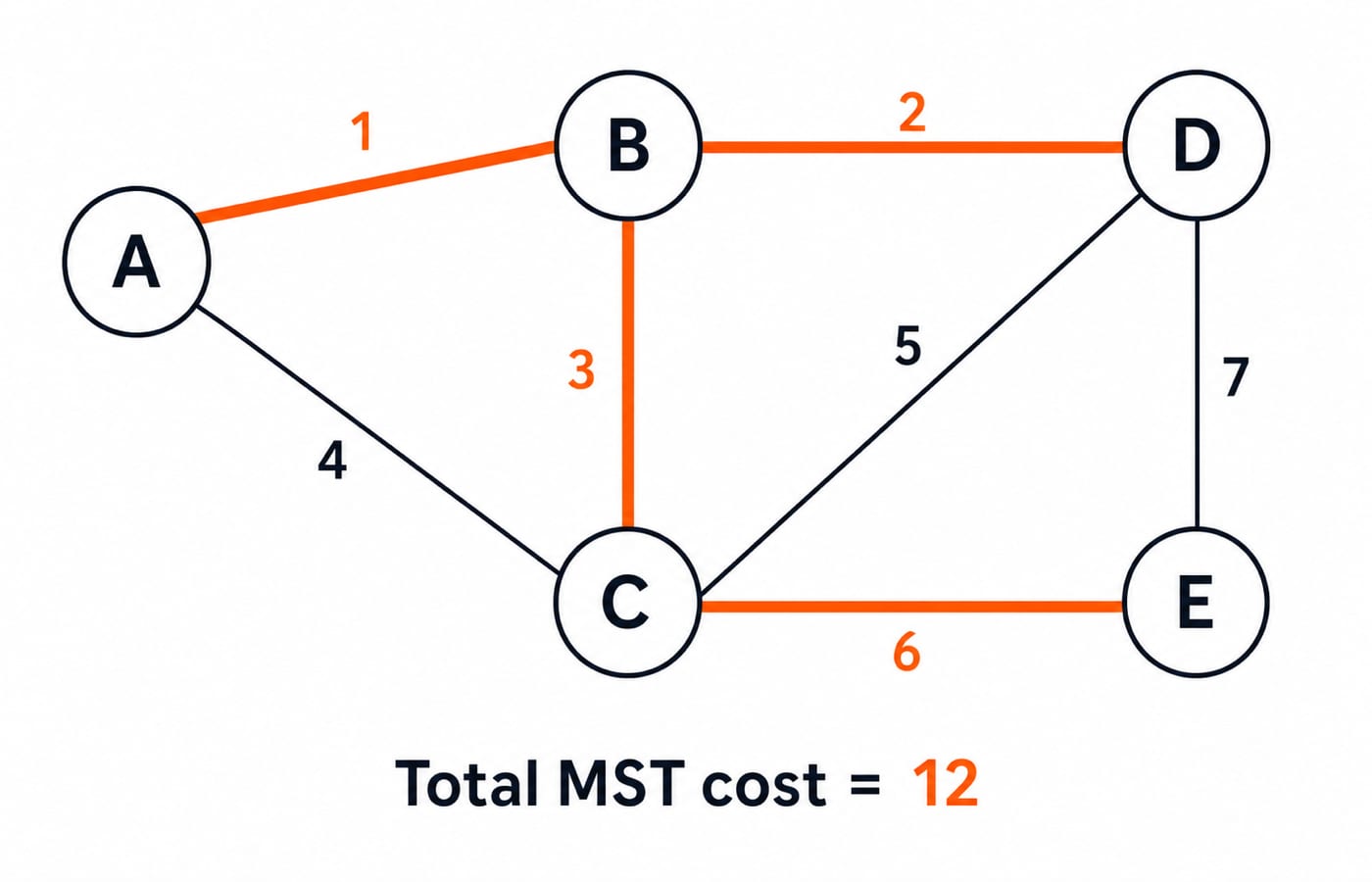
Use vertices A, B, C, D, E and these undirected edges:
Edge | Weight |
|---|---|
A-B | 1 |
B-D | 2 |
B-C | 3 |
A-C | 4 |
C-D | 5 |
C-E | 6 |
D-E | 7 |
Five vertices mean the final tree must have four edges. All weights are distinct, so this example will also have a unique MST.
Kruskal's algorithm, edge by edge
Sort edges by increasing weight. Accept an edge if its endpoints are currently in different components, and reject it if it closes a cycle.
Accept
A-B (1). Components become{A,B},{C},{D},{E}.Accept
B-D (2). Components become{A,B,D},{C},{E}.Accept
B-C (3). Components become{A,B,C,D},{E}.Reject
A-C (4). It closes cycleA-B-C-A.Reject
C-D (5). It closes cycleB-C-D-B.Accept
C-E (6). The tree now has four edges, so stop.
Kruskal returns {A-B, B-D, B-C, C-E}. Its cost is
1 + 2 + 3 + 6 = 12.
Prim's algorithm on the same graph
Start at A. At each step, take the lightest edge with one endpoint inside the growing tree and one outside.
Step | Vertices already in tree | Crossing candidates | Choice |
|---|---|---|---|
1 | {A} | A-B (1), A-C (4) | A-B (1) |
2 | {A,B} | B-D (2), B-C (3), A-C (4) | B-D (2) |
3 | {A,B,D} | B-C (3), A-C (4), D-C (5), D-E (7) | B-C (3) |
4 | {A,B,C,D} | C-E (6), D-E (7) | C-E (6) |
Prim returns the same four edges. Its independently summed cost is also 1 + 2 + 3 + 6 = 12. Agreement does not replace the correctness proof, but it is an excellent arithmetic and edge-selection check.
Cut and cycle properties as GATE tests them
Before accepting A-B, consider the cut {A} and {B,C,D,E}. Its crossing edges are A-B (1) and A-C (4), so the uniquely lightest edge A-B is safe. This is a direct cut-property question.
When Kruskal reaches A-C (4), accepted edges already provide path A-B-C with weights 1 and 3. Adding A-C creates a cycle in which weight 4 is uniquely heaviest, so the cycle property rejects it. The same check rejects C-D (5) against path C-B-D, whose edge weights are 3 and 2.
If a new edge (u,v) is added to a graph whose MST you already have, insert it into that tree. It creates exactly one cycle. If the new edge is lighter than the heaviest edge on that cycle, replace that heaviest edge. If it is heavier, the current MST remains optimal. A tie can preserve the cost while creating another MST.
When is the MST unique?
If every edge weight is distinct, the MST is unique. Suppose two minimum trees differ, and let e be the lightest edge that belongs to one of them but not the other, say to the first tree. Adding e to the second tree creates a cycle, and that cycle must contain an edge f that the first tree does not have, otherwise the whole cycle would sit inside the first tree, which is acyclic. Distinct weights and the choice of e force w(e) < w(f). Replacing f by e makes the second tree lighter, contradicting its minimum status.
The converse is false. Equal weights do not automatically mean multiple MSTs. In a triangle with XY=1, YZ=1, and XZ=2, the only MST uses XY and YZ, with cost 1+1=2. The two alternatives each cost 3.
Equal weights can create several MSTs. In the four-cycle P-Q-R-S-P, let PQ=1, RS=1, QR=2, and SP=2. Every spanning tree removes one cycle edge. A minimum tree must retain both weight-1 edges and choose exactly one weight-2 edge. Therefore there are exactly two MSTs:
{PQ, RS, QR}, cost1+1+2=4{PQ, RS, SP}, cost1+1+2=4
For a larger graph, process equal-weight edges as a group. Contract components formed by lower weights, identify which tied edges can connect the contracted components without a cycle, and count the valid choices. Do not multiply local choices unless they are independent.
Complexity and implementation choices
Kruskal sorts edges and uses disjoint-set union, giving O(E log E). Prim with an adjacency list and binary heap gives O(E log V). A matrix-based Prim implementation takes O(V^2) and can suit dense graphs.
These complexities are often paired with representation questions. The data structures question set is useful for revising heaps and disjoint sets around the algorithm itself. KnowledgeGate carries about 1,100 Algorithm questions for further practice on these implementations.
How GATE frames MST questions
Expect an edge order, final weight, safe-edge statement, update after adding an edge, or a count of distinct MSTs. On any numerical, stop after V-1 accepted edges and add the weights a second time. Confirm current paper instructions on the official GATE portal of the organising IIT.
Unique-MST questions, solved on the same graph
Each question changes one weight in the seven-edge graph above, so you can check your working against the trace you already have.
Question 1. Is the edge C-D (5) in every MST of the worked graph, in some MST, or in none?
Answer. In none. C-D lies on the cycle C-B-D, whose other two edges weigh 3 and 2, so 5 is the uniquely heaviest edge of that cycle and the cycle property keeps it out of every MST. The weights here are distinct, so the single MST {A-B, B-D, B-C, C-E} confirms it.
Question 2. Add a new edge A-E of weight 4 to the worked graph. What is the new MST, and what does it cost?
Answer. Insert A-E into the old tree. The A-to-E path there is A-B, B-C, C-E, so the cycle carries weights 1, 3, 6 and the new 4. The heaviest cycle edge is C-E (6), and 4 is lighter, so C-E leaves and A-E enters. The MST becomes {A-B, B-D, B-C, A-E} at cost 1 + 2 + 3 + 4 = 10. Note that A-C weighs 4 as well, so weight 4 is now a tie, but A-C closes a cycle at the moment it is considered, so the MST stays unique.
Question 3. Restore the original weights, then change D-E from 7 to 6, so C-E and D-E both weigh 6. How many distinct MSTs are there, and what does each cost?
Answer. The edges of weight 1, 2 and 3 still join A, B, C and D, and A-C (4) and C-D (5) still close cycles. Vertex E must then be attached by exactly one of the two weight-6 edges, and either choice gives a spanning tree. There are exactly two MSTs, {A-B, B-D, B-C, C-E} and {A-B, B-D, B-C, D-E}, each costing 1 + 2 + 3 + 6 = 12.
The short version
Kruskal grows a forest by sorted edges. Prim grows one tree by lightest crossing edges. Both are applications of the cut property, while cycle rejection uses the cycle property. Distinct weights guarantee one MST; repeated weights require actual counting.
Re-run the worked graph from another Prim start vertex and verify that the cost remains 12. Then use the GATE Test Series for timed algorithm practice, and the GATE category page to choose the next subject drill.
Keep learning
Tree Data Structure: Types, Traversals and a Worked BST Example
Build one nine-node binary search tree, classify its shape, trace four traversals, and work through insertion, search, deletion and complexity checks.
Updated 21 Oct 20266 min readDSA & Algorithms
Graphs in Data Structures: Complete Guide with BFS, DFS and Dijkstra Worked Examples
Learn graph terminology, representations and algorithm selection by tracing one unweighted graph with BFS and DFS, then solving a weighted graph with Dijkstra.
Updated 17 Oct 20266 min readDSA & Algorithms

Physical Security and Cryptography Basics: Controls, Keys and Worked Examples
Learn how physical and cryptographic controls work together, then apply them in a four-asset server-room model and a step-by-step toy RSA example.
Updated 13 Oct 20265 min readDSA & Algorithms

Stack Data Structure: Operations, Applications and Worked Examples
Build a stack from its LIFO rule, trace array and linked-list operations, evaluate a postfix expression, and practise recursion, applications, and common traps.
Updated 8 Oct 20265 min readDSA & Algorithms