Number System MCQs: 12 solved digital electronics questions with explanations
Number system MCQs with solutions: 12 solved GATE questions on binary, octal and hex conversion, radix equations, and 1's and 2's complement signed numbers.
KnowledgeGate Team
Exam prep & CS education
Updated 26 Jul 20266 min read337 views
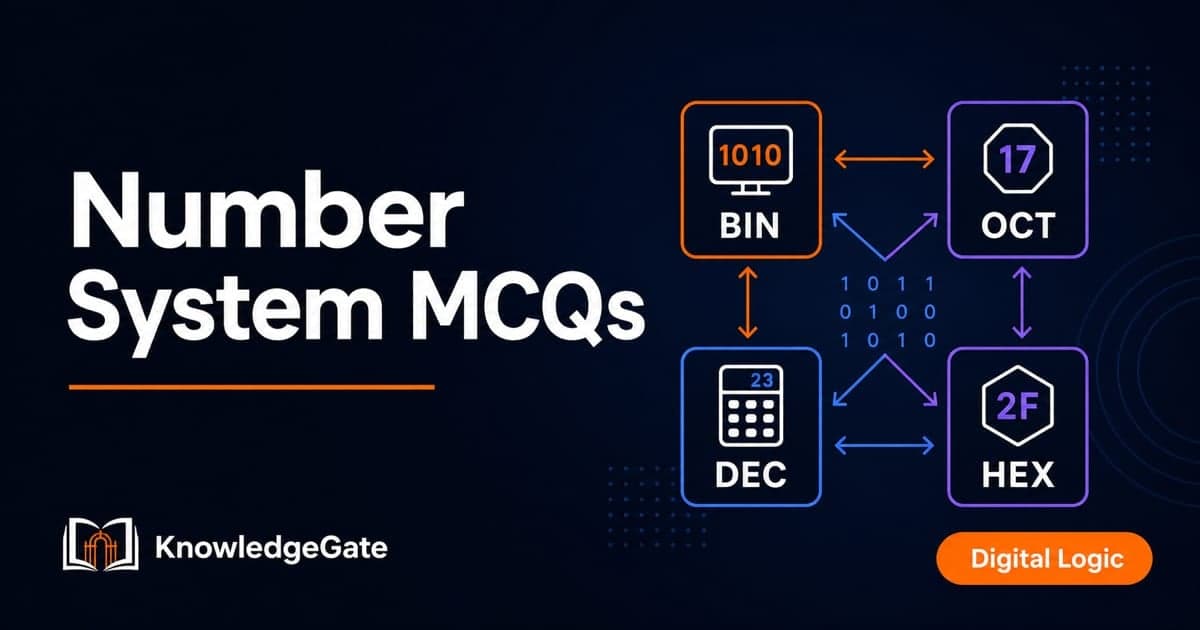
Number systems are where a digital electronics paper opens, and where careless aspirants leak easy marks: a base conversion done in the wrong direction, a 2's complement range off by one bit, or a signed-number question read as unsigned. The same handful of ideas, conversion between binary, octal and hexadecimal, solving for an unknown radix, and 1's versus 2's complement, come back in GATE year after year. Work each previous-year question on paper before reading its answer. In the conversion questions especially, the slip is rarely the base itself; it is the regrouping of bits, and the padding you need before you can regroup. If the underlying idea feels shaky, start with the Digital Electronics learn module.
Binary, octal and hexadecimal conversions
Q1. The number (123456) in base 8 is equivalent to (GATE 2004)
(a) (A72E) base 16 and (22130232) base 4
(b) (A72E) base 16 and (22131122) base 4
(c) (A73E) base 16 and (22130232) base 4
(d) (A62E) base 16 and (22120232) base 4
Answer: (a). The fastest route between power-of-two bases is through binary. Write each octal digit as three bits to get 001 010 011 100 101 110, then regroup those bits into fours for hex (A72E) and into twos for base 4 (22130232). Only option (a) matches on both regroupings, which is the whole point of listing two bases at once (see the full solution).
Q2. The hexadecimal representation of (657) in base 8 is (GATE 2005)
(a) 1AF
(b) D78
(c) D71
(d) 32F
Answer: (a) 1AF. Convert each octal digit to three bits: 6 is 110, 5 is 101, 7 is 111, giving 110101111. Now group the bits into fours from the right, 1 1010 1111, and read each group as a hex digit to get 1AF. Never convert octal to hex digit-by-digit directly; always pass through binary (see the worked solution).
Q3. (1217) in base 8 is equivalent to (GATE 2009)
(a) (1217) base 16
(b) (028F) base 16
(c) (2297) base 10
(d) (0B17) base 16
Answer: (b) (028F) base 16. Compute the decimal value first: 1×512 + 2×64 + 1×8 + 7 = 655. Then 655 in hex is 0x28F. The distractors reuse the same digit string in another base to catch anyone who compares symbols instead of values (see the step-by-step solution).
Q4. Let the representation of a number in base 3 be 210. What is the hexadecimal representation of the number? (GATE 2021)
(a) 15
(b) 21
(c) D2
(d) 528
Answer: (a) 15. Go through decimal for any conversion between non-related bases: 210 in base 3 is 2×9 + 1×3 + 0 = 21 in decimal, and 21 in decimal is 0x15. Option (b) is the trap for anyone who copies the decimal value straight across without converting to hex (see the full solution).
Q5. The value of a 16-bit unsigned integer X in hexadecimal is BCA9. The representation of X in octal is (GATE 2017)
(a) 571244
(b) 736251
(c) 571247
(d) 136251
Answer: (d) 136251. Expand the hex digits to binary: B C A 9 becomes 1011 1100 1010 1001. Octal needs groups of three, so pad with two leading zeros to 18 bits and regroup: 001 011 110 010 101 001, which reads as 136251. The padding step is where most slips happen (see the worked solution).
Radix equations and base arithmetic
Q6. If (73) in base x equals (54) in base y, the possible values of x and y are (GATE 2004)
(a) 8, 16
(b) 10, 12
(c) 9, 13
(d) 8, 11
Answer: (d) 8, 11. Turn both numerals into values: 73 in base x is 7x + 3, and 54 in base y is 5y + 4. Setting them equal gives 7x - 5y = 1, and checking the options, x = 8 and y = 11 gives 56 - 55 = 1. This kind of question is solved fastest by substituting the choices rather than solving the Diophantine equation cold (see the step-by-step solution).
Q7. In the equation (7526) base 8 minus (Y) base 8 equals (4364) base 8, find Y. (GATE 2014)
(a) 1634
(b) 1737
(c) 3142
(d) 3162
Answer: (c) 3142. Subtract directly in octal, borrowing 8 rather than 10 at each column, or convert, subtract in decimal, and convert back. The cleanest check is addition: 4364 + 3142 in octal is 7526, so Y is 3142. Verifying by adding the answer back to the subtrahend catches borrow mistakes instantly (see the full solution).
Signed numbers, 1's and 2's complement
Q8. The number 43 in 8-bit 2's complement representation is (GATE 2000)
(a) 01010101
(b) 11010101
(c) 00101011
(d) 10101011
Answer: (c) 00101011. For a positive number the 2's complement form is just its ordinary binary value with a 0 sign bit. 43 is 32 + 8 + 2 + 1, which is 101011, and padding to eight bits gives 00101011. The complement steps only matter for negatives (see the worked solution).
Q9. The 2's complement representation of the decimal value -15, using the minimum number of bits, is (GATE 2002)
(a) 1111
(b) 11111
(c) 111111
(d) 10001
Answer: (d) 10001. Four bits of 2's complement only span -8 to +7, so -15 does not fit and you need five bits. Write +15 as 01111, invert to 10000, and add 1 to get 10001. The "minimum number of bits" phrase is the real question here, not the arithmetic (see the step-by-step solution).
Q10. The range of integers that can be represented by an n-bit 2's complement number system is (GATE 2005)
(a) -2^(n-1) to 2^(n-1) - 1
(b) -(2^(n-1) - 1) to 2^(n-1) - 1
(c) -2^(n-1) to 2^(n-1)
(d) -(2^(n-1) + 1) to 2^(n-1) + 1
Answer: (a) -2^(n-1) to 2^(n-1) - 1. With n bits there are 2^n patterns; exactly half encode negatives, from -2^(n-1) up to -1, and the other half cover 0 through 2^(n-1) - 1. The asymmetry, one extra negative value with no positive twin, is the fact that Q9 quietly relied on (see the full solution).
Q11. Zero has two representations in which schemes? Consider (a) sign-magnitude, (b) 1's complement, (c) 2's complement. (GATE 1999)
(a) Only a
(b) a and b
(c) a and c
(d) a, b and c
Answer: (b) a and b. Sign-magnitude has +0 as all zeros and -0 as a leading 1 with zeros, and 1's complement has +0 as all zeros and -0 as all ones. Two's complement collapses these into a single all-zero zero, which is exactly why it wins one extra negative value on the range (more previous-year questions on 1's complement).
Q12. In 2's complement addition, overflow (GATE 2002)
(a) is flagged whenever there is a carry from the sign-bit addition
(b) cannot occur when a positive value is added to a negative value
(c) is flagged when the carries from the sign bit and the previous bit match
(d) none of the above
Answer: (b). Overflow in 2's complement can only happen when both operands share a sign and the result comes out with the opposite sign. Adding a positive and a negative always produces a result that fits, so no overflow is possible there. Equivalently, overflow is detected when the carry into the sign bit differs from the carry out of it, not when a carry is merely present (see the step-by-step solution).
How this set is examined
The 12 questions above trace how examiners actually test number systems: pure conversions between binary, octal and hex (Q1 to Q5), a radix equation and octal arithmetic (Q6 to Q7), and the signed-number family built on 1's and 2's complement (Q8 to Q12). Notice how Q9, Q10 and Q11 are really one idea seen from three angles, the asymmetric 2's complement range. Once the Boolean algebra and K-map MCQs feel easy too, you are through the first two units of the subject.
If conversions still feel slow, the full theory with worked base-change examples sits in our Number systems and base conversions deep dive, which starts from place value and derives each conversion method. GATE aspirants get the full digital electronics sequence inside GATE Guidance by Sanchit Sir, and you can place the subject in the wider syllabus on the GATE CS Exam page. Solve, review the ones you missed, and come back a week later; the second pass is where the marks get locked in.
Keep learning
Special Logic Circuits MCQs: 12 Solved Questions on Adders, Encoders, PLA and DAC
Solve 12 special logic circuits MCQs covering recognition, hardware counts, Boolean identities and numerical calculations. Each answer includes the reasoning you should reproduce in an exam.
19 Sep 20268 min read69 viewsDigital Electronics MCQs
Function Equivalence MCQs: 12 Solved Boolean Algebra Problems
Solve 12 function-equivalence questions step by step, from De Morgan's law and absorption to minterm sets, counterexamples and a four-option MSQ.
Updated 17 Sep 20268 min readDigital Electronics MCQs
CLA & Arithmetic Logic MCQs: 10 Solved Questions with Explanations
Solve ten CLA and arithmetic logic MCQs with compact workings for carry equations, timing paths, hardware sizing and operand-pair counting.
Updated 16 Sep 20267 min readDigital Electronics MCQs
Sync Counter Design MCQs: 11 Solved Questions on Modulus, State Sequences and Excitation Logic
Solve 11 synchronous-counter questions covering modulus boundaries, repeated outputs, common-clock tracing, excitation equations, enables and composite states.
Updated 14 Sep 20267 min readDigital Electronics MCQs