Other Array Types MCQs: 10 Solved Questions with Explanations
Work through 10 live MCQs and learn how index alignment, logical size, physical capacity, sparse storage, and 1-based heap arithmetic determine each answer.
KnowledgeGate Team
Exam prep & CS education
Updated 24 Oct 20267 min read
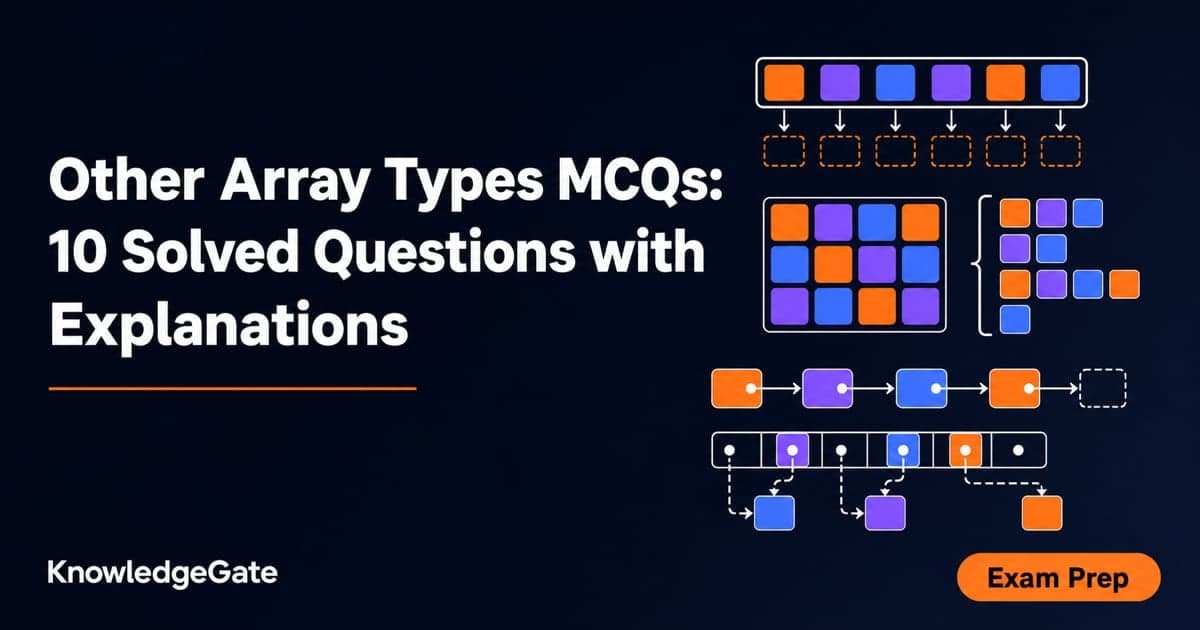
“Other array types” is not one definition that you can memorise and apply everywhere. Bit arrays, parallel arrays, dynamic arrays, bounded-size layouts, sparse matrices, and array-backed heaps are six different ideas, so decide what one index or one size represents before you trust an option. Dynamic-array grow and shrink thresholds are the design policy of a particular implementation rather than a universal law, so do not memorise a percentage as a rule. Separate logical size from physical capacity, then use the Data Structures MCQs hub for broader revision.
1. Other array types: the six ideas to separate before solving
First ask what one position means. It may represent a bit, one field index shared across arrays, or a heap node related to other indices.
Type | What is stored | Index relationship | Concrete example |
|---|---|---|---|
Bit array | One logical bit per position | Position | Eight flags: |
Parallel arrays | Separate fields in separate arrays | Equal indices form one logical record |
|
Dynamic array | Elements plus unused backing slots | Logical size can be smaller than capacity | Size 29, capacity 100, unused slots |
Bounded-size dynamic array | Occupied positions and fixed reserve positions | Current elements occupy the first logical-size positions | Capacity 8, occupied |
Sparse matrix | Only the non-zero entries and their coordinates | Stored coordinates identify positions in the full matrix |
|
1-based heap array | Heap nodes | Parent of index | Parent of index 9 is |
Logical size counts visible elements, while physical size or capacity counts all allocated backing slots, including unused ones. Revise Arrays in C: Declaration, Initialization and Worked Examples if the ordinary contiguous-array baseline is unclear.
2. Bit arrays, binary arrays and sparse matrices: Questions 1, 4 and 10
Question 1
Accenture 2025
Open Question 1 in the question bank.
What is a bit array?
A. Data structure for representing arrays of records
B. Data structure that compactly stores bits
C. An array in which most of the elements have the same value
D. Array in which elements are not present in continuous locations
Correct answer: B.
A bit array compactly stores bit-valued or Boolean states, as in [1, 0, 1, 1, 0, 0, 1, 0]. A describes record storage, C points towards repeated-value data, and D conflicts with normal array contiguity.
Question 4
UP Police 2016
Open Question 4 in the question bank.
The number of different binary arrays of order n x n, where each cell stores either 0 or 1, is:
A. 2^(2n)
B. 2^(n^2)
C. n^2
D. 2^n
Correct answer: B.
An n x n array has n^2 independent cells, and each cell has two choices. The multiplication rule therefore gives 2^(n^2) possible arrays. For n = 2, four cells produce 2^4 = 16 arrays, confirming the exponent.
Question 10
Beltron Programmer 2025
Open Question 10 in the question bank.
Which of the following is the most suitable reason for using a sparse matrix representation instead of a traditional 2D array?
A. It allows dynamic resizing of the matrix.
B. It simplifies matrix multiplication logic.
C. It reduces memory usage when most elements are zero.
D. It improves cache performance in matrix traversal.
Correct answer: C.
A dense 1000 x 1000 matrix reserves 1,000,000 value positions. For 5,000 non-zero values, simple row-column-value triplets use 5,000 x 3 = 15,000 scalar fields. In this simplified field-count comparison, 15,000 / 1,000,000 x 100 = 1.5%, so space is the primary reason; the other behaviours depend on the sparse format.
3. Parallel arrays: Questions 2 and 9
Question 2
AMCAT 2025
Open Question 2 in the question bank.
Which of the following can be called a parallel array implementation?
A.
firstName = ['Joe','Bob','Frank','Hans']
lastName = ['Smith','Seger','Sinatra','Schultze']
heightInCM = [169,158,201,199]
for i in xrange(len(firstName)):
    print "Name:",firstName[i], lastName[i]
    print "Height in CM:", heightInCM[i]
B.
firstName = ['Joe','Bob','Frank','Hans']
lastName = ['Smith','Seger']
heightInCM = [169,158]
for i in xrange(len(firstName)):
    print "Name:",firstName[i], lastName[i]
    print "Height in CM:", heightInCM[i]
C.
firstName = ['Joe','Bob']
lastName = ['Smith','Seger','Sinatra','Schultze']
heightInCM = [169,158]
for i in xrange(len(firstName)):
    print "Name:",firstName[i], lastName[i]
    print "Height in CM:", heightInCM[i]
D.
firstName = ['Joe','Bob']
lastName = ['Smith','Seger' ,'Schultze']
heightInCM = [169,158]
for i in xrange(len(firstName)):
    print "Name:",firstName[i], lastName[i]
    print "Height in CM:", heightInCM[i]
Correct answer: A.
The lengths are 4, 4, 4 in A, 4, 2, 2 in B, 2, 4, 2 in C, and 2, 3, 2 in D. Only A stays aligned, so index 2 combines Frank, Sinatra, and 201 without an out-of-range access.
Question 9
LTI Mindtree 2023
Open Question 9 in the question bank.
Which of the following is a disadvantage of parallel array over the traditional arrays?
A. When a language does not support records, parallel arrays can be used
B. Increased locality of reference
C. Ideal cache behaviour
D. Insertion and Deletion becomes tedious
Correct answer: D.
Insertion or deletion requires coordinated changes to the first-name, last-name, and height arrays while preserving alignment. A is a use case, while B and C can be advantages for suitable access patterns.
4. Dynamic-array size, capacity and insertion: Questions 3, 5 and 7
Question 3
BPSC 2024
Open Question 3 in the question bank.
What is the time complexity of inserting at the end in dynamic arrays?
A. O(1)
B. O(n)
C. Either O(1) or O(n)
D. More than one of the above
E. None of the above
Correct answer: C.
An append takes O(1) when unused capacity remains. If the backing array is full, allocating a larger array and copying n elements makes that append O(n); across a long sequence, the amortized cost is O(1). The question asks for the per-operation possibilities, so C is the most complete option.
Question 5
Goldman Sachs 2024
Open Question 5 in the question bank.
The size of the dynamic array is deallocated if the array size is less than _________% of the backend physical size.
A. 30
B. 40
C. 10
D. 20
Correct answer: A.
This question assumes a 30% shrinking policy, not a universal runtime standard. At size 29 and capacity 100, 29 / 100 x 100 = 29%, so the stated policy triggers. At size 30, the result is exactly 30%, which is not less than 30%.
Question 7
TCS 2024
Open Question 7 in the question bank.
What is meant by physical size in a dynamic array?
A. The size allocated to elements
B. The size extended to add new elements
C. The size of the underlying array at the back-end
D. The size visible to users
Correct answer: C.
Physical size is backing-array capacity. With five visible elements and capacity eight, logical size is 5, physical size is 8, and 8 - 5 = 3 slots remain. D describes logical size.
5. Bounded-size arrays and heap indexing: Questions 6 and 8
Question 6
Hexaware 2025
Open Question 6 in the question bank.
Array is divided into two parts in ____________
A. Hashed Array Tree
B. Geometric Array
C. Bounded-size dynamic array
D. Sparse Array
Correct answer: C.
At capacity 8, occupied indices 0..4 form one region and reserve indices 5..7 form the other, a five-element and three-position split inside a single array. That is what C describes. A hashed array tree also has structure, but it spreads elements across many fixed-size leaf arrays reached through a top-level directory, so it is not one array cut into two parts. A geometric array names a growth pattern only, and a sparse array is about which entries get stored at all.
Question 8
GATE 2001
Open Question 8 in the question bank.
Consider a 1-based array representation of an n-element binary heap, where elements are stored from index 1 to index n. For a non-root element stored at index i (1 < i <= n), the index of its parent is:
A. i - 1
B. floor(i/2)
C. ceiling(i/2)
D. (i + 1)/2
Correct answer: B.
In a 1-based heap, the children of parent p are at 2p and 2p + 1, so reversing the relation gives parent floor(i/2) for i > 1; the root at index 1 has no parent. For even index 8, floor(8/2) = 4; for odd index 9, floor(9/2) = floor(4.5) = 4. This question also appears in the earlier Heaps and Priority Queues MCQs set, where it anchors heap-array basics. Here it tests whether you can pick the 1-based index rule from a mixed set of array representations.
6. Other array types: a three-check method for timed MCQs
Use this routine before reading the options:
Identify the index meaning. Parallel arrays at index 2 produce
(Frank, Sinatra, 201).Separate size from capacity. Size 29 against capacity 100 gives
29%, below the assumed 30% threshold.Distinguish saving space from reorganising data. Sparse storage saves space when zeros dominate; parallel arrays reorganise fields.
Reject four common traps: unequal parallel-array lengths, a resize threshold treated as universal, sparse confused with non-contiguous, and a parent index taken as ceiling(i/2). That returns 5 for index 9, while the correct parent is 4. In a 1-based heap, indices 8 and 9 both have parent 4.
7. How other array types MCQs are tested, and what to practise next
Question 1 checks a definition; Questions 2, 6, and 9 check layout and coordination; Questions 3, 5, and 7 check capacity and append behaviour; and Questions 4, 8, and 10 use representation arithmetic or memory choice. Re-solve the set without options, then explain every rejected choice.
Use the Coding & DSA category to choose your next topic. For a wider placement-coding path, use Coding for Placements. For the next revision pass, use the ten linked pages and Data Structures MCQs hub.
Keep learning
3D and Multidimensional Array MCQs: 10 Solved Questions with Explanations
Solve ten multidimensional-array questions with lower-bound normalisation, address formulas, array transformations, and careful step-by-step traces.
Updated 20 Oct 20268 min readData Structures MCQs
1D and 2D Array Addressing MCQs: 12 Solved Questions
Solve 12 array-address questions step by step, from negative lower bounds and 1D offsets to row-major, column-major, triangular and tri-diagonal storage.
Updated 16 Oct 20268 min readData Structures MCQs
Structure Modification and Pointer Logic MCQs: 10 Solved Linked List Questions
Solve 10 linked-list MCQs by tracing each pointer update. The explanations cover reversal, duplicate removal, deletion, insertion, sentinels, and invalid links.
11 Oct 20269 min readData Structures MCQs
Binary Tree Properties MCQs: 12 Solved Questions with Explanations
Work through 12 binary tree MCQs from GATE and campus papers, then use the explanations and one worked tree to fix mistakes in shape, degree and recursion.
Updated 7 Oct 20268 min readData Structures MCQs