Regex and Finite Automata Equivalence: Conversions, Worked Examples and Exam Traps
Build and verify equivalent regex, NFA and DFA descriptions step by step. The worked conversions show what each state means and how to catch a false match.
KnowledgeGate Team
Exam prep & CS education
Updated 17 Oct 20266 min read
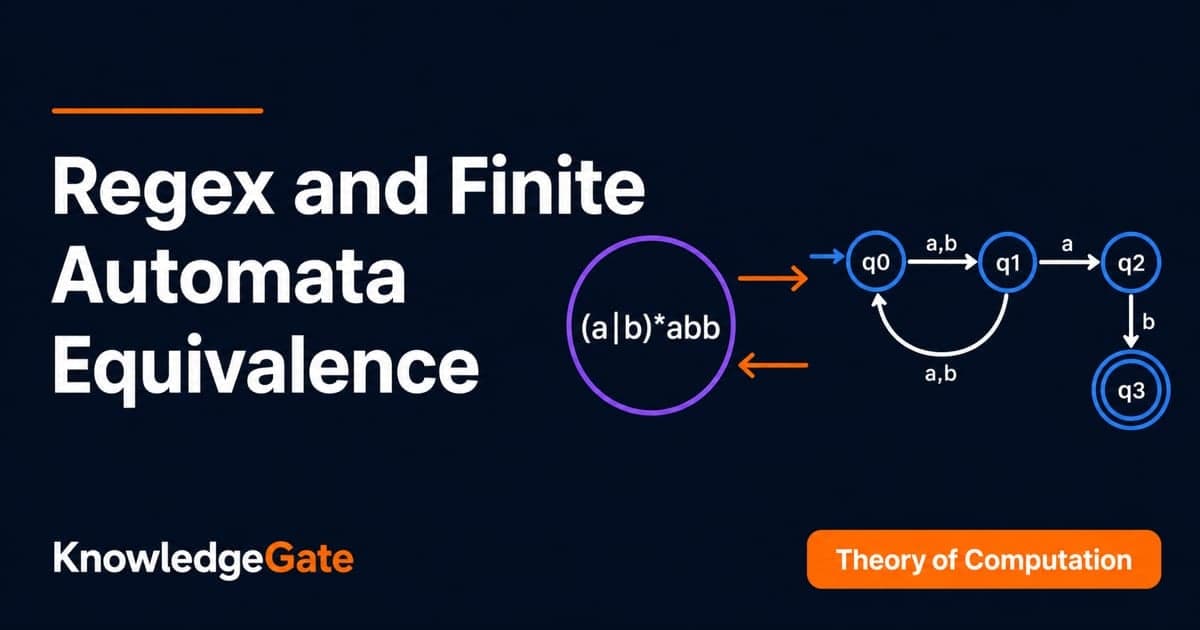
A regular expression and a finite automaton can look unrelated even when they describe exactly the same strings. In conversion questions, that gap makes symbol-pushing fragile and easy to mistrust. The reliable approach is to preserve the language at every step, so we will build one complete regex-to-NFA-to-DFA example, reverse an FA into a regex, and apply concrete equivalence checks from CS fundamentals.
What regex and finite-automata equivalence actually means
Fix an alphabet Sigma. A regular expression R denotes a language L(R), while an NFA or DFA M recognises a language L(M). Saying R and M are equivalent means exactly this:
L(R) = L(M)
Their symbols, shape and number of states need not look alike. Regular expressions, epsilon-NFAs, NFAs and DFAs all describe exactly the regular languages, so conversion is possible in both directions. The pumping lemma helps establish regular-language boundaries, but it is not a conversion algorithm.
Keep precedence fixed while reading every expression: star binds first, concatenation second and union last. Therefore (0|1)*101 means any binary prefix followed by the exact suffix 101. It does not mean 0 | 1*101.
The conversion map to remember
The forward route is:
regex -> epsilon-NFA -> DFA -> optional minimum DFA
In Thompson's construction, a symbol contributes one labelled edge. Union adds an epsilon split and join, concatenation connects fragments with an epsilon edge, and star adds both an epsilon bypass and an epsilon return. Epsilon-closure followed by subset construction removes nondeterminism without changing the language. The guide to DFA, NFA and subset construction develops those reachable-set mechanics further.
The reverse route is FA -> GNFA -> regex. Add a new start and a new accepting state, label absent edges with the empty language, combine parallel edges by union, then eliminate intermediate state k using:
Rij <- Rij | Rik(Rkk)*Rkj
Arden's theorem offers another route through regular-language equations. Whichever route you choose, the invariant is the same: every step must preserve all accepted strings, not merely agree on a few samples.
Worked example: convert (0|1)*101 to an NFA
Use one language throughout the forward conversion:
R = (0|1)*101
Sigma = {0,1}
L(R) = {w101 | w in {0,1}*}
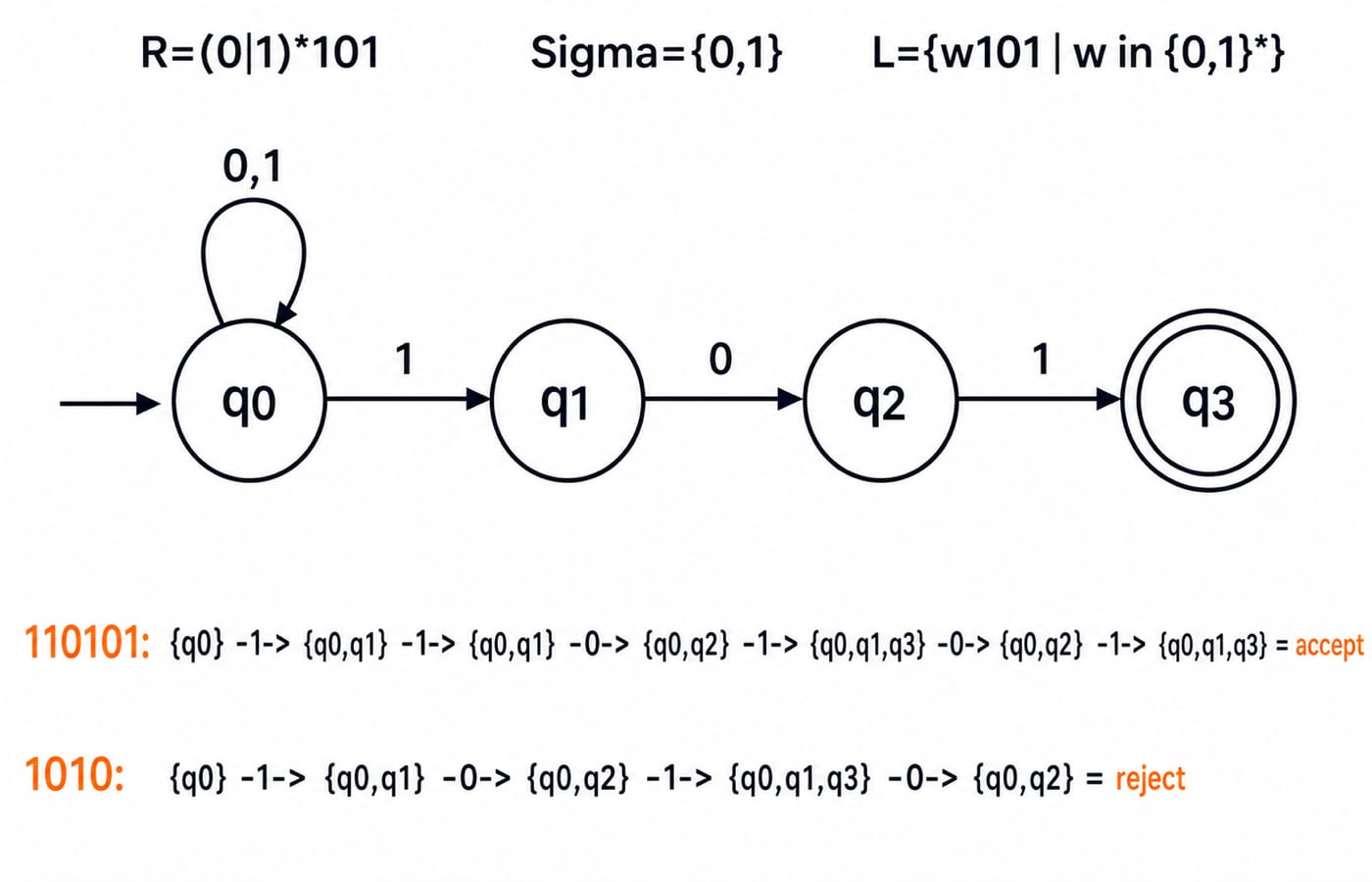
A compact direct NFA uses start state q0 and only accepting state q3:
State | On | On |
|---|---|---|
|
|
|
|
|
|
|
|
|
|
|
|
The loop at q0 consumes an arbitrary binary prefix. Its extra branch on 1 guesses where the final 101 starts. For 110101, the full state-set trace is:
{q0} -1-> {q0,q1} -1-> {q0,q1} -0-> {q0,q2} -1-> {q0,q1,q3} -0-> {q0,q2} -1-> {q0,q1,q3}
The set contains q3 after all six symbols, so the NFA accepts. For 1010, the trace ends at {q0,q2}. The branch that reached q3 after 101 cannot consume the last 0, so the machine rejects. As boundary checks, 101 is accepted, while epsilon, 10 and 1011 are rejected.
Determinise the NFA and verify the same language
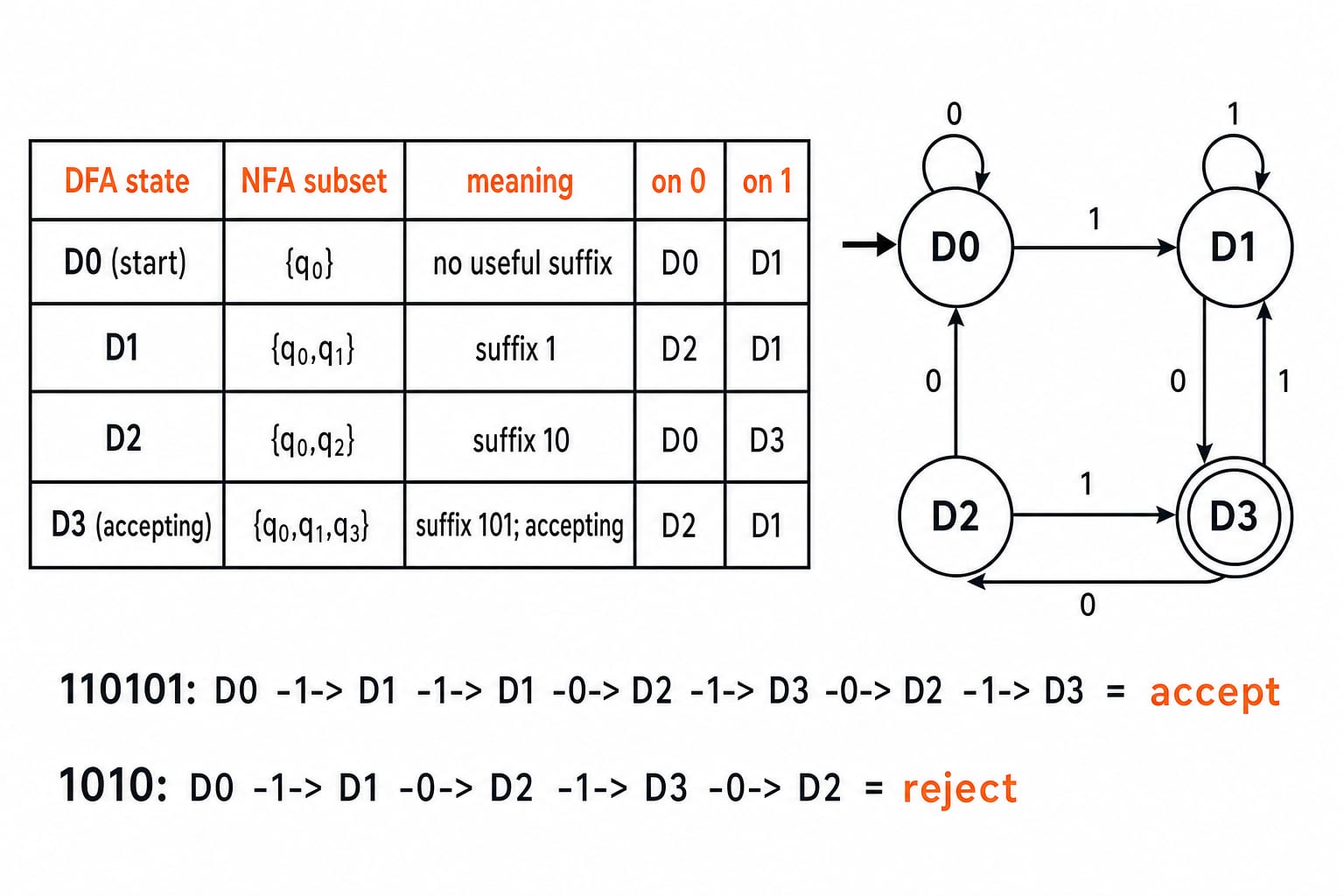
Subset construction produces only four reachable subsets. A DFA state is accepting exactly when its subset contains q3.
DFA state | NFA subset | Meaning | On | On |
|---|---|---|---|---|
|
| no useful suffix |
|
|
|
| suffix |
|
|
|
| suffix |
|
|
|
| suffix |
|
|
The empty subset is unreachable because every reachable set retains q0. Now 110101 follows D0 -1-> D1 -1-> D1 -0-> D2 -1-> D3 -0-> D2 -1-> D3, so it is accepted. Input 1010 ends with D0 -1-> D1 -0-> D2 -1-> D3 -0-> D2, so it is rejected.
The four states are also minimal. D3 is accepting and the other states are not. Suffix 1 distinguishes D2 from both D0 and D1, while suffix 01 distinguishes D1 from D0. Equivalence follows from the subset invariant: after every input prefix, the DFA state contains exactly the NFA states reachable on that prefix.
Reverse direction: turn a small FA into a regex
Consider an automaton M over {a,b}. State p is the start, r is accepting, and its only transitions are p -a-> p, p -b-> r and r -b-> r. Its strings contain zero or more a symbols followed by one or more b symbols.
For a GNFA, add new start s with s -epsilon-> p and new final f with r -epsilon-> f. Eliminate p first. The new label from s to r is:
epsilon(a)*b = a*b
Eliminating r then gives:
a*b(b)*epsilon = a*bb*
Thus the equivalent regex is exactly a*bb*. Input aabbb follows p -a-> p -a-> p -b-> r -b-> r -b-> r and matches the regex. Input aba reaches r after ab but has no move on the last a; it also fails the regex. Replacing the result with a*b* is wrong because that expression also admits epsilon and aaa.
How to prove equivalence and find a counterexample
There are three dependable proof routes. Use a semantics-preserving construction such as subset construction, reduce both descriptions to minimal DFAs and compare them up to state renaming, or build a DFA for their symmetric difference and check whether any accepting state is reachable.
For example, compare R1=(0|1)*101 with R2=(0|1)*0101. String 101 belongs to L(R1) but not L(R2), so this one witness disproves equivalence. Testing 0101 alone proves nothing because both expressions accept it.
For two DFAs, form product states (x,y) and mark a pair accepting when exactly one component accepts. Breadth-first search from the paired start returns a shortest distinguishing string if a mismatch is reachable. If no mismatch is reachable, the DFAs are equivalent.
Exam-style traps and a reliable solving routine
Typical question formats ask you to choose an equivalent regex, complete a transition, calculate epsilon-closures, list reachable subsets, perform one GNFA elimination, or decide whether two machines accept the same language. The focused follow-on, Regex and FA Equivalence MCQs: 10 Solved PYQs, lets you apply these methods.
Use each trap as a correction cue:
Following only
q0 -1-> q1and droppingq0-> retain the whole set{q0,q1}.Accepting when
q3first appears during1010-> consume the full input; the final set is{q0,q2}.Treating
epsilonas an alphabet symbol -> take an epsilon transition without consuming input.Reading
(0|1)*101as0 | 1*101-> apply precedence or retain the parentheses.Replacing
a*bb*witha*b*-> testepsilonas a counterexample.
For a quick routine, write the alphabet and acceptance condition, parenthesise the regex, build the transition table, compute closures before moves, and retain only reachable subsets. Trace one accepted string and one boundary reject. Then seek a counterexample before starting a long proof. KnowledgeGate has 30+ published practice questions tagged to Regex & FA Equivalence, which is useful as a practice-pool cue.
Short version and the next practice step
Remember the chain: regex to epsilon-NFA by fragments, epsilon-NFA to DFA by closures and subsets, then DFA to regex by GNFA elimination. Equivalence means the same language, not the same drawing. Here, 110101 ends at D3, while 1010 ends at D2; the reverse example gives a*bb*, not a*b*.
Reconstruct the four-row table without looking, then test 101, 00101, 1010 and epsilon: accept, accept, reject, reject. Continue with Theory Of Computation / Automata Theory as the focused route, or Zero to Hero: Complete CS Course for broader multi-subject study.
Keep learning
Regex Basics and Definitions: Operators, Worked Examples and Exam Patterns
Learn how regular expressions denote languages, how their three core operators bind, and how to build and check expressions with exact binary examples.
Updated 21 Oct 20265 min readTheory of Computation
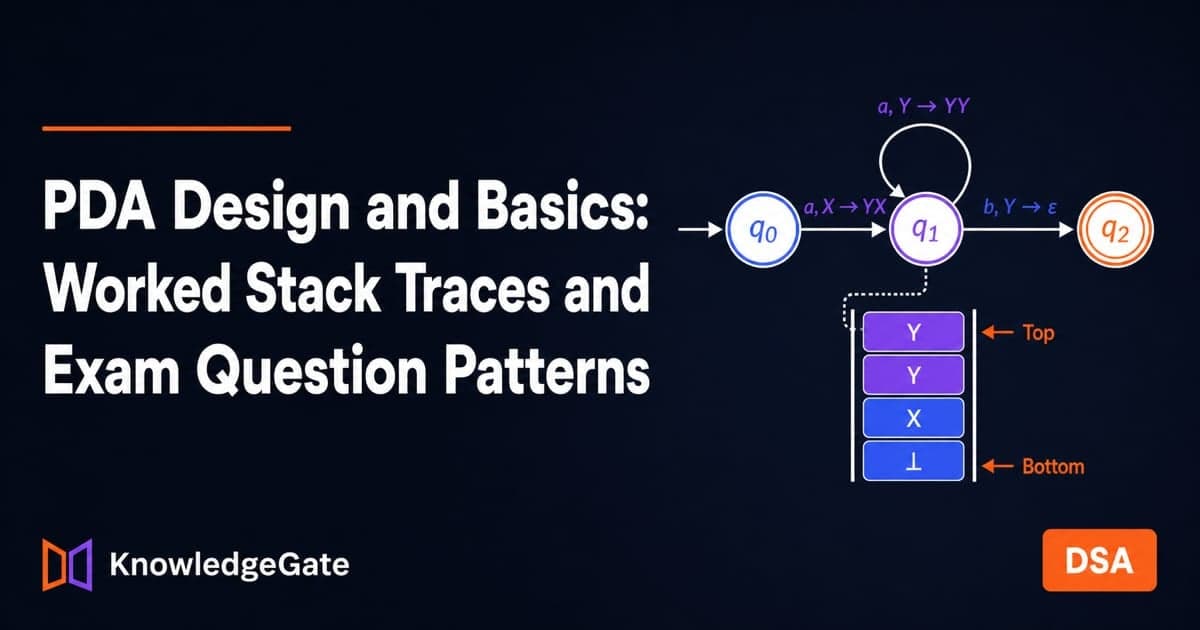
PDA Design and Basics: Worked Stack Traces and Exam Question Patterns
Learn how a pushdown automaton uses its stack, then design and trace a complete machine for a^n b^n. The worked CFG conversion and rejection checks make every move testable.
Updated 13 Oct 20266 min readTheory of Computation
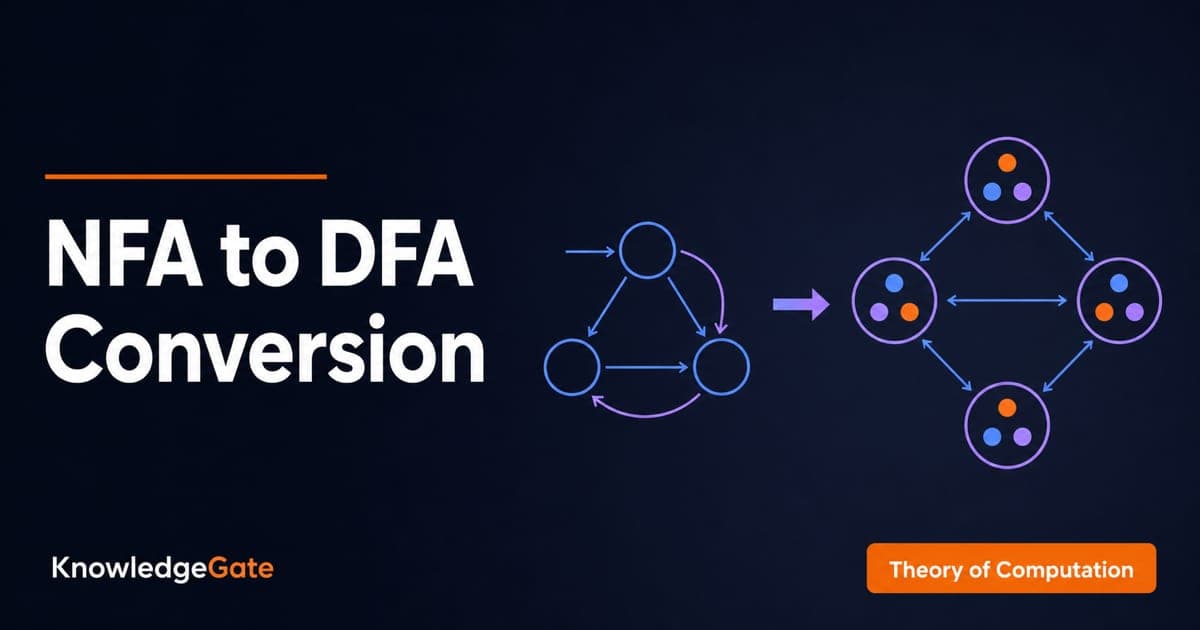
NFA to DFA Conversion: Subset Construction, Worked Example, and Exam Traps
Learn subset construction by converting one three-state NFA row by row, checking the result with strings, and then minimising the reachable DFA.
Updated 9 Oct 20265 min readTheory of Computation
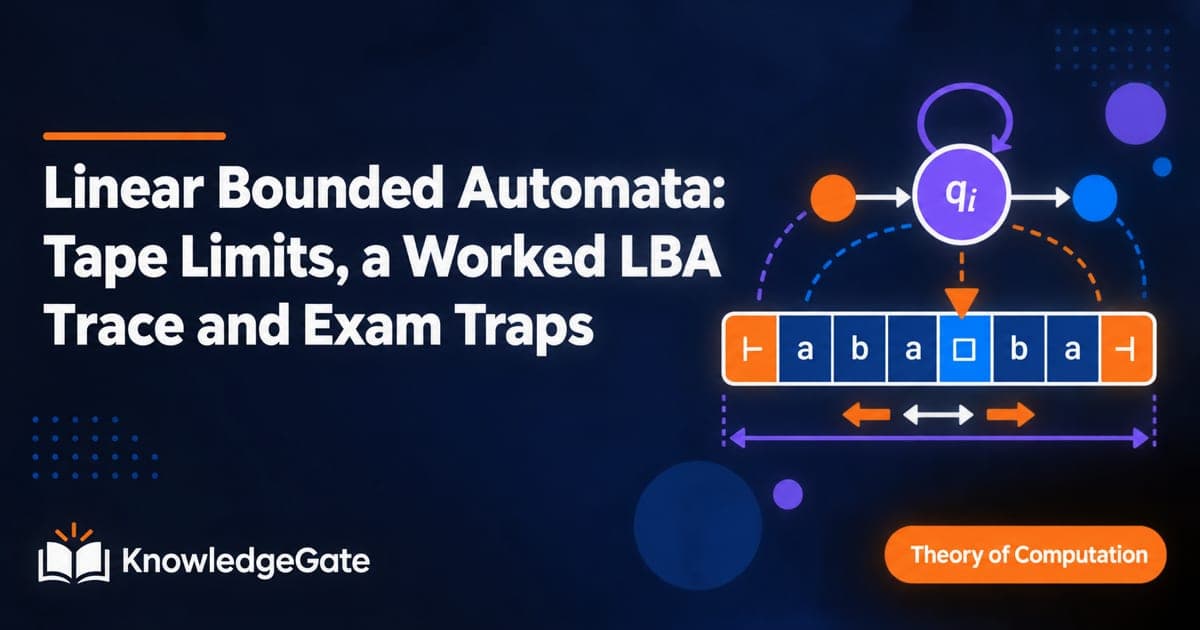
Linear Bounded Automata: Tape Limits, a Worked LBA Trace and Exam Traps
See exactly what an LBA bounds, where it sits in the language hierarchy, and how a six-cell marking machine accepts aabbcc while rejecting three near misses.
Updated 4 Oct 20266 min readTheory of Computation