Round Robin Scheduling MCQs: 12 Solved Questions Explained
Attempt 12 published Round Robin scheduling questions, then check the reasoning behind each answer. The set progresses from core behaviour to queue traces and CPU/I/O timing.
KnowledgeGate Team
Exam prep & CS education
Updated 27 Aug 20269 min read112 views
Round Robin looks like simple rotation, but every answer depends on the ready queue at a scheduling boundary. When a quantum expires, admit processes that arrived during the slice before requeuing the unfinished process; when a burst finishes, remove that process. Completion time marks the last CPU slice, turnaround is completion minus arrival, and waiting is turnaround minus the total CPU burst. A large quantum approaches FCFS; a smaller one improves response but triggers more switches. For CPU and I/O questions, record when each process begins I/O and when the CPU becomes idle. Draw a timeline and the queue together, then attempt each question before reading its answer. If those foundations feel uncertain, first rebuild the underlying scheduling theory.
1. Round Robin basics, time sharing, and limiting cases
Q1
Which scheduling policy is most suitable for a time-shared operating system?
(a) Shortest Job First
(b) Round Robin
(c) First Come First Serve
(d) Elevator
Answer: (b) Round Robin. Preemptive fixed slices cycle through the ready queue and give each process bounded CPU access. FCFS can delay interactive work, SJF needs burst knowledge, and Elevator schedules disks.
Q2
If the time-slice used in the round-robin scheduling policy is more than the maximum time required to execute any process, then the policy will
(a) degenerate to shortest job first
(b) degenerate to priority scheduling
(c) degenerate to first come first serve
(d) none of the above
Answer: (c) degenerate to first come first serve. With bursts 2, 4, 3 in that arrival order and quantum 5, every process finishes in its first allocation. Execution remains 2 -> 4 -> 3.
Q3
A scheduling algorithm assigns priority proportional to the waiting time of a process. Every process starts with priority zero (the lowest priority). The scheduler re-evaluates the process priorities every T time units and decides the next process to schedule. Which one of the following is TRUE if the processes have no I/O operations and all arrive at time zero?
(a) This algorithm is equivalent to the first-come-first-serve algorithm
(b) This algorithm is equivalent to the round-robin algorithm.
(c) This algorithm is equivalent to the shortest-job-first algorithm.
(d) This algorithm is equivalent to the shortest-remaining-time-first algorithm
Answer: (b) This algorithm is equivalent to the round-robin algorithm. At each T-unit decision, the process just run has waited least while the others have waited longer. Selection therefore rotates in T-unit slices.
2. Scheduling objectives, preemption, and starvation
Q4
Which of the following statement(s) is/are correct in the context of CPU scheduling?
(a) Turnaround time includes waiting time
(b) The goal is to only maximize CPU utilization and minimize throughput
(c) Round-robin policy can be used even when the CPU time required by each of the processes is not known apriori
(d) Implementing preemptive scheduling needs hardware support
Answer: (a), (c), (d) For CPU-only examples, turnaround = completion - arrival and waiting = turnaround - CPU burst. B wrongly minimises throughput. RR needs no predicted burst; timer interrupts enable preemption.
Q5
Which one or more of the following CPU scheduling algorithms can potentially cause starvation?
(a) First-in First-Out
(b) Round Robin
(c) Priority Scheduling
(d) Shortest Job First
Answer: (c) and (d) Higher-priority arrivals can indefinitely postpone low-priority work, while repeated short arrivals can starve a long SJF job. FIFO eventually advances, and RR repeatedly serves ready processes.
Q6
Which of the following statements are true? I. Shortest remaining time first scheduling may cause starvation II. Preemptive scheduling may cause starvation III. Round robin is better than FCFS in terms of response time
(a) I only
(b) I and III only
(c) II and III only
(d) I, II and III
Answer: (d) I, II and III. Short arrivals may starve a long SRTF job. Preemption can cause starvation when arrivals repeatedly displace one process. RR usually improves response because later jobs run before an earlier long job finishes.
3. Trace the ready queue before calculating anything
At each dispatch, run min(remaining burst, quantum), admit new arrivals, remove a completed process, and otherwise append it to the queue tail. Use the question's context-switch definition.
Q7
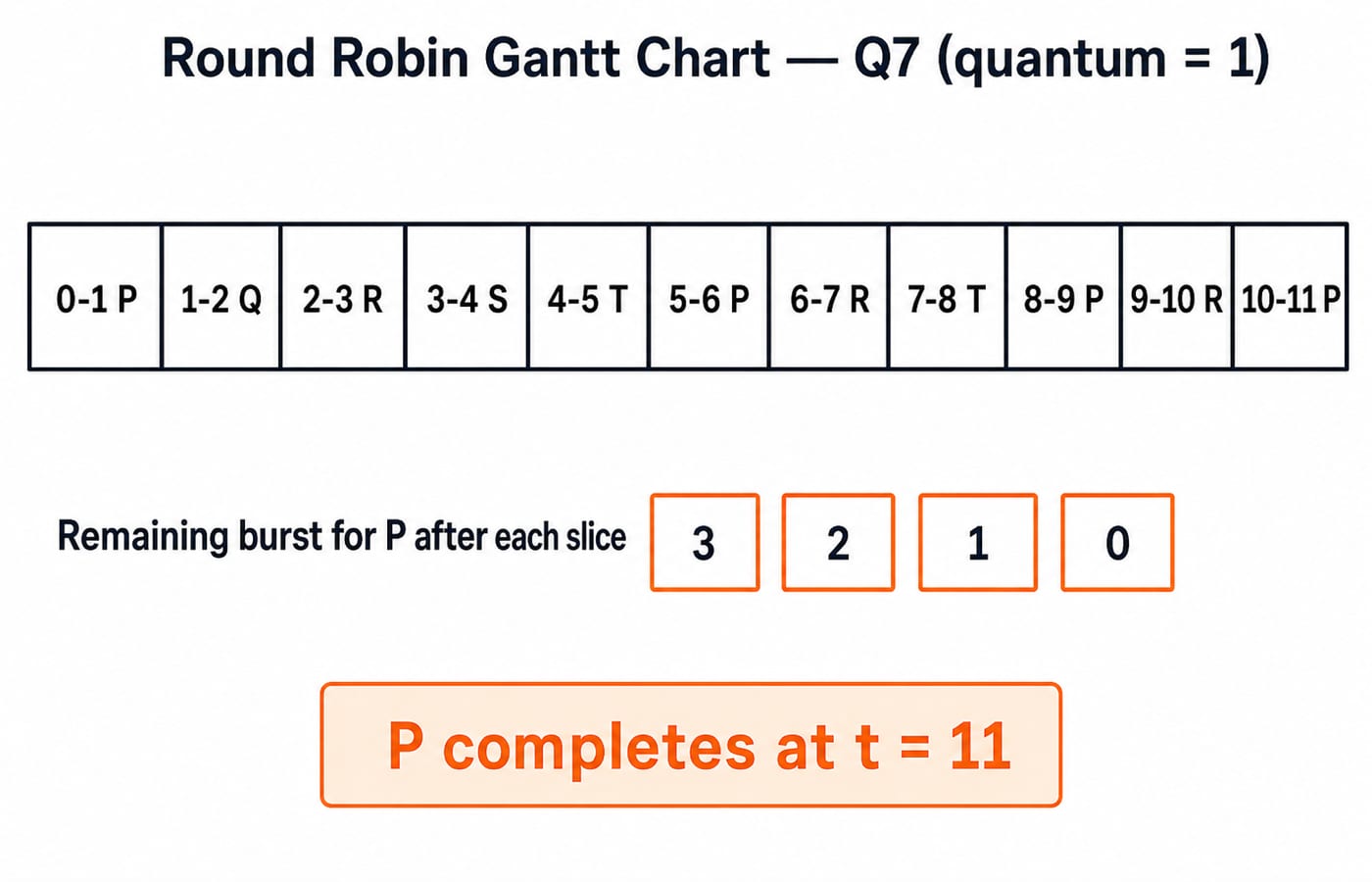
Assume that the following jobs are to be executed on a single processor system. The jobs are assumed to have arrived at time t = 0 and in the order P, Q, R, S, T; calculate the departure time (completion time) for job P if scheduling is round robin with time slice 1. Job CPU Burst Time P 4 Q 1 R 8 S 1 T 2
(a) 4
(b) 10
(c) 11
(d) 12
Answer: (c) 11. Trace to P's finish: 0-1 P, 1-2 Q, 2-3 R, 3-4 S, 4-5 T, 5-6 P, 6-7 R, 7-8 T, 8-9 P, 9-10 R, 10-11 P. Its fourth CPU unit ends at t = 11; burst and completion time differ.
Q8
Consider four processes P, Q, R, and S scheduled on a CPU as per round robin algorithm with a time quantum of 4 units. The processes arrive in the order P, Q, R, S, all at time t = 0. There is exactly one context switch from S to Q, exactly one context switch from R to Q, and exactly two context switches from Q to R. There is no context switch from S to P. Switching to a ready process after the termination of another process is also considered a context switch. Which one of the following is NOT possible as CPU burst time (in time units) of these processes?
(a) P = 4, Q = 10, R = 6, S = 2
(b) P = 2, Q = 9, R = 5, S = 1
(c) P = 4, Q = 12, R = 5, S = 4
(d) P = 3, Q = 7, R = 7, S = 3
Answer: (d) P = 3, Q = 7, R = 7, S = 3. D gives 0-3 P, 3-7 Q, 7-11 R, 11-14 S, 14-17 Q, 17-20 R. It has one S -> Q and two Q -> R transitions, but no R -> Q. The other options produce P, Q, R, S, Q, R, Q, satisfying every count.
4. Compare turnaround times with one table, not intuition
Calculate turnaround = completion - arrival for every process before comparing averages. Fair CPU access does not imply minimum average turnaround.
Q9
For the processes listed in the following table, which of the following scheduling schemes will give the lowest average turnaround time?
(a) First Come First Serve
(b) Non-preemptive Shortest Job First
(c) Shortest Remaining Time
(d) Round Robin with Quantum value two
Answer: (c) Shortest Remaining Time. The averages are FCFS 7.25, non-preemptive SJF 6.75, SRTF 6.25, and RR with quantum 2 8.25. SRTF gives A = 3, B = 14, C = 4, D = 4, hence (3 + 14 + 4 + 4) / 4 = 6.25. Try Process Scheduling MCQs: 12 Solved for mixed-algorithm practice.
5. Quantum bounds, utilisation, and CPU/I/O timing
Q10
Consider n processes sharing the CPU in a round-robin fashion. Assuming that each process switch takes s seconds, what must be the quantum size q such that the overhead resulting from process switching is minimized but at the same time each process is guaranteed to get its turn at the CPU at least every t seconds?
(a) q ≤ (t − ns)/(n − 1)
(b) q ≥ (t − ns)/(n − 1)
(c) q ≤ (t − ns)/(n + 1)
(d) q ≥ (t − ns)/(n + 1)
Answer: (a) q ≤ (t - ns)/(n - 1). Between its turns, the other n - 1 processes use at most (n - 1)q, and n switches cost ns. From (n - 1)q + ns ≤ t, isolate q. The largest allowed value minimises proportional switching overhead.
Q11
A uni-processor computer system only has two processes, both of which alternate 10ms CPU bursts with 90ms I/O bursts. Both the processes were created at nearly the same time. The I/O of both processes can proceed in parallel. Which of the following scheduling strategies will result in the least CPU utilization (over a long period of time) for this system ?
(a) First come first served scheduling
(b) Shortest remaining time first scheduling
(c) Static priority scheduling with different priorities for the two processes
(d) Round robin scheduling with a time quantum of 5 ms
Answer: (d) Round robin scheduling with a time quantum of 5 ms. Trace 0-5 P1, 5-10 P2, 10-15 P1, 15-20 P2. I/O starts at 15 and 20, so the CPU idles from 20 until 105. The pattern repeats every 105 ms, using the CPU for 20 ms, or about 19.0%. Letting each burst finish repeats every 100 ms, so utilisation is 20%. RR is therefore the least.
Q12
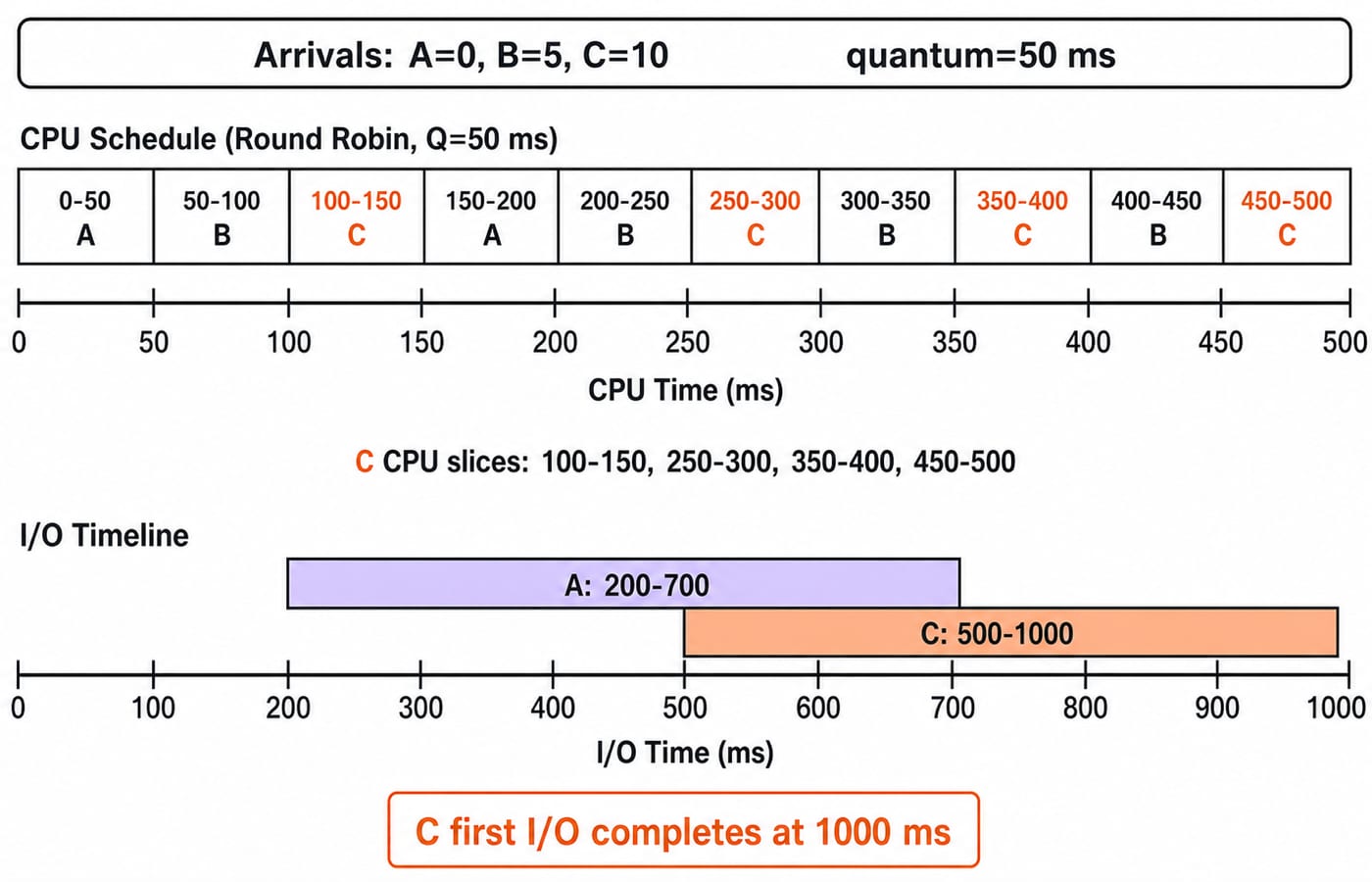
Three processes A, B and C each execute a loop of 100 iterations. In each iteration of the loop, a process performs a single computation that requires tc CPU milliseconds and then initiates a single I/O operation that lasts for tio milliseconds. It is assumed that the computer where the processes execute has sufficient number of I/O devices and the OS of the computer assigns different I/O devices to each process. Also, the scheduling overhead of the OS is negligible. The processes have the following characteristics: The processes A, B, and C are started at times 0, 5 and 10 milliseconds respectively, in a pure time sharing system (round robin scheduling) that uses a time slice of 50 milliseconds. The time in milliseconds at which process C would complete its first I/O operation is ___________.
This is a numerical-answer question, so there are no options to choose from.
Answer: 1000 ms. Trace 0-50 A, 50-100 B, 100-150 C, 150-200 A, 200-250 B, 250-300 C, 300-350 B, 350-400 C, 400-450 B, 450-500 C. C gets 4 x 50 = 200 ms of CPU, starts I/O at 500, and finishes at 500 + 500 = 1000 ms. The other iterations are irrelevant.
6. Answer key, common traps, and the next practice step
Question | Answer | Question | Answer |
|---|---|---|---|
Q1 | B | Q7 | C (11) |
Q2 | C | Q8 | D |
Q3 | B | Q9 | C (6.25) |
Q4 | A, C, D | Q10 | A |
Q5 | C, D | Q11 | D |
Q6 | D | Q12 | 1000 |
Build these three habits consistently: update the queue at every boundary; distinguish burst, response, waiting, turnaround, and completion; write the inequality or timeline before touching the options.
Use GATE Guidance by Sanchit Sir for structured GATE preparation. Choose CS Fundamentals for Placements by Sanchit Sir for placement-focused CS, or browse CS Fundamentals for Exams & Placements for related material.
Keep learning
Process Synchronization MCQs: 10 Solved Cross-Concept Questions with Explanations
Solve 10 mixed Process Synchronization questions, then learn how shared state, atomic operations, waiting behaviour and lock ownership decide each answer.
Updated 24 Oct 20267 min readOperating System MCQs

Process Basics and PCB MCQs: 12 Solved Questions with Explanations
Solve 12 Process Basics and PCB questions, then use each explanation to repair the exact concept boundary behind the correct option.
Updated 20 Oct 20268 min readOperating System MCQs

Critical Section MCQs: 12 Solved Questions on Race Conditions and Mutual Exclusion
Practise critical-section MCQs on race conditions, mutual exclusion, Bakery ordering, stale writes and priority inversion, with explanations and two complete traces.
Updated 16 Oct 20268 min readOperating System MCQs
Hardware Synchronization MCQs: 10 Solved Test-and-Set, Spinlock and Barrier Questions
Attempt 10 hardware synchronization questions, then check concise explanations of atomic instructions, busy waiting, lock failures and barrier races.
Updated 12 Oct 20267 min readOperating System MCQs