SBI PO Syllabus and Exam Pattern 2026: Prelims, Mains, Psychometric Test and Interview Decoded
The SBI PO selection runs beyond Prelims and Mains: a psychometric test, group exercise and interview decide the final merit. A stage-by-stage decode of what each assessment tests, which parts have a syllabus, and how to split your preparation, with every official specific pointed at the current SBI notification.
KnowledgeGate Team
Exam prep & CS education
19 Jul 20265 min read
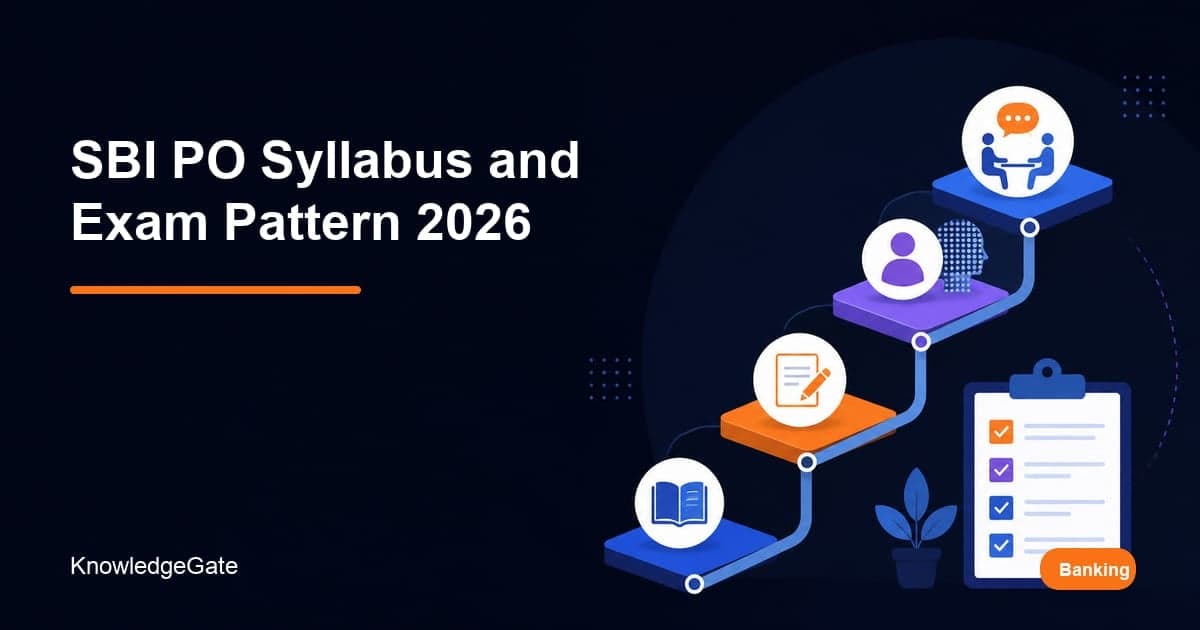
The SBI PO is not a two-exam selection. Beyond Prelims and Mains sits a final phase that recent SBI notifications describe as a psychometric test, a group exercise and an interview, and aspirants who discover it late lose ground they had earned on paper. Two of those three assessments have no syllabus to revise, which is exactly why they need a slot in your week from the start, not in the fortnight before the call letter.
SBI PO selection process: three phases, from Prelims to the interview
Selection runs in three phases: the Preliminary examination, the Main examination, and a final phase of psychometric test, group exercise and interview. Here is how each maps onto what you prepare:
Stage | Where to prepare it | What you prepare there |
|---|---|---|
Preliminary exam | English Language, Quantitative Aptitude and Reasoning Ability at screening speed | |
Main exam | Four objective sections plus the Descriptive Test | |
Psychometric test, group exercise and interview | Built on your Mains awareness work | Consistent self-presentation, group communication, banking-context answers |
The Prelims screens, the Mains does most of the ranking, and the final phase decides among candidates who all cleared the written stages. That ordering should drive your hours.
SBI PO Prelims syllabus: English, Quantitative Aptitude and Reasoning Ability
The Preliminary exam covers three sections: English Language, Quantitative Aptitude and Reasoning Ability. Its job is to decide who reaches the Mains, so prepare it for speed and accuracy rather than depth.
In practice this means daily timed work on reading comprehension and grammar, arithmetic and data interpretation, and the puzzle and seating-arrangement families that dominate banking reasoning. The trap here is familiarity: the topics look easy in an untimed practice set and behave very differently under a running clock. A few focused weeks of honest timed practice clear this stage; untimed months do not.
SBI PO Mains syllabus: four objective sections and a descriptive test
The Mains syllabus is a step up from Prelims in both breadth and difficulty:
Reasoning and Computer Aptitude: the harder puzzle sets, plus basic computer awareness woven into reasoning items.
Data Analysis and Interpretation: the Mains version of quant, built around caselets and multi-source data sets rather than standalone arithmetic.
General, Economy and Banking Awareness: current affairs, the economy and the banking system. This section rewards months of steady reading and cannot be compressed into a revision week.
English Language: comprehension and usage at Mains difficulty.
Descriptive Test: essay and letter writing, typed under time. Structured writing is a skill you build by writing, not by reading model answers.
Two of these deserve special respect. Data Analysis and Interpretation punishes candidates who prepared Prelims-level arithmetic and stopped. And the awareness section does double duty, because the same banking and economy reading feeds your interview answers later.
SBI PO exam pattern: the six details that decide how you attempt each paper
The syllabus tells you what is asked. The exam pattern tells you how it is counted and timed, and SBI resets it cycle by cycle, so for a 2026 attempt read these six details off the current notification and keep them on one page:
The sections of each phase in the order they appear, so your mocks rehearse the real running order.
Question count against maximum marks per section. Where a section carries more marks per question, accuracy there is worth more than speed elsewhere.
Time allowed per section and for the paper as a whole, and whether the sections are separately timed. Separate timing means an unfinished section cannot be rescued later.
The negative-marking rule, copied exactly. It decides how sure you must be before attempting a doubtful question.
Sectional qualifying marks, where the cycle has them, sitting beside the overall cut-off. One weak area can end an otherwise good attempt.
How the descriptive paper is taken and evaluated, and how the phases are weighted into the final merit list. Both tell you where an extra hour pays.
SBI PO Psychometric Test, Group Exercise and Interview: what each one assesses
Recent SBI notifications describe a psychometric test for personality profiling, with its output made available to the interviewing panel. Check how the current cycle runs this on the official careers page at sbi.co.in. A psychometric test has no syllabus and no right answers. What stands out to a panel is inconsistency, so answer honestly and consistently rather than guessing at an ideal personality.
The group exercise is a small-group discussion task. You are assessed on how you reason with other people: listening, building on someone else's point, disagreeing without heat, and staying composed when the discussion turns. You cannot cram this the week before, but you can practise it by discussing an editorial or a banking development aloud with a study partner every week.
The interview draws on banking awareness, current affairs, your graduation subjects and why you want an officer's role in a bank. Expect to defend a view rather than recite one, usually on a recent banking development or something from your own degree. This is where your General, Economy and Banking Awareness hours pay a second dividend.
How to split your SBI PO preparation
A practical division of effort:
Mains: the majority of your time, started from day one. It carries the largest syllabus, does most of the ranking, and its awareness section needs months of daily reading that cannot be back-loaded.
Prelims: a steady timed-practice slice. Enough to clear the screen with margin, never so much that it eats your Mains depth.
Psychometric, group exercise and interview: a running thread, not a block. Daily awareness reading plus a weekly spoken discussion covers most of it long before the call letter arrives.
If SBI PO is one of several banking exams on your list, sequence your attempts with a banking exam preparation plan that works whatever the calendar, and browse the wider Banking & Insurance section to see where these same hours transfer.
The short version
Three phases, one merit list. Prepare Mains as the main event from day one, keep Prelims sharp with timed practice, and let awareness reading and weekly speaking practice cover the final phase. If you want the written stages already structured in one place, the SBI PO Complete Preparation bundle covers Prelims and Mains together; if you only need the screening stage first, the Prelims course alone gets you moving.
Before you commit your calendar, pull the current notification from the official SBI careers site for the exact dates, marks, weightages, eligibility and vacancies. Those move cycle to cycle; the three-phase shape of the selection does not.
Keep learning
RBI Grade B Previous Year Analysis: Recurring Topics and Study Priorities
Use recurring topic families to choose what to revise, then let your errors decide the time allocation. Work through DI, reasoning and reading examples before building a practical weekly plan.
22 Oct 20264 min readBanking Exams
RBI Grade B Exam Pattern and Marking Scheme: Phases, Scores and Penalties
Clearing Phase I and earning final-merit marks are different jobs. Understand the General-cadre stages, section timers and score calculations before planning your next mock.
18 Oct 20265 min readBanking Exams
GST Explained for Competitive Exams: Rates, CGST vs SGST vs IGST
Separate GST rates from tax components, then work through a 1,000 rupees supply and a simple input tax credit chain. Keep dated reforms apart from the concepts you use in calculations.
Updated 14 Oct 20265 min readBanking Exams
RBI Grade B Eligibility and Selection Process: Age, Qualifications and Stages
Check your RBI Grade B General Cadre eligibility in the right order: stream, age, qualification and previous appearances. Worked examples explain the boundaries before you plan for each selection stage.
9 Oct 20265 min readBanking Exams