Software Quality in Software Engineering: Metrics, Testing and Worked Examples
Learn the vocabulary and calculations behind software quality, from McCall's factors to basis-path testing and service availability.
KnowledgeGate Team
Exam prep & CS education
Updated 21 Jul 20266 min read

Most students can say that quality means software works, then lose marks on the precise vocabulary. Software quality is a testable set of factors, distinctions and formulas: McCall's eleven factors, QA against QC, verification against validation, and three quantities you compute rather than describe, defect density, cyclomatic complexity and availability. Marks go missing in the definitions far more often than in the arithmetic.
What software quality actually means
Pressman's three-part framing defines quality as conformance to stated functional and performance requirements, documented development standards, and implicit expectations of professional software. A product must therefore meet its purpose, follow the agreed process and behave dependably.
Functional quality asks whether software meets its specification and performs required tasks with few defects. Structural quality asks whether its code is maintainable, testable and sensibly organised. Correct output can coexist with poor internal design.
Quality models organise these properties. McCall groups the “ilities” by operation, revision and transition. ISO/IEC 25010, which succeeded ISO/IEC 9126, supplies a separate model. Use the official ISO standard for its exact current list.
Software quality factors you must be able to name
The core factors have distinct meanings:
Correctness: conformance to requirements and objectives.
Reliability: probability of failure-free operation for a stated time and environment.
Efficiency: performance relative to time and memory resources.
Integrity: protection against unauthorised access or modification.
Usability: effort to learn, operate and understand the product.
Maintainability: effort to locate and correct faults.
Flexibility: effort to modify the product for new requirements.
Testability: effort to test the product's correctness.
Portability: effort to move software to another environment.
Reusability: ability of components to serve another application.
Interoperability: ability to exchange data or work with other systems.
McCall groups them into three memorable views. Product Operation contains correctness, reliability, efficiency, integrity and usability. Product Revision contains maintainability, flexibility and testability. Product Transition contains portability, reusability and interoperability.
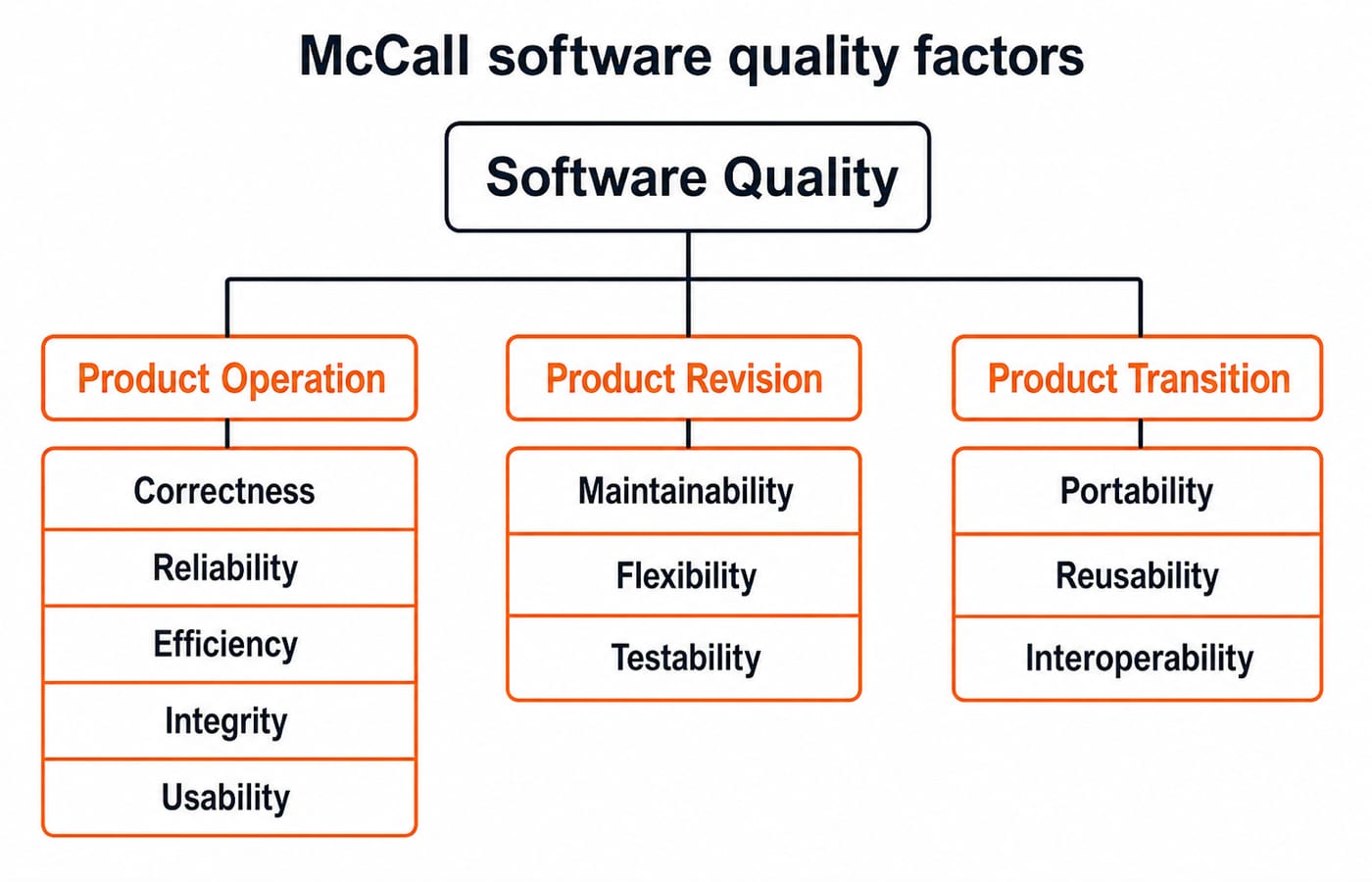
Correctness means conformance to specification. Reliability is the probability of failure-free operation under stated conditions and time. They are not synonyms, a favourite one-mark trap.
Software metrics: measuring quality with numbers
Metrics replace impressions with repeatable numbers. Size metrics include LOC, KLOC and function points. Quality and design metrics include defect density, cyclomatic complexity, coupling and cohesion.
Module X has 45 defects in 15,000 LOC. Module Y has 12 in 3,000 LOC. Defect density is defects divided by KLOC:
Module X size = 15,000 / 1,000 = 15 KLOC.
Module X density = 45 / 15 = 3.0 defects per KLOC.
Module Y size = 3,000 / 1,000 = 3 KLOC.
Module Y density = 12 / 3 = 4.0 defects per KLOC.
Module Y has fewer total defects but more per KLOC, so this metric rates Y lower. A smaller raw count is not automatically better.
Aim for low coupling and high cohesion. Cohesion from best to worst is functional, sequential, communicational, procedural, temporal, logical and coincidental. Coupling from best to worst is data, stamp, control, common and content. Content coupling is worst.
Cyclomatic complexity: a worked example step by step
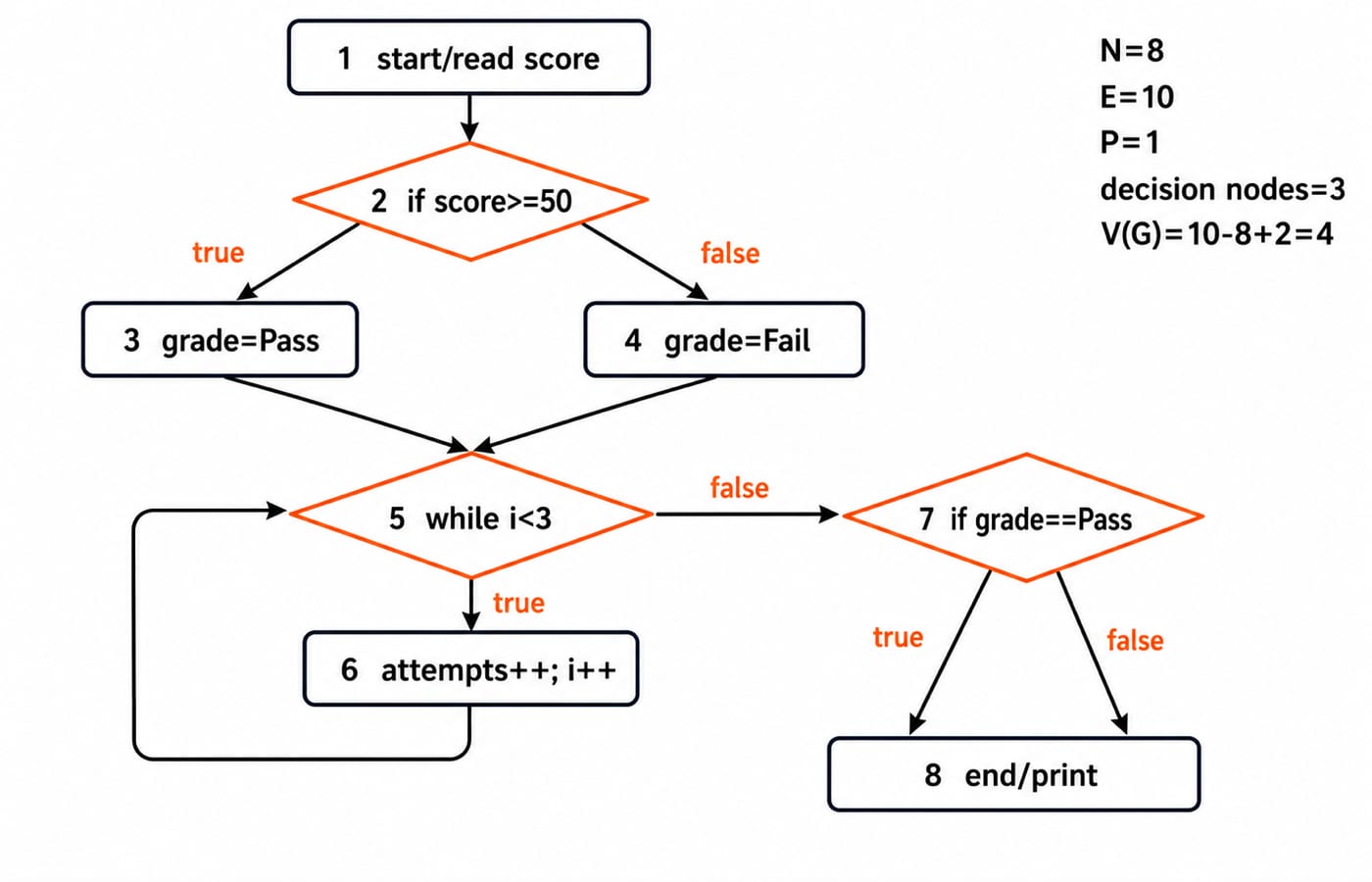
Take this small program. Each statement carries the number of the node it becomes in the control-flow graph below.
read score                   // node 1
if (score >= 50)             // node 2
    grade = "Pass"           // node 3
else
    grade = "Fail"           // node 4
i = 0
while (i < 3)                // node 5
    attempts = attempts + 1  // node 6
    i = i + 1
if (grade == "Pass")         // node 7
    print grade
end                          // node 8: print and end merge here
McCabe's equivalent methods are:
V(G) = E - N + 2P, where E is edges, N is nodes and P is connected components.V(G) = number of predicate nodes + 1for a single connected flow graph.V(G) = number of enclosed regions + 1.
The eight numbered statements are the eight nodes, so N = 8, and the whole thing is one connected piece, so P = 1. Count the edges: 1 to 2; the true and false pair out of 2; 3 to 5 and 4 to 5; the loop's 5 to 6, 6 back to 5, and 5 to 7 on exit; and the true and false pair out of 7 into the shared print-and-end node. That is E = 10. The first if, the while and the final if give three predicate nodes.
Edge formula:
V(G) = 10 - 8 + 2(1) = 2 + 2 = 4.Predicate formula:
V(G) = 3 + 1 = 4.Region formula: three enclosed regions plus the outside region gives
V(G) = 3 + 1 = 4.
All methods give four linearly independent paths, so basis-path testing needs at least four test cases. The value also upper-bounds the branch-coverage test count here. Larger values mean harder testing and maintenance.
QA versus QC, and verification versus validation
Quality Assurance (QA) is process-oriented, proactive and preventive, covering standards, audits and reviews. Quality Control (QC) is product-oriented, reactive and detective, covering testing and product inspection.
Verification asks, “Are we building the product right?” Reviews, walkthroughs and inspections check conformance to specification. Validation asks, “Are we building the right product?” Execution checks the user's actual need.
An informal walkthrough is author-led. A Fagan inspection is formal, with defined roles and a defect log. Both are static verification. The one-mark rule is that verification is mostly static, validation is dynamic, and testing sits under validation and QC.
Software reliability and a worked availability example
Software reliability is the probability of failure-free operation for a specified time and environment. MTTF is mean time to failure; MTTR is mean time to repair. Some texts use MTBF for mean operating time between failures, while others define the full cycle as MTBF = MTTF + MTTR. Follow the question's convention.
Here MTBF means 300 hours of operating time, and MTTR is 12 hours. Availability is uptime divided by uptime plus downtime:
Total cycle time =
300 + 12 = 312 hours.Availability =
300 / 312 = 0.961538....As a percentage,
0.961538... x 100 = 96.1538...%, or about 96.15%.
Halving MTTR to 6 hours gives 300 / 306 = 0.980392..., or 98.04%. Faster recovery improved availability without changing the failure interval. If MTBF means the full cycle, use availability = MTTF / MTBF.
Jelinski-Moranda and Musa are reliability-growth models. Do not invent constants; calculate only when a question supplies a model and parameters.
How exams and interviews test software quality
Software Engineering is not in the current GATE CS core syllabus. It does sit in the UGC NET Computer Science syllabus, and in many PSU and teaching-recruitment notifications. Confirm inclusion and weightage against the conducting body's official syllabus for your own attempt.
Questions ask you to compute V(G), rank coupling or cohesion, separate QA from QC and verification from validation, match an “ility”, or calculate defect density and availability. In interviews, high complexity means more paths and harder testing, often calling for refactoring.
Flow-graph counting uses the vocabulary in Graph Theory: Euler and Hamiltonian Paths, Coloring and Connectivity. Mishandled locks turn concurrency defects into quality failures, making Process Synchronization and Semaphores: Race Conditions, Peterson's Solution, Wait and Signal a useful companion.
The short version and where to go next
Software quality is a named set of factors. Measure it with defect density, complexity, coupling and cohesion. Remember V(G) = E - N + 2P = predicate nodes + 1. Keep QA apart from QC, verification apart from validation, and availability tied to uptime and repair.
For Software Engineering with core CS for placements and technical recruitment, use Computer Science Fundamentals for Placements by Sanchit Sir. For GATE planning, start with GATE Guidance by Sanchit Sir. GATE CS Subject Weightage: Where Your Study Hours Actually Pay Off shows which subjects deserve the remaining hours.
Redraw the eight-node graph and derive V(G) = 4 all three ways. That is the skill a numerical question checks.
Keep learning
Function Keys F1-F12 Explained: Uses, Worked Shortcut Map and Exam Traps
Learn what F1 through F12 do in named Windows and Microsoft application contexts, then solve a nine-command classification and avoid common modifier traps.
Updated 20 Oct 20266 min readUGC NET Computer Science

E-Waste Management Explained: Lifecycle, Worked Recovery Example and Exam Traps
Learn how e-waste moves from use to reuse, recycling and controlled residue. A hypothetical 600 kg batch shows how to close the mass balance and avoid denominator traps.
Updated 16 Oct 20266 min readUGC NET Computer Science

Data Protection, IPR and Open Source Explained: Two Worked Cases and Exam Traps
Separate privacy from security, match IP rights to software assets, and solve two numerical cases on data minimisation and mixed-licence releases.
Updated 12 Oct 20266 min readUGC NET Computer Science

Common Software & Tools MCQs: 12 Solved ICT Questions Explained
Attempt 12 previous-year ICT MCQs before reading concise explanations that separate applications, hardware, web tools, abbreviations, malware and operating systems.
8 Oct 20267 min readUGC NET Computer Science