Subgroup MCQs: 12 Solved Questions on Definitions, Examples, and Tests
Attempt these 12 published subgroup questions, then use the fresh explanations to check each definition, counterexample, and order calculation.
KnowledgeGate Team
Exam prep & CS education
Updated 27 Aug 20267 min read
Subgroup questions often move from a definition check to closure, identity, inverses, intersections, or possible subgroup orders. Attempt each question before reading its explanation, then compare your reasoning with the subgroup test and worked calculations. Use Discrete Mathematics MCQs as the wider practice hub, or locate the topic in the broader GATE CS Exam Preparation route.
Related reading: group theory and group inverses.
1. The subgroup test to use before solving the MCQs
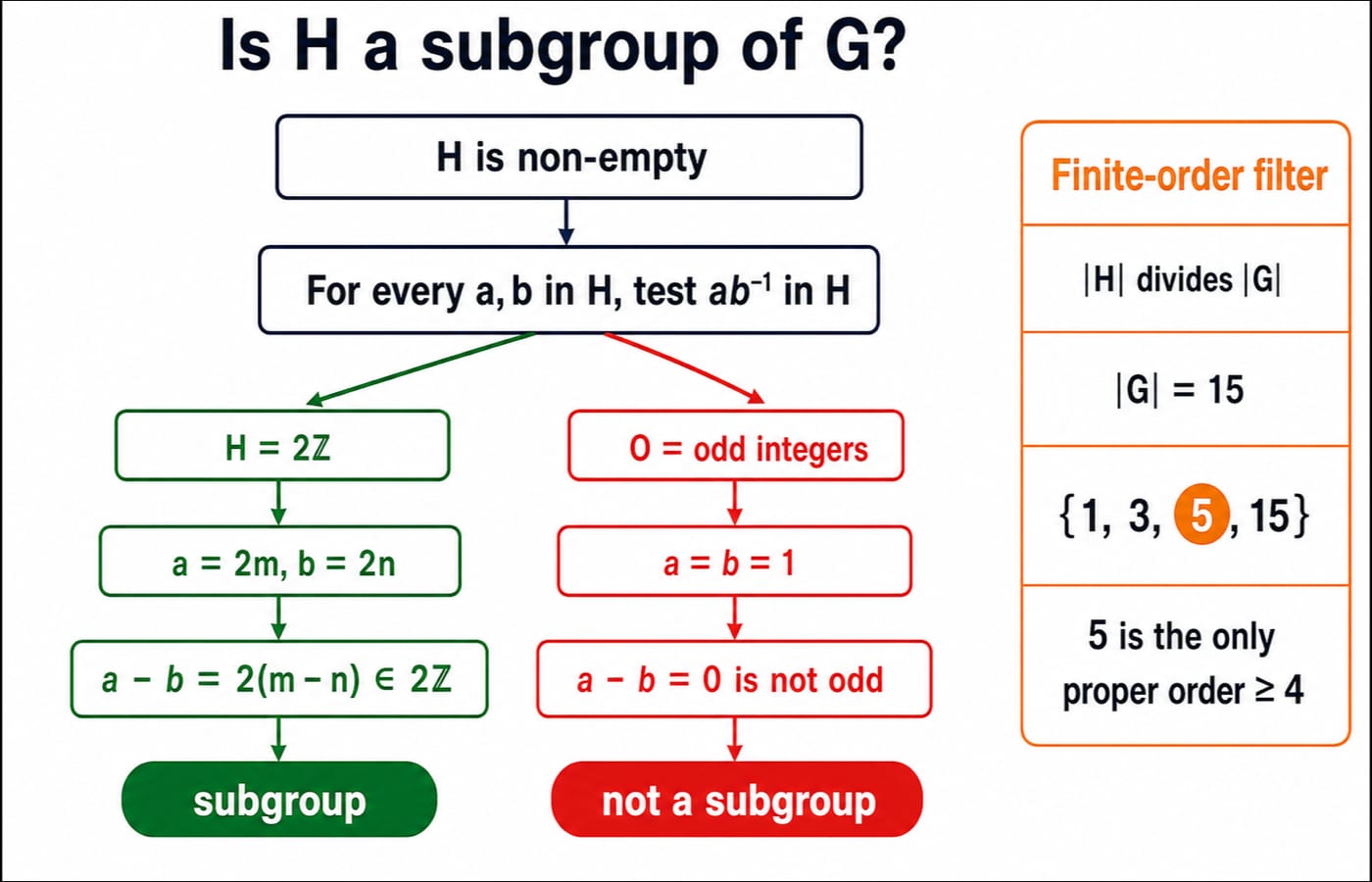
A non-empty subset H of a group G is a subgroup if ab^{-1} in H for every a,b in H. For an additive group, this becomes a-b in H. Associativity is inherited from G, so you do not need to prove it again.
Two quick supporting checks will save time. Every subgroup must contain the identity. Also, for a finite group, Lagrange's theorem requires |H| to divide |G|. Divisibility is necessary for a subgroup of a specified group, but it is not automatically sufficient. If a question asks for the largest possible order, establish existence, usually by giving a cyclic-group example.
For a quick refresh on the surrounding vocabulary, see Group Theory for GATE CS: Axioms, Lagrange, Rings, Fields.
2. Questions 1-2: recognise a subgroup from identity, closure and inverses
Question 1
The set of all even integers under addition is:
A group
A monoid but not a group
A semigroup but not a monoid
Neither a group nor a semigroup
Answer: A group
Write every even integer as 2k. Closure follows because 2m+2n=2(m+n), which is even. The identity is 0=2(0). The inverse of 2m is -2m=2(-m), also even. Associativity comes from integer addition, so all group conditions hold.
Question 2
Which of the following is not a subgroup of (z,+)? [Assume O and E denote the set of odd integers and even integers respectively]
(O,+)
(E,+)
({3k | k∈Z},+)
(-4k | k∈Z,+)
Answer: (O,+)
The odd integers fail independently in two ways: 0 is not odd, so the identity is missing, and 1+1=2, so closure fails. Even integers and multiples of 3 pass the additive subgroup test. Multiples of 4 do too: subtracting any two numbers 4m and 4n gives 4(m-n), still a multiple of 4.
3. Questions 3-4: union, intersection and inherited commutativity
Question 3
Subgroups are NOT closed under which of the following?
(Union)
(Intersection)
(Concatenation)
None of these
Answer: (Union)
Both 2Z and 3Z are subgroups of (Z,+). Yet 2 is in 2Z, 3 is in 3Z, and 2+3=5 is in neither, so their union is not closed. If a,b lie in both subgroups, ab^{-1} lies in both. "Concatenation" is not standard subgroup terminology, so union is the unambiguous answer.
Question 4
Which of the following statements are correct?
The union of any two subgroups of a group G is also a subgroup of G
The intersection of any two subgroups of a group G is also a subgroup of G
The union of all the proper subgroups of a group (G, *) is always a subgroup of G
Every subgroup of an abelian group is also an abelian group
Answer: The intersection statement and the abelian-subgroup statement are correct.
The 2Z,3Z example disproves the first statement. In additive Z_6, the proper subgroups {0,3} and {0,2,4} have union {0,2,3,4}, which is not closed because 2+3=5 is absent. Intersections pass the subgroup test. If a,b belong to a subgroup of an abelian group, the inherited operation still satisfies ab=ba.
4. Questions 5-6: prime orders and subgroup intersections
Question 5
let (A, X) be a group of prime order, how many proper-subgroups are possible for A?
0
1
P-1
P
Answer: 1
Let the prime order be p. By Lagrange, a subgroup can have order only 1 or p. The order-p subgroup is all of A, leaving only the trivial subgroup {e} of order 1. The identity-only subgroup {e} is proper because it is not equal to A.
Question 6
There is a group (G, *) order of the group is 11, and another group (P, *) order of the group is 17. Let there be another non-empty group H formed by the intersection of group G and P. Then what will be the possible order of H?
11
1
17
28
Answer: 1
Treat H as the common subgroup stated in the question. Its order must divide both 11 and 17. Since gcd(11,17)=1, the only possible value is |H|=1, the identity-only intersection.
5. Questions 7-8: product sets and the finite-closure theorem
Question 7
H and K be two subgroups of group G. If |HK| = 12 and |H ∩ K| = 6, then which of the following can be the order of H?
1
3
8
None of these
Answer: None of these
The formula |HK|=|H||K|/|H intersection K| gives 12=|H||K|/6, hence |H||K|=72. More decisively, H intersection K is a subgroup of H, so 6 must divide |H|. None of 1,3,8 is divisible by 6.
Question 8
Given below are two statements :
Statement (I) : If H is non empty finite subset of a group G and ab∈H ∀ a, b∈H, then H is also a group
Statement (II) : There is no homomorphism exist from (Z, +) to (Q, +); where Z is set of integers and Q is set of rational number.
In the light of the above statements, choose the most appropriate answer from the options given below :
Both Statement I and Statement II are correct
Both Statement I and Statement II are incorrect
Statement I is correct but statement II are incorrect
Statement I is incorrect but statement II are correct
Answer: Statement I is correct but statement II are incorrect
For Statement I, the powers a,a^2,... stay in the finite set and must repeat. That repetition yields an identity power and an inverse power, so the subset is a subgroup. Statement II has a counterexample: f: Z -> Q, f(n)=n. Since f(m+n)=m+n=f(m)+f(n), it is a homomorphism. Statement I is true and Statement II is false. Exam source: UGC NET Computer Science, Paper 2 (December), 2023.
6. Questions 9-10: cyclic subgroups and the divisor filter
Question 9
Let G be a group of order 6, and H be a subgroup of G such that 1 < |H| < 6. Which one of the following options is correct?
Both G and H are always cyclic.
G may not be cyclic, but H is always cyclic.
G is always cyclic, but H may not be cyclic.
Both G and H may not be cyclic.
Answer: G may not be cyclic, but H is always cyclic.
Lagrange and the strict inequalities leave |H|=2 or |H|=3. Every group of prime order is cyclic, so H is cyclic. However, G need not be cyclic because S_3 is a non-cyclic group of order 6. Exam source: GATE Computer Science, Set 1, 2021.
Question 10
Let be a group with 15 elements. Let be a subgroup of . It is known that and that the size of is at least 4. The size of is __________.
Answer type: numerical answer
Answer: 5
The divisors of 15 are 1,3,5,15. The condition L != G removes 15, while |L| >= 4 removes 1 and 3. Only 5 remains. Exam source: GATE Computer Science, Set 3, 2014.
7. Questions 11-12: largest possible proper subgroup orders
Question 11
Let be a group of 35 elements. Then the largest possible size of a subgroup of other than itself is ________ .
Answer type: numerical answer
Answer: 7
The divisors of 35 are 1,5,7,35, so the largest proper divisor is 7. This size is attainable, not merely allowed: cyclic C_35 has a subgroup of order 7. Exam source: GATE Computer Science, 2020.
Question 12
Let be a finite group on 84 elements. The size of a largest possible proper subgroup of is ________.
Answer type: numerical answer
Answer: 42
By Lagrange, a proper subgroup order must be a proper divisor of 84. The largest is 84/2=42, and cyclic C_84 has a subgroup of order 42, so the bound is attained. In Questions 11 and 12, dividing n by its smallest prime factor p gives the largest proper divisor n/p. Exam source: GATE Computer Science, 2018.
8. Short version, traps to avoid, and the next practice step
Use
ab^{-1}ora-bfor membership tests.Trust intersections, but prove closure for a union.
Use Lagrange as an order filter, then show existence when "possible" appears.
Avoid checking multiplication but not inverses for an infinite subset, assuming every divisor occurs as a subgroup order, and confusing a necessary divisibility condition with proof that the subgroup exists.
If set membership or relation notation is slowing you down, review Set Theory and Relations for GATE: Closures and Posets. Then continue with GATE Guidance by Sanchit Sir for the full Group Theory lesson and practice sequence.
Keep learning
Conditional Probability Questions with Solutions: 12-Question Practice Set
Practise 12 conditional probability questions on independence, restricted samples, Bayes' rule, draws and complements, with checked calculations.
20 Oct 20267 min readDiscrete Mathematics MCQs
Order of Elements in Groups MCQs: 10 Solved Objective Questions
Build a reliable method for finding element orders, then apply it to 10 bank questions, including NAT, MSQ and two composition-table problems.
Updated 16 Oct 20267 min readDiscrete Mathematics MCQs
Partial Order Relation MCQs: 12 Solved Poset and Total Order Questions
Solve 12 published partial order questions with fresh explanations covering posets, total orders, lattices, recursive comparisons, linear extensions and counterexamples.
12 Oct 20267 min readDiscrete Mathematics MCQs
Set Operations MCQs: 11 Solved Questions with Step-by-Step Explanations
Solve 11 set operations MCQs, then compare your decisive step with a fresh explanation covering counts, identities, complements and constructions.
Updated 8 Oct 20267 min readDiscrete Mathematics MCQs