System Calls and Dual Mode in OS: Mode-Bit Trace, Worked Example and Exam Traps
Follow one read() call across the user-kernel boundary, calculate its stated overhead, and learn the distinctions that make system-call questions easier.
KnowledgeGate Team
Exam prep & CS education
Updated 17 Oct 20265 min read
A program appears to call read() just like an ordinary function, yet the data may come from a resource that only the kernel may access. Where, exactly, does privilege change, and does that change also mean the CPU has switched processes? A controlled-transfer instruction changes privilege at the system-call boundary, while a process switch is a separate scheduling event; the mode-bit and timing results follow from that distinction.
System calls and dual mode: the protection contract
Applications run in user mode, a restricted state. The operating system uses kernel mode for privileged operations involving hardware, interrupt controls, and address translation. This separation prevents one faulty or malicious application from directly damaging the OS or another process, and it is foundational across core CS subjects.
A mode bit represents the current privilege state, but its encoding depends on the architecture. Our illustrative convention is M = 1 for user mode and M = 0 for kernel mode. Follow the transition, not a supposedly universal value.
A system call is a controlled request for an OS service. Examples include reading, writing, process creation, and memory mapping. The kernel retains authority over how the service is performed.
Four events learners often mix up
Event | Trigger | Timing | Does privilege normally change? | Example |
|---|---|---|---|---|
Ordinary procedure or library call | A normal call instruction in the program | Synchronous | No |
|
System call | An intentional controlled-transfer instruction | Synchronous | Yes |
|
Hardware interrupt | An external device or timer | Asynchronous | Yes, when handled by the OS | Timer signal from hardware |
Exception | The current instruction or its execution | Synchronous | Usually, when the OS handles it | Divide by zero |
A library wrapper may arrange the call number and arguments and execute a controlled transfer, but it is not the kernel service. Kernel entry does not imply a context switch. The kernel may return to the same process.
“Trap” commonly names an intentional synchronous transfer. Architecture manuals classify these events differently, so no instruction name is universal.
What the CPU and kernel do at the boundary
The boundary follows a protected sequence:
The program places the call number and arguments in agreed locations.
It executes a controlled-transfer instruction.
Hardware saves resume state, changes privilege, and enters through a protected point.
The kernel validates the request and user-supplied addresses.
The service runs, and the kernel prepares a return value or error.
A privileged return restores user state and user mode.
User code cannot select an arbitrary kernel instruction. Predefined gates or vectors restrict entry, and the kernel validates the file descriptor, buffer range, and requested length.
If an operation blocks, the scheduler may run another process. A quick cached operation can finish without that switch. Privilege change and scheduling are separate decisions.
Worked example: trace one read() call end to end
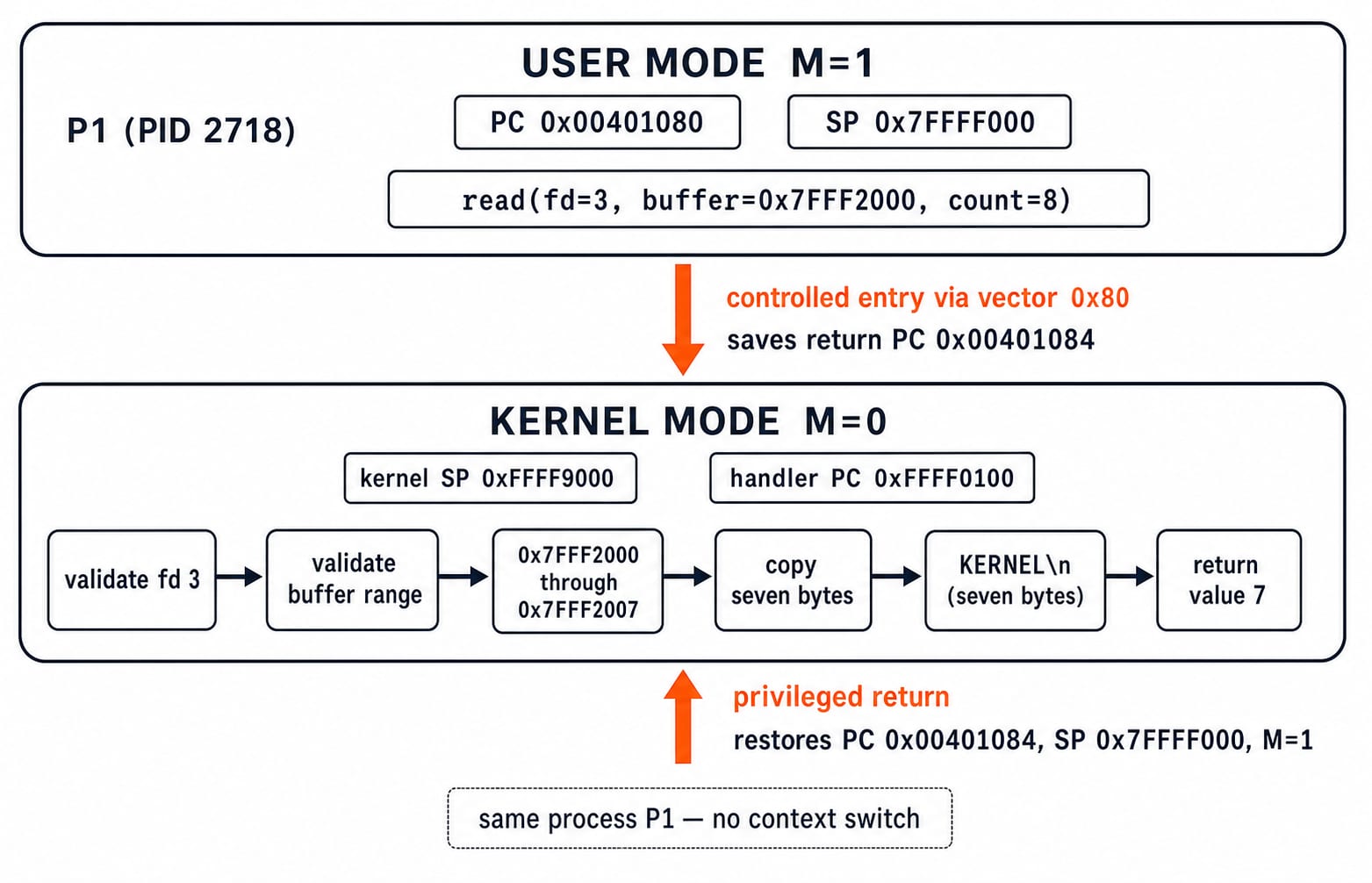
On a simplified teaching machine, process P1 (PID 2718) executes read(fd = 3, buffer = 0x7FFF2000, count = 8) at user PC = 0x00401080. The next PC = 0x00401084, user SP = 0x7FFFF000, and M: 1 -> 0 -> 1.
At
PC 0x00401080,P1is in user mode, soM = 1.The wrapper supplies the
readcall number and arguments3,0x7FFF2000, and8.Controlled entry saves return
PC 0x00401084, changes toM = 0, selects kernelSP = 0xFFFF9000, and dispatches through illustrative vector0x80to handler0xFFFF0100.The kernel confirms that fd
3is readable and that the eight-byte destination range,0x7FFF2000through0x7FFF2007, is writable.The source has seven available bytes,
KERNEL\n, so the kernel copies seven bytes and sets the return value to7.Privileged return restores user
SP = 0x7FFFF000,PC = 0x00401084, andM = 1.
The byte result is:
requested = 8, available = 7, so return value = min(8, 7) = 7.
Positions 0x7FFF2000 through 0x7FFF2006 receive data; 0x7FFF2007 does not. Real ABIs choose their own registers, vectors, stacks, and addresses. This is a teaching model.
Compute the overhead from the same trace
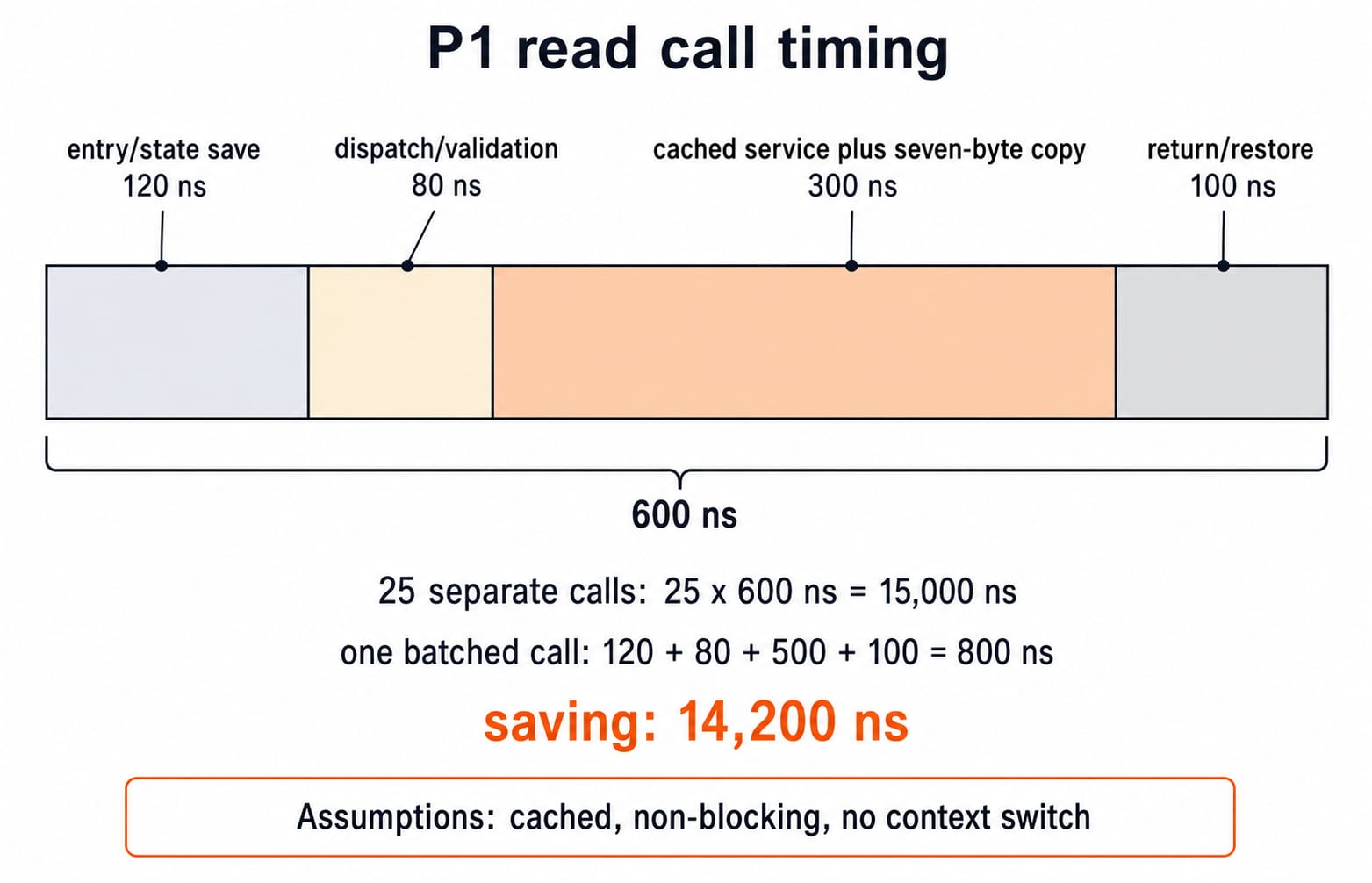
Suppose an exam problem gives entry and state save = 120 ns, dispatch plus validation = 80 ns, cached service and seven-byte copy = 300 ns, and return plus restore = 100 ns.
The total kernel-mediated call time is:
120 + 80 + 300 + 100 = 600 ns.
For 25 identical calls, with no blocking:
25 x 600 ns = 15,000 ns = 15 microseconds.
Those calls return 25 x 7 = 175 bytes in total. If batching allows one call to return all 175 bytes, and the question states that its service portion takes 500 ns, then:
batched time = 120 + 80 + 500 + 100 = 800 ns.
saving = 15,000 - 800 = 14,200 ns = 14.2 microseconds.
Assumptions are cached data, no scheduling delay, page fault, retry, or overlap. Blocking or a process switch would change the elapsed-time model.
Traps and wrong turns to correct
“Every function call enters the kernel.”
strlen()normally stays in user space.read()needs a controlled OS request.“Every system call switches processes.” The non-blocking trace can return to
P1without a scheduler-selected change.“Kernel mode means a kernel process is running.” It is a CPU privilege state. The kernel may execute for the calling process.
“A system call gives unrestricted kernel access.” The application gets protected entry points, validation, and a controlled return.
“The mode encoding is always the same.” Follow the question's convention. Another machine may label the states differently.
“Only entry cost matters.” Include entry, validation, service, and return. Here they total
600 ns.
How exams test system calls and dual mode
Prepare three recurring forms: classifying privileged operations, tracing mode before, during, and after a call, and adding transition, service, and return costs.
Using our values, P1 starts at user PC 0x00401080 with M = 1, runs the handler at 0xFFFF0100 with M = 0, and resumes at 0x00401084 with M = 1. Controlled entry and a privilege change necessarily occurred. A process context switch did not necessarily occur.
For the broader OS roles, kernel structures and scheduling foundation, start with Introduction to Operating System: Core Concepts with a Worked CPU Schedule. This post stays at the system-call boundary, tracing privilege, return state and per-call timing.
Short version and the next study step
User mode restricts applications.
A system call is a controlled request for a kernel service.
The CPU crosses the boundary through a protected entry point.
The kernel validates and serves the request.
A privileged return restores user mode.
In the worked trace, P1 moved through M: 1 -> 0 -> 1, and read(..., 8) returned 7 bytes.
For a broad, structured sequence across CS, continue with ZERO TO HERO. For placement-focused revision of OS and other core subjects, use Computer Science Fundamentals for Placements.
The natural next concept is Process Management MCQs: 12 Solved Process-State Questions, because system calls can create, block, wake, or terminate processes.
Keep learning
Critical Section in Process Synchronization: Race Conditions and Correctness Worked Step by Step
See how two sensible updates to x can finish at 6, 7, or 8. The worked trace connects race conditions to mutual exclusion, progress, bounded waiting, and safe synchronization choices.
Updated 21 Oct 20266 min readOperating Systems
Semaphores and Process Ordering in OS: P/V Traces, Worked Examples and GATE Traps
Learn one consistent semaphore convention, then trace ordering constraints, shared-variable updates, bounded-buffer permits, rendezvous, and deadlock step by step.
Updated 13 Oct 20265 min readOperating Systems
Round Robin Scheduling Explained: Gantt Charts, Waiting Time and GATE Traps
Learn a fixed Round Robin queue convention, trace staggered arrivals, calculate CT, TAT, WT and RT, and see how quantum size and context-switch cost change results.
Updated 9 Oct 20265 min read65 viewsOperating Systems
Paging and TLB Explained: Address Translation, EMAT and Exam Traps
Follow one virtual address from its VPN through the TLB to a physical frame, then calculate page-table size, TLB reach and effective memory access time.
Updated 4 Oct 20266 min readOperating Systems