TPSC Computer Science Syllabus: ATO Core Blocks in Prerequisite Order
Build TPSC ATO Computer Science from the foundations up: seven core areas in prerequisite order, worked examples, mastery gates and a ten-hour weekly cycle.
KnowledgeGate Team
Exam prep & CS education
Updated 25 Jul 20265 min read226 views
A flat “Computer Science syllabus” hides which topics unlock others, so one gap can spread across subjects. The TPSC Assistant Technical Officer Computer Science core runs to seven areas: Programming Concepts, Data Structures and Algorithms, Operating Systems, DBMS, Computer Networks, Software Engineering and Computer Organization. They are not seven independent lists. Paging arithmetic needs hexadecimal place value, subnetting needs binary boundaries, and normalisation needs functional dependencies. Order them by dependency, work each to a value you can re-derive rather than recall, and a gap stops resurfacing three subjects later. Start with TPSC ATO Computer Science courses and practice.
1. Identify the exact TPSC Computer Science route first
TPSC recruits Computer Science under more than one post, and the technical scope differs between them. The seven-area core here is the Assistant Technical Officer (Computer Science) scope. Take marks, dates, eligibility, vacancies, selection stages and paper rules from your own advertisement on the Tripura Public Service Commission site, tpsc.tripura.gov.in, never from a syllabus summary.
Core technical subjects | Confirm in your own notice | Only from the official notification |
|---|---|---|
Programming, DSA, OS, DBMS, Networks, Software Engineering, Computer Organization | Pedagogy and any supporting paper | Official weights or question counts |
Those seven areas repeat across most state teaching-service Computer Science papers, so this base is not single-exam work: DSSSB, KVS, NVS, EMRS and RSSB draw on the same shared core across teaching Computer Science exams.
2. Block A: programming before data structures and algorithms
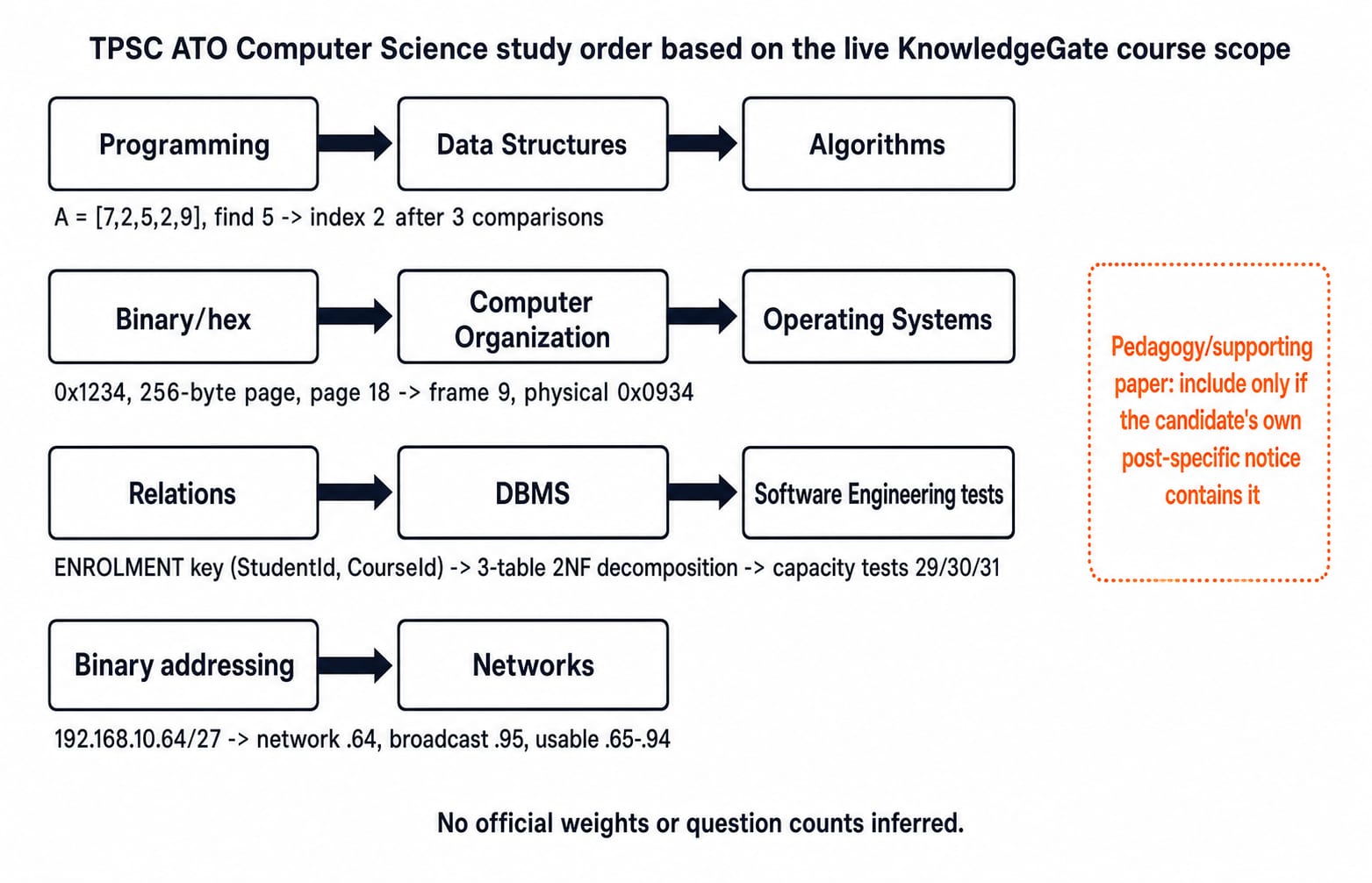
Follow this chain: data types and expressions -> control flow -> functions and recursion -> arrays, pointers and records -> stacks, queues, trees and graphs -> searching, sorting and algorithm analysis. If you cannot trace an array or function call, memorising algorithms hides the gap.
For the array int a[5] = {7, 2, 5, 2, 9} and target = 5, linear search checks index-value pairs (0, 7), (1, 2) and (2, 5). It returns index 2 after 3 comparisons. The worst case checks all 5 elements, so runtime grows as O(n).
Mastery gate: trace values and indices, implement the search, then explain its best and worst cases. Move to trees and graphs only after mastering all three.
3. Block B: number representation and computer organisation before OS
Use the order binary and hexadecimal notation -> logic and data representation -> registers, memory and addressing -> processes and scheduling -> virtual memory and file systems. Digital Logic is a prerequisite for Computer Organization, not an eighth subject bolted on.
Take a 16-bit virtual address and a 256-byte = 2^8-byte page. The lower 8 bits give the offset; the upper 8 give the page number. Thus 0x1234 gives page 0x12 = 18 and offset 0x34 = 52. If page 18 maps to frame 9, the physical address is 9 x 256 + 52 = 2304 + 52 = 2356, or 0x0934.
Mastery gate: convert 0x1234 to decimal and back, split it into page and offset for a 256-byte page, then say what that split becomes at 512 bytes. Until those are automatic, page-table arithmetic is blind formula use.
4. Block C: relational foundations before DBMS design and testing
Build DBMS as sets and relations -> keys and SQL -> functional dependencies -> normalisation -> transactions and concurrency. After basic programming, place Software Engineering beside it as requirements -> design -> implementation -> testing and maintenance.
Consider the relation ENROLMENT(StudentId, CourseId, StudentName, CourseName), with candidate key (StudentId, CourseId). Given StudentId -> StudentName and CourseId -> CourseName, each non-key attribute depends on part of the composite key, violating 2NF. Decompose it into STUDENT(StudentId, StudentName), COURSE(CourseId, CourseName) and ENROLMENT(StudentId, CourseId).
Apply the same care to testing: for an enrolment capacity of 30, check boundary inputs at 29, 30 and 31 students.
5. Block D: binary addressing before network calculations
Study binary arithmetic -> network models and framing -> IPv4 addressing and subnetting -> routing -> transport and application protocols. Subnetting sits in the middle of that chain because routing and address aggregation only make sense once you can place a network boundary in binary.
For 192.168.10.64/27, the prefix leaves 5 host bits, giving 2^5 = 32 addresses. The network address is 192.168.10.64; adding 31 gives the broadcast address 192.168.10.95. Excluding both leaves .65 through .94, or 32 - 2 = 30 usable hosts. Derive the range from binary boundaries before using shortcuts, so routing and aggregation do not rest on memorised tables.
6. Treat pedagogy and supporting sections as a notification gate
Pedagogy is not part of the ATO technical core. For another TPSC Computer Science teaching post, copy section names from its official notice before adding pedagogy or a support area.
If pedagogy is confirmed, try this diagnostic. A learner says for (i = 0; i < 3; i++) print(i); outputs 1 2 3. Trace it: i=0 -> print 0, i=1 -> print 1, i=2 -> print 2, then stop at i=3. The actual output is 0 1 2. Diagnose the initialisation and loop-condition misconception. Computer Science pedagogy methods and misconceptions goes deeper on this block; add it to your plan only if your own notice lists it.
7. Turn the map into a ten-hour study cycle
A ten-hour weekly cycle assigns 3 hours to Programming and DSA, 2 to Computer Organization and OS, 2 to DBMS and Software Engineering, 2 to Networks, and 1 to mixed retrieval and error review. Check: 3 + 2 + 2 + 2 + 1 = 10 hours. Treat the split as a starting point and shift hours toward your weakest block.
Every block clears the same gate: learn -> work three examples by hand -> attempt an unseen set -> log one prerequisite gap. A subnet error from binary conversion returns to binary practice; a scheduling error from process-state confusion returns to the state model. If your notice confirms another section, move one hour from your strongest block after a diagnostic. The structured TPSC ATO Computer Science course provides the full route.
8. Use tests to validate blocks, then take the next step
The TPSC ATO Computer Science test practice set has 18 unit tests and 7 full-length mocks, so 18 + 7 = 25 tests to distribute across Blocks A to D.
In a 40-question set, suppose you record 27 correct, 8 wrong and 5 blank. Attempts are 27 + 8 = 35, total is 35 + 5 = 40, and attempted accuracy is 27 / 35 x 100 = 77.1%. Treat that number as a diagnostic, not a target, and sort each loss into Blocks A to D or a confirmed conditional block.
The short version: confirm the post, learn prerequisites first, test each block, and revisit the earliest broken link.
Keep learning
TPSC vs BPSC Teaching Exams: Which State CS Route Fits You?
Compare TPSC and BPSC as conditional Computer Science teaching routes through a five-gate audit that separates official eligibility from personal readiness.
Updated 3 Aug 20266 min readTPSC Computer Science
TPSC Computer Science PYQs: A No-Guesswork Trend Analysis Method
Turn a small set of Computer Science papers into a careful personal study plan. This method separates observed patterns from guesses and converts errors into scheduled drills.
Updated 1 Aug 20266 min readTPSC Computer Science
TPSC Computer Science Weightage: Rank High-Return Topics with Syllabus and PYQs
A fixed TPSC CS weightage chart would be convenient, but the official syllabus does not provide one. Learn to turn verified papers and diagnostic gaps into a personal revision order.
Updated 29 Jul 20265 min readTPSC Computer Science
TPSC Computer Science 14-Week Study Plan: Weekly Topics, PYQs and Mocks
Turn 8 to 12 reliable study hours into a practical weekly cycle of CS repair, PYQs, unit tests, full mocks and two evidence-led revision passes.
Updated 26 Jul 20266 min readTPSC Computer Science