Transformations MCQs: 10 Solved Computer Graphics Questions with Explanations
Practise ten published Computer Graphics transformation MCQs, then check each answer through matrix entries, coordinate rules and geometric invariants.
KnowledgeGate Team
Exam prep & CS education
Updated 25 Aug 20267 min read
Transformation questions look simple until one item mixes visual recognition, matrix order, homogeneous coordinates and verbal classification. Memorising four definitions will not survive a coordinate-mapping problem, because you must read the entries, apply the rule and check where actual points land. Solve each item before checking its answer, and work through every numeric check on paper. Questions 1, 2, 3 and 5 are UGC NET previous-year questions, and the 2-D Transformations PYQ Questions hub provides more practice with the same matrix rules.
Transformation matrix MCQs: rules, entries and invariants
Transformation | Coordinate rule | What stays unchanged |
|---|---|---|
Translation |
| Distances and orientation |
Scaling |
| The origin |
Counter-clockwise rotation |
| Distances from the pivot |
x-shear |
| The y-coordinate and enclosed area |
Reflection in the x-axis |
| Distances, but orientation reverses |
Inverse |
| The original point is restored |
For homogeneous column vectors, write a point as [x y 1]^T. In a 3 x 3 affine matrix, the last column carries translation, and the rightmost matrix acts first in a product. Rigid transforms preserve every distance; ordinary scaling and shear are non-rigid.
Use a two-step routine: first identify the matrix family from its entries. Then test one actual point instead of trusting a visual resemblance. A single test point can reject a plausible-looking distractor before you calculate the full mapping.
Transformation matrices and coordinate mapping
Question 1: match four homogeneous matrices to their diagrams (UGC NET 2020, June)
Solve the original UGC NET question
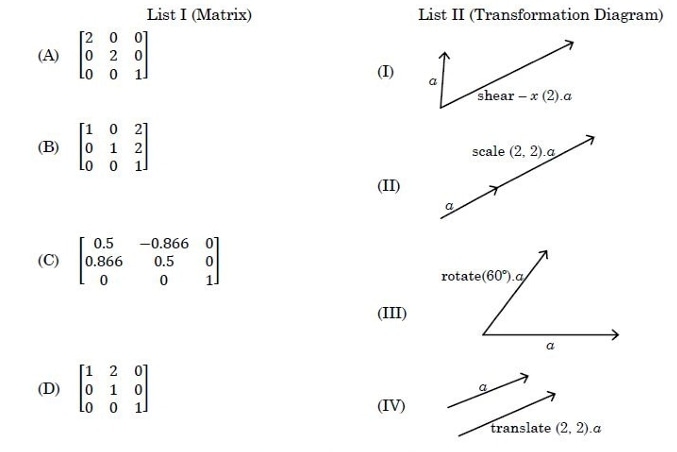
Match List I with List II. List I gives 3×3 matrices representing 2𝐷 transformations and List II shows the corresponding transformation diagrams.
Choose the correct answer from the options given below:
A. 𝐴−𝐼𝑉,𝐵−𝐼𝐼,𝐶−𝐼𝐼𝐼,𝐷−𝐼
B. 𝐴−𝐼𝑉,𝐵−𝐼𝐼𝐼,𝐶−𝐼𝐼,𝐷−𝐼
C. 𝐴−𝐼𝐼𝐼,𝐵−𝐼𝐼,𝐶−𝐼𝑉,𝐷−𝐼
D. 𝐴−𝐼𝐼,𝐵−𝐼𝑉,𝐶−𝐼𝐼𝐼,𝐷−𝐼
Correct answer: D. 𝐴−𝐼𝐼,𝐵−𝐼𝑉,𝐶−𝐼𝐼𝐼,𝐷−𝐼
Matrix A = diag(2,2,1) doubles both coordinates, so A -> II; B has last column (2,2,1)^T, so it translates by (2,2) and B -> IV. Matrix C uses cos 60 degrees = 0.5 and sin 60 degrees approximately 0.866, giving C -> III, while D gives x' = x + 2y, the x-shear in I. The full mapping is therefore A -> II, B -> IV, C -> III, D -> I.
Question 2: choose the matrix that maps one figure to the other (UGC NET 2018, December)
Solve the original UGC NET question
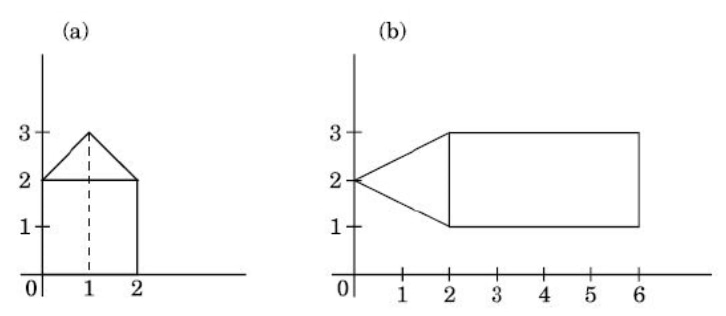
Which homogeneous 2D matrix transforms figure (a) on the left into figure (b) on the right?
A.
B.
C.
D.
Correct answer: C. [[0,-2,6],[1,0,1],[0,0,1]]
Option C means x' = -2y + 6 and y' = x + 1. It maps the roof peak (1,3) -> (0,2), the left roof corner (0,2) -> (2,1) and the right roof corner (2,2) -> (2,3). As a base check, (0,0) -> (6,1), the lower-right corner of the transformed rectangle. All four results match the target figure and rule out the distractors.
Segment operations and inverse transformations
Question 3: functions performed on GKS segments (UGC NET 2017, January)
Solve the original UGC NET question
A segment is an object described by GKS commands and data that start with CREATE SEGMENT and terminate with CLOSE SEGMENT. Which functions can be performed on these segments?
A. Translation and Rotation
B. Panning and Zooming
C. Scaling and Shearing
D. Translation, Rotation, Panning and Zooming
Correct answer: D. Translation, Rotation, Panning and Zooming
Translation and rotation change a segment's placement or orientation, while panning and zooming alter the displayed view. Options A and B give only half of the intended operation set, and C omits the position and view operations tested here.
The informal word reverse from the mathematical inverse T^{-1}. An inverse is defined by T^{-1}T = I.
Question 4: the general operation that undoes a transform
Which transformation is used for undoing the applied transformation:
A. Reverse transformation
B. Rotation transformation
C. Reflection transformation
D. Inverse transformation
Correct answer: D. Inverse transformation
The general undo operation is the inverse because T^{-1}T = I. Translation (5,-3) is undone by (-5,3), rotation 30 degrees by -30 degrees, and scaling (2,4) by (1/2,1/4) when both original factors are non-zero. Reflection is self-inverse in its special case, but inverse transformation is the general answer.
Homography, rigid transforms and non-rigid transforms
A projective transform is broader than an affine transform, which is broader than a rigid transform. General homogeneous matrices can represent projective mappings, while rigid transforms preserve Euclidean distances.
Question 5: identify the general homogeneous transformation (UGC NET 2022, June)
Solve the original UGC NET question
This transformation is called
A. Scaling
B. Shear
C. Homography
D. Steganography
Correct answer: C. Homography
A full 4 x 4 matrix acting on [x y z 1]^T produces homogeneous coordinates [x-bar y-bar z-bar w-bar]^T, the general projective or homography form in 3-D. Scaling and shear are constrained affine special cases; steganography means hiding data and is unrelated to coordinate mapping.
Question 6: identify a non-rigid transformation
Which of the following transformations can be classified as a non-rigid transformation?
A. Rotation
B. Scaling
C. Reflection
D. Translation
Correct answer: B. Scaling
A rigid transform preserves the distance between every pair of points. The points (0,0) and (3,4) are distance sqrt(3^2 + 4^2) = 5 apart; scaling by 2 sends them to (0,0) and (6,8), whose distance is sqrt(6^2 + 8^2) = 10. Rotation, reflection and translation keep the distance 5, so scaling is non-rigid.
Shearing and scaling transformation MCQs
Question 7: change shape while preserving enclosed area
Which of the following transformations can change the shape but not the size of an object?
A. Scaling
B. Shearing
C. Dilation
D. Translation
Correct answer: B. Shearing
Here, size must mean enclosed area. The horizontal shear x' = x + 2y maps the rectangle (0,0), (2,0), (2,1), (0,1) to the parallelogram (0,0), (2,0), (4,1), (2,1); its base 2 and height 1 still give area 2, although its outline and some side lengths change. Scaling and dilation change area, while translation changes neither shape nor area.
Question 8: scale a symbolic point on two axes
If a point P(x, y) undergoes a scaling transformation with factors 2 in the x-direction and 3 in the y-direction, what is the new coordinate of the point?
A. (2x, 3y)
B. (x, y)
C. (x/2, y/3)
D. (x, 3y)
Correct answer: A. (2x, 3y)
Apply the axes separately: x' = 2x and y' = 3y. For example, P = (4,-2) maps to (8,-6). Option C uses inverse scale factors, while Option D forgets the x-axis scaling.
Orientation and fixed-point rotation MCQs
Question 9: select the true transformation statement
Which of the following statements about transformations is true?
A. Translation changes the orientation of a shape.
B. Rotation changes the size of a shape.
C. Scaling by a positive factor preserves the orientation of a shape.
D. Reflection changes the size of a shape.
Correct answer: C. Scaling by a positive factor preserves the orientation of a shape.
Take the triangle (0,0), (2,0), (0,1) and scale uniformly by 2 to get (0,0), (4,0), (0,2). The signed-area determinant remains positive, so vertex order and orientation stay unchanged even though size increases. Translation preserves orientation, rotation preserves size, and reflection preserves size while reversing orientation, eliminating A, B and D.
Question 10: name the transform about a fixed point
Which of the following transformations is used to rotate a shape around a fixed point?
A. Translation
B. Reflection
C. Rotation
D. Scaling
Correct answer: C. Rotation
Rotation keeps every point's distance from the pivot fixed while changing its angular position. Around the origin, rotating (3,4) by 90 degrees counter-clockwise gives (-4,3), and each point is distance 5 from the pivot. Translation slides, reflection mirrors across a line, and scaling changes radial distance.
Keep these four traps visible while revising:
Translation changes position.
Rotation changes direction about a pivot.
Positive-determinant scaling preserves orientation.
Reflection reverses orientation but preserves lengths.
Transformations MCQs: how to review the set and what to solve next
Transformation problems call for four exam moves. Identify entries in a homogeneous matrix for Questions 1, 2 and 5; distinguish operation families for Questions 3, 4, 6 and 10; apply a coordinate rule for Questions 7 and 8; and eliminate statements through invariants for Question 9. Redo Questions 1, 2, 7 and 8 on paper, because they reveal whether your method is understood or merely memorised.
Place this practice inside the wider Paper 2 subject map with UGC NET Computer Science Syllabus Areas: Paper 2.
For a structured subject path, continue with NTA-UGC-NET Paper - 2, or use UGC NET CS Exam Preparation as the wider course hub. If you only need more question practice, use the transformations practice hub and solve before checking the explanation.
Keep learning

Ecosystem Fundamentals MCQs: 10 Solved Questions on Meaning and Ecological Organisation
Solve 10 ecosystem MCQs with clear explanations of ecological organisation, productivity, sustainability, environmental ethics, energy balance and conservation.
8 Sep 20268 min readMCQ Practice

Architectural and Component Design MCQs: 12 Solved Questions
Solve 12 bank MCQs on software architecture, component roles, repositories, MVC, DFDs, structure charts and UML, each with a direct worked explanation.
Updated 6 Sep 20268 min readMCQ Practice

C++ Constructors MCQs: 12 Solved Object-Initialization Questions
Solve 12 published C++ constructor questions by tracing object creation, copy semantics, arrays, access, virtual rules, and dynamic allocation.
Updated 5 Sep 20267 min readMCQ Practice

Clipping Algorithms MCQs: 11 Solved Cohen-Sutherland and Cyrus-Beck Questions
Solve 11 clipping questions with fresh explanations, checked outcodes, line classifications, boundary intersections and a practical revision routine.
Updated 3 Sep 20268 min readMCQ Practice