Types of Programming Languages MCQs: 12 Solved Classification Questions
Work through 12 solved programming-language classification questions. Each solution identifies the deciding axis, checks the options and explains the main trap.
KnowledgeGate Team
Exam prep & CS education
Updated 24 Oct 20267 min read
A programming language can be classified by abstraction level, paradigm, execution model, application domain and memory model at the same time. MCQs become confusing when separate axes are treated as one list. Choose an option first, then name the classification axis that decides it. Language levels, runtimes, typing, memory, scripting, modules and notation are separate clues, so controlled classification beats name recall.
1. Types of programming languages: classify on one axis at a time
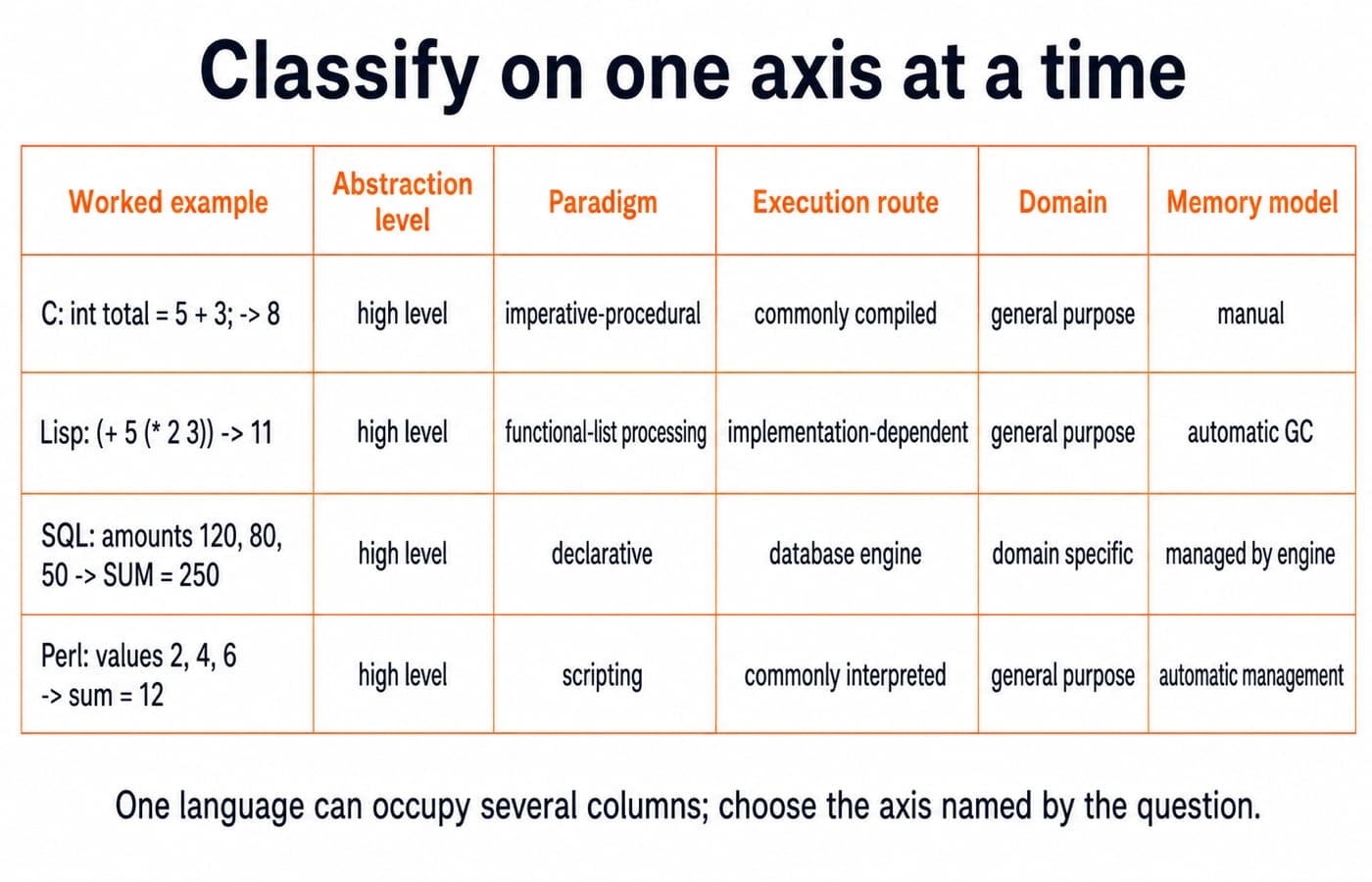
Use five questions: how close to hardware, how the solution is expressed, how it executes, how broad its domain is and how storage is reclaimed. The corresponding labels are machine, assembly or high level; imperative, object-oriented, functional or declarative; compiled, interpreted or virtual-machine based; general purpose or domain specific; and manual management or automatic garbage collection.
Example | Worked result | Classification |
|---|---|---|
C: |
| High level, imperative/procedural, general purpose, commonly compiled |
Lisp: |
| High level, functional/list processing, automatic garbage collection |
SQL: |
| High level, declarative, domain specific |
Perl: values |
| High level, general purpose, scripting-oriented, commonly interpreted |
These labels overlap. Definitions, translators, parameters and language-quality criteria are practised in Programming Languages MCQs: 12 Solved Questions on Definition and Purpose; classification questions instead ask which axis decides the label. Coding & DSA groups the broader practice paths that use these languages. Compiled versus interpreted describes an implementation route, not a fixed language property.
2. Recognition and high-level language features: Questions 1-2
Question 1. Identify the non-language
KVS 2026, Computer Science
Which of the following is not an example of a Programming Language?
A. C++
B. Python
C. Impress
D. Ruby
Answer: C. Impress
C++, Python and Ruby are programming languages, whereas Impress is presentation software. Classify what each item is instead of trusting a technical-sounding name.
Question 2. High-level language features
DSSSB 2021, Computer Science, TGT - Shift 3
Which of the following is the feature(s) of High level programming languages?
I. Portability
II. Easy debugging
A. Only I
B. Only II
C. Both I and II
D. Neither I nor II
Answer: C. Both I and II
High-level source depends less on one processor's instruction set, improving portability after translation. Meaningful identifiers and structured constructs ease debugging compared with machine code. Portability means retargeting source, not running one compiled binary everywhere.
3. Language generations and runtime families: Questions 3-4
Question 3. First-generation programming
DSSSB 2021, Computer Science, TGT - Shift 4
The programming of first generation computers was done in ____ language.
I. Machine
II. High level
A. Only I
B. Only II
C. Both I and II
D. Neither I nor II
Answer: A. Only I
First-generation programming uses machine language, the processor-facing binary instruction form. High-level languages need translation, so statement II does not match the named generation.
Question 4. The non-.NET language
DSSSB 2023, Computer Science, TGT
Which of the following languages is a non .NET language?
A. C#
B. F#
C. J#
D. Pascal
Answer: D. Pascal
C#, F# and J# target the .NET environment; Pascal is the outsider. Test membership in that runtime family, not whether each option is high level.
4. Modules, memory management and language names: Questions 5-7
Question 5. Module-based language
UPPSC Polytechnic Lecturer 2022, Computer Science
Module-based programming language is:
A. C
B. C++
C. ML
D. Ada
Answer: D. Ada
Ada is the expected exam answer because its packages and modular facilities make modularity a central language-design feature. ML-family languages also have substantial module systems, so the stem is not a universal exclusivity claim. An Ada package can export push(5) and pop() while hiding its internal array of capacity 10, separating interface from implementation.
Question 6. Automatic garbage collection
ISRO 2007 and BEL 2007, Computer Science
Which of the following programming language(s) provides garbage collection automatically
A. Lisp
B.
C++C. Fortran
D. C
Answer: A. Lisp
Lisp is the automatic-garbage-collection choice; C and C++ leave lifetime management to the programmer, and Fortran provides no such collector either. If live references still reach only 2 of 3 heap objects, the remaining 1 is what an automatic collector reclaims.
Question 7. Expand COBOL correctly
REET 2022, Computer Science
In the acronym COBOL, what does the prefix “CO” represent?
A. Component Object
B. Computer Oriented
C. Common
D. Common Oriented
Answer: C. Common
Common Business-Oriented Language yields the prefix Common, eliminating A, B and D. This is a language-identification item, not a paradigm question.
5. Procedural dispatch, dynamic typing and scripting: Questions 8-10
Question 8. Compile-time and runtime call resolution
Hexaware 2024
Which of the following statement is true?
I) In Procedural programming languages, all function calls are resolved at compile-time
II) In Object Oriented programming languages, all function calls are resolved at compile-time
A. I only
B. II only
C. Both I and II
D. Neither I nor II
Answer: A. I only
Answer A follows the question's simplified textbook contrast: ordinary direct procedural calls are resolved statically, while overridden methods can use runtime dispatch. Real procedural programs can call through function pointers or dynamic linkage, so statement I is not a universal language rule. add(4, 6) returns 4 + 6 = 10; with virtual Shape s = new Circle(); s.draw(), the runtime object selects Circle.draw(). The inheritance and dispatch model continues in Object Oriented Technology Explained.
Question 9. Static and dynamic typing
GATE 2003, Computer Science
Which of the following statements is FALSE ?
A. In statically typed language, each variable in a program has a fixed type
B. In un-typed languages, values do not have any types
C. In dynamically typed languages, variables have no types
D. In all statically typed languages, each variable in a program is associated with values of only a single type during the execution of the program
Answer: C. In dynamically typed languages, variables have no types
Dynamic typing retains runtime type information, so the claim that variables “have no types” is false. After x = 5 then x = "five", the binding changes values while each value keeps its runtime type. The distinction is between the variable and the value, not the presence of types.
Question 10. Identify the scripting language
IBPS 2023
Which of the following is primarily classified as a high-level scripting language rather than a low-level or system programming language?
A. Assembly
B. C
C. Perl
D. C++
E. Machine Language
Answer: C. Perl
Perl is the high-level scripting language. Machine Language and Assembly are low level, while C and C++ are system or general-purpose compiled languages in this contrast. In Perl, summing 2, 4, 6 gives 2 + 4 + 6 = 12.
6. Mixed classification and notation systems: Questions 11-12
Question 11. Find both wrong level classifications
UGC NET 2025, Paper I, June
Choose the ‘WRONG’ statement:
A. Machine Language is a low level language
B. ‘FORTRAN’ is a high level language
C. ‘C’ is a low level language
D. ‘SQL’ is a low level language
A. A and B Only
B. B and C Only
C. A and C Only
D. C and D Only
Answer: D. C and D Only
A and B are true. C is high level with low-level facilities, while SQL is high-level and declarative, so C and D are wrong. SUM returns 120 + 80 + 50 = 250, specifying an aggregate rather than processor instructions. Review C with C Language: Concepts, MCQs, Coding Questions.
Question 12. Animation-language categories
UGC NET 2014, Computer Science, Paper 2 (December)
Which of the following categories of languages do not refer to animation languages ?
A. Graphical languages
B. General-purpose languages
C. Linear-list notations
D. None of the above
Answer: D. None of the above
Each category can describe animation here, so none is excluded. Motion from x = 0 px to x = 120 px over 2 seconds can use a graphical timeline, a general-purpose program or ordered animation commands.
7. Answer audit, classification traps and the next step
Question | Correct answer | Deciding axis | Main trap |
|---|---|---|---|
Q1 | C | Entity recognition | Application mistaken for language |
Q2 | C | Abstraction/features | Source versus binary portability |
Q3 | A | Generation | Mixing generations |
Q4 | D | Runtime family | Ignoring runtime family |
Q5 | D | Modularity | Ignoring package boundaries |
Q6 | A | Memory model | Manual versus automatic reclamation |
Q7 | C | Acronym | False expansion |
Q8 | A | Dispatch | Ignoring |
Q9 | C | Typing | Calling values typeless |
Q10 | C | Scripting/use | Scripting versus system |
Q11 | D | Abstraction level | Missing the second error |
Q12 | D | Notation category | Excluding valid notation |
For the final self-check:
Identify the axis named by the stem.
Test every statement containing
all,onlyornone.Separate language, runtime and application.
Re-read the option text behind your chosen letter before committing to it.
Rework Question 11 as four true or false checks, then compare add(4, 6) = 10 with runtime selection of Circle.draw() in Question 8. Continue with NTA-UGC-NET Paper - 2.
Keep learning
Classes and Objects MCQs: 12 Solved OOP Questions with Explanations
Solve 12 classes and objects MCQs, check each explanation, and use a worked Java trace to separate instance state, constructors, overloading and nested classes.
20 Oct 20267 min readProgramming Languages Survey
Programming Language Syntax MCQs: 12 Solved Questions on Grammar, Tokens and Semantics
Solve 12 MCQs on syntax, tokens, pseudocode, C grammar and runtime behaviour. Each explanation identifies the rule and applies it.
Updated 16 Oct 20268 min readProgramming Languages Survey
Imperative Programming Structure and Flow Control MCQs: 12 Solved Questions
Test whether you can trace changing state, choose the right loop, read a flowchart, and follow event-driven or exceptional control paths through 12 solved MCQs.
12 Oct 20267 min readProgramming Languages Survey
Static vs Dynamic Binding MCQs: 11 Solved Questions on Scope, Aliasing and Dispatch
Solve 11 binding questions from GATE and UGC NET papers by tracing lexical scope, runtime call chains, declared types and shared storage cells. Each answer shows why the tempting shortcuts fail.
Updated 8 Oct 20267 min readProgramming Languages Survey