Consider the diagram shown below where a number of LANs are connected by…
2006
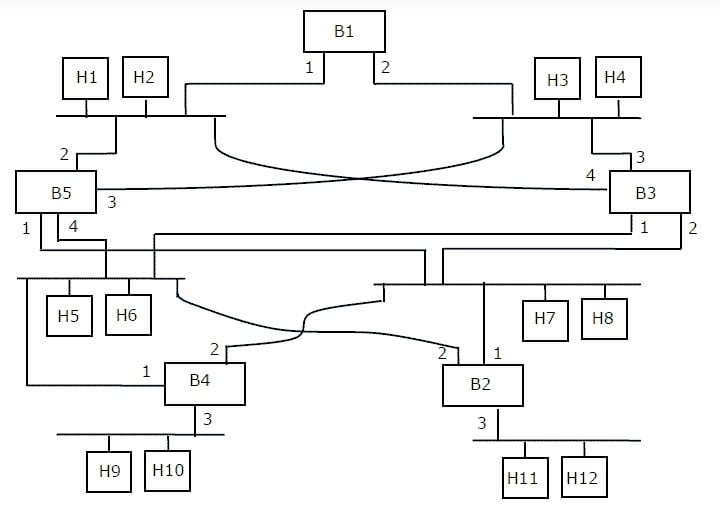
Consider the diagram shown below where a number of LANs are connected by (transparent) bridges. In order to avoid packets looping through circuits in the graph, the bridges organize themselves in a spanning tree. First, the root bridge is identified as the bridge with the least serial number. Next, the root sends out (one or more) data
units to enable the setting up of the spanning tree of shortest paths from the root bridge to each bridge.
Each bridge identifies a port (the root port) through which it will forward frames to the root bridge. Port conflicts are always resolved in favour of the port with the lower index value. When there is a possibility of multiple bridges forwarding to the same LAN (but not through the root port), ties are broken as follows: bridges closest to the root get preference and between such bridges, the one with the lowest serial number is preferred.
Answer: A. A — Key idea: For a broadcast sent by a host, the switch forwards the frame out all spanning-tree designated ports except the port the frame arrived on (and any…
- A.
A
- B.
B
- C.
C
- D.
D
Attempted by 23 students.
Show answer & explanation
Correct answer: A
Key idea: For a broadcast sent by a host, the switch forwards the frame out all spanning-tree designated ports except the port the frame arrived on (and any ports blocked by STP). Build the forwarding table by tracing each spanning-tree branch from the bridge to the hosts and grouping hosts by the port that leads to their branch.
Step 1: Identify the incoming port for the broadcast (the port to H1).
Step 2: For each other physical port on B3, follow the spanning-tree branch and list the hosts reachable down that branch.
Step 3: The forwarding table maps each port to the hosts reachable via that port. The broadcast will be forwarded out all these ports (except the incoming one).
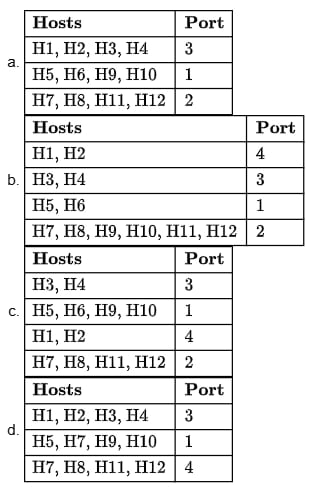
Final forwarding table on B3 (hosts grouped by the port that reaches their branch):
Port 3: Hosts H1, H2, H3, H4
Port 1: Hosts H5, H6, H9, H10
Port 2: Hosts H7, H8, H11, H12
Why other proposed tables are incorrect:
Any table that assigns H1 and H2 to a port other than the port leading to their branch (port 3) is wrong; those hosts are reached via port 3.
Any table that assigns the same host to two different ports or omits a host from all ports is invalid because each host must be reachable via exactly one designated port on the spanning tree.