PQRS is a cyclic quadrilateral and PQ is the diameter of the circle. If angle…
202320232023
PQRS is a cyclic quadrilateral and PQ is the diameter of the circle. If angle QPR = 65 degrees, then what is the value of angle PSR?
Answer: A. 155 degrees — Two circle-geometry facts govern this problem: (1) Angle in a semicircle -- an angle inscribed in a semicircle and subtended by the diameter is always 90…
- A.
155 degrees
- B.
25 degrees
- C.
90 degrees
- D.
Can't be determined
Attempted by 12 students.
Show answer & explanation
Correct answer: A
Two circle-geometry facts govern this problem: (1) Angle in a semicircle -- an angle inscribed in a semicircle and subtended by the diameter is always 90 degrees. (2) Cyclic quadrilateral property -- opposite angles of a cyclic quadrilateral are supplementary, i.e. they sum to 180 degrees.
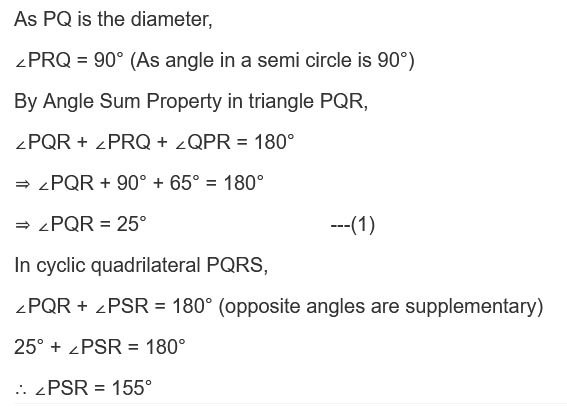
Since PQ is the diameter of the circle and R lies on the circle, angle PRQ = 90 degrees (angle in a semicircle).
In triangle PQR, the angles sum to 180 degrees: angle QPR + angle PRQ + angle PQR = 180 degrees. Substituting angle QPR = 65 degrees and angle PRQ = 90 degrees gives angle PQR = 180 - 90 - 65 = 25 degrees.
In cyclic quadrilateral PQRS, angle PQR (at vertex Q) and angle PSR (at vertex S) are opposite angles, so angle PQR + angle PSR = 180 degrees.
Therefore, angle PSR = 180 - 25 = 155 degrees.
Independent check via the inscribed angle theorem: chord PR subtends angle PQR at Q and angle PSR at S, with Q and S lying on opposite arcs of chord PR -- angles subtended by the same chord from opposite arcs are supplementary, confirming 25 + 155 = 180 degrees.