Consider a system with five processes P0 through P4 and three resource types…
2017
Consider a system with five processes P0 through P4 and three resource types A, B and C. Resource type A has seven instances, resource type B has four instances and resource type C has six instances. Suppose at time T0 we have the following allocation.
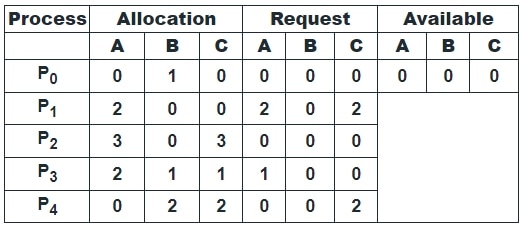
If we implement the Deadlock detection algorithm, we claim that the system is ________
Answer: D. Not in deadlock state — Concept: The deadlock detection algorithm works on the current resource-allocation state. Repeatedly look for any process whose remaining Request vector is…
- A.
Semaphore
- B.
Deadlock state
- C.
Circular wait
- D.
Not in deadlock state
Attempted by 176 students.
Show answer & explanation
Correct answer: D
Concept: The deadlock detection algorithm works on the current resource-allocation state. Repeatedly look for any process whose remaining Request vector is component-wise less than or equal to the current Available vector; let that process finish and add its Allocation back to Available. If every process can finish this way, the state is deadlock-free; if at some point no unfinished process can proceed, those remaining processes are deadlocked.
Setup: Available is (A=0, B=0, C=0). The resource totals are A=7, B=4, C=6 (each total equals the sum of that column's allocations plus the available amount). Now scan the processes to find one whose Request is satisfiable.
P0: Request (0,0,0) <= Available (0,0,0). P0 finishes and releases its Allocation (0,1,0). Available becomes (0,1,0).
P2: Request (0,0,0) <= Available (0,1,0). P2 finishes and releases (3,0,3). Available becomes (3,1,3).
P3: Request (1,0,0) <= Available (3,1,3). P3 finishes and releases (2,1,1). Available becomes (5,2,4).
P1: Request (2,0,2) <= Available (5,2,4). P1 finishes and releases (2,0,0). Available becomes (7,2,4).
P4: Request (0,0,2) <= Available (7,2,4). P4 finishes and releases (0,2,2). Available becomes (7,4,6).
Cross-check: All five processes finished in the order P0, P2, P3, P1, P4 and Available returned to the resource totals (7,4,6). Because a complete finishing sequence exists, the system is not in a deadlock state. (Other valid orders also exist, e.g. P0, P2, P3, P4, P1.)
A video solution is available for this question — log in and enroll to watch it.
Explore the full course: Mppsc Assistant Professor Computer Science Paper 2