Match List-I and List-II Choose the correct answer from the options given below:
2022
Match List-I and List-II
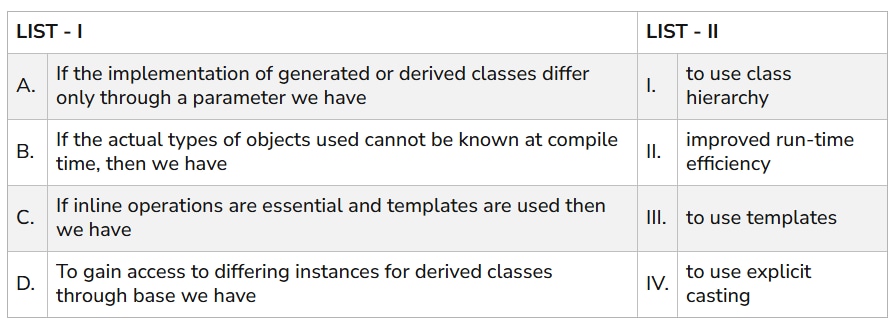
Choose the correct answer from the options given below:
Answer: B. A-III, B-I, C-II, D-IV — Correct matching: A → to use templates; B → to use class hierarchy; C → improved run-time efficiency; D → to use explicit casting. A (If implementations…
- A.
A-I, B-II, C-IV, D-III
- B.
A-III, B-I, C-II, D-IV
- C.
A-I, B-III, C-II, D-IV
- D.
A-II, B-I, C-III, D-IV
Attempted by 43 students.
Show answer & explanation
Correct answer: B
Correct matching: A → to use templates; B → to use class hierarchy; C → improved run-time efficiency; D → to use explicit casting.
A (If implementations differ only through a parameter): Use templates because they parameterize code at compile time and avoid creating separate class hierarchies for each parameter variant.
B (If actual object types cannot be known at compile time): Use a class hierarchy with polymorphism (inheritance and virtual functions) to select behavior at run time.
C (If inline operations are essential and templates are used): This yields improved run-time efficiency because templates enable compile-time expansion and inlining, removing virtual-call overhead.
D (To gain access to differing derived instances through a base): Use explicit casting (for example dynamic_cast or static_cast as appropriate) to access derived-specific members when you have a base-class reference or pointer.
Therefore the correct answer is the matching that pairs A with templates, B with class hierarchy, C with improved run-time efficiency, and D with explicit casting.
A video solution is available for this question — log in and enroll to watch it.
Explore the full course: Mppsc Assistant Professor Computer Science Paper 2