Let p and q be two statements. Consider the following logical identities: (A)…
2024
Let p and q be two statements. Consider the following logical identities:
(A) ∼(p ∧ q) = ∼p ∨ ∼q
(B) ∼(p ∨ q) = ∼p ∧ ∼q
(C) p ∧ ∼p = T
(D) ∼(p → q) = p ∧ ∼q
(E) p ∨ q = ∼p ∨ ∼q
Choose the correct answer from the options given below:
Answer: A. (A), (B) and (D) Only — Check each statement: (A) ∼(p ∧ q) = ∼p ∨ ∼q This is De Morgan's law, so it is true. (B) ∼(p ∨ q) = ∼p ∧ ∼q This is also De Morgan's law, so it is true. (C) p…
- A.
(A), (B) and (D) Only
- B.
(D) Only
- C.
(C), (D) and (E) Only
- D.
(A), (B) and (C) Only
Attempted by 255 students.
Show answer & explanation
Correct answer: A
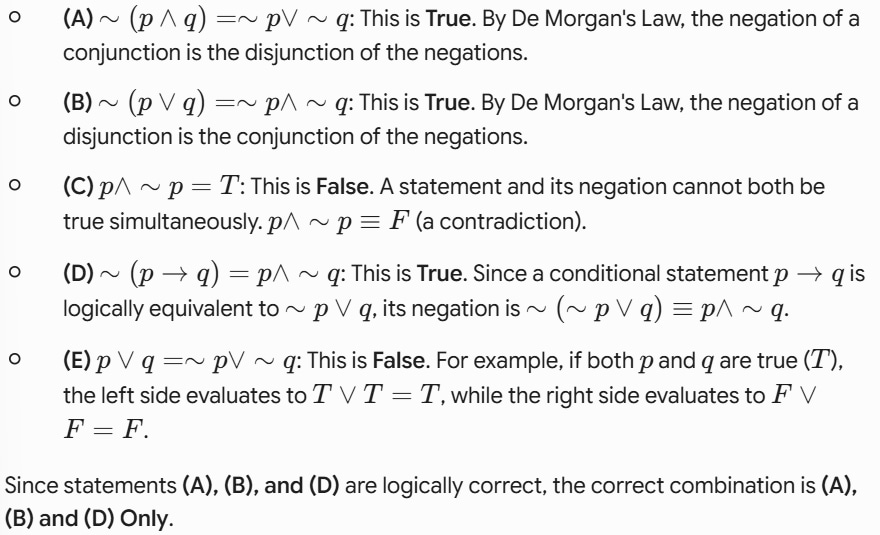
Check each statement:
(A) ∼(p ∧ q) = ∼p ∨ ∼q
This is De Morgan's law, so it is true.
(B) ∼(p ∨ q) = ∼p ∧ ∼q
This is also De Morgan's law, so it is true.
(C) p ∧ ∼p = T
A statement and its negation cannot both be true. Therefore p ∧ ∼p = F, not T. So (C) is false.
(D) ∼(p → q) = p ∧ ∼q
Since p → q ≡ ∼p ∨ q, we get:
∼(p → q) = ∼(∼p ∨ q) = p ∧ ∼q
So (D) is true.
(E) p ∨ q = ∼p ∨ ∼q
This is not a valid logical identity. For example, if p = T and q = T, then p ∨ q = T but ∼p ∨ ∼q = F. So (E) is false.
Therefore, the correct statements are (A), (B), and (D).
Final Answer: (A), (B) and (D) Only.
A video solution is available for this question — log in and enroll to watch it.