Critically compare Symmetric and Asymmetric Encryption methodologies. Discuss…
Critically compare Symmetric and Asymmetric Encryption methodologies. Discuss one major advantage and one significant limitation of each, and explain how modern security protocols leverage both systems.
Attempted by 28 students.
Show answer & explanation
1. Fundamental Concepts
Encryption is the process of converting plaintext into ciphertext to ensure data confidentiality. The primary difference between the two methodologies lies in the management of cryptographic keys. Symmetric Encryption uses a single, shared secret key for both encryption and decryption. In contrast, Asymmetric Encryption (also known as Public Key Cryptography) utilizes a mathematically linked key pair: a Public Key for encryption and a Private Key for decryption.
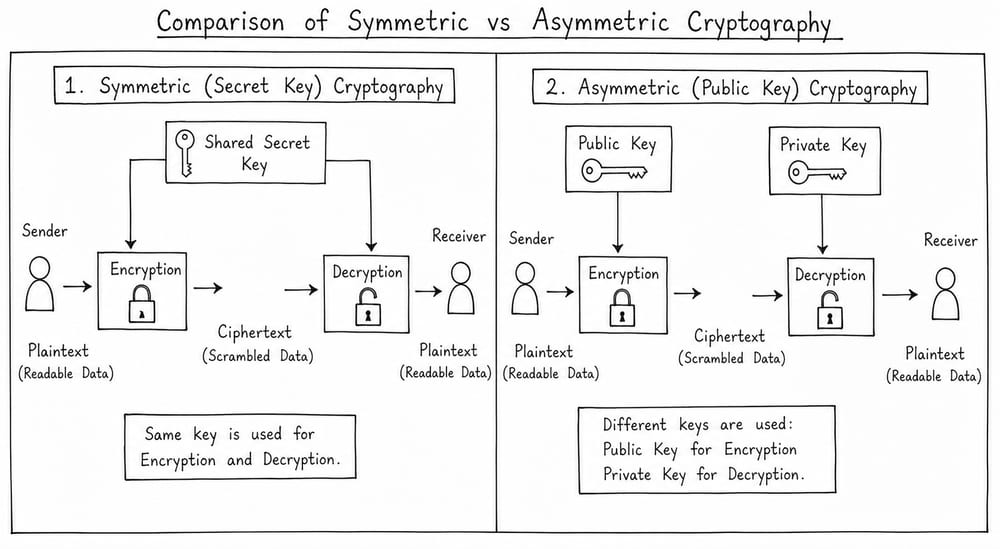
2. Advantages and Limitations
Symmetric Encryption:
Advantage: It is computationally efficient and extremely fast, making it the ideal choice for encrypting large volumes of data (e.g., hard drive encryption).
Limitation: The "Key Distribution" problem is its greatest weakness. Securely sharing the secret key with a remote receiver without it being intercepted is a significant logistical challenge.
Asymmetric Encryption:
Advantage: It provides superior security for open networks. Since the private key never needs to be transmitted or shared, the risk of key compromise during exchange is eliminated.
Limitation: It is significantly slower than symmetric encryption because the mathematical algorithms (like RSA) required to manage key pairs are highly resource-intensive.
3. Modern Implementation:
The Hybrid Approach Modern communication protocols, such as SSL/TLS (HTTPS), do not choose one over the other; instead, they use a hybrid model. Asymmetric encryption is used initially to securely exchange a temporary "session key." Once both parties have this key, they switch to Symmetric encryption for the remainder of the conversation to maintain high-speed data transfer. This combines the security of asymmetric systems with the performance of symmetric systems.