The slope of the function
2017
The slope of the function
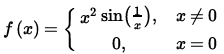
Answer: B. 0 — ConceptThe slope of a curve at a point is the value of its derivative there. When a function is defined piecewise and the point lies at the join, the…
- A.
1
- B.
0
- C.
-1
- D.
None
Attempted by 2 students.
Show answer & explanation
Correct answer: B
Concept
The slope of a curve at a point is the value of its derivative there. When a function is defined piecewise and the point lies at the join, the derivative cannot be read off a standard rule; it must be computed from the limit definition f'(a) = limh→0 [ f(a+h) − f(a) ] / h. A bounded factor times a quantity tending to 0 also tends to 0 (Squeeze Theorem): since −1 ≤ sin θ ≤ 1, |h·sin θ| ≤ |h| → 0.
Application
We need the slope at x = 0, i.e. f'(0), with f(0) = 0.
Write the difference quotient at 0: [f(0+h) − f(0)] / h = [ h2 sin(1/h) − 0 ] / h.
Cancel one factor of h: = h · sin(1/h).
Bound it: since |sin(1/h)| ≤ 1, we have 0 ≤ |h·sin(1/h)| ≤ |h|.
Take the limit as h → 0: |h| → 0, so by the Squeeze Theorem h·sin(1/h) → 0. Hence f'(0) = 0.
The slope of the function at the origin is therefore 0.
Cross-check
For x ≠ 0 the product rule gives f'(x) = 2x·sin(1/x) − cos(1/x). This does not approach a single limit as x → 0 (the cos(1/x) term oscillates), so the derivative is NOT continuous at 0 — yet the value at 0 itself, obtained from the definition above, exists and equals 0. The two facts are consistent: a derivative can exist at a point without being continuous there.