Analogy Questions: Concepts, Shortcuts and Solved Examples
Learn a relation-first method for word, number, letter and figure analogies. Four worked examples show how to preserve direction and eliminate tempting options.
KnowledgeGate Team
Exam prep & CS education
Updated 27 Oct 20266 min read
Analogy questions can feel like guesswork when two items appear connected in several ways. A broad association may sound reasonable and still lead to the wrong option. The safer method is to fix the relation, direction and strength before looking at the choices. We will apply that method to Thermometer : Temperature, 6 : 42, COLD : DPME and an arrow-and-dots figure analogy.
Analogy concepts: match the same relationship, not the same topic
The form A : B :: C : D means that A is related to B in the same precise way that C is related to D. Test three properties: the relation, its direction and its level of specificity.
For Thermometer : Temperature, the useful sentence is "a thermometer measures temperature". Saying that both are connected with weather is too loose. Reverse the pair and the sentence changes to "temperature is measured by a thermometer". The idea remains valid, but its direction has changed.
Analogy questions usually draw on four families: semantic or word relations, number operations, letter-position transformations, and figure transformations involving rotation, reflection, count or shading. KnowledgeGate has over 290 published Reasoning questions tagged under Analogy. The Aptitude Courses for Exams & Placements hub connects this practice with wider quantitative, reasoning and verbal preparation.
The five-step analogy shortcut: classify, phrase, map, test, eliminate
Use the same five steps for every family:
Classify the given pair.
State
A -> Bas one exact sentence or operation.Preserve the direction.
Apply the identical rule to C.
Use the options to test and eliminate, not to invent the relation.
For words, first test function, user-tool, part-whole, class-member, young-one, place, cause-effect and degree. For numbers, try one-step arithmetic, powers, digit operations and n(n+1) or n(n-1) before building a compound rule. For letters, write A=1 through Z=26 and record every shift. For figures, track direction, count and fill separately.
Do not scan all the options before identifying the relation. If two rules survive, prefer the simpler one that explains every component, then let the options break the tie. A shortcut is useful only when it preserves the logic.
Word analogy solved example: use a complete relation sentence
Solve Thermometer : Temperature :: Barometer : ?
(a) Humidity
(b) Pressure
(c) Rainfall
(d) Speed
The complete relation is instrument measures quantity. A thermometer measures temperature. Applying the same relation and direction, a barometer measures pressure. The answer is (b) Pressure.
The distractors are all measurable quantities, which makes them plausible. Humidity is measured by a hygrometer, rainfall by a rain gauge and speed by a speedometer. None gives the required relation for a barometer.
Now check direction. Temperature : Thermometer :: Pressure : Barometer is also valid, but its sentence is quantity is measured by instrument. Never apply the forward sentence silently when the pair has been reversed.
Number analogy solved example: test the smallest complete rule
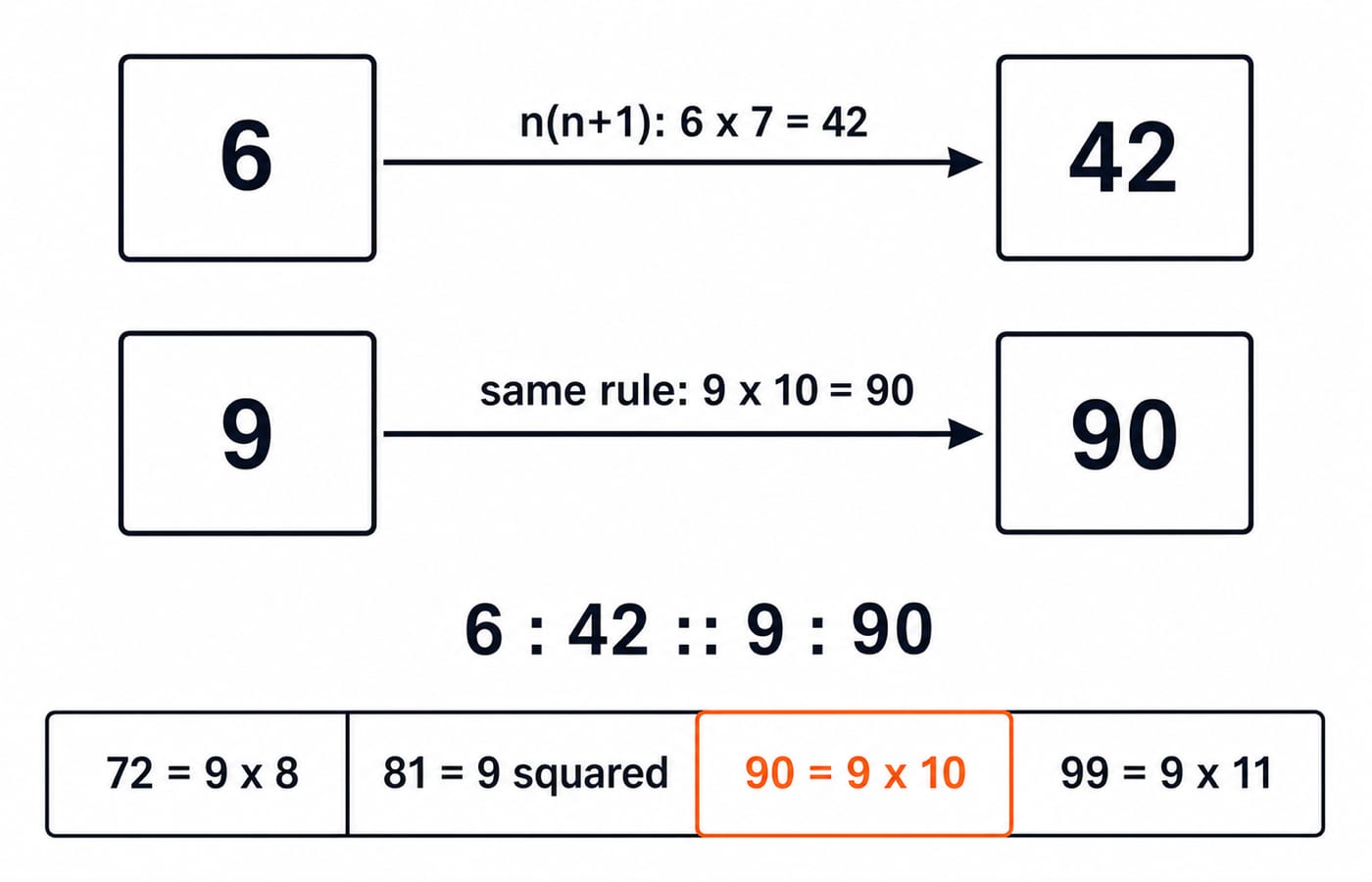
Solve 6 : 42 :: 9 : ?
(a) 72
(b) 81
(c) 90
(d) 99
Test the neighbouring-number product n(n+1):
For 6,
6 x (6+1) = 6 x 7 = 42.Keep the rule unchanged for 9.
9 x (9+1) = 9 x 10 = 90.
The answer is (c) 90. Each distractor reveals a common slip. 72 = 9 x 8 changes the rule to n(n-1). 81 = 9 squared drops the +n part. 99 = 9 x 11 changes the offset from +1 to +2. The form n squared + n is algebraically identical to n(n+1), so it is not a competing pattern.
For a quick numeric check, try difference or sum, multiplication or division, square or cube, neighbouring-number products, and only then digit-based rules. Reject a complicated expression once a simpler rule explains both pairs.
Letter analogy solved example: convert letters to controlled shifts
Solve COLD : DPME :: WARM : ?
(a) XBSN
(b) XBRN
(c) VZQL
(d) XCSN
Write every position instead of checking only the first letter:
C(3) -> D(4)O(15) -> P(16)L(12) -> M(13)D(4) -> E(5)
Each letter moves +1, with no reordering. Apply the same shift vector to WARM: W(23) -> X(24), A(1) -> B(2), R(18) -> S(19) and M(13) -> N(14). The result is XBSN, so the answer is (a).
Option (b) fails only at R -> R. Option (c) applies -1, including the wrap from A to Z. Option (d) changes the second shift to +2.
Now test wrap-around with ZAP : ABQ :: YOX : ?. The rule is still +1, and Z -> A shows that the alphabet is cyclic. Therefore Y(25) -> Z(26), O(15) -> P(16) and X(24) -> Y(25), giving ZPY. There is no position 27.
Figure analogy solved example: separate rotation from count
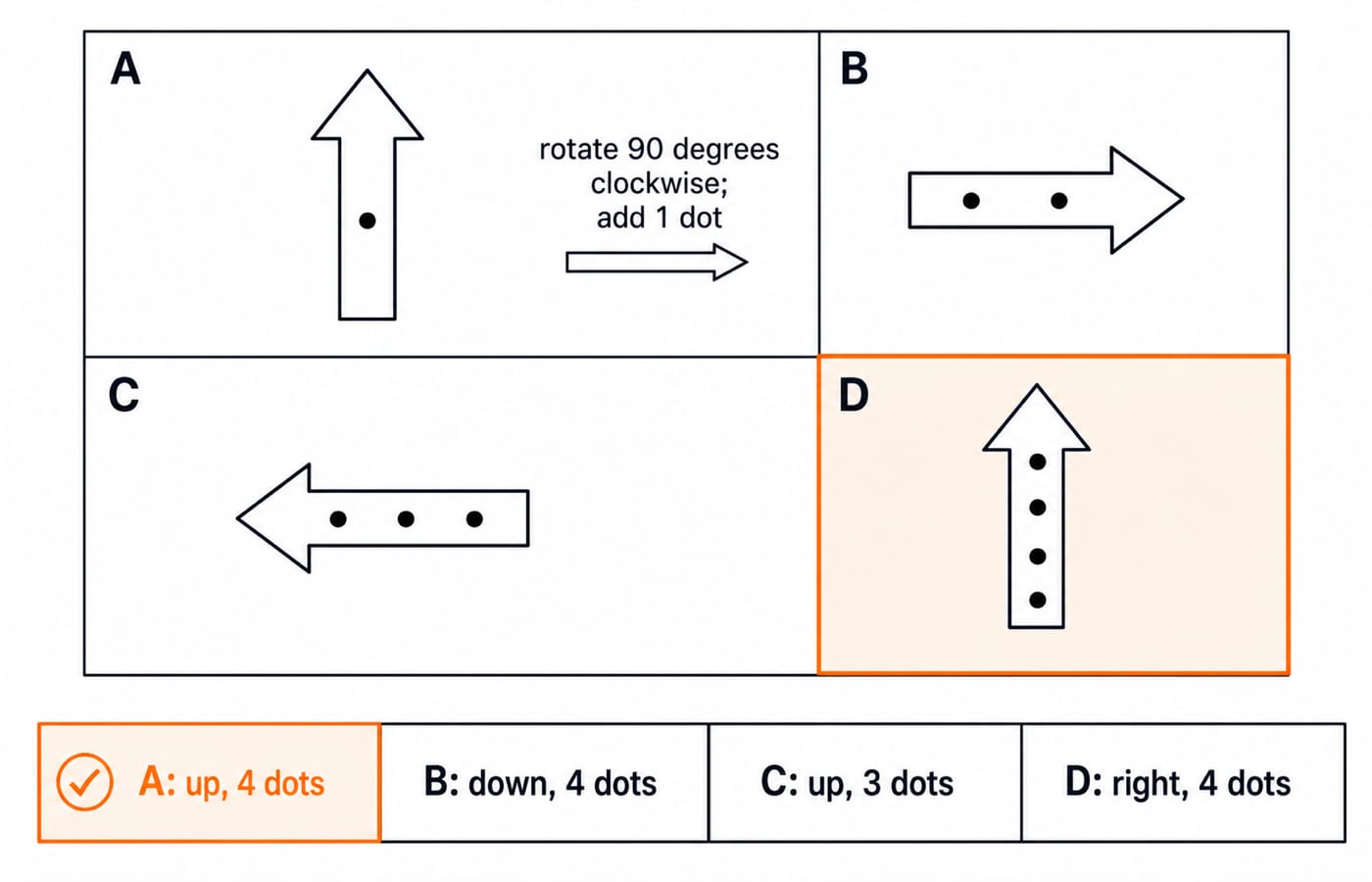
Imagine four panels. Panel A contains an outlined arrow pointing up, with exactly one black dot centred on its shaft. Panel B contains the same arrow rotated 90 degrees clockwise to point right, with exactly two black dots. The transformation has two independent parts: rotate clockwise by 90 degrees and add one dot.
Panel C contains the same outlined arrow pointing left, with exactly three black dots. Apply both parts. A left-pointing arrow rotated 90 degrees clockwise points up, while three dots become four. The answer is (a), an up arrow with four black dots.
The options are:
(a) Up arrow with four dots
(b) Down arrow with four dots
(c) Up arrow with three dots
(d) Right arrow with four dots
Option (b) rotates anticlockwise. Option (c) omits the count change. Option (d) makes the wrong turn. For any figure analogy, use the tracker orientation | count | fill | shape and change only the features demonstrated by A-to-B.
How competitive exams frame analogy, and the traps that cost marks
Questions may ask you to complete the fourth term, choose a pair with the same relation, identify the odd pair or complete a visual transformation. The method is the same, but the presentation can change.
Exact syllabi, section structures and timing vary by examination and cycle. Check the relevant exam authority's current notification before relying on any exam-specific detail.
Turn each common mistake into a correction:
Mistake | Correction |
|---|---|
Broad association | Write a complete relation sentence. |
Correct relation in reverse | Check direction before transferring it. |
Number rule fits only the first pair | Substitute the second input explicitly. |
Only the first letter is shifted | Write the full shift vector. |
Rotation is treated as reflection | Track orientation separately. |
Colour or count changes without evidence | Modify only demonstrated features. |
For a wider map, use Aptitude for Placements: Section Topics and Weekly Plan. If you are combining analogy practice with a broader reasoning plan, place relation-based questions before longer puzzle sets. Neither route changes the core rule-first method.
Analogy short version: state the rule, transfer it, then practise
Remember type -> relation -> direction -> transfer -> check. That chain produced pressure, 90, XBSN, and an up arrow with four dots.
Build a 20-question learning loop: 5 word, 5 number, 5 letter and 5 figure analogies. For every miss, record one cause: relation, direction, operation, shift or visual feature. Use Aptitude for Placements: A 30-Day Practice Routine to schedule repeated loops.
Choose Aptitude for Placement for structured placement and recruitment preparation, or APTITUDE for GATE Exam for a GATE-oriented aptitude path.
Keep learning

Percentage for Competitive Exams: Concepts, Shortcuts and Solved Examples
Learn percentage by naming the base first. Work through fraction shortcuts, successive changes, reverse calculations, comparisons and a fictional selection funnel.
Updated 26 Oct 20265 min readAptitude & Reasoning

Partnership Aptitude: Concepts, Shortcuts and Solved Examples
Learn one reliable capital-time method for partnership problems, then apply it to delayed entry, changing investments, allowances and reverse calculations.
Updated 24 Oct 20265 min readAptitude & Reasoning
Number System Concepts and Shortcuts: Solved Examples for Competitive Exams
Learn how to classify numbers, choose the right divisibility or prime-factor method, and verify remainders, factors, HCF, LCM, and unit digits.
Updated 22 Oct 20266 min readAptitude & Reasoning

Age Ratio-Based Problems: 12 Questions with Step-by-Step Solutions
Solve 12 age ratio-based questions from the KnowledgeGate practice bank. Each fresh solution shows how to form the equation, shift every age correctly, and verify the answer.
18 Oct 20267 min readAptitude & Reasoning