Number System Concepts and Shortcuts: Solved Examples for Competitive Exams
Learn how to classify numbers, choose the right divisibility or prime-factor method, and verify remainders, factors, HCF, LCM, and unit digits.
KnowledgeGate Team
Exam prep & CS education
Updated 22 Oct 20266 min read
Number System questions can look unrelated until you spot the structure underneath. Most reduce to classification, divisibility, prime exponents, or a repeating remainder cycle. This guide shows how to choose a method, when each shortcut is valid, and how to check it with actual values. Each result should be easy to verify. The aim is faster, auditable working, not a collection of tricks that cannot be explained.
Build the Number System Map Before Learning Shortcuts
Natural numbers are the counting numbers 1, 2, 3, .... Whole numbers add 0, and integers add negative whole numbers. Rational numbers can be written as p/q, where p and q are integers and q is not zero. Irrational numbers cannot be written in that form. Rational and irrational numbers together form the real numbers.
For classification, -7 is an integer and rational; 0 is whole, integer, and rational; 3/8 is rational; sqrt(2) is irrational; and sqrt(49) = 7 is natural, whole, integer, and rational.
A factor divides a number exactly, while a multiple is produced by multiplying it. A prime has exactly two positive factors; a composite has more. Prime factorisation expresses a number as primes. Co-prime numbers have HCF 1, so 8 and 15 are co-prime although both are composite. In division, the quotient counts complete groups and the remainder is left over.
Remember three boundaries: 0 is even but neither positive nor negative, 1 is neither prime nor composite, and division by 0 is undefined.
Divisibility Tests: Apply the Smallest Useful Check
Choose the test that uses the fewest digits:
For
2and5, inspect the last digit.For
3and9, add all digits.For
4and8, test the last two and last three digits respectively.For
6, the number must pass both the2and3tests.For
11, take the alternating sum of digits. It must be a multiple of11, including0.
Consider 735,264. It is divisible by 2 because its last digit is 4. Its digit sum is 7 + 3 + 5 + 2 + 6 + 4 = 27, so it is divisible by both 3 and 9. It is therefore divisible by 6 as well. The last three digits give 264 = 8 x 33, so the number is divisible by 8. For 11, the alternating sum is 7 - 3 + 5 - 2 + 6 - 4 = 9. Since 9 is not a multiple of 11, the number is not divisible by 11.
Now make 53x4 divisible by 9. Its digit sum is 5 + 3 + x + 4 = 12 + x. The only digit making this a multiple of 9 is x = 6. Substitution gives 5 + 3 + 6 + 4 = 18, confirming the answer.
HCF and LCM Through Prime Exponents
Prime factorisation turns HCF and LCM into an exponent choice:
84 = 2^2 x 3 x 7
126 = 2 x 3^2 x 7
For the HCF, take the minimum exponent of every shared prime: 2 x 3 x 7 = 42. For the LCM, take every prime at its maximum exponent: 2^2 x 3^2 x 7 = 252.
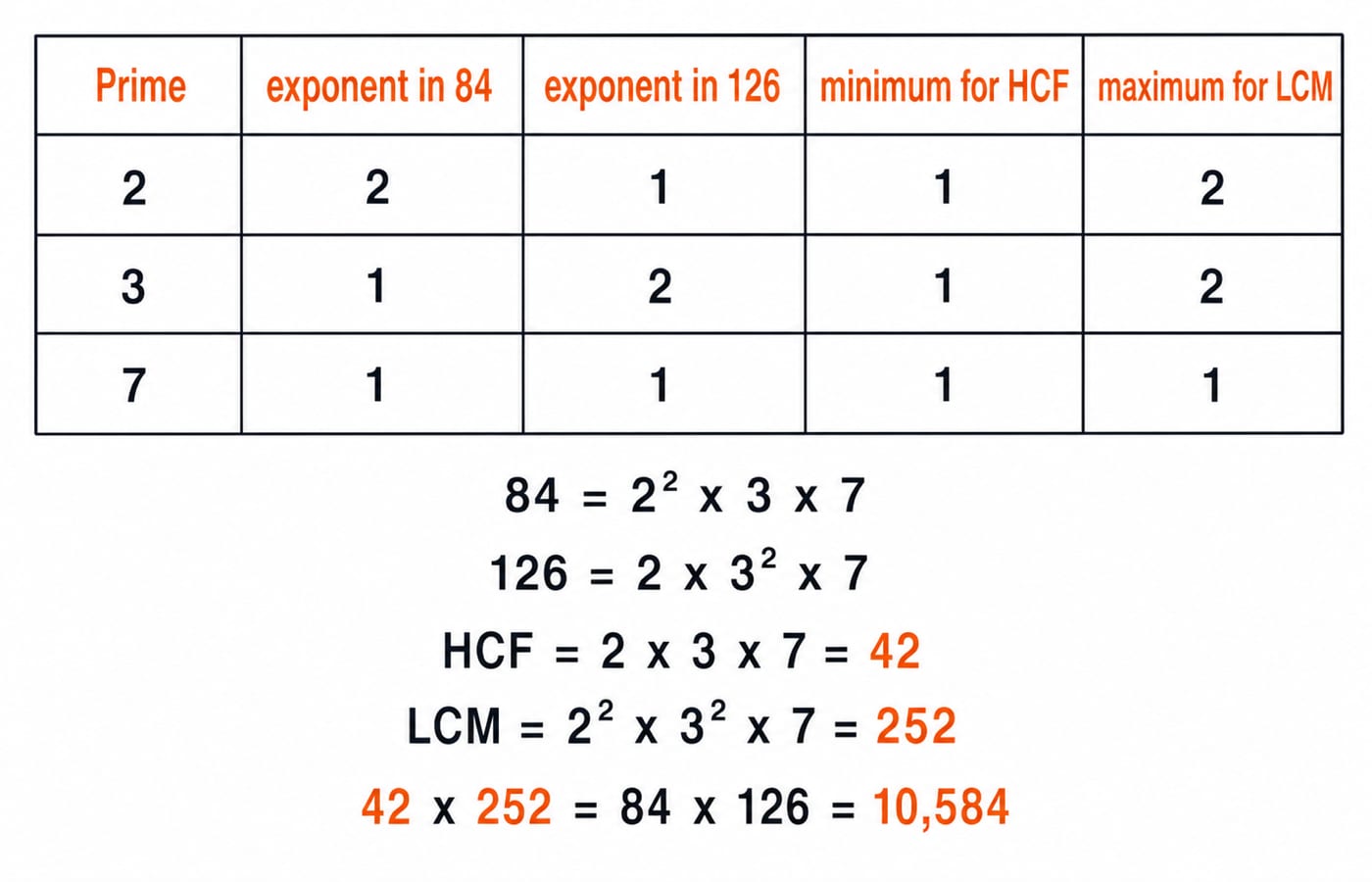
Verify the pair: 84 x 126 = 10,584 and 42 x 252 = 10,584. The identity HCF(a,b) x LCM(a,b) = a x b holds for two positive integers. Do not extend it unchanged to three numbers.
For a timing problem, suppose lights flash every 18, 24, and 30 seconds. Their LCM is 2^3 x 3^2 x 5 = 360 seconds, so they next flash together after 6 minutes.
Remainders and Unit Digits: Look for the Cycle
For positive divisor d, the division algorithm is N = dq + r, with 0 <= r < d. That final bound matters because a valid remainder is always smaller than the divisor.
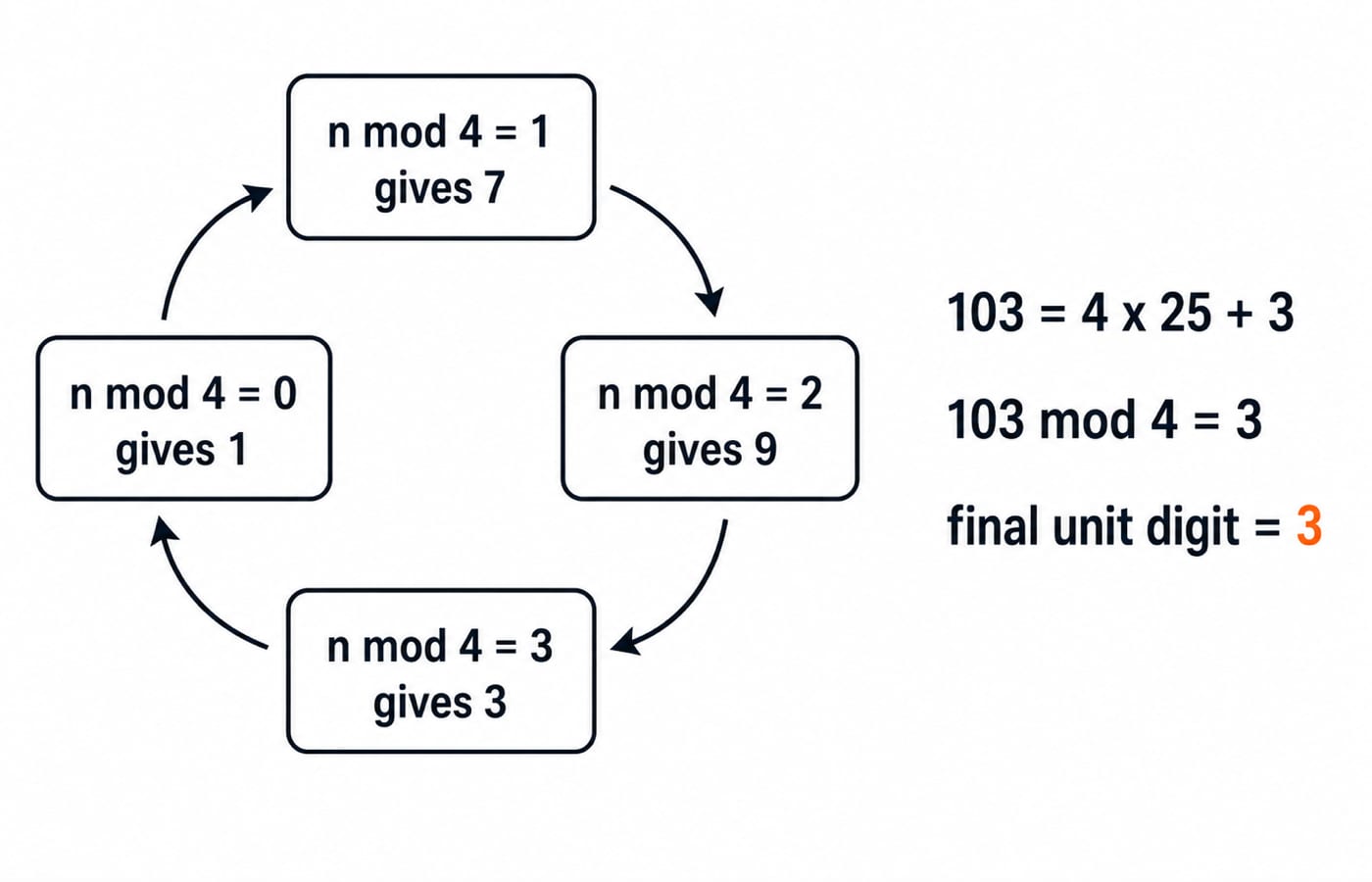
To find the unit digit of 7^103, write the first four powers:
7^1gives77^2gives97^3gives37^4gives1
The cycle then repeats. Since 103 = 4 x 25 + 3, exponent 103 uses the third position, so the unit digit is 3.
The same method solves 2^100 mod 7. Successive remainders are 2, 4, 1, a cycle of length 3. Because 100 = 3 x 33 + 1, choose the first cycle entry, giving remainder 2. If an exponent is exactly divisible by the cycle length, use the final listed entry, not a position zero.
Count Factors and Complete Perfect Powers
Start with 360 = 2^3 x 3^2 x 5^1. Any positive factor may use exponent 0, 1, 2, or 3 for 2, giving four choices; 0, 1, or 2 for 3, giving three; and 0 or 1 for 5, giving two. Therefore, the number of positive factors is (3 + 1)(2 + 1)(1 + 1) = 4 x 3 x 2 = 24.
To make 360 a perfect square, every prime exponent must be even. The exponents on 2^3 and 5^1 are odd, so the smallest multiplier is 2 x 5 = 10. Check it: 360 x 10 = 3,600 = 60^2.
Trailing zeroes are another prime-exponent count. Each zero in 100! needs a factor pair 2 x 5, and factors of 5 are fewer. Their count is floor(100/5) + floor(100/25) = 20 + 4 = 24. No 125 term is needed because 125 > 100.
How Competitive Exams Mix These Ideas
Four prompt patterns cover much of the practical decision-making:
A missing digit suggests a divisibility condition.
A repeated meeting time suggests LCM.
A greatest equal grouping suggests HCF.
A remainder or unit digit of a large power suggests a cycle.
Use the same solving order every time: identify the prompt, choose its representation, calculate, then substitute or bound-check the result.
The mix varies across placement tests and government examinations. Confirm the current syllabus and scheme in the official notification for the specific examination you plan to take. For a structured schedule, use the Aptitude for Placements guide. Practise the core patterns with Number System MCQs, and use the Number Systems and Base Conversions guide when your target test includes representation in other bases.
Traps That Make a Fast Method Wrong
Fast working still needs precise conditions. Avoid these common errors:
Calling
1prime. It has only one positive factor, so it is neither prime nor composite.Assuming co-prime numbers must be prime. The composite numbers
8and15have HCF1.Testing divisibility by
6using only evenness. The number must also be divisible by3.Swapping HCF and LCM. Greatest equal grouping points to HCF, while repeating events point to LCM.
Reporting a remainder equal to or greater than the divisor. A claimed remainder
7after division by7is another complete group, so the remainder is0.Treating cycle position
0as empty. When the exponent is a multiple of the cycle length, select the final listed position.
Build a compact checking habit. Refactor HCF and LCM results, substitute every missing digit, confirm 0 <= r < d, and calculate the first few powers before trusting a remembered cycle.
The Short Version and the Next Practice Step
Use a simple hierarchy: classify the number first, apply a divisibility test where possible, switch to prime exponents for factors, HCF, LCM, and perfect powers, then use modular cycles for large powers. Let 735,264 anchor divisibility, 84 and 126 anchor exponent choices, and 7^103 anchor cyclicity.
500+ published KnowledgeGate questions are mapped to Mathematics and Aptitude > Number System. Placement-focused learners can continue with the Aptitude for Placement course. GATE-focused learners can use the Aptitude for GATE course. If you are still choosing a route, browse Aptitude Courses for Exams & Placements.
Next, solve one question each on divisibility, HCF or LCM, factor counting, and remainder cycles. For every mistake, record whether the cause was concept selection, arithmetic, or verification.
Keep learning

Age Ratio-Based Problems: 12 Questions with Step-by-Step Solutions
Solve 12 age ratio-based questions from the KnowledgeGate practice bank. Each fresh solution shows how to form the equation, shift every age correctly, and verify the answer.
18 Oct 20267 min readAptitude & Reasoning

Mixture and Alligation: Rules, Shortcuts and Solved Examples for Exams
Learn how concentration, alligation and the retention factor solve the main mixture question types, with step-by-step examples and arithmetic checks.
Updated 14 Oct 20265 min readAptitude & Reasoning

Mental Ability Concepts and Shortcuts: Solved Examples for Competitive Exams
Learn a four-step reasoning process, then apply it to number patterns, mirror coding, directions, syllogisms, blood relations and ranking problems.
Updated 10 Oct 20267 min readAptitude & Reasoning

Mensuration and Geometry for Competitive Exams: Formulas, Shortcuts and Solved Examples
Learn how to choose the right mensuration formula, avoid common geometry traps, and solve 2D path and 3D recasting problems step by step.
Updated 6 Oct 20266 min readAptitude & Reasoning