Mental Ability Concepts and Shortcuts: Solved Examples for Competitive Exams
Learn a four-step reasoning process, then apply it to number patterns, mirror coding, directions, syllogisms, blood relations and ranking problems.
KnowledgeGate Team
Exam prep & CS education
Updated 10 Oct 20267 min read

Mental ability questions often look unrelated because a number series, a coded word, a direction trace and a syllogism have different surfaces. Underneath, each asks you to extract a rule while preserving every constraint. The repeatable process is: represent, find the invariant, apply the smallest valid rule, then verify. A shortcut helps only when it preserves the logic. It is never a licence to guess from the options.
Mental ability is a family of reasoning tasks, not one trick
Here, mental ability means rule-based reasoning with verbal, numeric and spatial information. Useful families include pattern and series, analogy and classification, coding-decoding, direction sense, deductive reasoning such as syllogisms, and relationship or ranking problems. This is a learning framework, not an official or exhaustive syllabus for every examination.
The same loop works across these families:
Translate the words or symbols into a compact representation.
Identify what stays consistent.
Perform only the necessary operation.
Substitute the answer into the original conditions.
This is stronger than collecting disconnected tricks that fail when wording changes. For the wider mix of quantitative aptitude, logical reasoning and verbal ability, see Aptitude Courses for Exams and Placements.
Pattern recognition: use differences before inventing a formula
Consider the sequence 3, 8, 15, 24, 35, ?. Start with first differences:
8 - 3 = 515 - 8 = 724 - 15 = 935 - 24 = 11
The differences are 5, 7, 9, 11, rising by 2. The next difference is therefore 13, so the missing term is 35 + 13 = 48.
Now cross-check through position. The rule a_n = n^2 + 2n gives 3, 8, 15, 24, 35 for n = 1, 2, 3, 4, 5. For n = 6, it gives 6^2 + 2(6) = 36 + 12 = 48. The difference table is faster here. The formula verifies the answer rather than adding a compulsory step.
A short finite list can fit several complicated formulas, so it does not prove a mathematically unique continuation. Prefer the simplest rule that fits every shown term and is consistent with the answer choices.
Always write differences in a separate row. That simple layout makes the progression visible and reduces mental arithmetic errors.
Coding, analogy and classification: name the relation first
For a mirror-alphabet code, write A = 1, B = 2, ..., Z = 26 and map each position to 27 - original position.
For MIND:
M(13) -> N(14)I(9) -> R(18)N(14) -> M(13)D(4) -> W(23)
Thus, MIND -> NRMW. Apply the identical mapping to BRAIN: B(2) -> Y(25), R(18) -> I(9), A(1) -> Z(26), I(9) -> R(18) and N(14) -> M(13). The coded word is YIZRM.
In an analogy, state the relation before selecting an answer. Thermometer : temperature :: barometer : ? uses instrument : quantity measured, so the answer is air pressure, not weather or altitude. A pair can look grammatically similar while expressing the wrong meaning.
For classification, inspect 64, 81, 100, 121, 143. The first four are 8^2, 9^2, 10^2, 11^2. Since 11^2 = 121 and 12^2 = 144, 143 is not a square. It is the odd one out.
The relation label is the real shortcut: it prevents a familiar word or number from steering you towards the wrong choice.
Direction sense: turn every movement into coordinates
Take east as positive x, north as positive y, and the start as O = (0, 0). Ravi walks 6 m north to A = (0, 6), then 8 m east to B = (8, 6), then 2 m south to C = (8, 4). His net movement is 8 m east and 4 m north.
The shortest distance from the start is:
OC = sqrt(8^2 + 4^2) = sqrt(64 + 16) = sqrt(80) = 4sqrt(5) m
Both final coordinates are positive, so Ravi is north-east of the start. Keep distance walked separate from displacement. His path length is 6 + 8 + 2 = 16 m, while his displacement is 4sqrt(5) m.
A quick check is to add signed movements directly: north +6 - 2 = +4, while east remains +8. This matches C = (8, 4) before choosing an option.
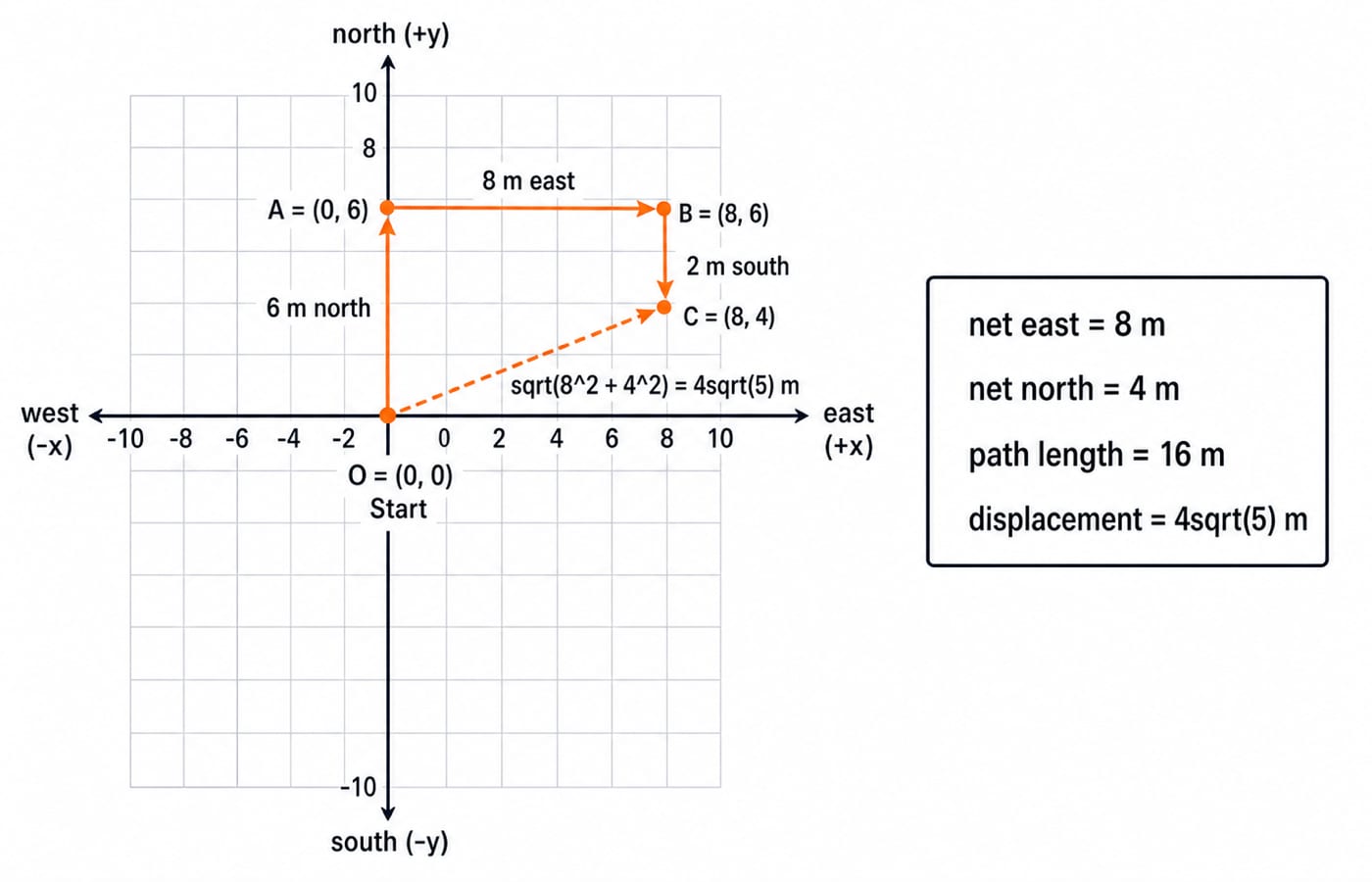
Coordinates prevent cancellation and left-right errors only when you update the point after every leg. If turns are relative to the walker's facing direction, update the facing first, then record the new coordinate.
Syllogisms: test only what the premises force
Use these premises:
Some poets are painters.
All painters are dreamers.
No dreamer is hurried.
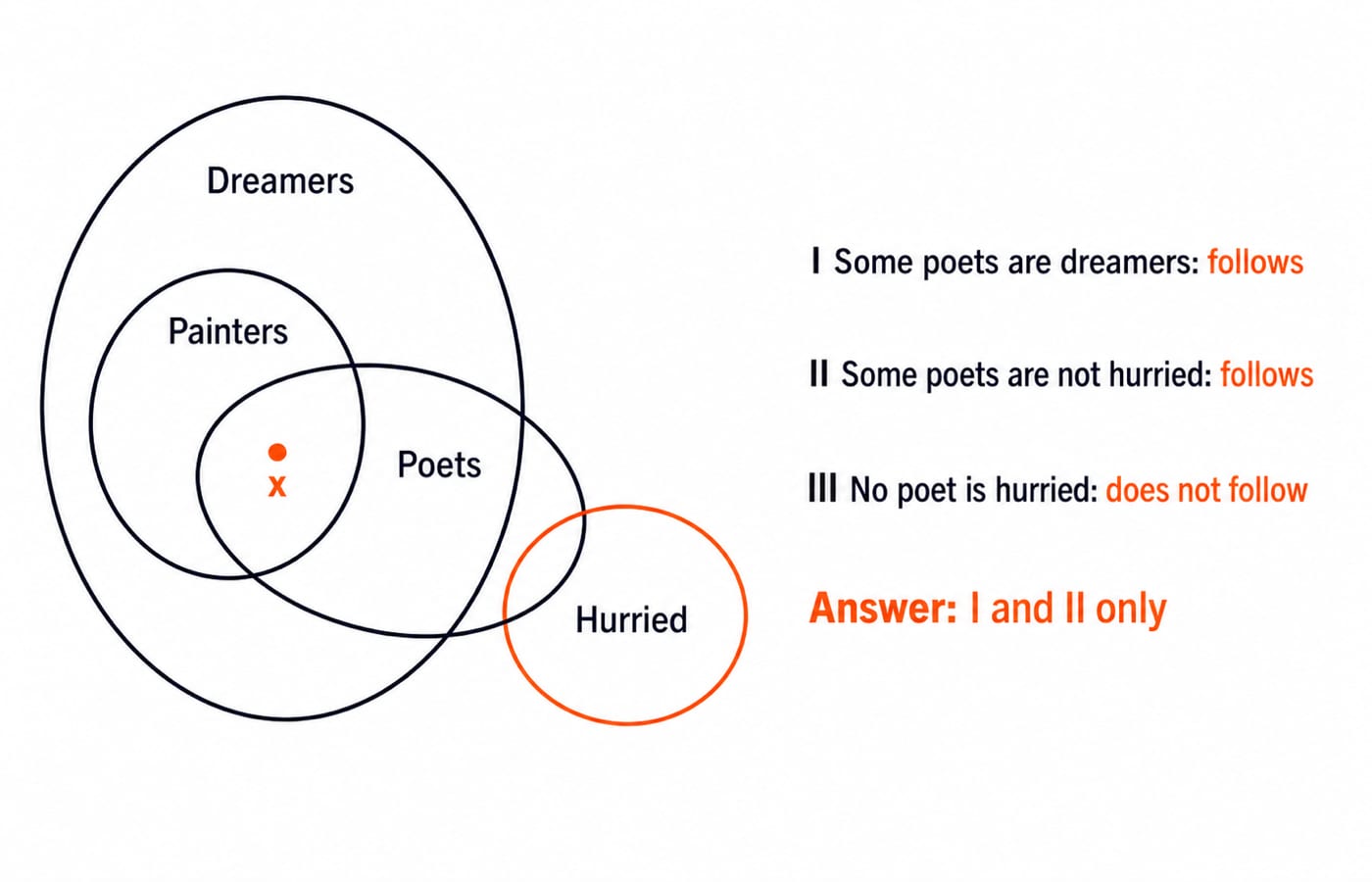
The first premise supplies at least one existing person, call that person x, who is both a poet and a painter. Every painter is a dreamer, so x is a dreamer. No dreamer is hurried, so x is not hurried.
Now test the conclusions:
Some poets are dreamers. This follows because
xis both.Some poets are not hurried. This follows because
xis a poet and is not hurried.No poet is hurried. This does not follow. The premises say nothing about poets outside the painter set.
The answer is I and II only. The safe shortcut is to mark subset, overlap and exclusion, then ask whether a counterexample can exist. Logical Reasoning for Placement Tests: 3 Solving Methods extends this method from single statements to puzzles and arrangement sets.
A conclusion follows only if every arrangement satisfying the premises also satisfies it. One supporting sketch is not enough.
Blood relations and ranking: use identities and positions
Riya is a woman and has no siblings. She points to Kunal and says, "His mother is the only daughter of my mother." Since Riya has no siblings and is female, the only daughter of Riya's mother is Riya. Therefore Kunal's mother = Riya. The pronoun "His" identifies Kunal as male, so Kunal is Riya's son. The first sentence is load-bearing because it resolves the identity without an unstated assumption.
For ranking, suppose a row has 40 candidates and Neha is 12th from the left. Her rank from the right is 40 - 12 + 1 = 29th. Arjun stands 9 places to her right, so he is 12 + 9 = 21st from the left and 40 - 21 + 1 = 20th from the right.
Work from the innermost relationship noun outward. For ranks, use left rank + right rank - 1 = total. When someone moves within a row, first add or subtract the position gap, then convert sides.
Shortcuts that save time, and the traps that make them fail
Use this recall table to choose a representation before calculating:
Question family | First representation | Check |
|---|---|---|
Series | First and second differences | Rule fits every term |
Coding | Alphabet positions and one mapping | Same mapping fits every letter |
Directions | Coordinates and current facing | Recompute net movement |
Syllogism | Set inclusion or exclusion | Search for a counterexample |
Blood relation | Identity chain | Use every qualifier |
Ranking | Numbered positions | Total reconciles from both ends |
Then spend ten seconds checking the exact demand. Separate path length from displacement. Confirm the code direction instead of decoding the result again. Ask whether a syllogism conclusion is necessary, not merely possible. For an option question, substitute the chosen option into the original conditions.
Repair common traps directly: replace an elaborate series rule with the smallest rule covering all data; never reverse all A are B into all B are A; update facing before movement; write identities before handling words such as only or gender clues; and subtract 1 for the shared person when reconciling two ranks.
How competitive exams frame mental ability, and the next practice step
Common shapes include series, analogies, odd items, letter codes, directions, syllogisms, relationships and ranks. Topic names, section labels, marks and counts vary by examination and cycle, so check the current syllabus and notification on the official site for your own exam.
190+ published KnowledgeGate questions are mapped to Mental Ability across Basic Mental Ability and Advance Mental Ability. Continue with GATE Verbal Aptitude and Reasoning: Solved Examples for a GATE-focused lesson, or use Aptitude for Placements: Section Topics and Weekly Plan to structure placement practice.
The short version is represent, find the invariant, apply, verify. Without looking back, reproduce 48, YIZRM, 143, 4sqrt(5) m north-east, I and II only, son and 20th from the right. Then choose Aptitude for Placement for the placement route or APTITUDE for GATE Exam (Complete Course) for the GATE route.
Keep learning
Number System Concepts and Shortcuts: Solved Examples for Competitive Exams
Learn how to classify numbers, choose the right divisibility or prime-factor method, and verify remainders, factors, HCF, LCM, and unit digits.
Updated 22 Oct 20266 min readAptitude & Reasoning

Age Ratio-Based Problems: 12 Questions with Step-by-Step Solutions
Solve 12 age ratio-based questions from the KnowledgeGate practice bank. Each fresh solution shows how to form the equation, shift every age correctly, and verify the answer.
18 Oct 20267 min readAptitude & Reasoning

Mixture and Alligation: Rules, Shortcuts and Solved Examples for Exams
Learn how concentration, alligation and the retention factor solve the main mixture question types, with step-by-step examples and arithmetic checks.
Updated 14 Oct 20265 min readAptitude & Reasoning

Mensuration and Geometry for Competitive Exams: Formulas, Shortcuts and Solved Examples
Learn how to choose the right mensuration formula, avoid common geometry traps, and solve 2D path and 3D recasting problems step by step.
Updated 6 Oct 20266 min readAptitude & Reasoning