Attribute Closure and Candidate Keys for GATE
Compute closure to a fixed point, use RHS analysis to find every minimal key, and handle prime attributes and candidate-key counting without guessing.
KnowledgeGate Team
Exam prep & CS education
Updated 19 Jul 20266 min read
Candidate keys are easy to miss when you try to see them by inspection. Treat the question as an algorithm instead. Start from attributes that every key must contain, compute closures to a fixed point, and test minimality separately from superkey status.
That process finds all the keys without trusting a clever-looking guess.
Attribute closure: use the fixed-point algorithm
For an attribute set X and functional dependencies F, the closure X+ is every attribute functionally determined by X under F. The procedure is short:
Set
result = X.For each FD Y -> Z, if Y is contained in
result, add Z toresult.Repeat the full scan until a pass adds nothing.
Stopping after one scan is unsafe because a newly added attribute can enable another FD, including one that appeared earlier in your written list.
Consider relation R(A, B, C, D, E) with:
F = {A -> B, B -> C, CD -> E, E -> D}First compute A+:
A+ = {A}
   = {A, B}       using A -> B
   = {A, B, C}    using B -> C
Neither CD -> E nor E -> D can fire. The fixed point is {A, B, C}, so A alone is not a superkey.
Now compute (AD)+:
Start:              {A, D}
Use A -> B:         {A, B, D}
Use B -> C:         {A, B, C, D}
Use CD -> E:        {A, B, C, D, E}
All attributes have been reached, so AD is a superkey. It is minimal because A+ is {A, B, C} and D+ is {D}. Removing either A or D destroys superkey status. Therefore AD is a candidate key.
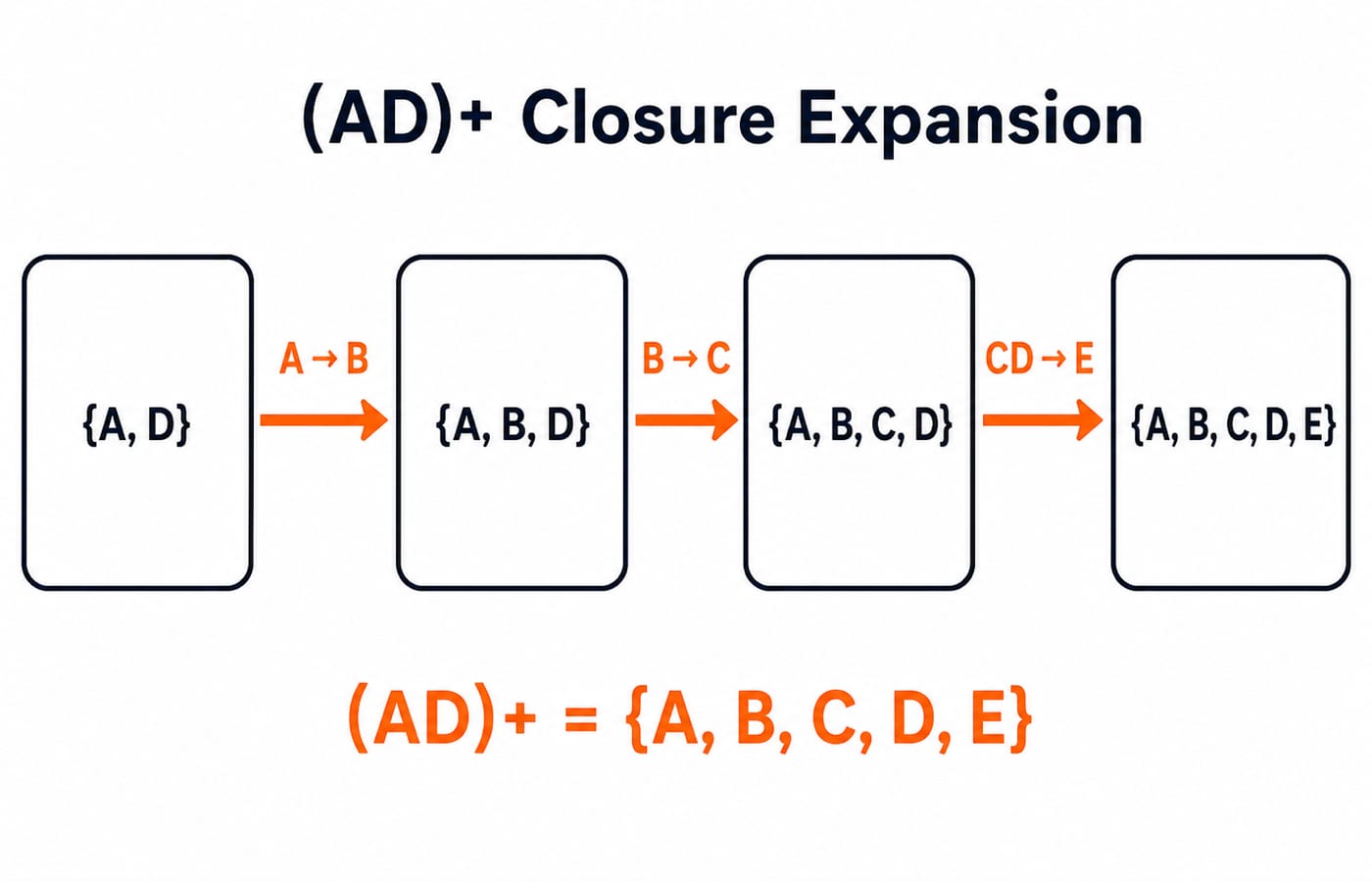
Repeat the derivation in a different order as a check. Starting from AD, derive C through A -> B -> C, then combine C with the original D to derive E. The result is again ABCDE.
Finding all candidate keys systematically
A superkey determines every attribute in the relation. A candidate key is a minimal superkey, meaning no proper subset remains a superkey. Finding one candidate key does not answer a question asking for all of them.
Use the RHS test on the same FD set. The attributes appearing on right-hand sides are {B, C, E, D}. Attribute A never appears on any RHS, so no other attributes can derive it. A must occur in every candidate key.
Start with the mandatory set {A}. Its closure is {A, B, C}. The missing attributes are D and E. Test the smallest additions:
We already found
(AD)+ = ABCDE, so AD is a candidate key.For AE, start with
{A, E}. A -> B adds B, B -> C adds C, and E -> D adds D. Thus(AE)+ = ABCDE. Since neither A nor E alone is a superkey, AE is also a candidate key.
No other minimal key exists. Adding B or C to A cannot supply D or E because A already derives both B and C. Any larger set containing AD or AE is a superkey but fails minimality. The complete candidate-key set is therefore:
{AD, AE}A useful classification is:
Attributes not on any RHS must be in every key. Here that set is
{A}.Attributes already in the closure of the mandatory set need not be added during enumeration. Here B and C are such attributes.
Remaining attributes are the useful choice set. Here choosing D or E completes a minimal key.
Do not read the last bullet as a universal claim that an attribute on a right-hand side can never be in a key. E sits on the right of CD -> E and still belongs to candidate key AE, because E also sits on the left of E -> D. The safe form of the rule is narrower: an attribute that appears on no left-hand side anywhere is never prime, since it enables no dependency and the rest of any superkey already derives it. Every other case is settled by closure and minimality.
Prime and non-prime attributes
An attribute is prime if it belongs to at least one candidate key. With keys AD and AE, the prime attributes are A, D, and E. The non-prime attributes are B and C.
Prime status matters when checking normal forms. Partial dependency of a non-prime attribute on a proper subset of a composite key is central to 2NF. In 3NF, for every non-trivial FD X -> A, either X must be a superkey or A must be prime. That is why missing even one candidate key can produce a wrong normalization answer.
Continue that chain in normalization from 1NF to BCNF, where closure and keys become inputs to the decomposition decisions.
Counting candidate keys: a worked pattern
Consider a second relation T(P, Q, R, S) with:
F = {P -> Q, Q -> P, R -> S, S -> R}P and Q determine each other, but neither pair member determines R or S. Similarly, R and S determine each other, but neither determines P or Q. A key must therefore select one attribute from {P, Q} and one from {R, S}.
The four combinations are:
PR, PS, QR, QSCheck PR: P -> Q and R -> S, so (PR)+ = {P, Q, R, S}. Neither P+ nor R+ contains all four attributes, so PR is minimal. The same symmetric argument verifies the other three pairs.
There are 2 x 2 = 4 candidate keys. This multiplication shortcut works because the two independent equivalence groups each contribute exactly one choice. Still write the combinations and verify one closure so that overlapping or cross-group dependencies do not hide an exception.
For another worked treatment of dependencies and design, see DBMS normalization explained.
How GATE tests closure and keys
Questions ask whether an FD follows from F, which sets are candidate keys, how many keys exist, or which attributes are prime. Four traps take most of the marks, and every one of them has already appeared above. Stopping the scan early loses E in (AD)+, because CD -> E can only fire once B -> C has supplied C. Answering ABD instead of AD trades a candidate key for a plain superkey. Ruling E out because it sits on a right-hand side deletes the second key, AE. Stopping at the first key found answers half of a question that asks how many keys exist, which is exactly what the four keys of T(P, Q, R, S) punish.
Write the closure as a growing set and annotate the FD that fires at each step. When the question depends on current syllabus or paper instructions, check the official GATE portal of the organising IIT. The GATE CS preparation category collects the rest of the DBMS sequence and the other GATE CS subjects.
The short version
Begin with attributes absent from every RHS, close them to a fixed point, and add the smallest useful combinations. A set becomes a candidate key only when its closure is the full relation and every attribute in the set is necessary. Enumerate all minimal alternatives before marking prime attributes.
Practise these steps under time pressure in the GATE Test Series. For every proposed key, write one full closure and one explicit minimality check.
Keep learning

Electronic Data Interchange (EDI) and E-Commerce: Layers, X12 Segments and Legal Validity Explained
Learn EDI from the business document to the X12 envelope, then follow it through a VAN, a 997 acknowledgment, signature verification and Indian cyber law.
Updated 26 Oct 20265 min readGATE Strategy & Roadmap

Cyber Threats and Malware Attacks: Types, Attack Vectors, and Worked Security Problems
Learn to distinguish malware classes, map attacks to the CIA triad, and solve password, cipher, and key-count numericals. The guide also covers common attack vectors and a safe way to study Indian cyber law.
Updated 24 Oct 20266 min readGATE Strategy & Roadmap

Cyber Safety and Security: Information Security and Cyber Law with Worked Examples
Learn information security as an applied subject. Classify security failures, work Caesar and RSA examples, separate common attacks, and revise India's cyber-law framework.
Updated 22 Oct 20266 min readGATE Strategy & Roadmap

Internet & Web Technology for GATE: Syllabus Boundary, Weightage Method and Prep Order
Treat Internet and Web Technology as an overlap area, not a promised standalone subject. Build scope, paper-audit, URL-tracing and subnetting skills in a 12-session plan.
Updated 18 Oct 20265 min readGATE Strategy & Roadmap