Internet & Web Technology for GATE: Syllabus Boundary, Weightage Method and Prep Order
Treat Internet and Web Technology as an overlap area, not a promised standalone subject. Build scope, paper-audit, URL-tracing and subnetting skills in a 12-session plan.
KnowledgeGate Team
Exam prep & CS education
Updated 18 Oct 20265 min read
“Internet & Web Technology” is a study label spanning Computer Networks, application-layer protocols, web basics and security. For GATE CS preparation, use the completed official GATE 2026 CS syllabus as a boundary model, then replace it with your cycle's official syllabus when available. Audit completed papers, trace a browser-to-server flow, solve a subnet and order only retained material.
Is Internet & Web Technology a separate GATE subject?
KnowledgeGate's GATE Test Series describes subject-wise coverage under Computer Networks, with no separate Internet & Web Technology block. Use the phrase as an overlap label, not proof of an official standalone GATE subject.
Use Internet Fundamentals: DNS, URLs and Worked Examples for architecture, connection types, URLs and browser-to-server mechanics. The boundary ledger decides what belongs in GATE preparation, measures completed-paper appearances and orders retained topics.
Core network concepts to verify for the current cycle | Web concepts that support understanding | Broader web-development extensions |
|---|---|---|
TCP/IP layers, IP addressing, DNS, HTTP | Browser-server flow, URLs, cookies, caching, HTTPS | HTML, CSS, JavaScript, MVC, server-side scripting, hosting, emerging technologies |
The official syllabus for the target cycle decides which rows belong in the first pass; the overlap label supplies neither inclusion nor marks.
Internet & Web Technology topics in three scope rings
KnowledgeGate's practice bank organises the material into seven areas for revision: Internet Fundamentals; Protocols & Services; Web Design & Development; Web Publishing & Hosting; Server Side & Security; Emerging Technologies; and Website, Browser & Services. Those categories describe practice coverage, not official GATE scope.
Together they cover Internet basics and connection types; TCP/IP, addressing and core protocols; websites, webpages and browsers; DNS, HTTP and common Internet services; web technologies; hosting, publishing and server-side scripting; security, client-server links and newer technologies. The practice bank has 240+ questions available for practice, which gives useful practice depth. Prioritise in this order: official-cycle scope first, prerequisite order second, question-bank depth third. A large practice bank makes revision easier, but cannot establish official weightage or predict the next paper.
Build a completed-paper weightage ledger
Build a completed-paper audit with columns for year, session, question number, primary concept, overlap tag, question type, marks and source page. Count each question once. An overlap tag such as DNS + application layer records the connection without double counting.
Illustration: session A has Q8 on DNS for 1 mark and Q31 on subnetting for 2, giving 1 + 2 = 3. Session B has one HTTP item for 1. Session C has a 1-mark TCP/IP item and a 2-mark client-server item, giving 1 + 2 = 3. The series is 3, 1, 3; sorted, it is 1, 3, 3, so the median is 3 and the observed span is 1-3. This describes only those sessions, not a guaranteed allocation.
Trace a URL through DNS, TCP, TLS and HTTP
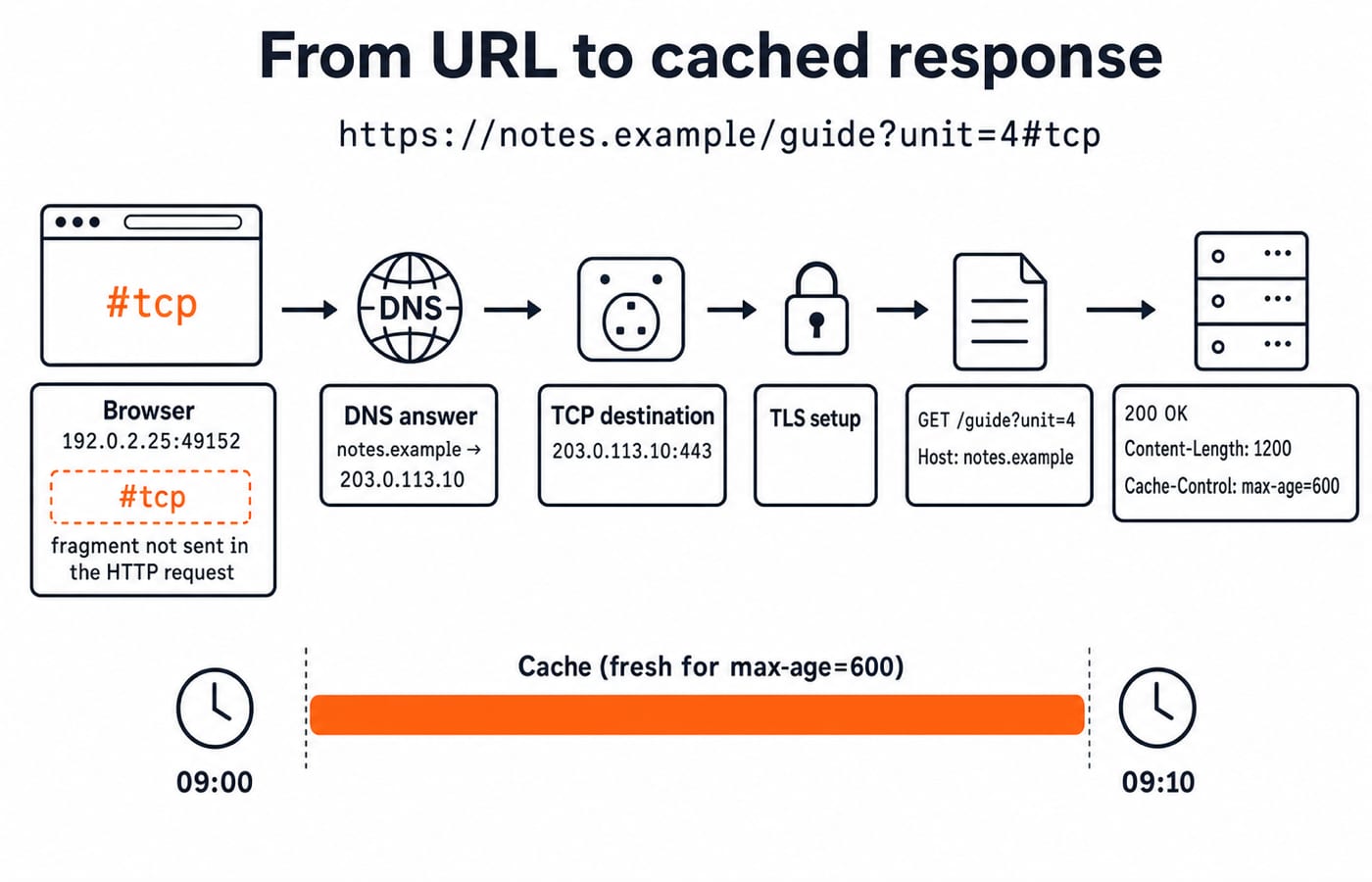
Take https://notes.example/guide?unit=4#tcp. Its scheme is https, host is notes.example, path is /guide, query is unit=4, and fragment is tcp. The browser handles the fragment, so #tcp is absent from the HTTP request target.
DNS resolves the host to documentation address 203.0.113.10. Client 192.0.2.25 opens port 49152 to server port 443. After TCP and TLS setup, the browser sends GET /guide?unit=4 HTTP/1.1 with Host: notes.example. The server returns HTTP/1.1 200 OK, Content-Length: 1200 and Cache-Control: max-age=600. If stored at 09:00, it remains fresh until 09:10, because 600 seconds / 60 = 10 minutes.
Keep the roles separate: DNS resolves a name, TCP connects endpoints, TLS protects the session, and HTTP carries the request and response. Reinforce these distinctions with Application Layer MCQs.
Connect the web trace to a /27 subnet
For host 172.16.5.130/27, the /27 mask is 255.255.255.224. The last-octet block size is 256 - 224 = 32, so blocks begin at 0, 32, 64, 96, 128, 160, 192, 224.
Since 130 lies in the 128-159 block, the network address is 172.16.5.128 and the broadcast address is 172.16.5.159. The usable range is 172.16.5.129 through 172.16.5.158. Five host bits remain, so the conventional usable-host calculation is 2^(32-27) - 2 = 2^5 - 2 = 32 - 2 = 30. Check the full method against Subnetting and IP Addressing MCQs. Do not merge this calculation with DNS or HTTP just because all three can appear in a browser flow.
Put the in-scope material into 12 sessions
Use twelve 75-minute sessions. That is 12 x 75 = 900 minutes, or 900 / 60 = 15 hours.
Internet versus Web and client-server roles
TCP/IP layer map
IPv4 and CIDR
TCP versus UDP and ports
DNS
HTTP, HTTPS and URL anatomy
Browser-server trace and caching
Cookies, sessions and basic web security
Websites, webpages and web servers
HTML, CSS and JavaScript role boundaries, plus hosting basics
Mixed questions
Timed test and error-log repair
After checking the current official syllabus, keep in-scope sessions in the first pass and move web-development or hosting extensions to a second pass. Four sessions per week take three weeks; three per week take four. Move a missed session forward instead of squeezing two together. GATE Guidance by Sanchit Sir provides a structured preparation route.
Diagnose errors by their trap signature
Practise layers, URLs, DNS, HTTP, subnetting, roles, ports, caching, cookies and security.
If an answer treats the Internet and the Web as synonyms, separate the infrastructure from the Web service.
If DNS appears to transfer a page, state that it resolves notes.example to 203.0.113.10; HTTP carries the request and response.
If HTTPS appears to replace TCP, write the sequence as TCP, then TLS, then HTTP.
If an IP address appears to identify a process, add the port: client 192.0.2.25:49152 connects to server port 443.
If a port appears to identify a machine, separate server address 203.0.113.10 from service port 443.
If browser and search engine collapse into one role, label the client application and remote service separately.
If practice volume becomes a weightage claim, return to the completed-paper ledger.
Choose the next practice task
Use four checks before adding a topic to the plan: the official-cycle syllabus names or entails it, completed papers show how it was asked, the prerequisite chain is clear, and an error log identifies what to revisit. Question-bank volume is practice depth, not forecast evidence.
Reproduce the URL flow through 200 OK, solve 172.16.5.130/27 without notes, then attempt 20 mixed questions. Classify each miss as scope, protocol role, subnet arithmetic or terminology before moving to timed practice in the GATE Test Series.
Keep learning
Cyber Safety and Security: Information Security and Cyber Law with Worked Examples
Learn information security as an applied subject. Classify security failures, work Caesar and RSA examples, separate common attacks, and revise India's cyber-law framework.
Updated 22 Oct 20266 min readGATE Strategy & Roadmap
How to Use Practice Exams and Past Papers with Spaced Repetition
Turn practice exams and past papers into a spaced revision system. Learn how to analyse mistakes, schedule reattempts, and fit mocks into a weekly study plan.
15 Oct 20266 min readGATE Strategy & Roadmap
Information Security & Cyber Laws for GATE: Syllabus Scope, Weightage Reality and Prep Order
Check where security concepts overlap with GATE CS, where Cyber Laws sits outside the cited syllabus, and how to protect core preparation while serving a second target.
Updated 14 Oct 20265 min readGATE Strategy & Roadmap
Security in Mobile and Wireless Computing: Threats, Controls and a Worked Replay-Attack Example
Learn where wireless, device, application and identity controls apply, then trace exactly how a server detects message tampering and rejects a replay.
Updated 10 Oct 20266 min readGATE Strategy & Roadmap