Information Security & Cyber Laws for GATE: Syllabus Scope, Weightage Reality and Prep Order
Check where security concepts overlap with GATE CS, where Cyber Laws sits outside the cited syllabus, and how to protect core preparation while serving a second target.
KnowledgeGate Team
Exam prep & CS education
Updated 14 Oct 20265 min read
Information Security and Cyber Laws appear in university courses, recruitment tests and broader computer-science material. That familiar name does not prove that the subject belongs to GATE CS. The named GATE CS scope is narrower than the broader subject; assess weightage from completed papers and use a two-track order when a second exam or curriculum requires the broader material.
The official scope check: this is not a named GATE CS subject
IIT Guwahati's completed GATE 2026 CS syllabus PDF itself has exactly ten sections. It ends with Section 10, Computer Networks, and does not list Information Security, Cyber Security or Cyber Laws as a separate section or phrase. For this completed cycle, the pattern assigned 15 marks to General Aptitude, 13 to Engineering Mathematics and 72 to subject questions. It did not reserve a subject-wise quota for security or cyber law. Use the GATE CS exam preparation pathway for broader preparation, but use the official organising institute's documents as the scope authority for your own attempt.
What overlaps with GATE, and what remains outside the cited syllabus
The boundary becomes clearer when the terms are placed side by side.
Scope | Exact areas | Study decision |
|---|---|---|
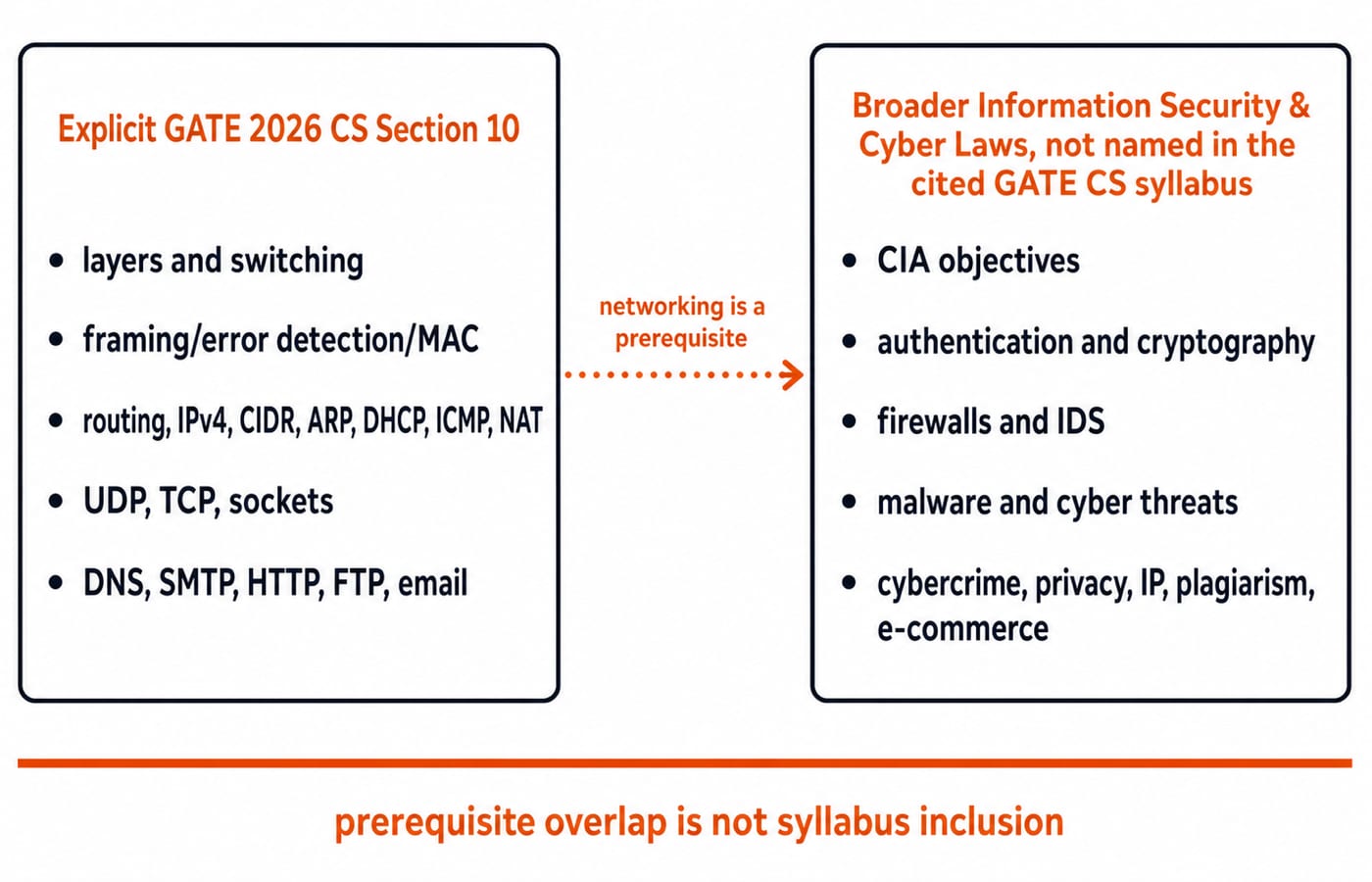
Explicit in GATE 2026 CS Section 10 | OSI and TCP/IP layering; packet, circuit and virtual-circuit switching; framing, error detection, MAC and Ethernet bridging; routing; fragmentation, IPv4, CIDR, ARP, DHCP, ICMP and NAT; flow and congestion control; UDP, TCP and sockets; DNS, SMTP, HTTP, FTP and email | Prepare as official Computer Networks scope |
Useful security foundation but not named there | Confidentiality, integrity, availability, authentication, cryptography, firewalls, IDS and malware | Study only for a separately named target |
Broader cyber-law and policy study | Cybercrime reporting, privacy, intellectual property, plagiarism and e-commerce controls | Follow the second syllabus |
The Computer Networks MCQs support the official networking foundation. Prerequisite overlap does not turn the broader rows into official GATE scope.
Weightage reality: audit completed papers, never invent a quota
Officially, GATE 2026 CS had no Information Security or Cyber Laws allocation. Claims such as "always 2 marks" or "high-weightage security topic" need completed-paper evidence, not a coaching taxonomy or question-bank size.
Consider a hypothetical audit sheet, not a historical paper: Q11 DNS, 1 mark, Q28 TCP congestion control, 2 marks, Q41 NAT, 1 mark, and Q52 RSA, 2 marks. Under the cited syllabus, the Computer Networks subtotal is 1 + 2 + 1 = 4 marks. RSA goes in an outside cited GATE 2026 CS scope column, so a combined security/network weightage of 6 marks is wrong. Why PYQs Beat Buying Another Question Bank explains the evidence-led audit method.
Worked boundary example: NAT changes addressing, not the security objective
Trace this connection: 10.0.0.8:51500 -> 203.0.113.5:40001 -> 198.51.100.20:443. The NAT table maps private source 10.0.0.8:51500 to public source 203.0.113.5:40001; destination 198.51.100.20:443 stays unchanged. NAT is explicitly within the cited GATE 2026 Computer Networks syllabus. Translation alone does not encrypt the payload or authenticate the server.
Now classify three incidents using broader security teaching:
Exposing 500 customer rows violates confidentiality because unauthorised people can read protected data.
Changing a balance from
8,000to80,000violates integrity because the stored value was altered without authority.Making the portal unavailable for 45 minutes violates availability because authorised users cannot reach the service when needed.
These CIA labels teach security reasoning; they do not prove official GATE inclusion. In any question, identify the requested network layer and security objective before choosing vocabulary.
If a second exam or curriculum requires the broader subject, study it in this order
Practice questions on Information Security & Cyber Laws cover internet and web services; threats and malware; physical security and cryptography basics; mobile and wireless security; intrusion detection; cyber safety and law; electronic data interchange and e-commerce; and ethical hacking. That is a broader practice syllabus, not the GATE one.
Use a prerequisite order: (1) internet services and network foundations, (2) CIA objectives, threats and malware, (3) symmetric and asymmetric cryptography plus authentication, (4) firewalls, IDS and access controls, (5) mobile and wireless risks, then (6) cyber law, privacy, intellectual property and digital transactions. A GATE-only learner should not displace an officially listed CS topic for this track. Use it when another named syllabus, recruiter or college curriculum requires it.
A six-week two-track preparation plan
Schedule four 90-minute sessions weekly: 4 x 90 = 360 minutes, or 6 hours; six weeks total 6 x 6 = 36 hours.
Week 1: layering, switching and data-link concepts.
Week 2: routing, IPv4, CIDR, support protocols and NAT.
Week 3: transport and application-layer protocols.
Weeks 4 to 6, GATE-only: official-subject PYQs, revision and timed tests.
Weeks 4 to 6, dual-target: CIA, threats and malware; then cryptography, authentication, controls and IDS; then cyber law, privacy and e-commerce.
Each session: 25 minutes concept study, 50 minutes solving 8 to 12 questions, 15 minutes updating the error log. 25 + 50 + 15 = 90. Move missed sessions forward; never double the next day. GATE Guidance by Sanchit Sir structures protected GATE study but does not promise a Cyber Laws block.
Question formats, practice depth and four scope traps
The completed GATE 2026 question paper pattern used MCQ, MSQ and NAT carrying 1 or 2 marks. Wrong one-mark and two-mark MCQs lost one-third and two-thirds, respectively. MSQ and NAT had no negative marking; MSQ had no partial marking. Verify your cycle's official rules.
More than 200 Information Security & Cyber Laws practice questions give you breadth, not GATE PYQs or weightage evidence. Solve sets of 20, reviewing every wrong or guessed answer.
Scope trap | Replacement check |
|---|---|
NAT = encryption | Did encryption occur? |
Error detection = authentication | Was identity actually verified? |
Common CS topic = official GATE topic | Does the official syllabus name it? |
Question-bank size = weightage | What do completed papers show? |
The short version and next action
Download the completed official syllabus, mark the exact Section 10 terms, then decide whether a second target genuinely needs the broader security-and-law track. The GATE-only path stays within official scope and uses completed papers for historical evidence. Classify the three incidents by confidentiality, integrity and availability, then begin Week 1. After preparing official topics, move to timed practice with the GATE Test Series.
Keep learning
Internet & Web Technology for GATE: Syllabus Boundary, Weightage Method and Prep Order
Treat Internet and Web Technology as an overlap area, not a promised standalone subject. Build scope, paper-audit, URL-tracing and subnetting skills in a 12-session plan.
Updated 18 Oct 20265 min readGATE Strategy & Roadmap
How to Use Practice Exams and Past Papers with Spaced Repetition
Turn practice exams and past papers into a spaced revision system. Learn how to analyse mistakes, schedule reattempts, and fit mocks into a weekly study plan.
15 Oct 20266 min readGATE Strategy & Roadmap
Security in Mobile and Wireless Computing: Threats, Controls and a Worked Replay-Attack Example
Learn where wireless, device, application and identity controls apply, then trace exactly how a server detects message tampering and rejects a replay.
Updated 10 Oct 20266 min readGATE Strategy & Roadmap
ISRO Scientist/Engineer CS Syllabus vs GATE CS: The Subject Overlap Map
See which core CS subjects transfer directly from GATE to ISRO, what drops out, how the question texture changes and where an ISRO-specific polish helps.
Updated 5 Oct 20264 min read52 viewsGATE Strategy & Roadmap