Banking Exams Quantitative Aptitude: Build Arithmetic Foundations Before Speed Tricks
Shortcuts fail when the arithmetic underneath them is unstable. Rebuild five connected foundations with worked examples, then move to timed practice in controlled stages.
KnowledgeGate Team
Exam prep & CS education
Updated 24 Aug 20266 min read

You may remember several shortcuts and still freeze when a question changes its wording. That usually looks like a speed problem, but the deeper gap is an unstable chain of percentages, ratios, averages, interest, and work rates. If one link is weak, a longer word problem becomes difficult to set up before calculation even begins.
Rebuild the chain concept first, writing every base and unit down, and only then move towards faster solving in controlled stages. A shortcut is useful only when you can explain why it works and reproduce the full method when the wording changes.
1. See the arithmetic dependency chain before practising speed
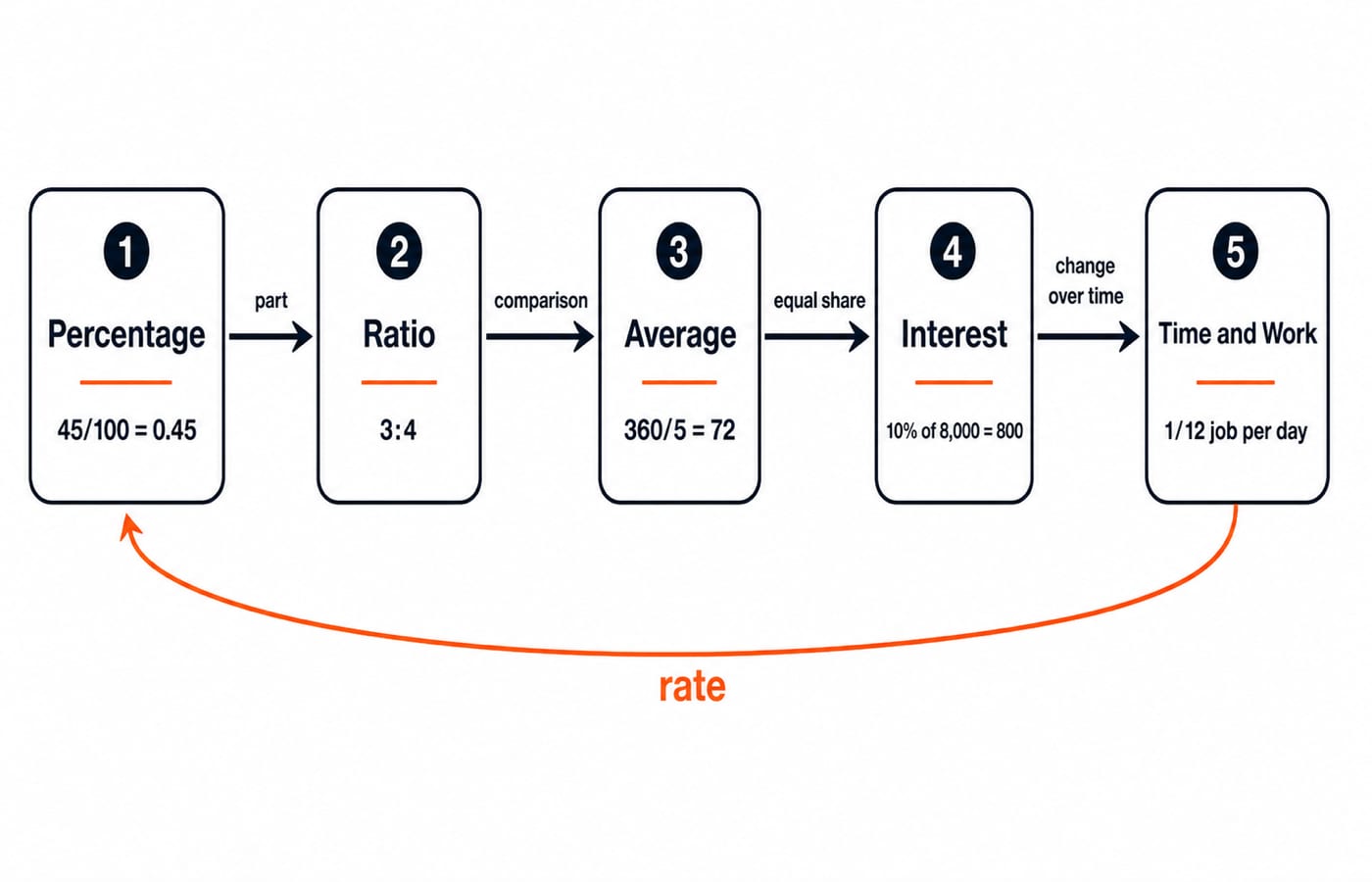
A percentage is a part per hundred. A ratio compares parts. An average divides a total into equal-share parts. Interest applies percentage change over time. Time and work uses the same proportional reasoning as rates.
Start with a small multiplication check: 45% of 240 = 0.45 x 240 = 108. Multiplication sense comes before any speed trick.
Check whether you can convert 3/8 into 37.5%, simplify 42:56 to 3:4, recover 360 from an average of 72 across 5 values, find 10% of 8,000 as 800, and identify 1/12 job per day for a worker who takes 12 days. If you miss two or more, rebuild those links before touching a timer, and keep your rough work visible. After rebuilding, use Bank PO quantitative aptitude high-yield topics to decide which areas deserve attention.
2. Percentages: build fraction sense before successive-change tricks
Fractions, decimals, and percentages are interchangeable forms of the same value. For example, 1/8 = 0.125 = 12.5%, 3/5 = 0.6 = 60%, and 7/20 = 0.35 = 35%.
To find 35% of 480, write:
(35/100) x 480 = 35 x 4.8 = 168
Cancel factors in 480/100 only when it makes the arithmetic clearer.
Begin with 500, increase it by 20%, then decrease the result by 10%:
After the rise:
500 x 1.20 = 600.After the fall:
600 x 0.90 = 540.Net change:
540 - 500 = 40, and40/500 x 100 = 8%.
The net result is an 8% rise. It is not simply +20% - 10% = +10% because the decrease uses 600 as its base, not 500.
For the reverse, if 600 follows a 20% rise, the original is 600/1.20 = 500. Subtracting 20% of 600 uses the wrong base.
3. Ratios and proportions: preserve the common term
A ratio gives relative parts. Suppose A:B = 3:5 and B:C = 10:7. The shared B must have equal parts, so multiply the first ratio by 2:
A:B = 6:10
Therefore, A:B:C = 6:10:7.
If A + B + C = 460, the total number of ratio parts is 6 + 10 + 7 = 23. One part is 460/23 = 20, so:
A = 6 x 20 = 120B = 10 x 20 = 200C = 7 x 20 = 140
Check the result: 120 + 200 + 140 = 460. Writing 3:5:7 would silently change the shared value of B. If a percentage share is requested, divide each part by 23 and then multiply by 100.
4. Averages: reconstruct the total before changing the group
Use total = average x number of items. Five scores averaging 68 total 68 x 5 = 340. Add a sixth score of 80: the new total is 420, and the average is 420/6 = 70.
For different-sized groups, do not average their averages. 20 observations averaging 64 total 1,280; 30 averaging 76 total 2,280. The combined average is:
(1,280 + 2,280)/(20 + 30) = 3,560/50 = 71.2
The tempting calculation (64 + 76)/2 = 70 would be valid only if the groups had equal sizes. The correct method weights each average by its group size, which is ratio reasoning again.
5. Interest: state the base for every year
Take a principal of 10,000 at 10% per year for 2 years. Under simple interest, the original principal remains the base:
SI = 10,000 x 10/100 x 2 = 2,000
The simple-interest amount is 10,000 + 2,000 = 12,000.
Under annual compound interest, the base changes after each year:
After year 1:
10,000 x 1.10 = 11,000.After year 2:
11,000 x 1.10 = 12,100.
The compound interest is 12,100 - 10,000 = 2,100. Its difference from simple interest is 2,100 - 2,000 = 100. The decision rule is simple: simple interest keeps the original base, while compound interest updates it.
6. Time and work: convert days into rates, then combine
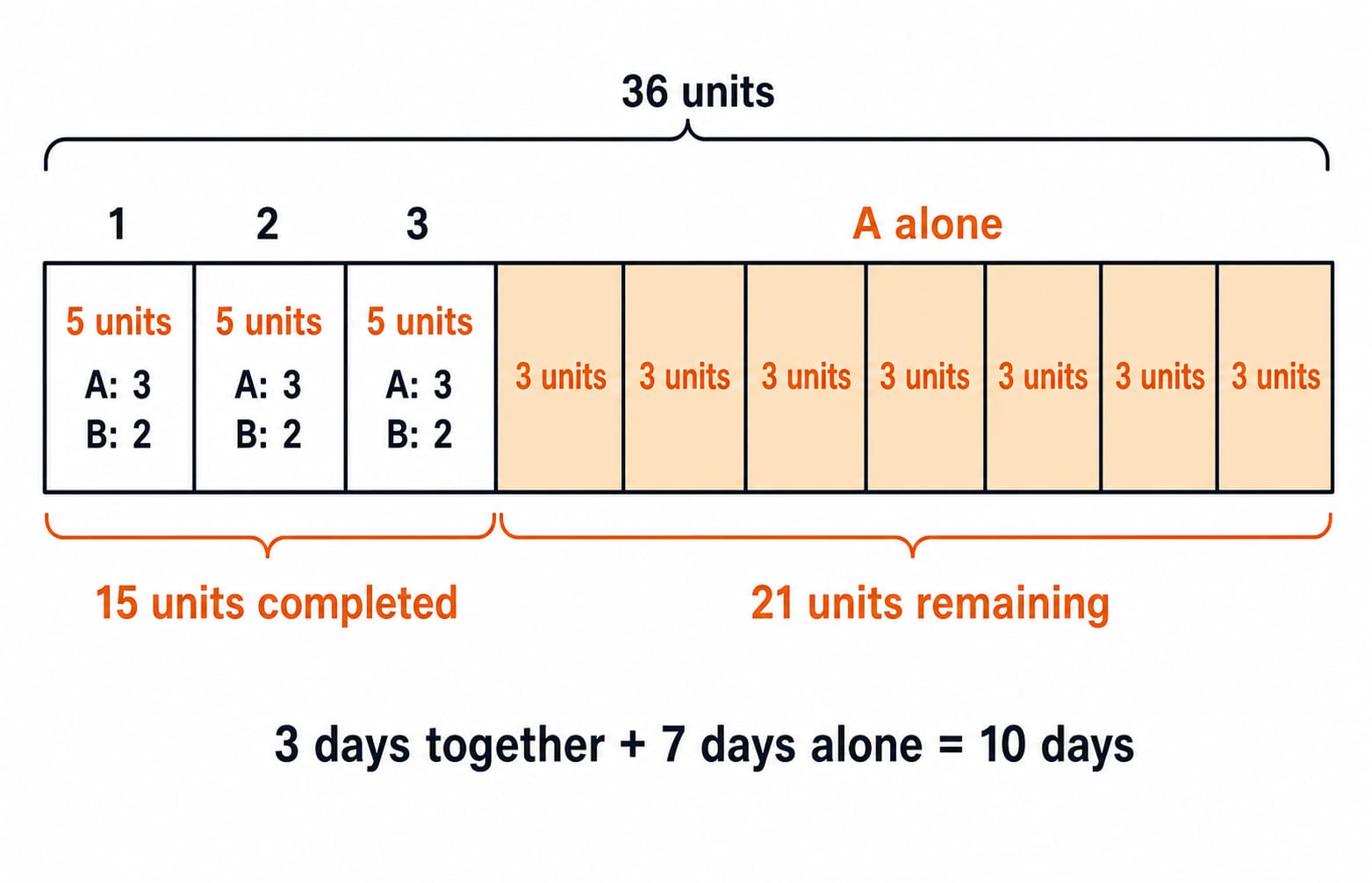
Suppose A finishes a job in 12 days and B in 18 days. Take the LCM, 36, as the total number of work units. A completes 36/12 = 3 units per day, while B completes 36/18 = 2 units per day. Together, they complete 5 units per day, so the job takes 36/5 = 7.2 = 7 1/5 days.
Now let both work together for 3 days. They complete 3 x 5 = 15 units, leaving 36 - 15 = 21 units. B leaves, and A finishes the remainder at 3 units per day in 21/3 = 7 more days. Total elapsed time is 3 + 7 = 10 days.
Never add 12 + 18 as if completion days were work rates. Also, do not round 7.2 days down to 7 unless the question explicitly asks about completed whole days.
7. How banking exams test the chain, and where shortcuts go wrong
A direct percentage or ratio question tests one link on its own. The forms that recur in bank quant sections chain several links inside a single question. A data-interpretation set hangs four or five questions off one table, and those questions routinely mix a percentage share, a ratio between two of the categories, and an average across a row, so one shaky link costs the whole set rather than one question. A caselet does the same without the table, and makes you extract the numbers from prose before any of that starts.
The arithmetic word problems are these same links wearing different nouns. Profit and loss, discount, mixtures and partnership are percentage and ratio questions. Pipes and cisterns, boats and streams, and trains are rate questions, which is why the 36-unit method above transfers to them unchanged: give the tank or the distance a convenient unit count, convert each agent into units per hour, then combine them, adding or subtracting as the direction demands. Simplification and approximation rows test nothing but the multiplication sense the chain opens with, at speed.
Question counts, sectional timing and the negative-marking fraction differ between IBPS and SBI and are set by each recruitment notification separately, so read them off the notification and information handout for the cycle you are sitting, published at ibps.in and sbi.co.in.
Wrong move | Why it fails | Replacement |
|---|---|---|
Treating | The changes use bases of | Use |
Using | The group sizes are | Combine totals: |
Adding | Completion times are reciprocals of work rates | Use |
Build speed in three passes. Solve 10 mixed questions untimed while writing every base and unit. Redo them in 15 minutes. Then attempt 20 fresh questions in 25 minutes, labelling each miss as concept, setup, calculation, or haste. For exam context, read the IBPS PO previous-year paper analysis. Explore broader options through the Banking and Insurance category.
8. The short version: earn speed by making the setup automatic
Percentages supply the language, ratios organise parts, averages rebuild totals, interest tracks a changing base, and time and work combines rates. Practise each link once, then repeat the speed ladder.
Learners targeting IBPS can inspect the IBPS PO Prelims course, while SBI aspirants can inspect the SBI PO Prelims course. A method is ready for speed practice only when you can reproduce its setup without looking up a shortcut.
Keep learning

RBI Grade B Previous Year Analysis: Recurring Topics and Study Priorities
Use recurring topic families to choose what to revise, then let your errors decide the time allocation. Work through DI, reasoning and reading examples before building a practical weekly plan.
22 Oct 20264 min readBanking Exams
RBI Grade B Exam Pattern and Marking Scheme: Phases, Scores and Penalties
Clearing Phase I and earning final-merit marks are different jobs. Understand the General-cadre stages, section timers and score calculations before planning your next mock.
18 Oct 20265 min readBanking Exams
GST Explained for Competitive Exams: Rates, CGST vs SGST vs IGST
Separate GST rates from tax components, then work through a 1,000 rupees supply and a simple input tax credit chain. Keep dated reforms apart from the concepts you use in calculations.
Updated 14 Oct 20265 min readBanking Exams
RBI Grade B Eligibility and Selection Process: Age, Qualifications and Stages
Check your RBI Grade B General Cadre eligibility in the right order: stream, age, qualification and previous appearances. Worked examples explain the boundaries before you plan for each selection stage.
9 Oct 20265 min readBanking Exams