RBI Grade B Syllabus 2026: Phase 1 and Phase 2 Decoded
Separate RBI's official General Cadre syllabus from practical study buckets, then use diagnostics and worked examples to build a balanced weekly plan.
KnowledgeGate Team
Exam prep & CS education
Updated 26 Aug 20265 min read93 views
RBI Grade B syllabus lists often mix RBI's official wording, coaching expansions and older patterns, making every topic look equally official and equally urgent. This guide first locks the 2026 General Cadre paper structure, then translates the named areas into practical study blocks, worked examples and a balanced week. It covers the General Cadre only. DEPR and DSIM use different papers and should not be folded into this map.
Related reading: IBPS PO syllabus and descriptive writing.
RBI Grade B 2026 syllabus at a glance: the official paper map
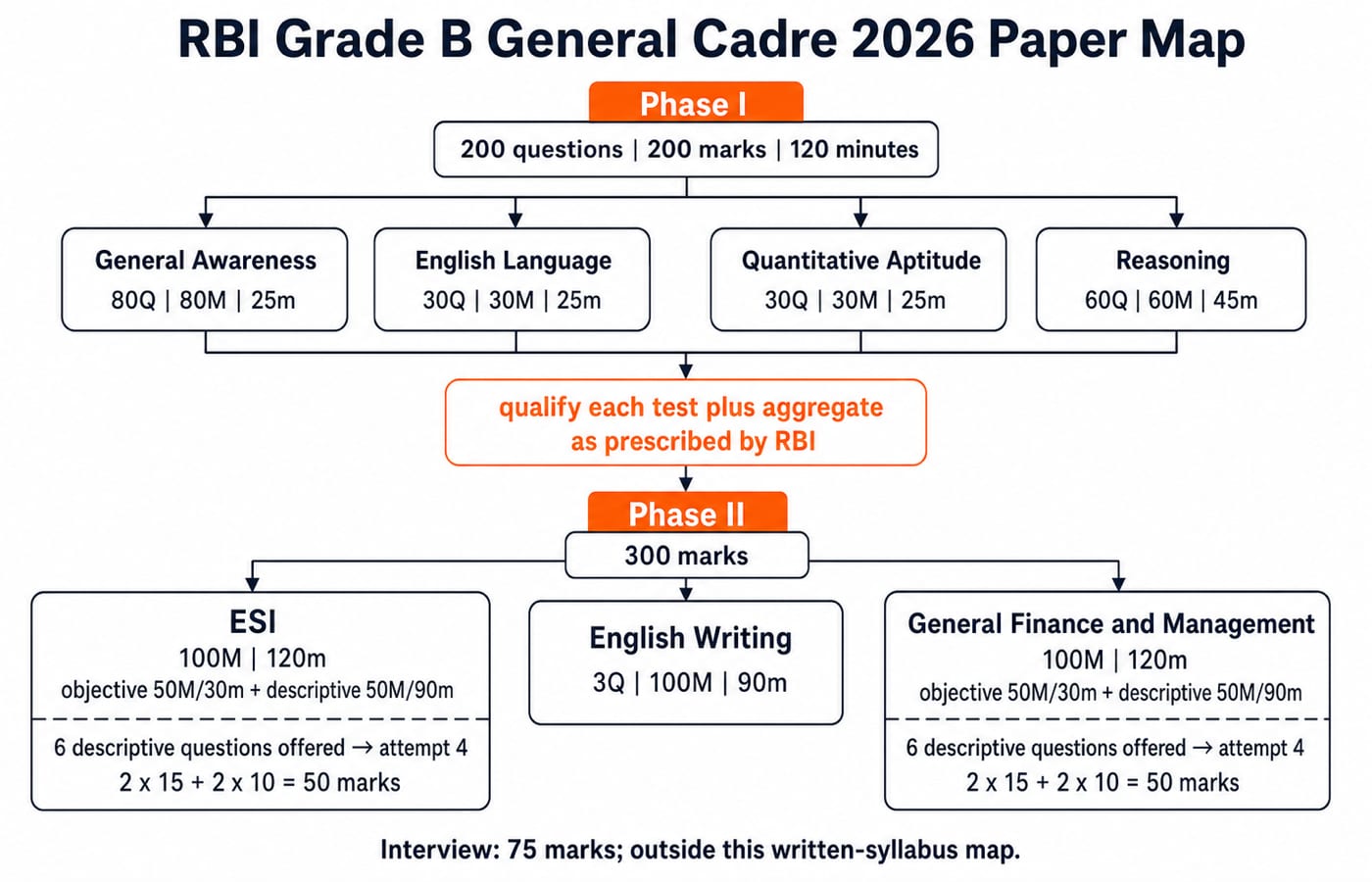
These figures come from RBI's Grade B recruitment notice for Panel Year 2026, Appendix II and the linked Phase I handout. The latest RBI notice and candidate handout control any later change.
Phase-I test | Questions | Marks | Minutes |
|---|---|---|---|
General Awareness | 80 | 80 | 25 |
English Language | 30 | 30 | 25 |
Quantitative Aptitude | 30 | 30 | 25 |
Reasoning | 60 | 60 | 45 |
Total | 200 | 200 | 120 |
Phase-II paper | Official format |
|---|---|
Economic and Social Issues | 100M/120m: objective 50M/30m + descriptive 50M/90m |
English Writing Skills | 3Q/100M/90m |
General Finance and Management | 100M/120m: objective 50M/30m + descriptive 50M/90m |
Phase II totals 300 marks. For each ESI and FM descriptive part, 6 questions are offered and 4 attempted: 2 x 15 + 2 x 10 = 50 marks. RBI also specifies a 75-mark interview, outside this written-syllabus guide.
General Awareness: turn a named test into four study folders
RBI names General Awareness in Phase I but gives no exhaustive chapter list in Appendix II. Use four study folders, not official weightage:
RBI and the banking system
Economy, monetary policy and fiscal policy
Budget, Economic Survey, reports and schemes
National and international current developments
File static background under the folder it explains. Compress one RBI policy release into decision, stated reason, transmission channel, one likely implication; record a report as issuer, metric, latest observation, why it matters. Do not copy a monthly current-affairs list without tagging each item to a folder.
English, Quantitative Aptitude and Reasoning: build the Phase I skill core
Use these study buckets, not an official RBI chapter list:
Test | Study buckets |
|---|---|
English | Comprehension, contextual grammar, vocabulary, sentence organisation |
Quantitative Aptitude | Number operations, arithmetic, data interpretation, series |
Reasoning | Puzzles/seating, inequalities/syllogisms, coding/series, relations/directions, data sufficiency |
SBI PO Prelims structures these shared skills, but SBI and RBI paper patterns differ.
Construct a 30-question, 45-minute diagnostic: English 8/10 in 10 minutes; Quant 5/10 in 18; Reasoning 7/10 in 17. Thus 8 + 5 + 7 = 20, and 20/30 x 100 = 66.7%. Use the next 90 minutes for Quant 40, Reasoning 30 and English 20: 40 + 30 + 20 = 90. This is a personal repair allocation, not a safe score or official weightage.
Economic and Social Issues: read RBI's four clusters together
RBI's Appendix II connects four ESI clusters:
Growth and development: national and per-capita income, poverty, employment, sustainability, environmental issues.
Indian economy: economic history, industrial and labour policy, monetary and fiscal policy since 1991, Economic Survey and Budget priorities, financial markets, banks and RBI, public finance, political economy, industry, agriculture, services.
External economy: globalisation, balance of payments, trade policy, IMF, World Bank, WTO, regional cooperation.
Social issues: social structure, demographics, urbanisation, migration, gender, social justice.
Use teaching numbers, not Indian data. Nominal income rises from 200 to 220 while the price index rises from 100 to 110. The later real value is 220 / 1.10 = 200; nominal growth is (220 - 200) / 200 x 100 = 10%; real growth is 0%. Keep definition, measure and interpretation together.
English Writing Skills: prepare for expression, structure and understanding
Appendix II says this paper assesses writing skills, including expression and understanding of the topic. It gives no fixed task-format list here.
For RBI's 3-question, 100-mark, 90-minute frame, try an adjustable mock: scan and order tasks for 5 minutes; give Questions 1, 2 and 3 exactly 28, 24 and 23 minutes; review for 10. Check: 5 + 28 + 24 + 23 + 10 = 90 minutes. Confirm that you answered the task, stated the claim early, supported each paragraph, and checked logic, grammar and completeness. Adjust 28/24/23 to actual task lengths.
General Finance and Management: separate the syllabus before combining it
RBI groups Finance around financial institutions and RBI functions; banking/non-banking systems; digital payments; forex/money/bond/equity markets; risk/derivatives; international banking, inclusion and alternative finance; public-private partnerships; banking governance; Budget concepts; accounting statements/ratios; inflation. Management covers management thought/functions; organisational behaviour; personality/perception; motivation/leadership/emotional intelligence; interpersonal relations; conflict/change; workplace ethics; corporate governance; communication.
Constructed inputs: debt 240, equity 160, profit after tax 24, assets 300. Debt-to-equity is 240 / 160 = 1.5, or 1.50 debt units per equity unit. Return on assets is 24 / 300 x 100 = 8%, or 8 profit units per 100 assets.
SBI PO Mains overlaps in General, Economy and Banking Awareness, English and descriptive writing, but does not cover or certify the full RBI ESI and FM syllabus.
Convert the RBI Grade B syllabus into a 10-hour working week
Illustrative 600-minute week, component/minutes: General Awareness/90; Phase I English/45; Quant/75; Reasoning/75; ESI/105; FM/105; English Writing/45; review and error-log repair/60. Check: 90 + 45 + 75 + 75 + 105 + 105 + 45 + 60 = 600.
Constructed week-two scores: Quant 12/20 = 60%; Reasoning 16/20 = 80%; ESI 14/20 = 70%; FM 11/20 = 55%. Transfer 30 minutes from Reasoning to FM: 75 - 30 = 45, 105 + 30 = 135; total 600. These are working values, not RBI cutoffs or targets.
The IBPS PO Syllabus 2026: Prelims & Mains Topics Decoded and SBI PO Syllabus and Exam Pattern 2026: All Stages Decoded guides compare shared skills only. Their marks, timings and structures do not apply to RBI Grade B.
RBI Grade B syllabus: the short version and next action
Follow this sequence: read the current RBI notice, copy the paper map, separate official syllabus from study buckets, run a diagnostic, assign weekly minutes, review errors, rebalance. Banking & Insurance Exam Preparation covers shared preparation but lists no RBI Grade B-specific course. Its over 28,000 published questions across the four broad Phase I subject families are platform-wide depth, not an RBI count or weightage signal. Start with the Phase I table and one 30-question, 45-minute diagnostic.
Keep learning
RBI Grade B Previous Year Analysis: Recurring Topics and Study Priorities
Use recurring topic families to choose what to revise, then let your errors decide the time allocation. Work through DI, reasoning and reading examples before building a practical weekly plan.
22 Oct 20264 min readBanking Exams
RBI Grade B Exam Pattern and Marking Scheme: Phases, Scores and Penalties
Clearing Phase I and earning final-merit marks are different jobs. Understand the General-cadre stages, section timers and score calculations before planning your next mock.
18 Oct 20265 min readBanking Exams
GST Explained for Competitive Exams: Rates, CGST vs SGST vs IGST
Separate GST rates from tax components, then work through a 1,000 rupees supply and a simple input tax credit chain. Keep dated reforms apart from the concepts you use in calculations.
Updated 14 Oct 20265 min readBanking Exams
RBI Grade B Eligibility and Selection Process: Age, Qualifications and Stages
Check your RBI Grade B General Cadre eligibility in the right order: stream, age, qualification and previous appearances. Worked examples explain the boundaries before you plan for each selection stage.
9 Oct 20265 min readBanking Exams