Best-First Search Explained: Greedy Heuristics, a Worked Graph and Exam Traps
Trace greedy best-first search on one weighted graph, price its returned path, test the heuristic, and compare the result with uniform-cost search, A* and BFS.
KnowledgeGate Team
Exam prep & CS education
Updated 8 Sep 20266 min read
Best-first search expands the "most promising" state. Questions get harder when its priority is unnamed, OPEN changes, or the first goal is mistaken for the cheapest path. Greedy best-first search can find a goal before finding the cheapest path, unlike uniform-cost search and A*.
Best-First Search: the family name and the greedy variant
Best-first search is a family that selects the next frontier node through an evaluation function. Let g(n) be the discovered cost from start S to n, and h(n) the estimated cost from n to goal G. The function supplies the priority.
Best-first search describes a family, but many AI questions mean its greedy variant, f(n)=h(n). The greedy variant uses f(n)=h(n); uniform-cost search uses f(n)=g(n), and A* uses f(n)=g(n)+h(n). Never switch formulas midway through a trace.
Strategy | Priority | What it favours |
|---|---|---|
Greedy best-first | Smallest | Apparently closest node to the goal |
Uniform-cost | Smallest | Cheapest discovered prefix |
A* | Smallest | Prefix cost plus estimated remainder |
For wider preparation, see GATE CS Exam Preparation Courses & Test Series.
Greedy best-first mechanics: OPEN, CLOSED, parents and ties
OPEN is a minimum-priority queue ordered by h. Add S, then repeatedly pop the smallest-h node. If it is G, reconstruct through parent pointers. Otherwise close it, generate outgoing neighbours, and add each unseen state with its h, accumulated g, and parent. Skip stale entries for closed states.
push S into OPEN
while OPEN is not empty:
    n = pop minimum h
    if n is closed: skip it
    if n is G: reconstruct the path using parents
    close n
    generate each unseen successor x
    set parent[x] = n, record g(x), and push x
Greedy records g to price the route, not for selection. A trace is determinate only when its duplicate and reopening policies are stated. This graph has no repeated state. Equal h values are broken alphabetically, though no tie changes the trace. CLOSED prevents cycling. Search terminates here, but greedy is not generally complete in an infinite space or optimal.
Best-First Search worked graph: edges, heuristics and route costs
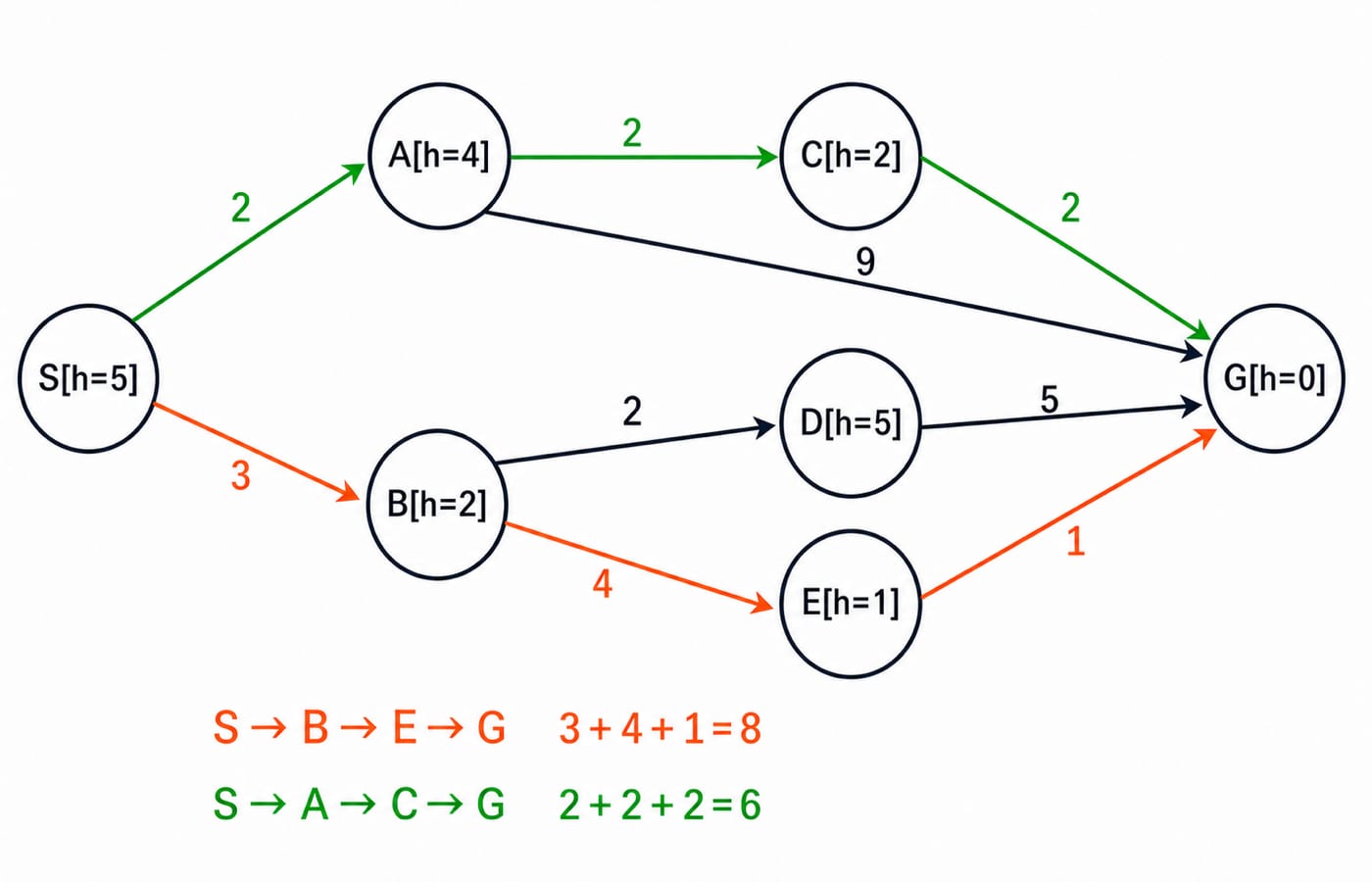
Use the directed graph with nodes S, A, B, C, D, E, G. Its only edges are S->A:2, S->B:3, A->C:2, A->G:9, B->D:2, B->E:4, C->G:2, D->G:5, and E->G:1.
Node |
| Actual cheapest remainder |
|---|---|---|
S | 5 | 6 |
A | 4 | 4 |
B | 2 | 5 |
C | 2 | 2 |
D | 5 | 5 |
E | 1 | 1 |
G | 0 | 0 |
Before running any algorithm, enumerate every complete route:
S-A-C-G:2+2+2=6S-B-E-G:3+4+1=8S-B-D-G:3+2+5=10S-A-G:2+9=11
Therefore S-A-C-G is the unique cheapest route, with cost 6.
Greedy best-first trace: every OPEN update
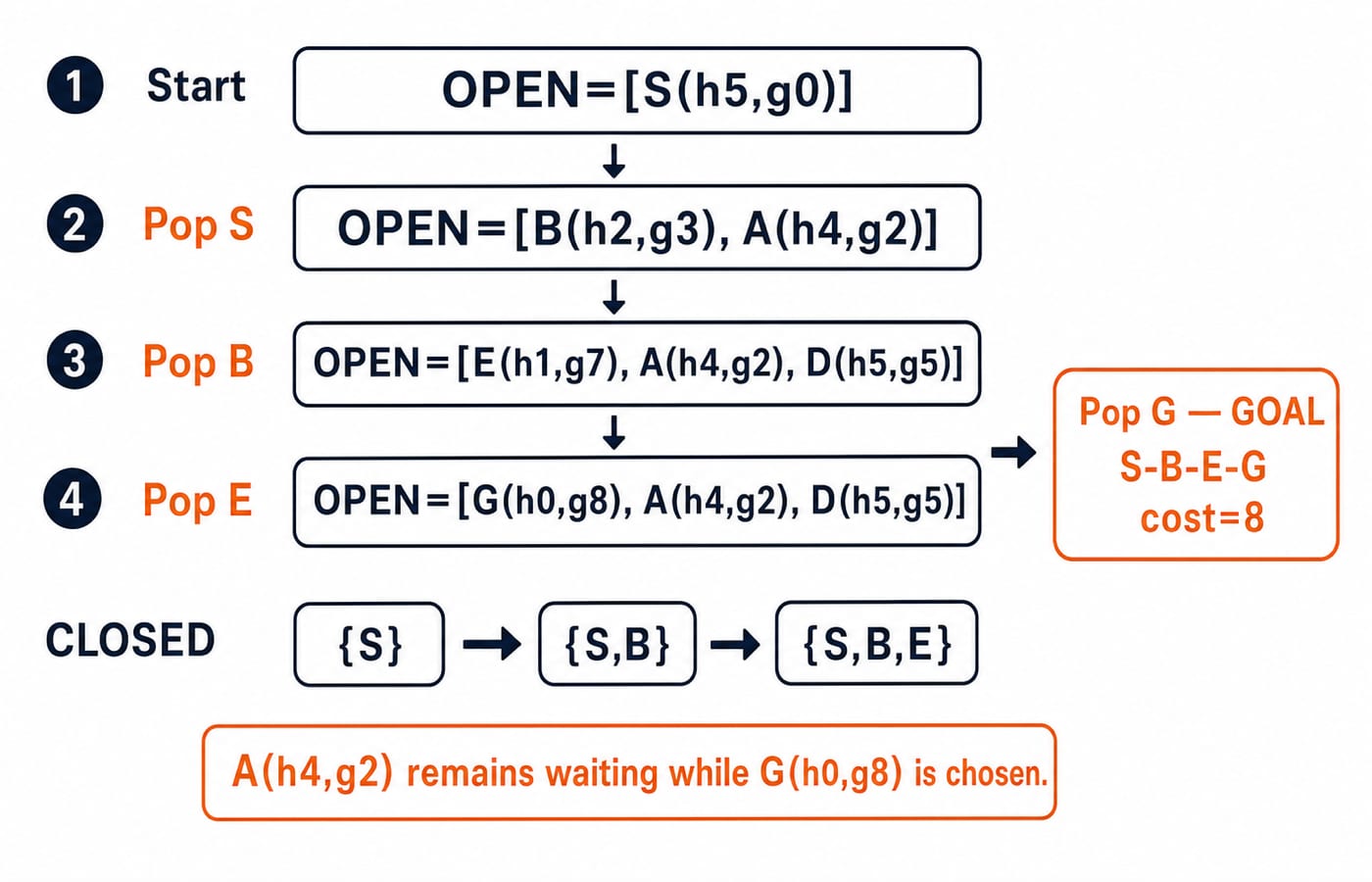
Start with OPEN=[S(g=0,h=5)] and CLOSED={}. Entries below are ordered by increasing h.
Step | Popped | Generated | OPEN after the step | CLOSED |
|---|---|---|---|---|
0 | None | None |
|
|
1 | S |
|
|
|
2 | B |
|
|
|
3 | E |
|
|
|
4 | G | Goal test succeeds |
|
|
On popping G, follow G<-E<-B<-S and reverse the pointers. The returned path is S-B-E-G, and its cost is 3+4+1=8. The expansion order is S,B,E,G. Neither A nor C is expanded before termination.
Why a good heuristic does not make greedy search optimal
The returned cost is 8, while independent route enumeration gave an optimum of 6. The gap is 8-6=2. Greedy sees h(B)=2<h(A)=4, then h(E)=1<h(A)=4, but never adds the already-paid g(B)=3 or g(E)=7 to its choices.
The heuristic is admissible because h(n)<=h*(n) at every node: 5<=6, 4<=4, 2<=5, 2<=2, 5<=5, 1<=1, and 0<=0.
It is also consistent on every edge: 5<=2+4, 5<=3+2, 4<=2+2, 4<=9+0, 2<=2+5, 2<=4+1, 2<=2+0, 5<=5+0, and 1<=1+0.
Admissibility and consistency support A* guarantees under the relevant graph-search assumptions. They do not make greedy best-first optimal because greedy uses only h. This implementation tests the goal when popped, not when generated. It still returns cost 8 because G immediately has the minimum heuristic, 0.
Greedy best-first vs A*, uniform-cost search and BFS
Method | Priority | First choice after S | Next decisive frontier | Result |
|---|---|---|---|---|
Greedy |
| B, since | E, then G |
|
Uniform-cost |
| A, since | B at |
|
A* |
| B, since | After B: A= |
|
BFS | Depth | A first by alphabetical tie rule | First depth-two goal is via A |
|
For A*, expanding A creates C with g=2+2=4, h=2, f=6, and direct G with g=2+9=11, f=11. C then creates G with g=4+2=6, h=0, f=6. The pop order is S,B,A,C,G, returning the optimum cost 6.
A* with h=0 becomes uniform-cost search. Greedy with every h=0 creates ties because it ignores g. Review Graph Algorithms: BFS, DFS and Dijkstra Traced Step by Step for traversal and Greedy Algorithms: Huffman, Knapsack, Activity Selection for the greedy idea. BFS minimises edges in an unweighted graph. Here, two-edge S-A-G costs 11, so minimum depth is not minimum weighted cost.
Best-First Search exam traps to calculate
Check these answers directly from the trace:
After S, B is next because
h(B)=2<h(A)=4.After B, OPEN is
[E(h=1,g=7), A(h=4,g=2), D(h=5,g=5)].The greedy expansion order is
S,B,E,G.Greedy returns
S-B-E-Gat cost8; the optimum isS-A-C-Gat cost6.The heuristic is admissible and consistent, yet greedy is non-optimal.
Wrong rules have predictable results. Using g+h produces A*. Selecting smallest g produces uniform-cost search. Treating h as an edge cost corrupts priority and path arithmetic. Testing the goal on generation changes the algorithm. Without a tie rule, equal-priority orders are ambiguous. BFS is not a cheapest-path method on weighted edges.
Change only h(A) from 4 to 1. Greedy pops A after S, generates C(h=2,g=2+2=4) and direct G(h=0,g=2+9=11), then pops G. It returns S-A-G at cost 11, worse than the earlier 8 and optimum 6. A smaller local heuristic can change the route without making it cheaper. KnowledgeGate has 5+ live practice questions on Best First Search, a focused practice set rather than evidence of official recurrence.
Best-First Search: the short version and next step
Recall six steps: identify the evaluation function; place S in OPEN; pop minimum priority; move it to CLOSED; generate successors and record parents; when G is popped, reconstruct and separately total the edge costs. Here, priority h expands S,B,E,G, returns S-B-E-G, and pays 8; the cheapest route costs 6.
Self-check one: replace greedy priority with g+h. You should get S,B,A,C,G and cost 6. Self-check two: why does setting every h to 0 make A* uniform-cost search but leave greedy tie-dependent? A* orders by g+0=g; greedy compares identical zeroes and never consults g.
For heuristic search and broader AI concepts, use AI & ML for Placements | Generative AI Placement Course. For structured core GATE CS preparation, use GATE Guidance by Sanchit Sir. Before moving on, recreate the OPEN table without looking at the trace.
Keep learning
Problem Representation in AI: State Space, Worked Water-Jug Example and Exam Traps
Learn how states, operators, goals and costs turn a verbal task into a search problem. The worked water-jug trace separates valid states from reachable ones.
Updated 23 Oct 20265 min readML & Data Science
Foundations and Evolution of AI: Approaches, Timeline and a Worked Rational-Agent Example
Build a connected map of AI foundations, historical shifts and major paradigms, then calculate how a rational agent chooses under uncertainty.
Updated 19 Oct 20266 min readML & Data Science

Natural Language Processing Explained: Pipeline, TF-IDF Worked Example and Exam Patterns
Start from raw text, build BoW and TF-IDF vectors, compute cosine similarity, examine ambiguity, and finish with evaluation and exam-style checks.
Updated 15 Oct 20266 min readML & Data Science
Fundamentals of Planning in AI: STRIPS, State-Space Search and a Worked Blocks World Plan
Build a planning problem from facts, actions and goals, then follow every add and delete effect through a complete six-step Blocks World solution.
Updated 11 Oct 20266 min readML & Data Science