Capgemini Exceller Drive Hiring Process: A Stage-by-Stage Preparation Map
Map each typical Capgemini fresher stage to a concrete practice output before an Exceller drive, then use worked aptitude, coding, interview, and safety checks.
KnowledgeGate Team
Exam prep & CS education
Updated 23 Sep 20265 min read183 views
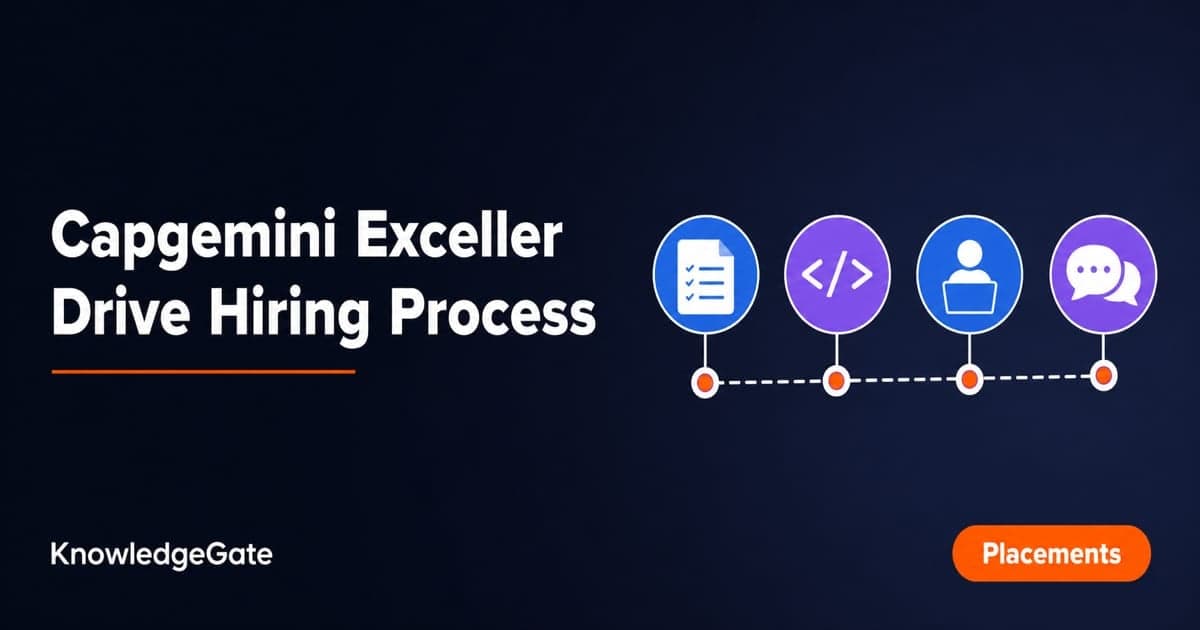
A Capgemini Exceller invitation can leave you choosing among aptitude, coding, CS, and interviews. Stages vary by role, campus, and drive, so use the current invitation rather than assuming one universal pattern.
Capgemini Exceller hiring process: what is stable and what can vary
Capgemini India describes Exceller as its flagship program for technical graduates, run with engineering institutes and graduate colleges, and points candidates at their college placement team. Exceller is the hiring brand, not one fixed exam pattern: Capgemini also runs Exceller off-campus drives, and a current Exceller drive for 2025 finance graduates lists only an English and communication module, then a technical interview.
Capgemini's recruitment-process page gives general Capgemini hiring guidance rather than an Exceller-specific sequence. It says the fresh-graduate placement process "typically" runs: online aptitude test, coding or technical assessment, group discussion for select roles, technical interview, then HR interview. Treat that as the likely shape of a technical Exceller drive; your invitation determines the actual stages.
Capgemini Exceller stages: map each round to a preparation bucket
The sequence below is the one Capgemini publishes for fresh graduates. The preparation buckets translate those stages into drills; your invitation determines the exact Exceller order.
Typical Capgemini careers-page stage | Skill signal | Practice areas | Practice output |
|---|---|---|---|
Online aptitude test | Quantitative, logical, verbal | Quantitative Aptitude, Logical Reasoning, English Assessment | Mixed timed set plus error log |
Coding or technical assessment | Pseudocode, programming, DSA, core CS | Pseudocode, Programming, DSA, DBMS, SQL, OS, CN, OOPs, Software Engineering | Trace plus coding solution |
Group discussion for select roles | Communication, teamwork | Communication Assessment | 60-second opener, two evidence points |
Technical interview | Explanation, application | Programming and core-CS buckets | 90-second solution walkthrough |
HR interview | Truthful behavioural evidence | Behavioral/Psychometric Assessment, HR Interview | Three verified STAR stories |
Compare recruiter tracks through Company-Specific Placement Courses, never by transferring one company's pattern.
Capgemini online assessment: work one mixed-practice block
Set a 40-minute drill: 18 minutes for 12 aptitude or reasoning questions, 7 for 2 English questions, 5 for 1 pseudocode trace, and 10 to review skips and errors. This practice split, not an official duration, gives 18 + 7 + 5 + 10 = 40.
A team closes 240 tickets. A handles 40%, so 0.40 x 240 = 96; B handles 35%, so 0.35 x 240 = 84. C has 100 - 40 - 35 = 25%, hence 0.25 x 240 = 60. Check: 96 + 84 + 60 = 240.
Record the topic as percentages, the mistake as subtracting 40 from 240, the method as multiplying 240 by 0.40, and the next drill as five percentage questions. If aptitude is the weakest bucket, extend the drill with Aptitude for Placements: A 30-Day Practice Routine.
Capgemini coding and technical assessment: trace before you type
Trace a first-occurrence binary search on [2, 4, 7, 7, 7, 10] with target 7. A match is recorded, then the search continues to the left so duplicate values do not hide the first index.
Step | low | high | mid | Value | Action |
|---|---|---|---|---|---|
1 | 0 | 5 | 2 | 7 | Record index 2; search left |
2 | 0 | 1 | 0 | 2 | Search right |
3 | 1 | 1 | 1 | 4 | Search right |
The loop stops with low = 2 and high = 1, leaving index 2 as the first occurrence. The interval halves at each step, so the iterative algorithm uses O(log n) time and O(1) extra space.
After the trace, practise one concise explanation each for SQL joins, DBMS normalisation, process scheduling, network layers, OOP inheritance, and the software-development lifecycle. Keep only the subjects named in your invitation.
Capgemini technical interview: turn the solution into a clear explanation
Explain the binary-search trace in four steps: state the first-occurrence goal; compare the middle value; record a match while moving left; stop when low exceeds high. On [2, 4, 7, 7, 7, 10], the recorded index is 2. The complexity is O(log n) time and O(1) iterative space.
Then change the target to 5. The trace ends with no recorded index because 4 < 5 < 7. This edge case tests whether the explanation covers failure as well as a successful match.
Capgemini communication, group discussion, and HR: use truthful evidence
For group discussion, only for select roles, practise 60 seconds: 10 for a position, 30 for two evidence-backed points, 20 for a trade-off and close.
A fictional STAR model is: Situation, 18 unresolved bugs; Task, identify release blockers; Action, reproduce all 18, rank 6 as blockers, assign owners, run a daily 15-minute check; Result, the 6 blockers close, so the backlog falls to 12 before the mock release, since 18 - 6 = 12. Write eight sentences: 2 Situation, 1 Task, 3 Action, 2 Result, since 2 + 1 + 3 + 2 = 8. Your own answer must use verified events and outcomes rather than these sample facts.
Prepare three real stories, conflict, missed target, new tool, each with a verifiable outcome. Behavioural or psychometric preparation means consistency and self-awareness, not guessing a personality.
Capgemini eligibility, documents, and recruitment-safety checks
Eligibility is drive-specific. Confirm the graduation year, degree or branch, academic threshold, backlog rule, location, application window, and required documents in the current listing or invitation.
Capgemini currently states: CV mandatory, cover letter optional, no hiring fees at any stage, and interview communication sent only through its official systems and channels. Match the job or application ID, inspect the sender domain, open the portal directly, and never send money or sensitive credentials to an unverified request.
Capgemini Exceller preparation: a seven-day final split
Finish each day with one Capgemini-ready artifact. Day 1: an invitation and eligibility checklist. Day 2: an error log from a mixed aptitude block. Day 3: the binary-search trace and one coding solution. Day 4: six one-minute CS explanations. Day 5: three STAR stories. Day 6: one mock combining the 40-minute block with a technical explanation. Day 7: a corrected CV, document folder, and recruiter questions.
If a day is missed, merge invitation checks with Day 7 and combine CS explanations with coding. Preserve the mixed assessment, one complete trace, one interview rehearsal, and the document check; cut repeated volume.
Trust the invitation for eligibility and order; prepare aptitude, coding, core CS, and interviews; keep one error log. The Capgemini Superset Course, Complete Preparation is the structured all-stage route. If concepts are sound, timed practice, error review, and truthful rehearsal may be enough.
Keep learning
Critical Section in Process Synchronization: Race Conditions and Correctness Worked Step by Step
See how two sensible updates to x can finish at 6, 7, or 8. The worked trace connects race conditions to mutual exclusion, progress, bounded waiting, and safe synchronization choices.
Updated 21 Oct 20266 min readOperating Systems
System Calls and Dual Mode in OS: Mode-Bit Trace, Worked Example and Exam Traps
Follow one read() call across the user-kernel boundary, calculate its stated overhead, and learn the distinctions that make system-call questions easier.
Updated 17 Oct 20265 min readOperating Systems
Semaphores and Process Ordering in OS: P/V Traces, Worked Examples and GATE Traps
Learn one consistent semaphore convention, then trace ordering constraints, shared-variable updates, bounded-buffer permits, rendezvous, and deadlock step by step.
Updated 13 Oct 20265 min readOperating Systems
Round Robin Scheduling Explained: Gantt Charts, Waiting Time and GATE Traps
Learn a fixed Round Robin queue convention, trace staggered arrivals, calculate CT, TAT, WT and RT, and see how quantum size and context-switch cost change results.
Updated 9 Oct 20265 min read66 viewsOperating Systems