Cognizant Coding Questions: 4 High-Value Patterns with Solved Examples
Learn to recognise four reusable coding patterns, trace each solution, justify its complexity, and test the edge cases that often break a correct-looking approach.
KnowledgeGate Team
Exam prep & CS education
Updated 16 Sep 20266 min read
The story may change, but your job stays the same: recognise the data pattern, choose a complexity that fits, and test edge cases under pressure. These four solved problems cover prefix sums, character frequency, interval merging, and matrix traversal. They are representative drills, not a claim about a fixed current Cognizant paper. Use Company-Specific Placement Courses when you want recruiter-focused preparation.
Cognizant coding questions: learn the pattern, not a memorised answer
Signal in the prompt | Useful structure | Pattern in this article | Target complexity |
|---|---|---|---|
contiguous range with a target sum and possible negative values | prefix sum + earliest-index hash map | longest subarray summing to 7 | O(n) |
two strings compared by character counts | frequency array or map | deletions needed for anagrams | O(n + m) |
overlapping start-end pairs | sort + one scan | merge five intervals | O(n log n) |
all cells in layer order | four shrinking boundaries | 3 x 4 spiral traversal | O(rows x columns) |
Before coding, ask:
What is the exact output?
Can values be negative or repeated?
What input size must the approach handle?
Which empty, one-item or tie case changes the logic?
See the Cognizant GenC role tracks and 8-week plan for context. KnowledgeGate's Cognizant Superset Course offers practice, not official assessment sections.
Your current assessment invitation controls languages, task count, timing and platform rules.
Cognizant coding pattern 1: longest subarray with sum 7
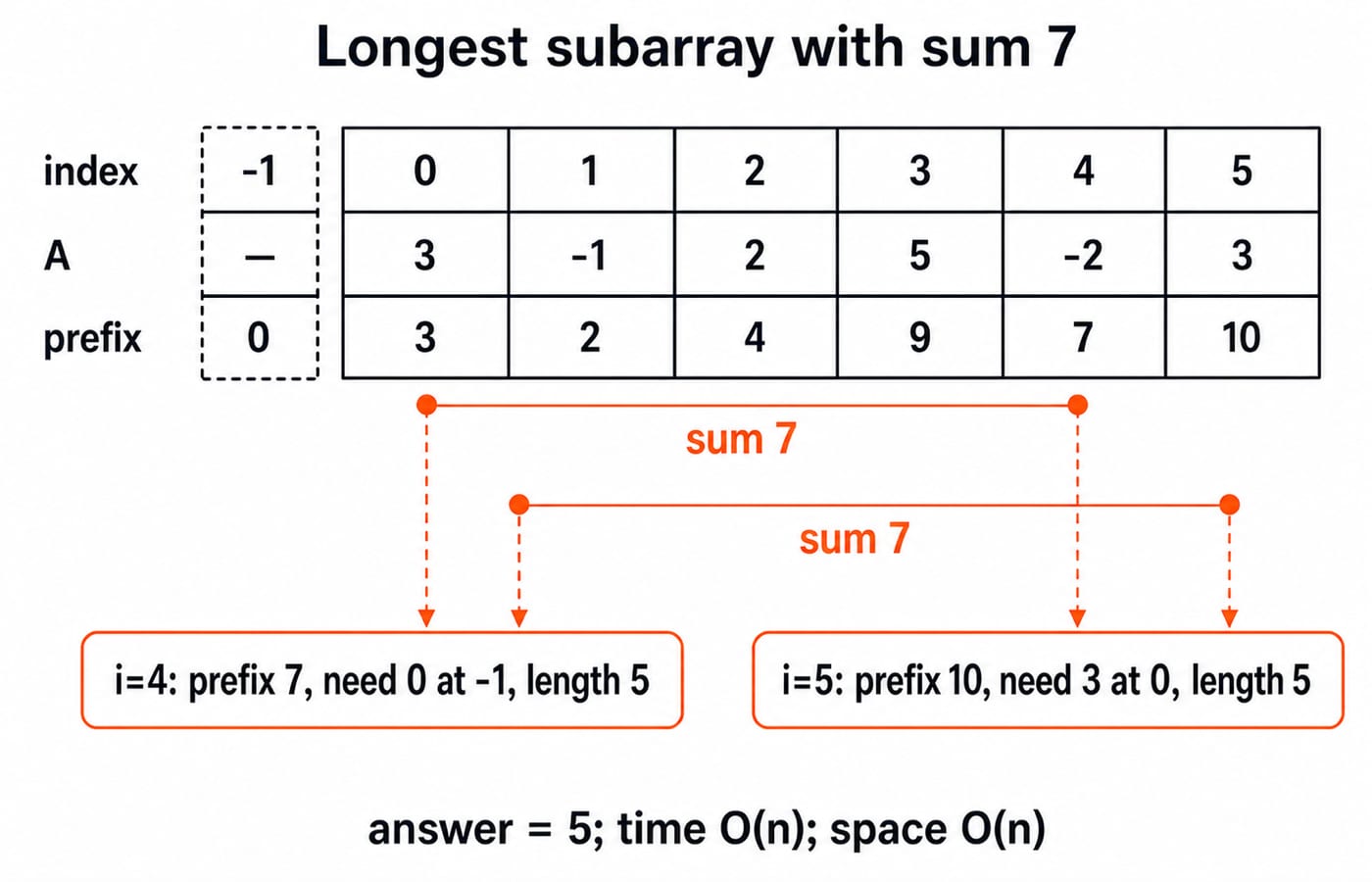
Practice prompt: Given A = [3, -1, 2, 5, -2, 3] and K = 7, return the maximum length of a contiguous subarray whose sum is K.
Begin with {0: -1} so index-zero subarrays count. Retain each prefix sum's earliest index for the longest candidate.
i | A[i] | prefix | prefix - K | earliest matching index | candidate length |
|---|---|---|---|---|---|
0 | 3 | 3 | -4 | none | none |
1 | -1 | 2 | -5 | none | none |
2 | 2 | 4 | -3 | none | none |
3 | 5 | 9 | 2 | 1 | 3 - 1 = 2 |
4 | -2 | 7 | 0 | -1 | 4 - (-1) = 5 |
5 | 3 | 10 | 3 | 0 | 5 - 0 = 5 |
Indices 0..4 give 3 + (-1) + 2 + 5 + (-2) = 7; indices 1..5 give (-1) + 2 + 5 + (-2) + 3 = 7. Both span five positions, so return 5.
first = {0: -1}; prefix = 0; best = 0
for each index i:
    prefix = prefix + A[i]
    if prefix - K exists in first:
        best = max(best, i - first[prefix - K])
    if prefix is absent from first:
        first[prefix] = i
return best
Time and space are O(n). Sliding windows for positive numbers fail because negatives reduce the sum.
Cognizant coding pattern 2: character frequencies and anagram deletions
Practice prompt: Given s1 = "cde" and s2 = "abc", find the minimum total deletions needed to make the strings anagrams. Assume lowercase English letters. For arbitrary Unicode, use a map instead of the 26-cell array.
Letter | Count in cde | Count in abc | Absolute difference |
|---|---|---|---|
a | 0 | 1 | 1 |
b | 0 | 1 | 1 |
c | 1 | 1 | 0 |
d | 1 | 0 | 1 |
e | 1 | 0 | 1 |
Total: 1 + 1 + 0 + 1 + 1 = 4. Delete d, e from cde and a, b from abc, leaving c. Fixed-alphabet time is O(|s1| + |s2|) with O(1) space. Checks: "" and "abc" return 3; two "abc" strings return 0. Continue with Arrays and Strings in Java: 4 Coding-Round Patterns.
Cognizant coding pattern 3: merge overlapping intervals
Practice prompt: Given closed intervals [(1, 3), (2, 6), (8, 10), (9, 12), (15, 18)], merge every overlap. They overlap or touch when next.start <= current.end. Although this input is sorted, the general algorithm first sorts by start.
Begin current = (1, 3). Because 2 <= 3, (2, 6) overlaps and current becomes (1, max(3, 6)) = (1, 6). Since 8 > 6, emit (1, 6) and set current to (8, 10). Because 9 <= 10, merge (9, 12) into (8, 12). Since 15 > 12, emit (8, 12), then (15, 18).
Return [(1, 6), (8, 12), (15, 18)]. Sorting is O(n log n); scanning is O(n). Output space is O(n); sort space is implementation-dependent. Checks: [] -> [], [(4, 7)] -> [(4, 7)], and [(1, 4), (4, 5)] -> [(1, 5)] for closed intervals.
Cognizant coding pattern 4: spiral traversal with shrinking boundaries
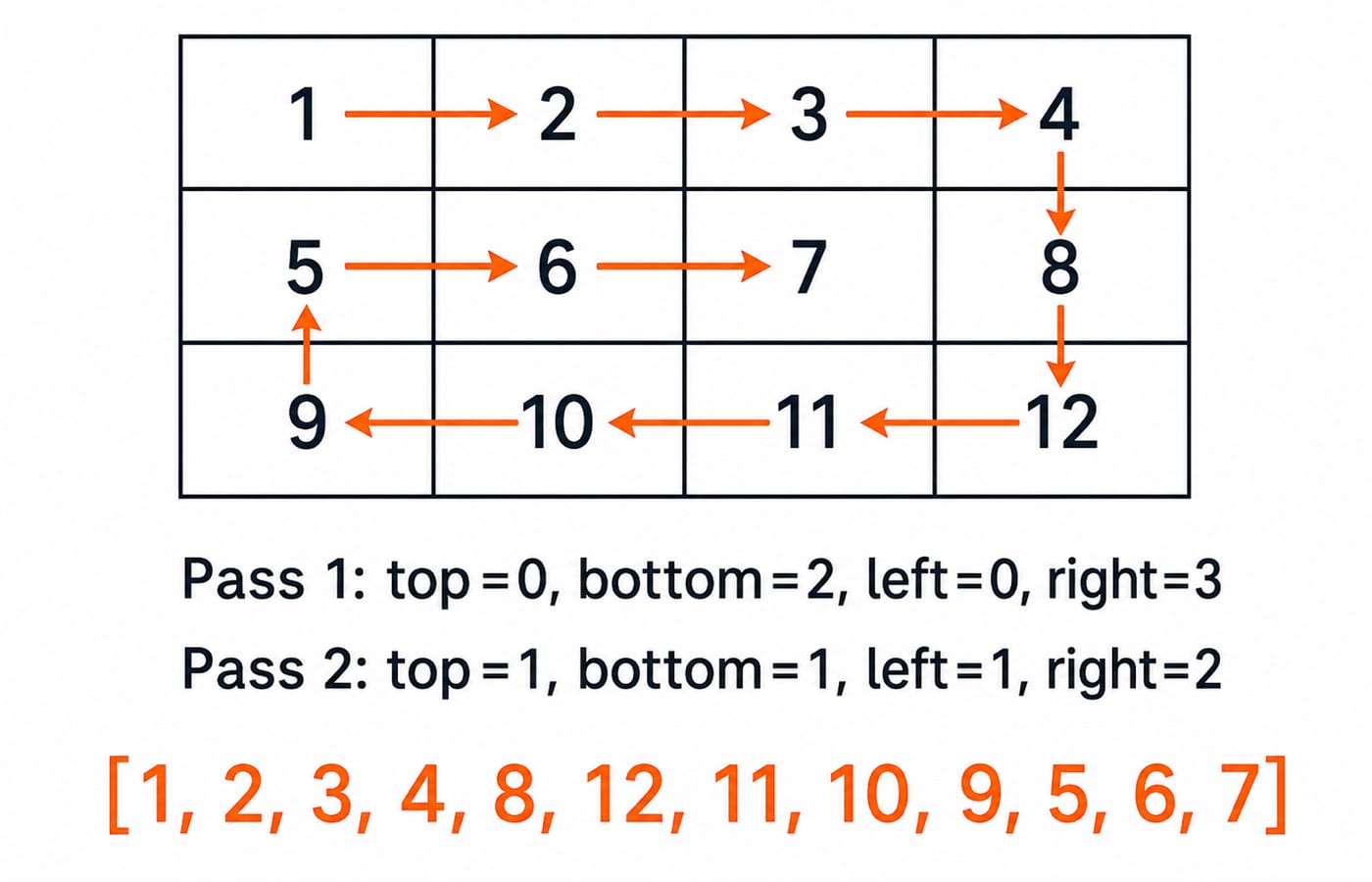
Practice prompt: Traverse [[1, 2, 3, 4], [5, 6, 7, 8], [9, 10, 11, 12]] clockwise. Initialise top = 0, bottom = 2, left = 0, and right = 3.
Pass 1 reads top row 1, 2, 3, 4, then sets top = 1; right column 8, 12, then right = 2; bottom row backwards 11, 10, 9, then bottom = 1; left column upwards 5, then left = 1. Pass 2 has top = bottom = 1 and left = 1, right = 2. It reads 6, 7, sets top = 2, and stops.
Return [1, 2, 3, 4, 8, 12, 11, 10, 9, 5, 6, 7]. Time is O(rows x columns) and space is O(1) excluding output. Guards top <= bottom and left <= right prevent duplicate cells. Checks: [[1, 2, 3, 4]] -> [1, 2, 3, 4] and [[1], [2], [3]] -> [1, 2, 3].
Cognizant coding questions: choose complexity from constraints
For n = 200, a double loop can make about 200^2 = 40,000 checks. At n = 100,000, it can require about 10,000,000,000. A linear pass processes 100,000 items, while n log2 n is roughly 100,000 x 16.61 = 1,661,000 comparison-scale steps. These illustrate growth, not machine timings or Cognizant limits.
Decisive constraints: negatives rule out an ordinary sliding window; a fixed lowercase alphabet needs 26 counters; unsorted intervals need sorting; outputting every matrix cell cannot beat O(rows x columns).
Explain in order: brute-force idea, why it may not scale, chosen invariant or data structure, time complexity, auxiliary space, one edge case. Justify every Big-O label.
Cognizant coding-round traps: test the claim before submitting
Use the exact mistake, failure, repair chain:
use a sliding window despite negative array values -> moving one boundary is no longer monotonic -> use prefix sums and an earliest-index map
overwrite an earlier prefix index -> a later match produces a shorter subarray -> retain the first index only
merge intervals without sorting -> a later interval can overlap an already-emitted range -> sort by start first
omit boundary guards in spiral traversal -> the middle row or column can be appended twice -> check
top <= bottomandleft <= rightbefore reverse traversalscall a practice problem an actual Cognizant question -> creates an unsupported company-specific claim -> label it representative and follow the current assessment invitation for the real format
Say the expected output before running this checklist:
compile or run once
retest the sample
empty input
one item
duplicates or ties
largest allowed input
Cognizant coding questions: the short version and next practice step
contiguous target sum with negatives -> prefix sum + earliest index, answer
5character comparison -> frequency differences, answer
4 deletionsoverlapping ranges -> sort + merge, answer
[(1, 6), (8, 12), (15, 18)]layered matrix order -> shrinking boundaries, answer
[1, 2, 3, 4, 8, 12, 11, 10, 9, 5, 6, 7]
Create a 75-minute learner drill, not an official simulation: 10 minutes to classify, 45 to implement two, 15 for boundary tests, and 5 to record the first wrong assumption. Total: 10 + 45 + 15 + 5 = 75 minutes.
For C, C++, Java and Python, use Coding for Placements. Use the course above for the company route. Redo them with new values and explain each invariant aloud.
Keep learning
HCLTech Recruitment Process and Test Pattern: Build Your Drive Map
Build a source-controlled HCLTech drive map from the current role page and invitation, then use worked diagnostics to prepare for each assigned stage.
Updated 23 Oct 20265 min readCompany-Specific Prep
Capgemini Coding Questions: 4 Patterns with Step-by-Step Solutions
Learn four transferable coding patterns through constructed Capgemini preparation examples. Each solution includes an invariant, complete trace, complexity and edge-case checks.
Updated 19 Oct 20266 min readCompany-Specific Prep
Capgemini Placement Preparation: An 8-Week Test-Matched Study Plan
Build an eight-week Capgemini preparation timetable from the route you are actually invited to take. Use two baselines and an error log to decide where every study hour goes.
Updated 15 Oct 20265 min readCompany-Specific Prep
Cognizant Recruitment Process and Test Pattern: What Each Stage Screens
Learn how to read a Cognizant drive invitation, map each possible stage to the skill it screens, and turn the stated test blocks into a focused study plan.
Updated 11 Oct 20265 min readCompany-Specific Prep