Cognizant Recruitment Process and Test Pattern: What Each Stage Screens
Learn how to read a Cognizant drive invitation, map each possible stage to the skill it screens, and turn the stated test blocks into a focused study plan.
KnowledgeGate Team
Exam prep & CS education
Updated 11 Oct 20265 min read
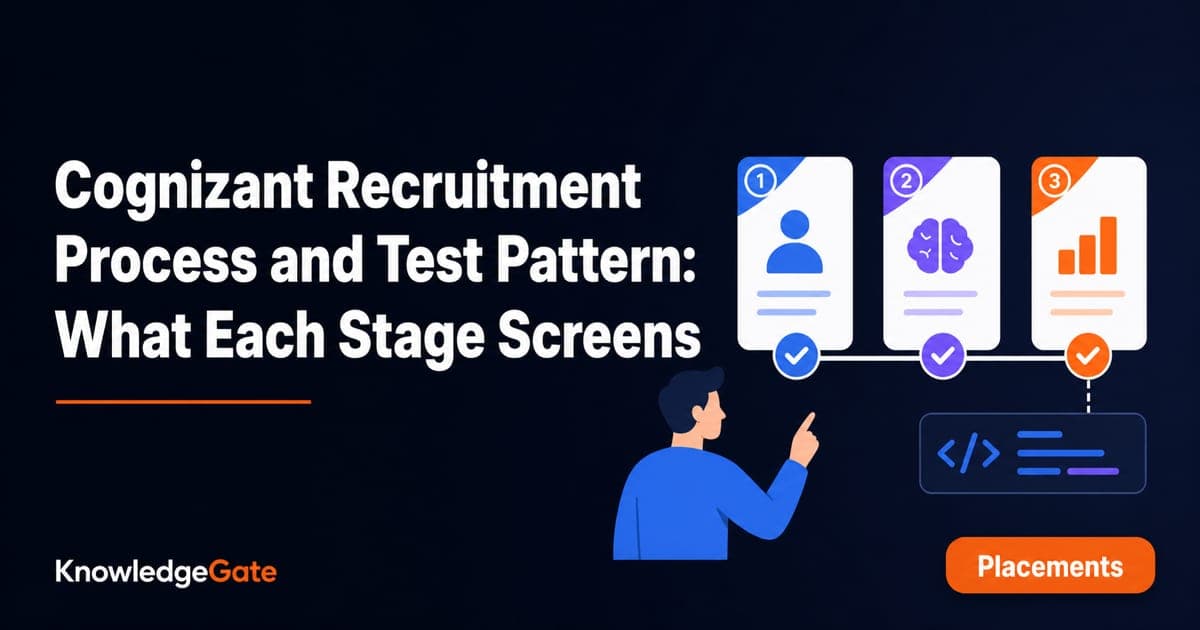
Two candidates can receive different Cognizant assessment instructions because the role, campus, hiring route and drive cycle can differ. So, do not memorise a round count. Read your invitation stage by stage and prepare for what each listed stage screens. This guide gives you a conditional process map, a worked invitation example and a source-of-truth checklist. Every sample value below is a teaching value, not a Cognizant rule.
Cognizant recruitment process: read it as a conditional flow
Use this conditional map: application and eligibility screen [if listed for your drive] → online assessment block(s) [if listed for your drive] → technical assessment and/or technical interview [if listed for your drive] → HR or business conversation [if listed for your drive] → document verification and written outcome. Order varies.
Possible stage | What it screens | Evidence you must produce | Source to check |
|---|---|---|---|
Application and eligibility | Stated-criteria fit | Accurate records | Current drive notice |
Communication or aptitude assessment | Language and problem solving | Submitted responses | Assessment instructions |
Coding or technical assessment | Implementation and knowledge | Tested answers | Assessment instructions |
Technical interview | Fundamentals and project ownership | Reasoned examples | Interview email |
HR or business conversation | Role fit and consistency | Truthful responses | Interview email |
Documents or outcome | Verification and decision | Requested records | Candidate portal |
Before the test: role, eligibility and logistics are the first screen
Make a ten-field drive card: exact role title, hiring route, allowed degree or branch, graduation year, aggregate rule, backlog rule, application deadline, test date or window, documents requested, and support contact. If a field is absent, write not stated and ask the authorised recruiter or placement cell.
Consider a fictional notice stating graduation year 2026, minimum aggregate 60%, and no active backlogs. Fictional candidate A has 71.4%, graduates in 2026, and has 0 active backlogs. The fictional margin is:
71.4 - 60 = 11.4 percentage points
It passes the fictional paper check only, not Cognizant eligibility.
Cognizant test pattern: translate named blocks into preparation tasks
Your invitation decides what applies. The Cognizant Superset Course offers structured practice, while Cognizant GenC Prep: Role Tracks and 8-Week Study Plan goes deeper. Neither replaces current instructions.
Preparation family, when named | What it screens | Useful practice evidence |
|---|---|---|
Communication or verbal | Comprehension and precise language | Timed sets |
Quantitative aptitude | Numerical problem solving | Timed workings |
Analytical or logical reasoning | Pattern and inference accuracy | Reviewed sets |
Game-style reasoning | Tracking changing rules | Error-free simulations |
Programming, pseudocode or coding | Implementing and testing | Executable solutions and tests |
Role-linked technical knowledge | Explaining choices | Answers with examples |
Worked example: turn one invitation into a test and study plan
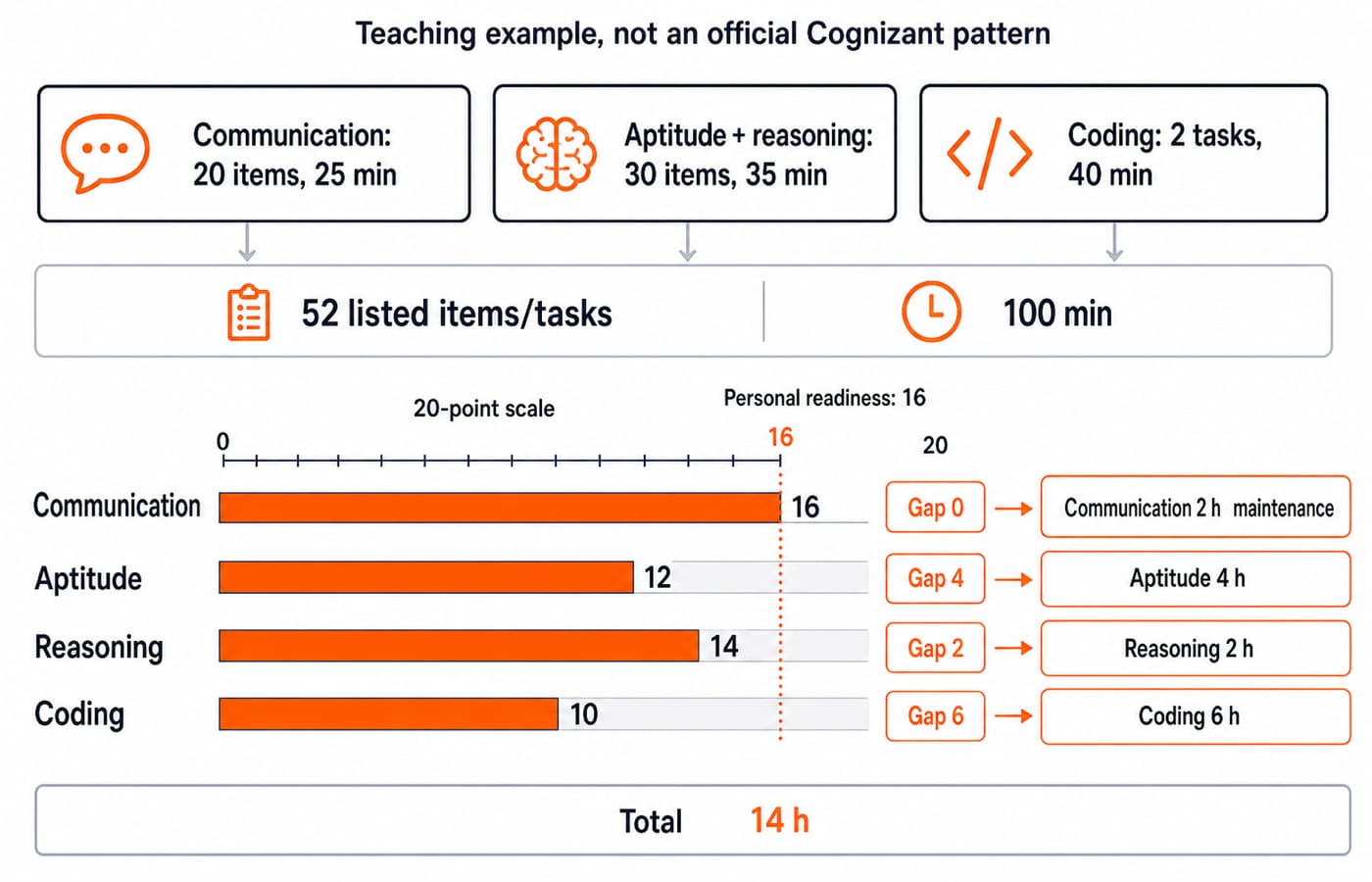
Take an illustrative invitation, not an official Cognizant pattern: 20 communication items in 25 minutes, 30 aptitude and reasoning items in 35 minutes, and 2 coding tasks in 40 minutes.
20 + 30 + 2 = 52 listed items/tasks
25 + 35 + 40 = 100 minutes
Platform navigation and switching rules control the attempt.
Illustrative scores on a common 20-point scale are communication 16/20, aptitude 12/20, reasoning 14/20, and coding 10/20. A personal readiness line of 16/20, not an employer cutoff, gives gaps of 16 - 16 = 0, 16 - 12 = 4, 16 - 14 = 2, and 16 - 10 = 6 points.
Reserve 2 hours of an illustrative 14-hour repair block for communication maintenance. Split the remaining 12 by gap: aptitude 4 hours, reasoning 2 hours, coding 6 hours. Check: 2 + 4 + 2 + 6 = 14 hours.
Technical assessment and interview: show reasoning, code and project ownership
A coding or technical assessment asks for executable work under stated constraints. A technical interview asks you to explain fundamentals, projects, debugging and trade-offs. Either or both may appear. Prepare one language, basic data structures, SQL, and CS areas named in the role or invitation.
In a fictional answer frame, a three-person team measures illustrative API P95 latency of 900 ms over 1,000 requests. You find an unindexed lookup, add the index and remove a repeated query. The next illustrative 1,000-request run records 420 ms.
The illustrative reduction is 900 - 420 = 480 ms. Relative to the original, (480 / 900) × 100 = 53.333...%, about 53.3%. The trade-off is storage use and write overhead. For rehearsal, use the Interview & Resume Preparation Course.
HR, business conversation and document checks: consistency is the test
It screens work ownership, role fit, communication, availability and application consistency. Avoid canned answers. In 45 seconds, reuse the fictional frame: problem, 900 ms P95; action, index plus query removal; result, 420 ms across 1,000 requests; trade-off, added storage and write cost.
Check five details: name spelling, degree and branch, graduation year, aggregate or CGPA representation, and project or internship dates. Only written portal or recruiter communication establishes the next step or offer. A conversation is not itself a selection result.
What can change between Cognizant drives, and how to verify it
Do not memorise | Verify here |
|---|---|
Role and track name | Current drive notice |
Eligibility | Current drive notice |
Number and order of stages | Candidate portal or authorised recruiter |
Section names | Official assessment screen |
Item counts | Official assessment screen |
Timings | Official assessment screen |
Switching or proctoring rules | Official assessment screen |
Coding languages | Official assessment screen |
Interview mode | Interview email or authorised placement cell |
Documents | Candidate portal or authorised recruiter |
Compensation | Current drive notice or written recruiter communication |
Deadlines | Candidate portal or current drive notice |
Apply these source checks with the Infosys interview-process guide and Wipro interview-process guide. Never substitute their stage details for Cognizant's current instructions.
Cognizant recruitment process: the short version and next action
First verify eligibility and logistics. Then map every named assessment block to a skill, prepare evidence for technical and conversational stages, and treat written drive communication as the controlling source. Your immediate action is to make the ten-field drive card, run the 20-point diagnostic with your real subjects, and replace every illustrative number with values from your current invitation. If you are comparing preparation paths beyond one employer, explore the Company-Specific Placement Courses without borrowing one company's stage details for another.
Keep learning
Wipro Drive Mistakes: Stage-by-Stage Rejection Traps and Fixes
Preventable execution errors can waste solid preparation. Diagnose the risk at each Wipro drive step and replace it with a checkable habit.
25 Oct 20265 min readCompany-Specific Prep
HCLTech Recruitment Process and Test Pattern: Build Your Drive Map
Build a source-controlled HCLTech drive map from the current role page and invitation, then use worked diagnostics to prepare for each assigned stage.
Updated 23 Oct 20265 min readCompany-Specific Prep
Capgemini Coding Questions: 4 Patterns with Step-by-Step Solutions
Learn four transferable coding patterns through constructed Capgemini preparation examples. Each solution includes an invariant, complete trace, complexity and edge-case checks.
Updated 19 Oct 20266 min readCompany-Specific Prep
Capgemini Placement Preparation: An 8-Week Test-Matched Study Plan
Build an eight-week Capgemini preparation timetable from the route you are actually invited to take. Use two baselines and an error log to decide where every study hour goes.
Updated 15 Oct 20265 min readCompany-Specific Prep