Wipro Drive Mistakes: Stage-by-Stage Rejection Traps and Fixes
Preventable execution errors can waste solid preparation. Diagnose the risk at each Wipro drive step and replace it with a checkable habit.
KnowledgeGate Team
Exam prep & CS education
25 Oct 20265 min read
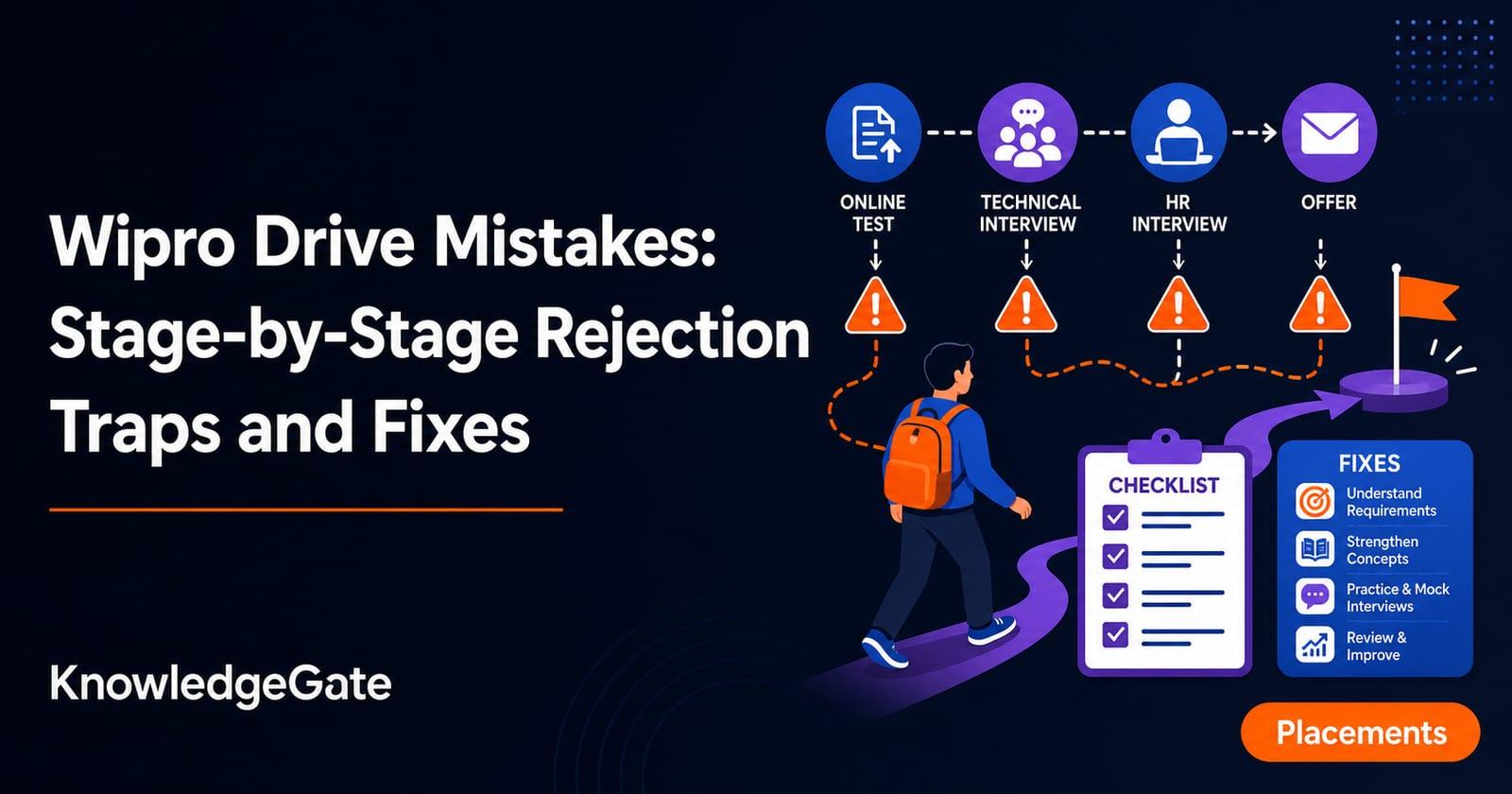
Candidates often prepare the right topics but lose control of the drive through preventable execution errors. A profile mismatch, careless mock habit, sample-only code, unplanned written response, or unsupported interview claim can weaken otherwise solid preparation. These are common rejection risks and corrective habits, not Wipro's published rejection policy. The live route can vary by role and invitation, whose current details control. Here is the stage-by-stage diagnosis and fix.
Wipro application mistakes: assuming the invitation is a formality
A generic profile feels efficient, but different hiring routes may ask for different details. Inconsistency across the application, resume, academic record, and current invitation creates an avoidable screening or verification risk. Old eligibility or process posts are not substitutes for the current instructions.
Create a five-row parity sheet for full name, email and phone, graduation year, degree and branch, and academic or backlog declaration. Suppose it reveals Aarav Kumar versus Aarav K., graduation year 2026 versus 2025, and Campus Helpdesk versus Helpdesk Bot. Resolve all three before submission, then save one final PDF. Route-specific resources such as Company-Specific Placement Courses are more useful than a copied generic checklist.
Wipro online assessment mistakes: chasing attempts instead of clean accuracy
Attempt count feels like progress, so candidates may guess, miss instructions, and mix concept errors with reading errors. The result is repeated weakness with no diagnosis of whether speed, accuracy, or knowledge is limiting performance. Check the current invitation and on-screen rules before deciding how to handle uncertain answers.
After every self-timed mock, classify each miss as concept, misread, time, or guess. The method in Wipro Mock Analysis: Turn Errors into a Study Plan turns those labels into revision work.
Here is a non-official practice comparison. Mock A has 40 questions, with 32 attempted, 24 correct, and 8 wrong. Attempted accuracy is 24 / 32 x 100 = 75%. Mock B has 28 attempted, 25 correct, and 3 wrong. Its accuracy is 25 / 28 x 100 = 89.3%. Mock B gives a better practice signal despite four fewer attempts. It does not predict selection.
Wipro coding mistakes: stopping when the sample case passes
One green sample creates false confidence. Before coding, state the input contract; before submitting, test duplicates, the smallest valid input, negative values, a normal case, and invalid input. The contract decides which cases are valid.
For second largest distinct value, a naive sorted second-last lookup on [4, 9, 9, 3] returns 9. After removing duplicates, the sorted values are [3, 4, 9], so the correct answer is 4. The same logic must produce:
[5, 5]to no second distinct value[-2, -8, -3]to-3[1, 2]to1[]to invalid input under the stated contract
A set plus sorting costs O(n log n) time and O(n) extra space. Tracking the two largest distinct values takes O(n) time and O(1) extra space. Use Wipro Coding & Written Test: How Each Section Is Scored for deeper preparation, while following the rules in the current assessment.
Wipro written communication mistakes: treating the first draft as final
Typing immediately feels fast, but it often produces repetition, a changed position, or an answer that misses the prompt. Practise a self-imposed 20-minute drill: 3 minutes plan + 14 minutes draft + 3 minutes edit, aiming for an illustrative 180-word response.
For Should companies allow hybrid work for freshers?, write one clear position. Support it with access to mentoring and focused individual work. Acknowledge unequal home setups, then propose scheduled office mentoring days as a practical condition. Close by restating the position. During the edit, check subject-verb agreement, repeated words, punctuation, and whether every paragraph supports the position. This structure keeps the answer balanced, relevant, and easy to review under pressure.
Wipro technical interview mistakes: giving definitions without evidence
Memorised definitions feel safe, but they collapse when follow-up questions reach a project choice, debugging method, or trade-off. Use claim -> evidence -> trade-off. If you reach a boundary, say, I do not know that part yet; here is how I would test it.
Consider an illustrative project answer. A candidate measures mean API response time across 100 repeated local requests, adds an index on user_id, then measures a change from 820 ms to 310 ms. The reduction is 820 - 310 = 510 ms; percentage improvement is 510 / 820 x 100 = 62.2%. The evidence is measurable, while the trade-off is extra index storage and slower writes. Replace every number with measurements from your own project. For the broader preparation sequence, use Wipro Interview Process: 3 Stages and a 14-Hour Plan, not as a universal current process rule.
Wipro HR interview mistakes: sounding polished but inconsistent
Memorising a perfect strength, teamwork, or conflict answer can create contradictions with the resume. Bluffing and blaming teammates also fail under detailed follow-ups. Build three truthful STAR cards and cross-check each one against your resume.
For example, a 4-person project is 2 days behind and projected to finish 4 days late. The candidate groups 6 open issues into 3 pairs, assigns each pair to a clear owner, and runs two 20-minute syncs. The team finishes 1 day late, improving the projected delay by 3 days. This shows ownership without a heroic claim and keeps the trade-off visible: coordination helped, but did not erase the delay. That makes the story credible and repeatable. Substitute your real team size, actions, and result.
Wipro drive checklist: replace every risk with one proof artefact
Stage | Rejection risk | Replacement behaviour | Proof to carry |
|---|---|---|---|
Application/profile | Mismatch | Parity check | Final PDF |
Assessment | Blind attempts | Four-bucket error log | Last three mock summaries |
Coding | Sample-only testing | Five-case grid | Edge-case notes |
Written communication | No plan | 3/14/3 self-practice workflow | Edited response |
Interview | Vague or inconsistent claims | Claim, evidence, trade-off plus STAR | Two measured project stories and three truthful STAR cards |
The short version
Fewer unforced errors beat vague extra preparation. For structured Wipro-focused aptitude, reasoning, English, essay, and coding practice, use WIPRO Superset. If only one stage is weak, follow the relevant live guide above.
Keep learning
HCLTech Recruitment Process and Test Pattern: Build Your Drive Map
Build a source-controlled HCLTech drive map from the current role page and invitation, then use worked diagnostics to prepare for each assigned stage.
Updated 23 Oct 20265 min readCompany-Specific Prep
Capgemini Coding Questions: 4 Patterns with Step-by-Step Solutions
Learn four transferable coding patterns through constructed Capgemini preparation examples. Each solution includes an invariant, complete trace, complexity and edge-case checks.
Updated 19 Oct 20266 min readCompany-Specific Prep
Capgemini Placement Preparation: An 8-Week Test-Matched Study Plan
Build an eight-week Capgemini preparation timetable from the route you are actually invited to take. Use two baselines and an error log to decide where every study hour goes.
Updated 15 Oct 20265 min readCompany-Specific Prep
Cognizant Recruitment Process and Test Pattern: What Each Stage Screens
Learn how to read a Cognizant drive invitation, map each possible stage to the skill it screens, and turn the stated test blocks into a focused study plan.
Updated 11 Oct 20265 min readCompany-Specific Prep