Curriculum and School Environment for Teaching Exams: Concepts, Caselets and Worked Examples
Learn to separate curriculum from syllabus, diagnose school conditions, audit alignment with numbers, and solve teaching-exam caselets logically.
KnowledgeGate Team
Exam prep & CS education
Updated 26 Oct 20266 min read

Teaching-exam caselets become confusing when curriculum is treated as another word for syllabus, or school environment is reduced to buildings and facilities. Both shortcuts hide the clues that decide the answer. Curriculum levels, design principles, environmental dimensions, two numerical audits, inclusive role rotation, and a three-pass method help distinguish the clues that decide caselet answers.
A 45-minute lesson audit and a 16-item school-environment diagnostic show how to separate an alignment failure from an environmental bottleneck; eligibility, syllabus and paper details remain notification-specific.
Curriculum and school environment: the core distinction
A curriculum is the planned, enacted, and experienced set of learning opportunities. It includes outcomes, content, pedagogy, activities, assessment, feedback, and the norms learners absorb. A syllabus is narrower: it lists and sequences the content to be covered.
School environment means the physical, psychosocial, academic, organisational, and inclusive conditions in which learning occurs. School climate is related but more specific. It describes how members perceive and experience those conditions.
The relationship is practical. Curriculum specifies and organises learning, while the environment can enable, distort, or block its enactment. A sound plan can still fail in a humiliating or inaccessible classroom. Moving from what is planned to how it is taught is central to Computer Science Pedagogy for Teacher Exams too.
Types and levels of curriculum: intended, taught, learned, hidden, and null
Classify each case from its decisive clue.
Curriculum type | What it means | Clue in one classification case |
|---|---|---|
Formal or intended | The written plan | The timetable allocates one 40-minute laboratory period each week. |
Implemented or taught | What the teacher actually enacts | Only 15 of those 40 minutes involve hands-on work. |
Attained or learned | What learners demonstrate | 28 of 40 learners perform the target task, so attainment is 28/40 = 70%. |
Hidden | Unstated norms taught by routines and power | The same top-row learner is always made group leader. |
Null | What is consistently omitted | Accessibility is never discussed or modelled. |
Co-curricular | Planned learning alongside classroom study | A science-club project runs after class. |
Ask whether the clue is written, enacted, demonstrated, implicitly taught, omitted, or organised alongside the formal lesson. Here, the 40-minute allocation and 15-minute enactment describe different curriculum levels.
Curriculum design principles: turn content into a coherent learning path
Scope asks how much to include; sequence asks in what order. Continuity revisits learning at greater depth, while integration connects subjects or concepts. Balance protects attention across worthwhile areas. Relevance connects learning to meaningful contexts, flexibility permits responsive adjustment, and inclusion makes participation and evidence accessible.
A useful alignment chain is: outcome -> content -> learning experience -> assessment -> feedback. An activity is not automatically learner-centred or aligned. It earns its place when it advances the outcome and produces usable evidence.
In a four-lesson unit, revisit the core idea in lessons 1, 2, and 4 for continuity. Move from identification to comparison to justification for sequence. Connect the idea to science and language tasks for integration.
Curriculum alignment: a fully worked 45-minute lesson audit
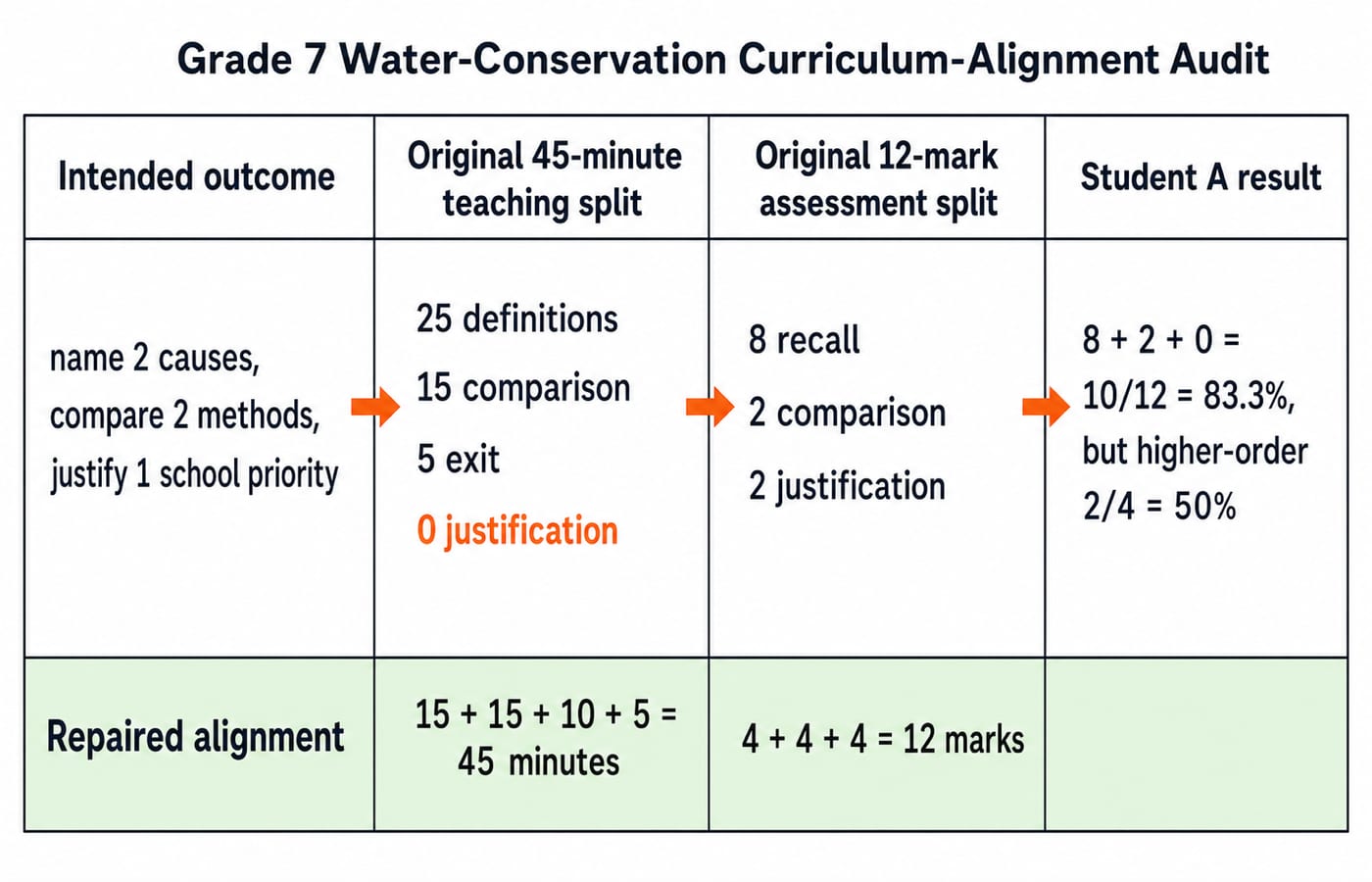
Consider a Grade 7 lesson on water conservation. Its outcome has three parts: name two causes of water waste, compare two conservation methods, and justify which method the school should adopt first.
The original plan uses 25 minutes for definitions and causes, 15 for comparing methods, 5 for an exit ticket, and 0 for guided justification. The total is 25 + 15 + 5 + 0 = 45 minutes. Its 12-mark check gives 8 marks to recall, 2 to comparison, and 2 to justification. Therefore, recall receives 8/12 = 66.7%, while comparison plus justification receives 4/12 = 33.3%.
Student A scores 8/8 for recall + 2/2 for comparison + 0/2 for justification = 10/12 = 83.3% overall. But on the two higher-order parts, the score is only (2 + 0)/(2 + 2) = 2/4 = 50%. The student has not met the justification part, so the overall score masks incomplete attainment.
Repair the lesson without changing its length: 15 minutes on causes + 15 on comparison + 10 on guided justification + 5 on the exit ticket = 45 minutes. Repair the check as 4 recall + 4 comparison + 4 justification = 12 marks. Equal weighting fits this three-part outcome because name, compare, and justify are all stated targets; a different outcome may justify a different split.
School environment: diagnose conditions, not just infrastructure
Four dimensions make school-environment caselets easier to diagnose:
Physical safety and access: light, ventilation, safe movement, equipment, and accessibility.
Emotional safety: respect, predictability, and freedom from humiliation and bullying.
Inclusion and participation: learner voice, equitable roles, and appropriate accommodations.
Academic support: high expectations, feedback, collaboration, and time to learn.
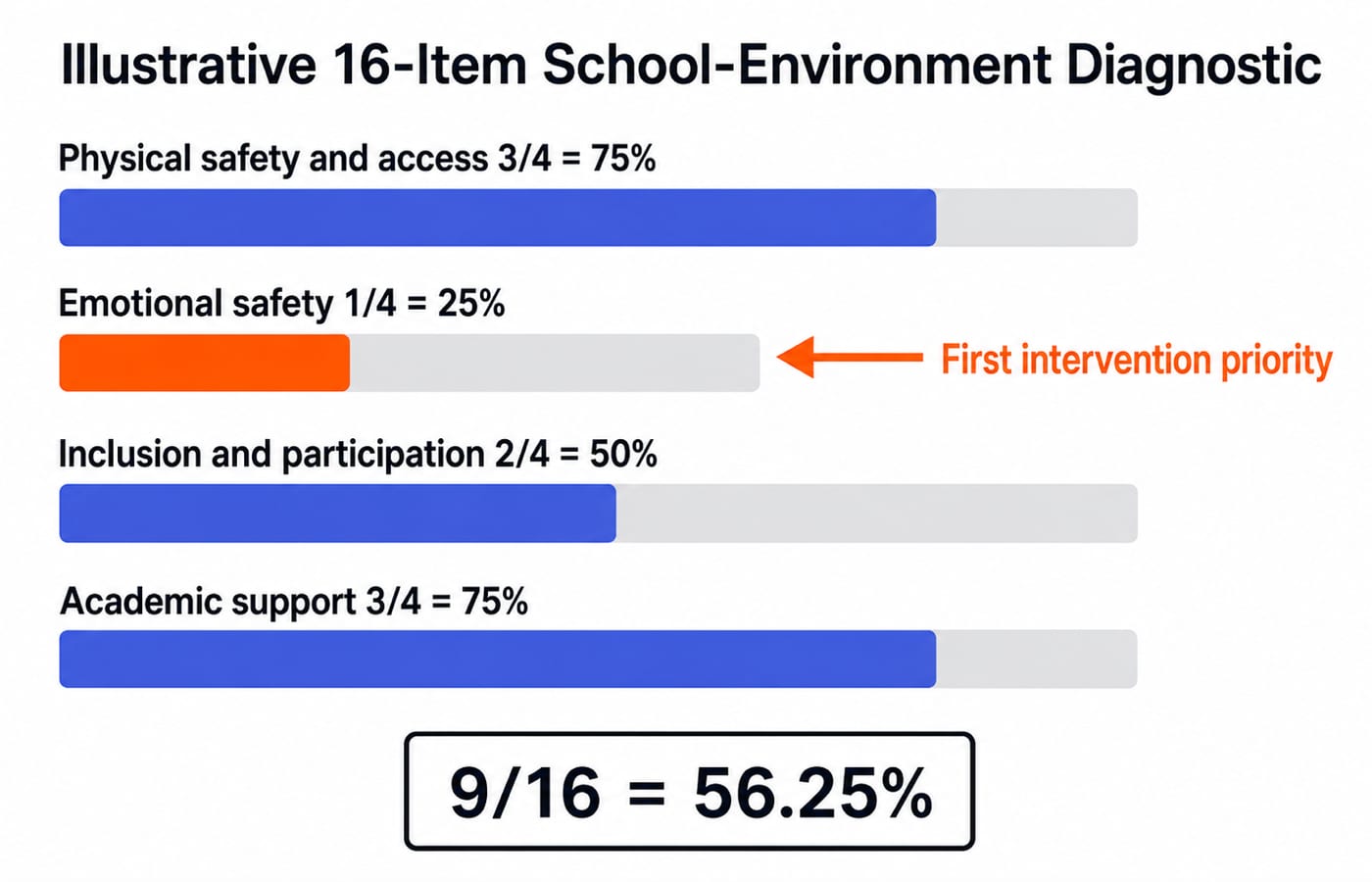
Leadership and rules are organisational forces that shape all four. Now use a 16-item checklist with four items per dimension. The observed scores are physical safety 3/4 = 75%, emotional safety 1/4 = 25%, inclusion and participation 2/4 = 50%, and academic support 3/4 = 75%. The total is 3 + 1 + 2 + 3 = 9, so the overall result is 9/16 = 56.25%.
The average is not the diagnosis. Emotional safety is the lowest dimension, so the first response should improve predictable reporting and respectful classroom routines. Repainting a wall would not address that bottleneck. The total does not determine priority: the lowest dimension identifies the first intervention.
Curriculum and environment together: an inclusive role-rotation case
Imagine 32 learners arranged into 8 groups of 4. Each group needs a facilitator, recorder, resource manager, and reporter. Rotate the four roles across four lessons so that every learner performs each role exactly once.
The assignment count confirms the design. Each lesson has 4 roles x 8 groups = 32 role assignments. Across four lessons, that becomes 32 x 4 = 128 assignments. Because each group contains four learners and completes a four-role cycle, every learner receives four assignments, one in each role.
The formal activity may be identical for everyone, but keeping one leader silently teaches hierarchy through the hidden curriculum. Planned rotation changes the participation environment without lowering the common outcome. Rotation alone is not inclusion, however. The teacher must still provide accessible materials, respectful feedback, and support matched to learner need.
Teaching-exam caselets: identify the clue, avoid the distractor
Apply the distinction before choosing a label:
A lesson teaches gender equality, but only boys handle laboratory equipment. The routine communicates an unstated norm, so it is hidden curriculum, not null curriculum.
Fieldwork appears in the written plan, but the teacher omits it. The implemented curriculum differs from the intended curriculum because a planned experience was not enacted.
A ramp is available, but one learner is excluded from group roles. Physical access exists, but full inclusion does not because participation remains unequal.
One local water problem is studied through science data, a language report, and a social-science policy discussion. The design shows integration across subjects.
Use three passes on longer caselets: identify what was planned, identify what was enacted, then identify what learners experienced or demonstrated. Only then label the curriculum level or environmental dimension.
Common traps are curriculum versus syllabus, hidden versus null, equality versus equity, infrastructure versus emotional climate, and activity versus alignment. UGC NET Paper 1 vs Paper 2: What Each Tests distinguishes broad aptitude from subject-specific preparation. Practise the classifications and classroom caselets until each answer names its decisive clue.
Curriculum and school environment: the short version and next step
Recall five points: curriculum is wider than syllabus; intended, taught, and attained answer different questions; hidden is unstated, while null is omitted; environment includes emotional and inclusive conditions, not only facilities; aligned outcomes, teaching, and assessment point together.
Use 20 minutes: redraw both diagrams in 8, classify the six Section 2 examples in 6, and explain the four Section 7 caselets in 6.
For primary-level CTET preparation, use the CTET Paper 1 Course 2026. For structured NET Paper 1 coverage, use the NTA UGC NET Paper 1 Course. Compare live CTET and UPTET paths under CTET & UPTET Teaching Eligibility Test Prep.
Keep learning

Inclusive Education and Special Needs for Teaching Exams: Concepts, Cases, and Common Traps
Learn to separate inclusion from integration, match barriers to supports, and solve teaching-exam caselets through one fully worked classroom redesign.
Updated 25 Oct 20266 min readCTET & UPTET

Guidance, Counselling and Mental Health for Teaching Exams: Concepts, Cases and Exam Traps
Learn to separate guidance, counselling and mental-health support, then apply the distinctions to learner cases without crossing a teacher's professional boundaries.
Updated 23 Oct 20266 min readCTET & UPTET

Classroom Management and Communication for Teaching Exams: Complete Notes and Worked Scenarios
Connect classroom management, communication, feedback, discipline, and teacher immediacy, then practise an exam-style vignette with a step-by-step solution.
Updated 19 Oct 20266 min readCTET & UPTET

Teaching-Learning Aids and ICT Integration for Teaching Exams: Notes with Worked Classroom Examples
Learn how to select and sequence teaching-learning aids, recognise genuine ICT integration, and solve classroom scenarios with worked calculations.
Updated 15 Oct 20265 min readCTET & UPTET