Guidance, Counselling and Mental Health for Teaching Exams: Concepts, Cases and Exam Traps
Learn to separate guidance, counselling and mental-health support, then apply the distinctions to learner cases without crossing a teacher's professional boundaries.
KnowledgeGate Team
Exam prep & CS education
Updated 23 Oct 20266 min read
Guidance, counselling and mental-health support all help a learner, so scenario options can sound equally kind while serving different purposes. The exam task is to identify whether the need is information, deeper exploration or a safety response. Classify the need, work through learner cases, use a response ladder and eliminate options that breach safety or autonomy. In every case, the teacher supports the learner without diagnosing them.
Guidance, counselling and mental health: separate the three
Guidance is a broad, preventive and developmental process. It provides information and helps a learner make educational, vocational or personal choices. Counselling is a more individualised, purposeful helping relationship in which concerns, feelings, alternatives and actions are explored. Mental health means well-being and functioning on a continuum, not simply the absence of a diagnosed disorder.
Guidance may reach many learners through orientation, information or group activities. Counselling usually explores one learner's concern more deeply. Mental-health promotion builds supportive conditions, while assessment and treatment belong to appropriately qualified professionals.
Use three clues: is the immediate need information and choice, deeper personal exploration, or a possible safety or health concern needing support and referral? The CTET CDP: High-Yield Concepts and Theorists guide places this distinction in the wider child-development context.
Types of guidance: educational, vocational and personal
The type describes the immediate purpose, not the whole learner.
Educational guidance: Aarav scores
18/20in algebra but8/20in geometry. He needs a four-week plan to repair his geometry study, so the immediate need is educational.Vocational guidance: Beena is comparing
3training routes after Class XII. She needs verified entry requirements and exploration of her interests, so the need is vocational.Personal or social guidance: Charu has experienced peer conflict on
4of the last6school days. She wants help communicating safely, so the need is personal.
One learner may need all three. Follow a simple cycle: identify need -> collect relevant information -> explore alternatives -> support the learner's decision -> plan action -> follow up. Guidance supports informed choice. It does not make the choice for the learner or turn one score into a destiny.
Counselling approaches: directive, non-directive and eclectic
Approach | Main role | Clue in a question |
|---|---|---|
Directive | The counsellor actively analyses the problem and suggests action | Advice-first and counsellor-led |
Non-directive or client-centred | The learner expresses, clarifies and chooses while the counsellor listens and reflects | Learner-led exploration |
Eclectic | Techniques are selected responsively for the learner and situation | A reasoned combination |
A school conversation may begin by stating privacy, purpose and the limits of confidentiality, then use open questions and reflection to clarify the concern. The learner and counsellor can compare possible next actions, agree on one immediate step, and plan follow-up or referral.
Who controls the choice identifies the approach. A counsellor-led recommendation is directive, learner-led exploration is non-directive, and a reasoned combination is eclectic. None authorises an unqualified teacher to diagnose a condition or provide clinical treatment.
Worked learner case: classify the needs before responding
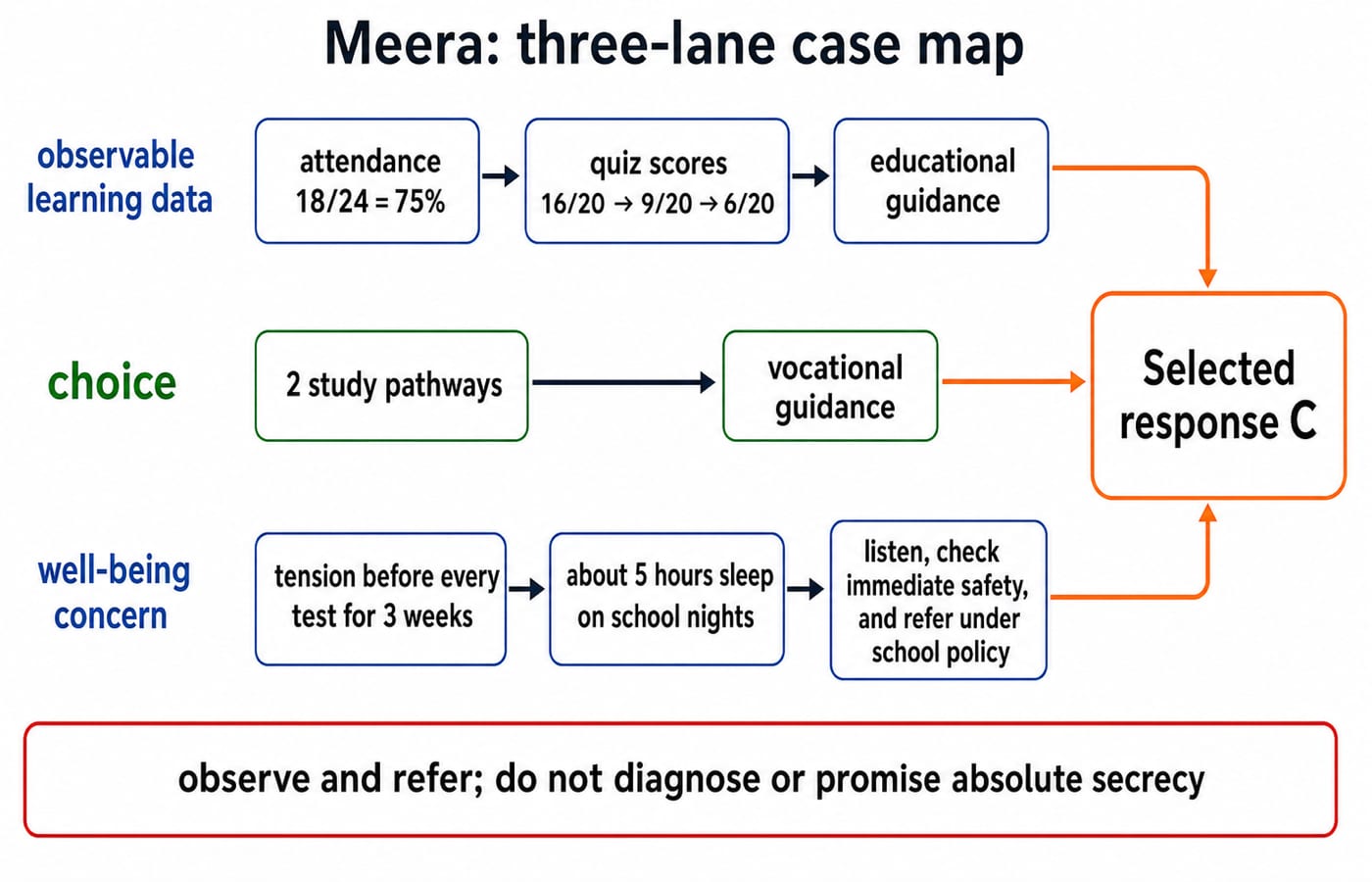
Meera, a Class XI learner, attended 18 of the last 24 school days. Her mathematics quiz scores changed from 16/20 to 9/20 to 6/20 across three weeks. She says she has felt tense before every test for 3 weeks, sleeps about 5 hours on school nights, and is unsure between 2 study pathways. What should the class teacher do first?
A. Diagnose an anxiety disorder and choose the easier pathway for her.
B. Announce the attendance and scores to the class so peers can motivate her.
C. Speak privately, listen without judgement, clarify immediate safety, involve the designated counsellor or safeguarding route under school policy, and separate the pathway decision from the support plan.
D. Promise complete secrecy and give a strict 10-day study timetable.
Answer: C. Work from observations, not labels:
Attendance is
18/24. Divide both numbers by6:18/24 = 3/4 = 0.75 = 75%.The quiz score moved from
16to6, so the decline is16 - 6 = 10marks.These changes are observable data, not a diagnosis. Distress and disrupted sleep across
3weeks justify timely support and referral.The
2pathways create a vocational-guidance need, but safety and appropriate support come first. Meera should retain agency in the later pathway decision.
A diagnoses and decides for Meera. B breaches privacy. D ignores the safety limits of confidentiality and treats distress as only a timetable problem. No single attendance, sleep or score threshold is diagnostic; the response follows the combined pattern of observed change and reported distress.
Mental health in school: promotion, observation and boundaries
Think of a continuum: well-being and ordinary fluctuation, sustained distress or impaired functioning, then possible crisis. Psychological safety, predictable routines, respectful relationships, belonging, clear help-seeking routes and chances to develop social and emotional skills are protective conditions. One bad day, behaviour or low score does not prove a disorder.
A teacher promotes a supportive classroom, notices changes in attendance, participation, mood or functioning without diagnosing, and connects learners to the school's designated support, safeguarding or health pathway. Teachers may listen and document observable facts, but should not conduct therapy or promise secrecy that conflicts with safety duties.
For the complete ten-life-skills framework and mental-health continuum, revise Mental Health and Life Skills for Teaching Exams. Guidance-and-counselling scenarios instead turn on the next responsible action: inform, explore, refer or escalate.
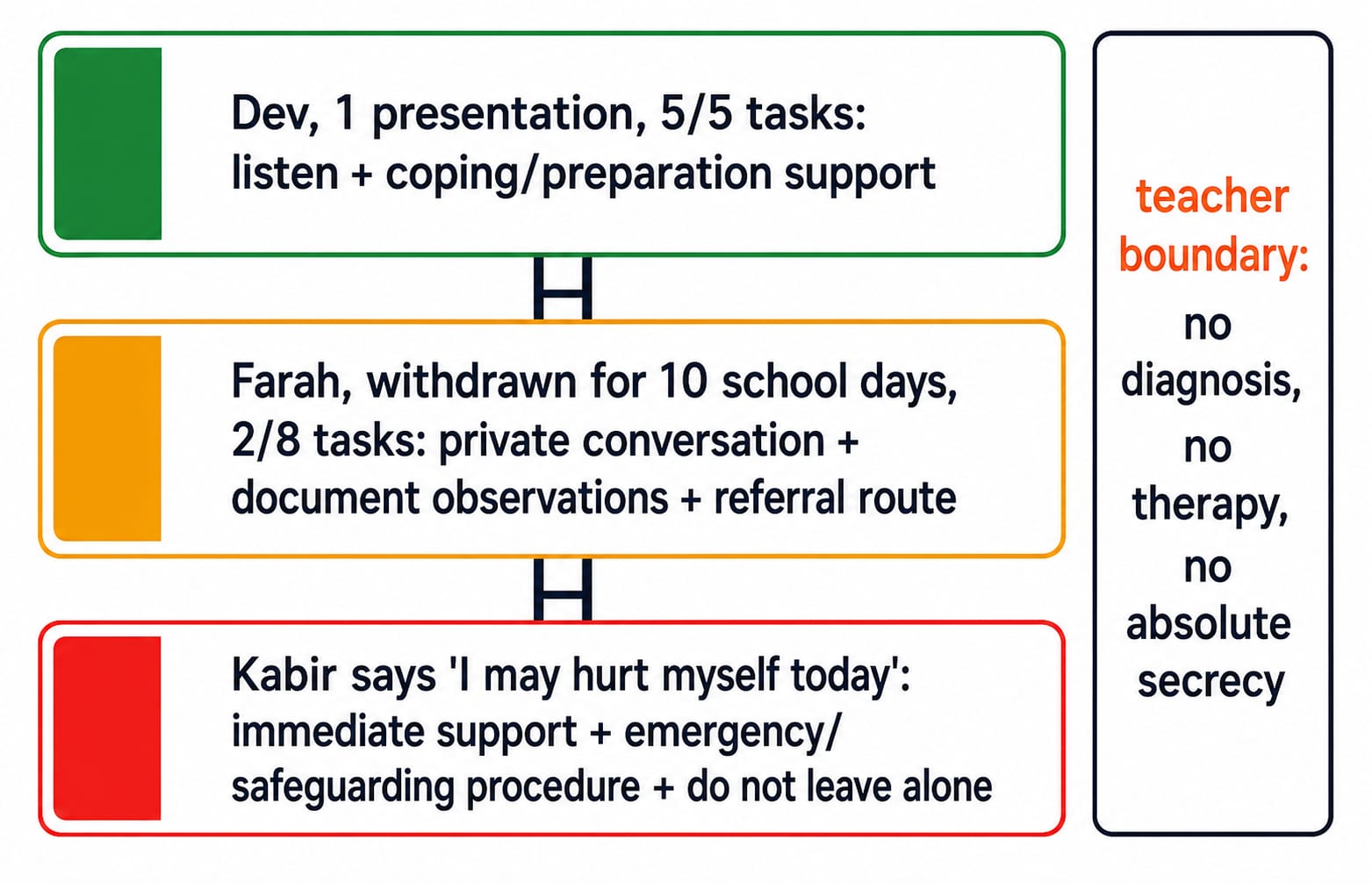
Mental-health response ladder: ordinary stress to immediate risk
Green, manageable stress: Dev is worried before
1presentation but attends class and completes5/5tasks. Normalise manageable stress and teach a coping or preparation step.Amber, sustained change: Farah has withdrawn from peers for
10school days and completed2/8tasks. Speak privately, listen, document observations and use the school's referral route.Red, immediate risk: Kabir says, "I may hurt myself today." Treat this as immediate risk, not a routine counselling exercise.
For Kabir, WHO's resource for teachers and other school staff supports a direct response: stay calm, listen without judgement, seek immediate help from the appropriate school or health service, follow the institution's emergency and safeguarding procedure, and do not leave the learner alone. Do not diagnose, challenge the learner to prove intent, promise secrecy, guess a helpline number or delay action until a later appointment.
Contacts and escalation routes depend on institutional and local policy. The principle is proportionate response: support ordinary stress, refer persistent functional change, and escalate immediate danger at once.
Teaching-exam traps: a four-pass elimination routine
Questions may ask you to classify guidance, identify a counselling approach, arrange the helping process, match a life skill to a situation, or respond to sustained distress or immediate risk. These forms recur often enough to be worth drilling deliberately.
Use four passes:
Identify the learner's immediate need.
Decide whether the option informs, explores or escalates.
Reject any breach of dignity, autonomy or safety.
Reject professional overreach, including diagnosis, guaranteed secrecy or a one-size-fits-all prescription.
If two options sound caring, prefer the one that listens, preserves agency and respects the safeguarding boundary. The decisive distinction is whether the evidence calls for information, exploration, referral or urgent escalation.
Guidance, counselling and mental health: the short version
Guidance supports informed choice. Educational, vocational and personal name the immediate purpose. Counselling explores concerns more deeply. Directive is counsellor-led, non-directive is learner-led, and eclectic combines techniques responsively. Teachers observe, support and refer rather than diagnose. Immediate danger requires immediate escalation, and the learner must not be left alone.
Next, redraw the three distinctions and the response ladder from memory, then apply them to a new school scenario. CTET aspirants can continue with the CTET Paper 1 Course, while UGC NET aspirants can use the NTA UGC NET Paper 1 Course. To compare school-level routes, browse the Govt Teaching Eligibility Tests category.
Keep learning
Classroom Management and Communication for Teaching Exams: Complete Notes and Worked Scenarios
Connect classroom management, communication, feedback, discipline, and teacher immediacy, then practise an exam-style vignette with a step-by-step solution.
Updated 19 Oct 20266 min readCTET & UPTET

Teaching-Learning Aids and ICT Integration for Teaching Exams: Notes with Worked Classroom Examples
Learn how to select and sequence teaching-learning aids, recognise genuine ICT integration, and solve classroom scenarios with worked calculations.
Updated 15 Oct 20265 min readCTET & UPTET
Nature, Objectives and Characteristics of Teaching: Concept Notes for Teaching Exams
Learn to separate what teaching is, what change it seeks and how an effective teaching process operates. A worked fraction lesson connects every concept.
Updated 10 Oct 20265 min readCTET & UPTET
सामान्य अशुद्धियाँ (Samanya Ashuddhiyaan): Complete Hindi Grammar Notes for CTET and TET Exams
Learn to identify and correct Hindi word-form, agreement, pronoun and redundancy errors through exact examples, a worked MCQ and a scored diagnostic.
Updated 6 Oct 20266 min readCTET & UPTET