Nature, Objectives and Characteristics of Teaching: Concept Notes for Teaching Exams
Learn to separate what teaching is, what change it seeks and how an effective teaching process operates. A worked fraction lesson connects every concept.
KnowledgeGate Team
Exam prep & CS education
Updated 10 Oct 20265 min read

Nature, objectives and characteristics of teaching are often memorised as three overlapping lists. Then a classroom situation makes two options look correct. The clean distinction is this: nature tells you what teaching fundamentally is, objectives tell you what learner change it seeks, and characteristics show how sound teaching operates. A worked fraction lesson can show how all three operate together in practice.
Nature of teaching: what the process actually is
Teaching is a deliberate, organised and responsive process in which a teacher helps learners build knowledge, skill, judgement or attitude through suitable experiences and feedback. It is more than speaking or transferring facts because learning evidence must shape the next move.
It is purposeful, social, interactive, learner-related, context-sensitive and dynamic. It combines the art of responding to people with disciplined professional practice.
Process | Main focus |
|---|---|
Teaching | Meaningful learning through experience, interaction and feedback |
Instruction | Organised directions or information |
Training | Reliable performance built through practice |
Indoctrination | Acceptance without open examination |
Learner-related teaching changes with prior knowledge and difficulty. Learners and Learning Process for Teaching Exams: Concepts, Examples and Traps owns learner profiles, theory lenses, scaffolding and transfer; the narrower task here is to classify teaching's nature, objectives, characteristics and elements.
Objectives of teaching: turn broad aims into observable learning
An aim is broad, such as "develop mathematical confidence". An objective states observable performance: "By the end of the lesson, each learner will convert at least two of 1/2, 3/4 and 5/8 into decimals correctly."
Cognitive objectives concern knowing, understanding, applying and judging. Skill objectives concern doing. Affective objectives concern interest, values and responsible participation. One lesson can serve multiple domains.
Keep the domain and the performance verb separate. "Explain why 3/4 = 0.75" is cognitive; "construct a fraction strip accurately" is a skill objective; "listen to a partner's method and revise one's answer respectfully" is affective. A lesson may use all three, but each objective needs its own evidence. One percentage cannot represent every domain.
The conversions are:
1/2 = 0.50
3/4 = 0.75
5/8 = 0.625
"At least two out of three" provides a visible success criterion. "Understand fractions" does not tell the teacher what evidence will count.
Characteristics of effective teaching: the evidence to look for
Characteristic | Evidence in the fraction lesson |
|---|---|
Goal-oriented | The two-out-of-three objective |
Planned and systematic | Diagnose, model, practise, check |
Interactive | Learners explain a conversion to a partner |
Learner-centred | Representations change when learners struggle |
Diagnostic and remedial | The exit ticket determines who needs another example |
Flexible and dynamic | Grouping changes after evidence |
Continuous and evaluative | Feedback occurs during and after practice |
Ethical and inclusive | Every learner gets access, wait time and respectful correction |
Objectives are intended learner outcomes. Characteristics are qualities visible in the process. A measurable objective alone does not make teaching learner-centred. The method and response to evidence must show it. Assessment and Evaluation for Teaching Exams: Complete Notes with Worked Examples owns measurement, tool choice, formative use and evaluation; this lesson uses an exit ticket only as evidence of diagnostic, responsive teaching.
Elements of teaching: how the parts form one system
The elements are teacher, learner, objectives, content, method or learning experience, environment and resources, assessment, and feedback. Changing one can affect others. A learner who cannot visualise 5/8 may need a fraction strip or grid before more symbolic practice.
Teaching is not a one-way path. The teacher sets an objective, elicits prior knowledge, selects an experience, observes, assesses and adapts the next step.
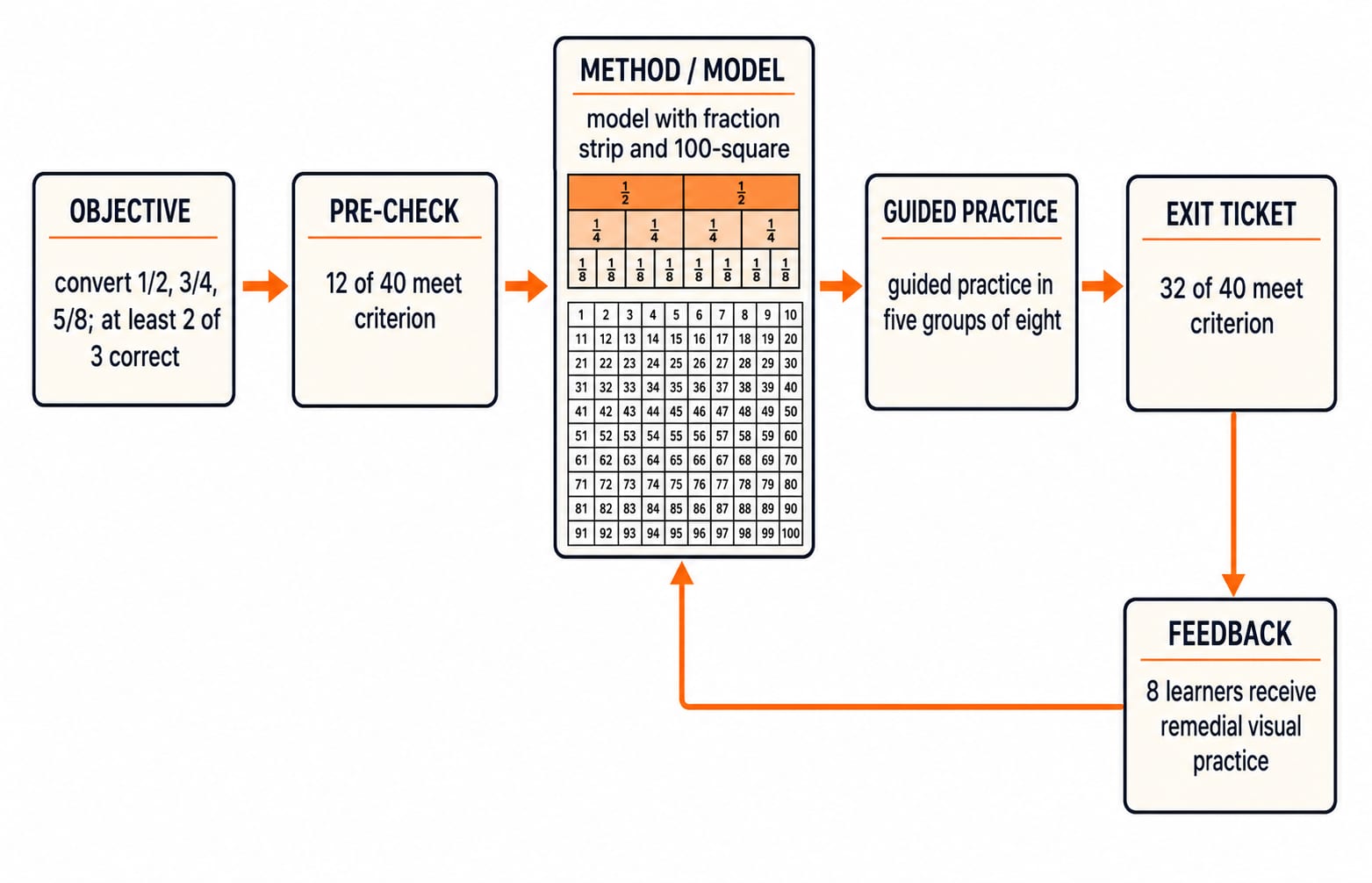
Teaching worked example: a 40-learner fraction lesson
A teacher gives the same three-item diagnostic check to 40 learners. Twelve meet the at-least-two-correct criterion:
12/40 = 3/10 = 30%.
The teacher forms five groups of eight, so 5 x 8 = 40 learners. Using a 100-square, the teacher models 1/2 = 50/100 = 0.50 and 3/4 = 75/100 = 0.75. Place-value reasoning then shows 5/8 = 625/1000 = 0.625.
During guided practice, every learner explains one conversion and solves a different item. On the three-item exit ticket, 32 learners meet the criterion:
32/40 = 4/5 = 80%.
That is 32 - 12 = 20 more learners and 80% - 30% = a 50-percentage-point increase in immediate performance. It is evidence for the next decision, not proof of long-term mastery.
The criterion shows purpose. Five groups and peer explanation show interaction. The exit ticket shows evaluation. The remaining 40 - 32 = 8 learners move to visual practice, showing diagnosis, flexibility and remediation.
Nature and characteristics of teaching: common exam traps
Learner-centred does not mean teacher-absent. Interactive does not mean every minute requires group work. Planned does not mean rigid, because a sound plan includes adaptation.
Use these quick classification checks:
Learners repeat a keyboard sequence until it is automatic: primarily training.
The teacher supplies ordered steps for a task: instruction.
The teacher asks for reasons, permits challenge and uses evidence: teaching rather than indoctrination.
Also separate an activity from an objective. "Use fraction strips" is a method. "Convert at least two of three fractions correctly" is an objective.
Teaching-exam questions: classify the stem before answering
Useful conceptual stem shapes include a definition or non-example, statement-feature matching, a classroom scenario, and objective-versus-method classification. They are not a universal official pattern. Identify the task before choosing an attractive pedagogical word.
Item A: Which is the best-written objective? (A) Teach fractions (B) Appreciate decimals (C) Convert at least two of 1/2, 3/4 and 5/8 correctly (D) Use a worksheet.
Answer: C. It names learner performance and a success criterion.
Item B: After an exit ticket, the teacher gives eight learners visual practice. Which characteristic is clearest? (A) Indoctrination (B) Diagnostic and remedial teaching (C) One-way instruction (D) Content completion.
Answer: B. Evidence changes the next teaching action.
For the role of teaching aptitude, read UGC NET Paper 1 vs Paper 2: What Each Tests. The CTET & UPTET Teaching Eligibility Test Prep category provides eligibility-test study options. Use the relevant body's current notification for official specifics.
Nature, objectives and characteristics of teaching: the short version
Nature = what teaching is.
Objectives = the learner change sought.
Characteristics = how the process behaves.
Recall the worked lesson as purpose -> experience -> interaction -> evidence -> adaptation. Revise the distinction table and calculation. For the common teaching and research aptitude paper, the NTA UGC NET Paper 1 Course offers structured coverage.
Keep learning

Classroom Management and Communication for Teaching Exams: Complete Notes and Worked Scenarios
Connect classroom management, communication, feedback, discipline, and teacher immediacy, then practise an exam-style vignette with a step-by-step solution.
Updated 19 Oct 20266 min readCTET & UPTET

Teaching-Learning Aids and ICT Integration for Teaching Exams: Notes with Worked Classroom Examples
Learn how to select and sequence teaching-learning aids, recognise genuine ICT integration, and solve classroom scenarios with worked calculations.
Updated 15 Oct 20265 min readCTET & UPTET

सामान्य अशुद्धियाँ (Samanya Ashuddhiyaan): Complete Hindi Grammar Notes for CTET and TET Exams
Learn to identify and correct Hindi word-form, agreement, pronoun and redundancy errors through exact examples, a worked MCQ and a scored diagnostic.
Updated 6 Oct 20266 min readCTET & UPTET

Universities and Learning Programmes for Teaching Exams: Types, Modes and Solved Examples
Separate university status, delivery mode and programme purpose with a repeatable method, then test it on five UGC NET-style classification cases.
Updated 2 Oct 20265 min readCTET & UPTET